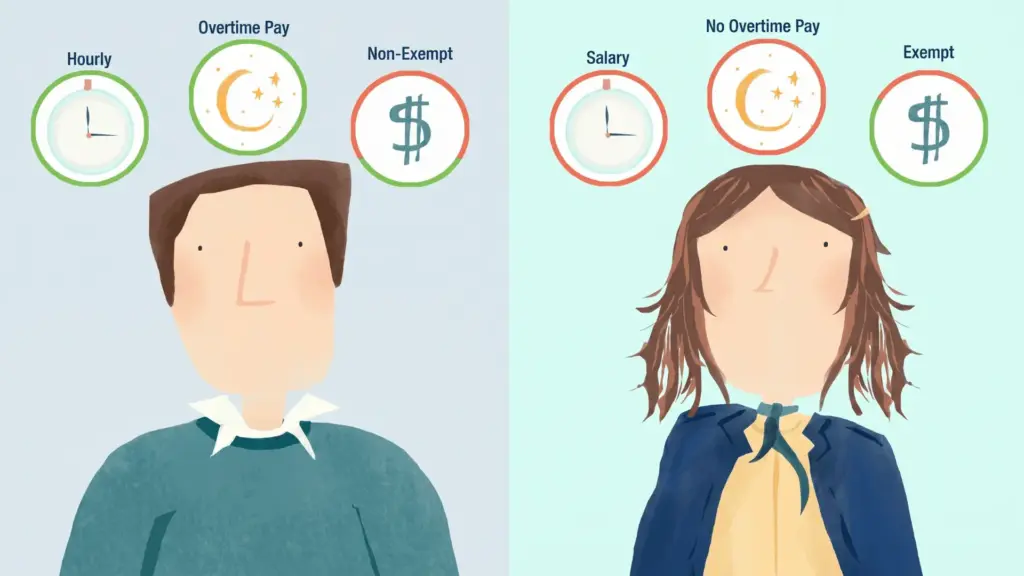
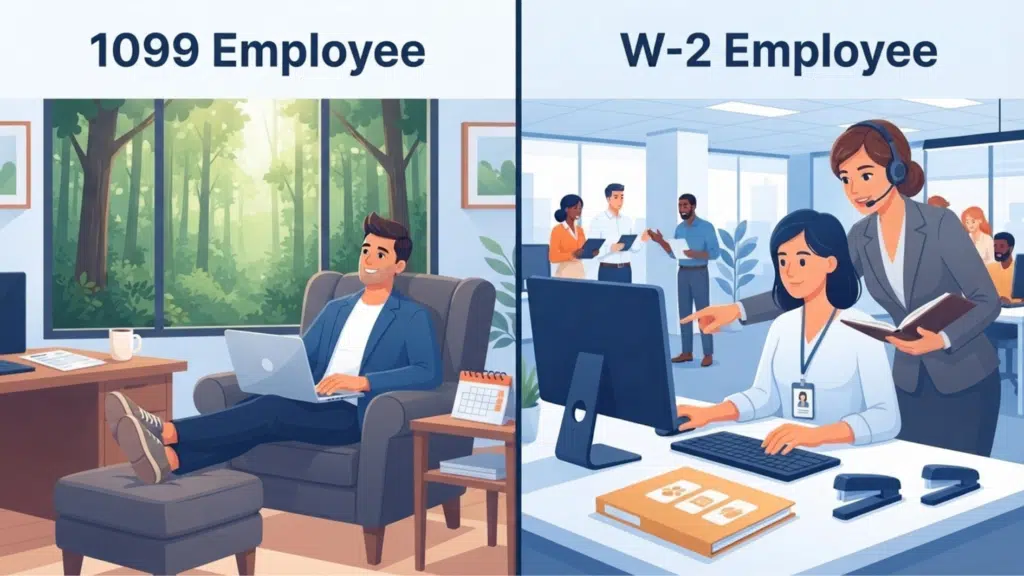

A job offering $90,000 as a W-2 employee and another paying $110,000 as a 1099 contractor might seem like an easy choice, but is it really?
The bigger paycheck doesn’t always mean you’ll keep more money once taxes, health insurance, retirement savings, and other costs are factored in.
In this blog, you will walk through 1099 vs W-2 employee, which classification you fall into, what it does to your tax bill, and how to tell which offer really pays more.
What is a 1099 Employee?
1099 employee is a common term for independent contractors, freelancers, or self-employed workers who are not traditional employees of a company.
They receive a Form 1099-NEC from businesses to report their earnings, rather than a W-2 form. Unlike W-2 employees, 1099 contractors control how, when, and where they work.
They often set their own schedules, choose their clients, negotiate rates, and may work for multiple businesses simultaneously.
Examples of 1099 employment: accountant, Real estate agent, graphic designer, independent therapist.
What is a W-2 Employee?
A W-2 employeeis a traditional worker hired directly by a company to perform work under the employer’s supervision.
Their employer provides important aspects of the job, such as work hours, responsibilities, and company policies; it withholds income and payroll taxes from their paychecks and provides an annual IRS Form W-2 (which reports their wages and the taxes already withheld).
Examples of W-2 Employment: physician, Teacher, Cashier, Nurse.
1099 vs W-2 Employee: A Quick Difference

Understanding the key differences between 1099 contractors and W-2 employees helps businesses and workers learn about taxes, benefits, and legal responsibilities.
| Aspect | 1099 Contractor | W-2 Employee |
|---|---|---|
| Work Control | Sets own schedule and work style. | Employer controls schedule and duties. |
| Employment | Works independently for one or more clients. | Works directly for one employer. |
| Job Security | Usually project-based. | Typically more stable employment. |
| Benefits | Provides its own benefits. | Often receives employer-paid benefits. |
| Work Expenses | Covers own business expenses. | The employer usually provides equipment and tools. |
| Flexibility | High flexibility and autonomy. | More structured work environment. |
Financial Outcomes of 1099 vs W-2 Employee
While 1099 contractors often earn more per hour or project, they also pay higher taxes and cover expenses that W-2 employees may receive as employer-paid benefits.
1. Higher Pay for 1099 Contractors
1099 contractors often command higher rates because businesses don’t provide employee benefits or pay the employer’s share of payroll taxes.
This higher pay compensates for added responsibilities like self-employment taxes, health insurance, retirement contributions, and unpaid time off.
2. Hidden Value of W-2 Benefits
W-2 employees may receive valuable benefits that increase their total compensation, including health insurance, paid vacation and sick leave, unemployment insurance, and other employer-paid perks.
These benefits provide financial security, reduce out-of-pocket costs, and add long-term value beyond base pay. Paid time off alone adds up more significantly than most people calculate
In contrast, 1099 contractors must cover their own insurance, retirement, and time off, which is typically reflected in higher hourly or project rates.
3. Business Expenses Reduce Net Income
1099 contractors are responsible for paying for their own: Health insurance, Equipment and software, Travel, Marketing, and other business-related expenses.
Although many of these costs may be tax-deductible, they still reduce overall take-home pay.
4. Compare Total Compensation, Not Just Salary
When comparing a 1099 contractor with a W-2 employee, look beyond the hourly rate or annual salary.
Consider benefits, taxes, business expenses, and overall take-home income to determine which option offers better financial value.
For example, a freelance graphic designer charging $65 per hour may appear to earn more than someone with a $75,000 W-2 salary. However, after paying for health insurance, software subscriptions, business expenses, and the 15.3% self-employment tax, the contractor’s take-home income may be much lower than expected.
How is Worker Classification Decided?
Worker classification isn’t a personal choice; neither the worker nor the employer can simply pick a label.
The IRS evaluates three key factors: behavioral control (who sets your hours and how you do the work), financial control (who provides equipment and covers expenses), and the type of relationship (contracts, benefits, and how permanent the work is).
Because these rules are complex, they aren’t applied uniformly across all situations, making proper classification essential for both workers and businesses.
California’s “ABC test” under AB5, for example, sets a higher bar for classifying someone as a contractor than federal law does, so the same job might legally be 1099 in one state and W-2 in another.
Penalties for Misclassifying an Employee
Misclassifying a worker as a 1099 contractor instead of a W-2 employee can lead to serious financial and legal consequences for employers.
- Back Taxes: Employers may owe unpaid income, Social Security, and Medicare taxes for misclassified workers.
- Interest Charges: Taxes owed can accrue interest from the date they should have been paid.
- Fines for Noncompliance: The IRS and state agencies can impose substantial fines for misclassification.
- Unpaid Overtime: Misclassified employees may be entitled to retroactive overtime pay under labor laws.
- Legal Action: Employees can file claims for benefits or unpaid wages, leading to lawsuits.
- Reputation Damage: Misclassification issues can harm a company’s credibility with employees, clients, and regulators.
W-2 vs 1099 Employee: Tax Implications
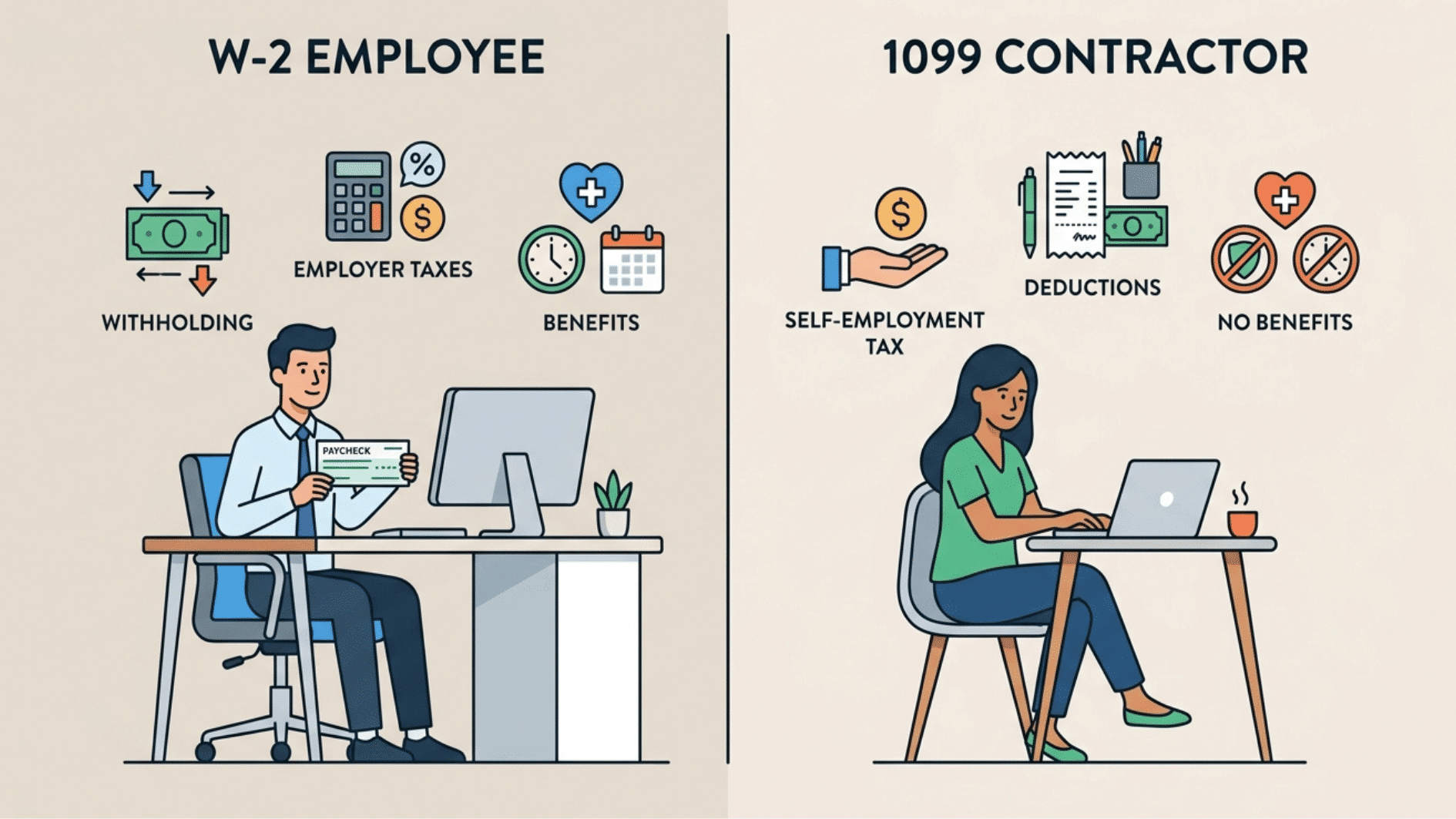
W-2 employees have taxes automatically withheld from each paycheck, while 1099 contractors are responsible for paying their own income and self-employment taxes.
1. Payroll Taxes
W-2 employees split Social Security and Medicare taxes with their employer, so they each pay a portion. In contrast, 1099 contractors pay the full 15.3% self-employment tax, covering both the employer and employee shares.
This makes independent work more financially demanding in terms of tax obligations and requires careful planning for quarterly payments
2. Tax Withholding
Employers automatically withhold taxes from W-2 employees’ paychecks, covering income tax, Social Security, and Medicare contributions.
1099 contractors, however, receive their full payment and must set aside money to cover their own taxes, including federal and self-employment taxes.
Contractors often make quarterly estimated payments to stay compliant and avoid penalties
3. Quarterly Estimated Taxes
Many 1099 contractors are required to make quarterly estimated tax payments to the IRS since taxes are not withheld from their income.
These payments cover federal income tax, Social Security, and Medicare contributions. Contractors must track earnings carefully and submit payments on time to avoid penalties and interest.
4. Business Tax Deductions
1099 contractors can deduct business expenses like home office costs, equipment, mileage, and software, reducing their taxable income.
W-2 employees generally cannot deduct unreimbursed work expenses under federal law, relying instead on employer reimbursements.
W-2 benefits also carry a taxable value that appears directly on the form. Understanding what imputed income is helps both employees and employers account for those figures correctly when reviewing tax obligations.
How to Decide What’s Best for Your Business?
Deciding whether to classify a worker as a W-2 employee or a 1099 contractor depends on your business needs, budget, and how you want to structure responsibilities and control.
- Control Over Work: W-2 employees work under your direction; 1099 contractors have more independence.
- Cost of Employment: Employees may cost more due to benefits, taxes, and insurance; contractors typically cost less upfront.
- Legal Obligations: Employers must follow labor laws for W-2s, including overtime, withholding, and compliance; 1099s handle their own taxes.
- Flexibility: Contractors can be hired for short-term projects, while employees are better for ongoing, consistent work.
- Risk and Liability: Misclassifying workers can lead to fines, back taxes, and legal penalties.
- Benefits and Perks: W-2 employees can receive health insurance, retirement plans, and paid leave; 1099s usually do not.
- Long-Term Strategy: Consider whether you want a dedicated workforce integrated into your company culture or a more project-based, flexible team.
Final Verdict
There is no winner in the 1099 vs W-2 employee debate. The better option depends on your financial goals, career preferences, and how much responsibility you’re willing to take on.
Choose a W-2 job if you want a steady paycheck, employer-paid benefits, automatic tax withholding, and greater job security.
Choose a 1099 contractor role if you prefer flexibility, setting your own schedule, working with multiple clients, and potentially earning higher rates.
Frequently Asked Questions
Can I Work as Both a W-2 Employee and A 1099 Contractor?
Yes, a worker can legally be both a W-2 employee and a 1099 independent contractor, but the work must be separate and distinct.
Can You Switch from W-2 to 1099?
Yes, transitioning from W-2 to 1099 status changes your tax responsibilities, benefits, and work structure, and you must comply with IRS and state regulations to avoid penalties.
How Much More Does a W-2 Employee Cost than A 1099?
A W-2 employee typically costs 25–40% more than a 1099 contractor when accounting for employer-paid payroll taxes, benefits, and insurance.