


Unclear rules can quickly lead to confusion, inconsistent decisions, and avoidable workplace issues that affect daily operations.
Whether it’s handling employee conduct, approving leave, or protecting company data, having well-defined workplace policies helps everyone understand what is expected from day one.
In this blog, you’ll learn what workplace policies are, why they matter, these essential policies every organization should have, and practical tips for creating, implementing, and maintaining them effectively.
What Is a Workplace Policy and Who Needs One?
A workplace policy is a written guideline that defines employee rules, expectations, responsibilities, and possible consequences.
It should be clear, specific, consistently enforced, and easy to access through a handbook or shared workspace.
Organizations of every size need policies, including startups, small businesses, large companies, remote teams, and regulated workplaces.
Well-written policies promote fairness, reduce confusion, and help employers meet legal, safety, and operational requirements.
Why Do Workplace Policies Matter?
Strong policies create a safer, more consistent, and legally compliant work environment. Here are the key reasons they matter.
- Support Legal Compliance: Policies help organizations meet employment laws and reduce the risk of legal disputes or regulatory issues.
- Set Clear Expectations: Employees understand what is expected of them, leading to fewer misunderstandings and more consistent behavior.
- Promote Fairness: Applying the same policies across the workplace encourages equal treatment and builds trust among employees.
- Improve Workplace Safety: Safety and conduct policies help reduce workplace risks and provide guidance for handling incidents.
- Strengthen Workplace Culture: Well-defined policies reinforce company values and encourage a respectful, professional work environment.
- Protect the Business: Policies safeguard company assets, confidential information, and reputation by setting clear standards for employee conduct.
Workplace Policies Every Company Should Have
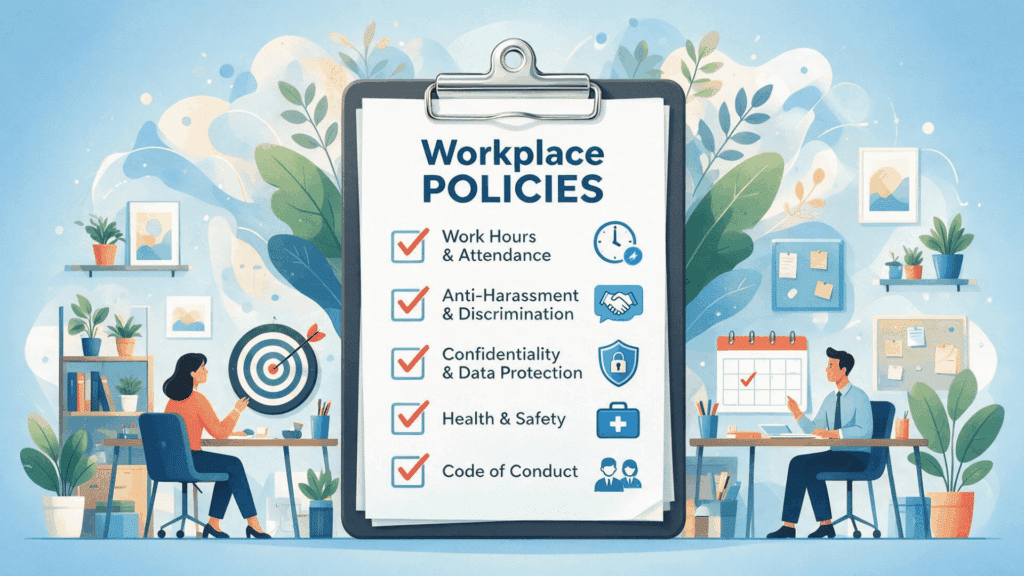
Each of these policies covers a different risk. Together, they’re the base set most HR and legal teams treat as a must-have.
1. Code of Conduct Policy
A code of conduct policy sets the standard for how staff treat each other, customers, and company property. It should cover polite talk and conflicts of interest.
It should also cover the use of company gear and general behavior on the job. Most staff read this policy first. It sets the tone for every other rule in the handbook.
2. Equal Employment Opportunity Policy
An equal employment opportunity policy says hiring, pay, and promotion don’t depend on race, gender, age, religion, or disability.
It should name the laws behind it, like Title VII and the ADA. The rules should also spell out how a worker can report a concern without fear of retaliation.
3. Anti-Harassment Policy
An anti-harassment policy defines what counts as harassment. It gives staff more than one way to report it, and reviewing real workplace harassment prevention tips can help HR teams spot gaps in their own reporting process.
A policy that sends every complaint through one manager fails the moment that manager is the one being reported. Add at least one backup contact, like HR or an anonymous line.
4. Health and Safety Policy
A health and safety policy explains how the company spots and fixes hazards. Add how to report injuries and meet OSHA rules too.
The policy should define employee and employer safety responsibilities. Regular training, emergency planning, and timely hazard reporting help reduce workplace risks.
Even office-only firms need this policy. It covers basics like exit routes and desk setup, not just factory-floor risks.
5. Attendance and Leave Policy
An attendance and leave policy spells out tardiness, missed days, and approved leave. It lays out the steps after repeat slip-ups.
Cover paid time off and sick leave too. Include any legally required leave, such as FMLA for employers with 50 or more employees, along with eligibility rules and employee responsibilities.
6. Compensation and Benefits Policy
A compensation and benefits policy covers pay schedules and overtime rules. It also covers how salary calls get made.
It should state whether each role counts as exempt or non-exempt under the FLSA. Getting this wrong causes one of the most common pay fights firms run into.
7. Remote and Hybrid Work Policy
A remote and hybrid work policy sets out who can work outside the office. It covers expected hours too. Cover how the team stays in touch and who pays for gear.
Say how remote staff gets judged on their work too. Face time isn’t a fair test once part of the team isn’t in the building.
8. Confidentiality and Data Security Policy
A confidentiality and data security policy defines what counts as sensitive company or customer data. It explains how to store that data.
Reporting a suspected leak matters just as much. This policy matters most for firms that handle payment data, health records, or product plans.
Basic data security steps help avoid a leak. A leak there brings real legal risk. A leak there brings real legal risk.
9. Technology and Social Media Policy
A technology and social media policy sets rules for company devices, networks, and accounts. It also covers what staff posts about the company in public.
It should draw a line between personal social media and posts about the company. A company mostly can’t control personal posts. But it can set rules for posts naming its clients or a live project.
10. Drug and Alcohol Policy
A drug and alcohol policy states whether substance use is banned on company grounds or during work hours. It also says whether the company tests for it.
The policy should also explain how employees can report concerns, the consequences of policy violations, and any support resources available, such as employee assistance programs (EAPs), where applicable.
Rules here shift by state, especially around cannabis. Check this policy against local law, not just a generic template.
11. Performance Management Policy
A performance management policy explains how reviews work. Goal-setting falls under it too. It also lists the steps before a firing for poor work.
A clear, steady review process protects a company if a fired worker later claims the decision was unfair, by showing consistent documentation and evaluation practices.
What Should Every Workplace Policy Include?
Every workplace policy should follow a consistent structure so employees know what to expect and where to find important information.
- Purpose: Explain why the policy exists and the issue it is designed to address.
- Scope: Specify who the policy applies to, including employees, locations, or job roles.
- Definitions: Clarify important terms that could otherwise be misunderstood.
- Policy Requirements: Outline the rules, expectations, or steps employees need to follow.
- Consequences: State what may happen if the policy is not followed.
- Review Schedule: Include when the policy was last updated and when it should be reviewed again.
- Policy Owner: Identify the department or person responsible for answering questions and maintaining the policy.
How Do You Implement Workplace Policies Effectively?

A policy only protects a company once it’s written, shared, enforced, and kept current. Skip any one step. A well-written policy turns into a document nobody reads.
Writing and Documenting
Start with the core parts from earlier. Cover purpose, scope, definitions, steps, results, review date, and owner. Write in plain words a new hire could follow on day one. Don’t use words meant to sound formal.
Keep the format consistent across all workplace policies, so employees know where to find key information. A standard structure also makes policies easier to update and maintain.
Enforcing Policies Consistently
Follow-through is where most policies fail. Say a manager lets one worker slide but writes up another for the same thing. The policy loses its weight. It loses staff trust too.
Communicating
A policy that only sits in a handbook nobody opens might as well not exist. Walk new hires through key policies during onboarding. Send a short note any time a policy changes.
Make policies easy to access through an employee handbook, company intranet, or shared digital workspace. Employees should be able to find the latest version whenever they need it.
Reviewing and Updating
Set a review date for every policy, at least once a year. Labor law shifts.
A policy written three years ago may no longer match how the company runs today, which is exactly why keeping your handbook updated matters as much as writing it in the first place.
Are Workplace Policies Legally Required?
Some are. Others are good practice, not a legal must. An equal employment opportunity policy and a health and safety policy are close to required.
Federal laws like Title VII and OSHA expect firms to stop and fix violations.
Understanding the legal limits for employers helps clarify where a policy becomes a legal necessity rather than a best practice.
A code of conduct or remote work policy isn’t required by any set law. It still protects the company with a clear, firm standard.
Should Workplace Policies Be Included in an Employee Handbook?
Yes. Workplace policies should live in one employee handbook, not spread across separate files and emails. A handbook gives staff one place to check.
A handbook gives staff one place to check, and starting from an employee handbook template guide makes it far easier to cover every required section from the start. That’s for policies staff check often, like attendance or leave.
Review the employee handbook regularly and update it whenever policies change. Employee acknowledgments help improve awareness and support consistent enforcement.
Conclusion
Well-designed workplace policies do more than document rules. They create consistency, support compliance, and help build a workplace where employees know what is expected of them.
From a code of conduct to performance management, each policy plays a role in reducing confusion and guiding everyday decisions.
Review your current policies regularly, update them as your workplace evolves, and ensure every employee can easily access them.
Which workplace policy has made the biggest difference in your organization? Share your opinion in the comments.
Frequently Asked Questions
What’s the Difference Between a Policy and A Procedure?
A policy is the rule itself. A procedure is the step-by-step process for following that rule. Think of how to request time off.
How Often Should Workplace Policies Be Reviewed?
At least once a year. Review sooner if labor law changes, or if the company shifts how it works, like moving to hybrid schedules.
Can a Company Use Different Workplace Policies Across States?
Yes. Many companies use one core policy with state-specific addendums to meet local requirements, such as sick leave or drug testing rules. This approach is easier to manage than creating separate policies for each location.