
Payroll mistakes and overtime disputes often occur when businesses misunderstand exempt vs non-exempt employee classifications.
Incorrect classification can lead to compliance issues, employee complaints, and costly penalties under the FLSA.
Understanding the difference between exempt and non-exempt employees helps businesses manage payroll correctly and protect employee rights. It also improves compliance with wage and overtime laws.
This article explains the rules for exempt vs. non-exempt employees, salary requirements, overtime eligibility, and how employers correctly classify workers.
Exempt vs. Non-Exempt Employee
Under the Fair Labor Standards Act (FLSA), employees are classified as exempt or non-exempt. Read below to understand what these classifications mean.
What Is an Exempt Employee?
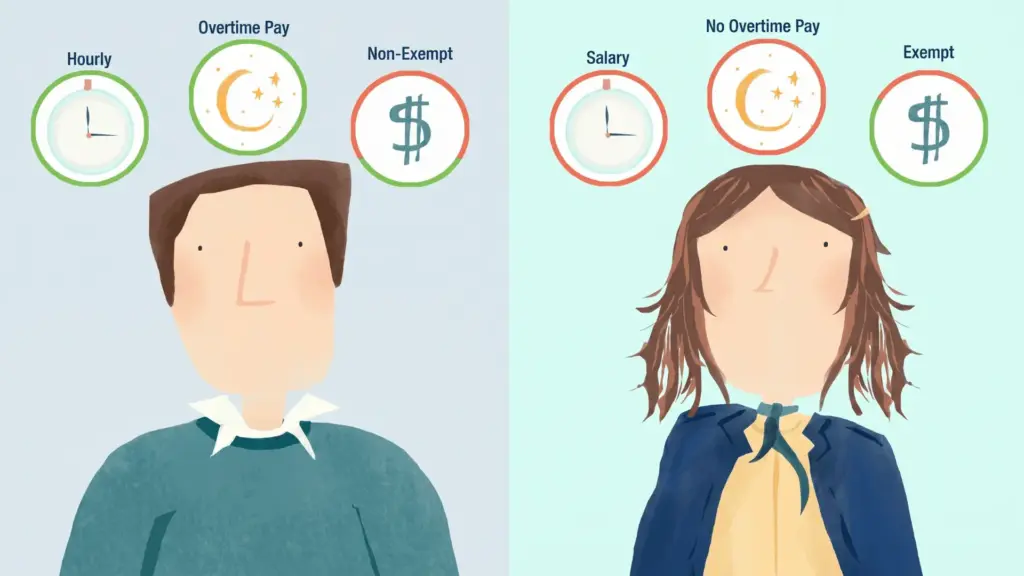
An exempt employee is a salaried worker who does not qualify for overtime pay. To qualify, the employee must earn at least $684 per week, though some states have higher limits.
Exempt employees usually handle executive, administrative, or professional duties that require independent decision-making. The Department of Labor(DOL) uses a duties test to determine whether an employee qualifies for exempt status.
For example, department managers and senior professionals are often classified as exempt employees. Their pay stays the same regardless of the number of hours worked.
What is a Non-Exempt Employee?
Non-exempt employees are typically paid hourly and are entitled to the state minimum wage.
If they work more than a standard 40-hour workweek, non-exempt employees are also entitled to minimum wage and overtime pay, calculated at a minimum of 1.5 times their regular hourly rate.
Instead of job duties, the main feature of non-exempt status is the correlation between hours worked and compensation.
This classification plays a vital role in protecting workers from overwork without adequate compensation and in ensuring fair labor practices across industries.
Exempt vs. Non-Exempt Employee: Key Differences
If you’re still unsure whether your employee should be classed as exempt or non-exempt, consider the following:
| Feature | Exempt Employees | Non-Exempt Employees |
|---|---|---|
| Overtime Pay | Not eligible for overtime pay | Eligible for overtime after 40 hours per week |
| Salary Basis | Paid a fixed salary | Usually paid hourly |
| Job Duties | Executive, administrative, or professional tasks | Manual, clerical, or routine tasks |
| Work Hours | No fixed 40-hour workweek requirement | Typically follows a 40-hour workweek |
| Minimum Salary Requirement | Must earn at least $58,656 annually | No minimum salary requirement |
| Flexibility in Hours | Often have flexible schedules | Usually follow fixed schedules |
| Common Examples | Managers, lawyers, software engineers | Retail workers, electricians, customer service staff |
Pros and Cons of Exempt vs Non-Exempt Employees
Classifying employees as exempt or non-exempt affects pay, scheduling, compliance, and employee satisfaction. Both classifications are important, but each offers distinct benefits and challenges.
Exempt Employees
Exempt team members typically hold professional, managerial, or specialized roles. These positions are often salaried and project-focused.
Pros:
- Predictable, stable pay not tied to hours worked
- Greater flexibility and autonomy in daily schedules
- No need for time tracking or clocking in and out
- Perceived as higher-level roles, which can support career growth
Cons:
- No overtime pay, even when working long hours
- Role expectations can lead to overwork and burnout
- Less visibility into actual hours worked
- Classification errors can result in legal penalties
Non-Exempt Employees
Non-exempt team members typically work in hourly roles where organizations tie compensation directly to the number of hours worked. Wage and hour laws govern these positions more strictly.
Pros:
- Eligible for overtime pay, creating income opportunities
- Clear boundaries between work time and personal time
- Well-suited for shift-based roles and hourly schedules
- Often easier to scale in operations-heavy businesses
Cons:
- Limited flexibility in when and where they work
- Must track and report hours precisely
- Mismanagement of time tracking can result in underpayment
- Perception of being lower on the org chart, which can affect morale
Why Should Hr Leaders Care About Exempt and Non-Exempt Employee Status?
Understanding exempt and non-exempt employee statuses enables HR leaders to ensure that people receive compensation that accurately reflects their classification.
Paying people in adherence to the law helps employers avoid lawsuits while also contributing to fair treatment of employees.
Ultimately, properly integrating policies on exempt and non-exempt employee status shows people that their company takes them seriously, setting the foundation for an engaged, productive workforce.
How Employers Classify Employees?
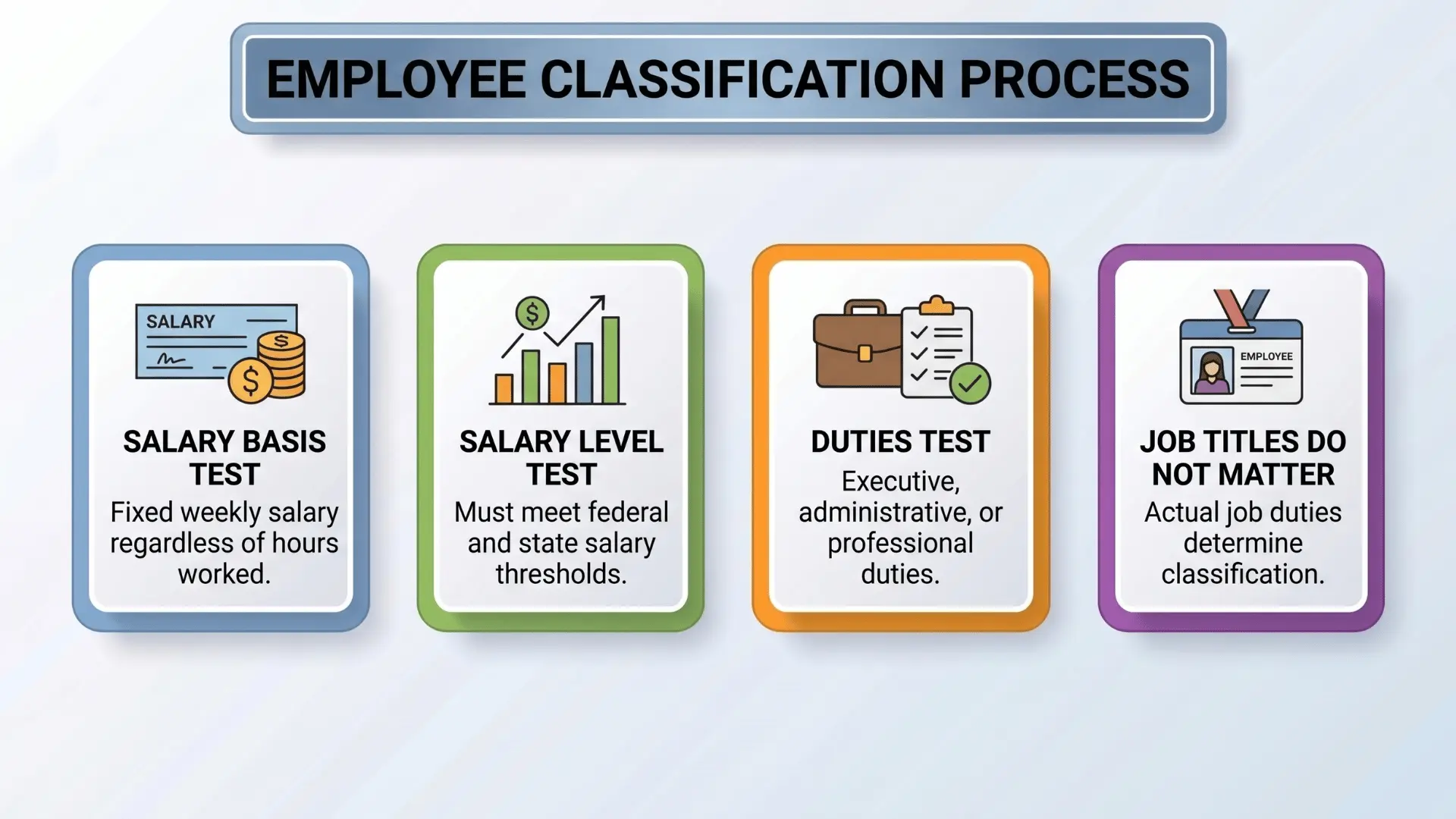
Employers use several tests to determine whether a worker qualifies as exempt or non-exempt.
- Salary Basis Test: Exempt employees must receive a fixed salary regardless of the number of hours worked.
- Salary Level Test: Employees must meet the federal salary threshold, though some states require higher amounts.
- Duties Test: Employees with executive, administrative, or professional duties are more likely to qualify as exempt.
- Job Titles Do Not Matter: A title alone does not determine exemption status. Actual job duties and pay structure are what matter.
Proper employee classification helps businesses follow labor laws and avoid payroll mistakes. Careful review of salary, duties, and pay structure can help prevent misclassification.
Consequences for Misclassifying Employees
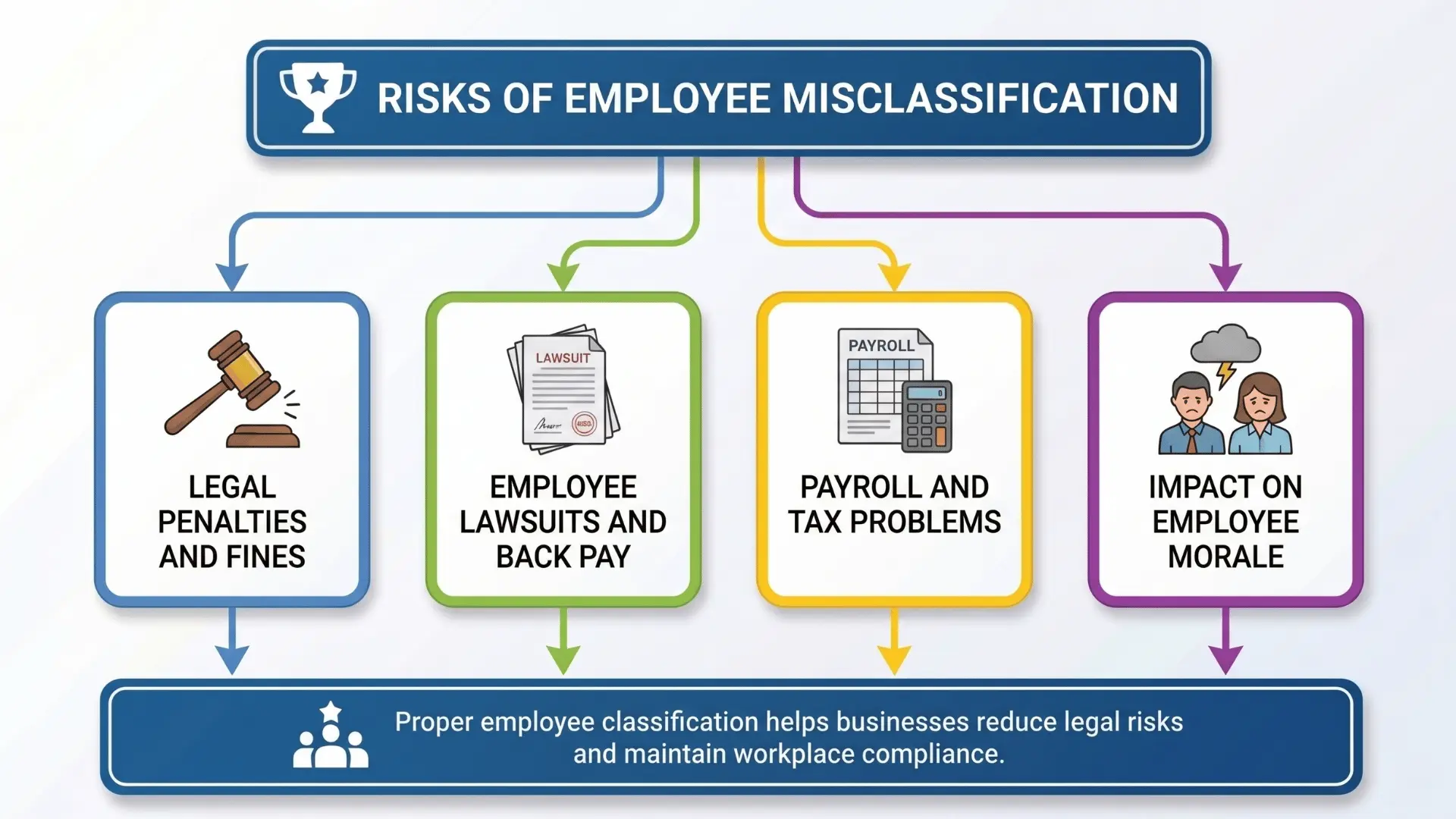
Misclassifying employees as exempt or non-exempt can lead to serious legal and financial issues.
Employers are responsible for ensuring that classifications meet salary and hour-duty requirements.
- Legal Penalties and Fines: Government agencies may impose fines and penalties for violating wage and hour laws.
- Employee Lawsuits and Back Pay: Misclassified employees may file wage claims or lawsuits for unpaid overtime or wages and back pay.
- Payroll and Tax Problems: Incorrect classification can lead to payroll errors, tax withholding issues, and compliance complications.
- Impact on Employee Morale: Misclassification can reduce employee trust, satisfaction, and overall workplace morale.
Getting classification wrong does more than trigger fines. It can quietly violate employee rights that federal law protects, often without either side realizing it.
Can You Reclassify an Employee From Exempt to Non-Exempt?
Yes, employers can reclassify employees from exempt to non-exempt status or vice versa when needed.
- Employers must review salary level, salary basis, and job duties before reclassification.
- Exempt employees must perform executive, administrative, or professional duties.
- Employers should clearly explain the reason for the classification change.
- Pay structure, overtime eligibility, and benefits may also need adjustment.
Proper reclassification helps businesses avoid compliance issues and payroll mistakes. Clear communication and accurate records are important during the process.
Tax Implications for Exempt Employees
Because exempt employees receive a fixed salary each pay period, their earnings are considered regular income and are subject to federal, state, and local income taxes where applicable.
They may also qualify for pre-tax benefits like health insurance, retirement plans, and flexible spending accounts (FSAs), which can help reduce taxable income.
Employers are responsible for withholding taxes such as federal income tax, Social Security tax, and Medicare tax from employee paychecks based on the information provided in W-4 forms.
Tax deductions are usually consistent because exempt employees earn a fixed salary. Their tax obligations may change depending on benefits, bonuses, and filing status.
State Laws and Nuances
In addition to federal regulations, some states have unique wage and labor laws that affect exempt, nonexempt, or both categories of employees.
| State | Minimum Exempt Salary (2026) | Special Rules and Notes |
|---|---|---|
| Alaska | $1,040 per week | Exempt employees must earn at least twice the state minimum wage for a 40-hour workweek. |
| California | $70,304 annually ($1,352 weekly) | Computer software employees must earn $58.85 per hour or $122,573.13 per year to qualify for the exemption. |
| Colorado | $1,111.23 per week | Computer employees must earn this amount weekly or at least $34.85 per hour. Exempt pay must meet both state and federal wage rules. |
| Maine | $871.16 per week | Job duties are more important than salary basis when determining exemption status. |
| New York | $1,199.10 per week | Executive and administrative employees must meet salary requirements. Some upstate employees earning $1,275 weekly may also qualify as exempt. |
| Washington | $1,541.70 per week | Computer professionals must earn at least $59.96 per hour. Salary thresholds may vary based on employer size. |
How to Implement Effective Employee Classification Practices?
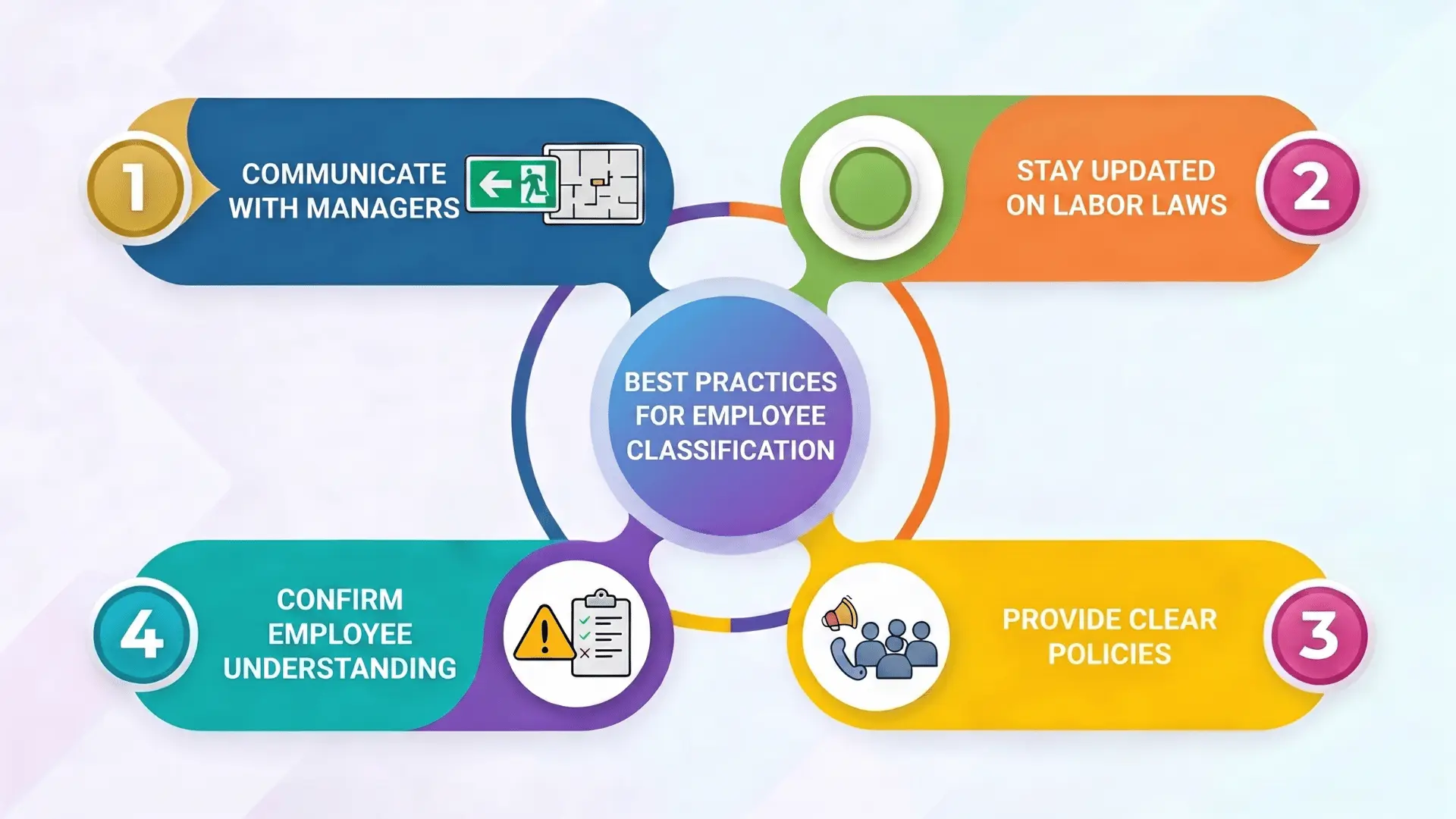
Managing exempt and non-exempt employee status correctly helps businesses stay compliant and avoid payroll issues. Clear communication and updated policies can reduce classification mistakes.
- Communicate with Managers: Keep HR informed about promotions, pay changes, and role updates.
- Stay Updated on Labor Laws: Review FLSA rules regularly and seek legal guidance when needed.
- Provide Clear Policies: Explain overtime, schedules, breaks, and remote work rules in the employee handbook.
- Confirm Employee Understanding: Ask employees to review and acknowledge workplace policies during onboarding.
Strong classification practices improve compliance and payroll accuracy. Clear communication and policies reduce employee confusion.
Conclusion
Understanding exempt vs non exempt employee classifications is essential for maintaining payroll accuracy, legal compliance, and fair compensation practices.
Correct classification helps businesses avoid overtime disputes, tax issues, employee lawsuits, and costly penalties under the FLSA.
Employers should review salaries, job duties, and labor laws to ensure proper classification. Strong classification practices improve trust and business operations.
Review employee classifications regularly and update policies as roles or pay structures change. Act now to reduce legal risks, avoid payroll mistakes, and keep your business compliant.
Have you dealt with an employee misclassification issue at your workplace? Share your experience in the comments below.
Frequently Asked Questions
Can Exempt Employees Receive Bonuses or Extra Compensation?
Yes, exempt employees can receive bonuses, commissions, or incentive pay in addition to their fixed salary.
Do Exempt Employees Need to Track Their Work Hours?
Exempt employees are usually not required to track hours for overtime purposes, though some companies may still monitor work time for attendance or productivity.
Can Remote Employees Be Classified as Non-Exempt?
Yes, remote employees can be non-exempt and must still follow overtime, break, and time-tracking rules under the FLSA.