

The National Labor Relations Board logged over 1,100 unfair labor practice charges tied to rehiring disputes in a single recent year, and most traced back to messy documentation rather than bad intentions.
That number says something most people miss: getting fired rarely closes the door for good. How long can you get rehired after being terminated usually comes down to why you left, not just when the termination happened.
Company policy, your performance record, prior attendance, and whether HR quietly marked your file eligible or ineligible all shape the real timeline, often more than the calendar itself.
Can You Be Rehired After Being Fired?
Yes, a terminated employee can be rehired, but eligibility depends on the employer’s rehire policy, the reason for termination, prior performance, and whether you were flagged as eligible for future roles.
There’s no universal law setting a waiting period. Individual companies decide the terms, and those terms shift based on how the separation happened.
Eligibility Conditions That Affect Rehiring:
- Reason and severity of the termination
- Performance, attendance, and HR documentation on file
- Whether you left in good standing and completed any required waiting period
- Availability of a suitable open role
- Skills, certifications, or professional growth gained since leaving
- Sign-off from HR or a former manager, including Form I-9 reverification if rehired within three years
Recommendation: Confirm your official rehire status with HR or a former supervisor before reapplying. Companies often classify former employees differently than the employees themselves expect.
When Will You Be Rehired and When Will You Not Be Rehired?
Most rehire decisions weigh circumstances more heavily than elapsed time, and the reasoning shifts again if the gap was a temporary furlough rather than a full termination. The table below breaks down common exit scenarios.
|
Situation |
Rehire Possibility |
Typical Outcome |
|---|---|---|
|
Layoff or role elimination |
Higher chance |
Considered again once roles reopen |
|
Mutual separation |
Moderate to high |
Depends on prior relationship and policy |
|
Fired for attendance |
Possible |
May need proof of improved reliability |
|
Performance-related exit |
Depends |
New skills or growth often help |
|
Quit without notice |
Possible |
Company reviews the circumstances |
|
Policy violations |
Lower chance |
Depends on how serious the violation was |
|
Gross misconduct or theft |
Very low chance |
Often flagged as do-not-rehire |
Whether it’s an attendance firing, quitting without notice, or a gross misconduct exit, the honest answer stays the same: documentation decides more than the calendar does.
How Long Do You Have to Wait Before Being Rehired?
There’s no single rule, and asking whether you can be rehired after being fired without knowing the specific policy usually leads to guesswork. Each employer sets waiting periods, which generally fall into three broad ranges.
1. Immediate to 90-Day Waiting Periods
Some employers let former staff reapply right away, or after a short cooling-off period, when the departure was mutual, minor, or tied to a temporary workforce change.
Even so, most companies still review attendance, conduct, and write-ups before extending an offer, so a fast window doesn’t guarantee approval.
For example, Amazon generally allows reapplication 90 days after termination for minor infractions or attendance issues linked to negative UPT, subject to job availability and eligibility review at that location.
2. Month Waiting Periods: 6-12
Many corporate rehire eligibility policies default to a six- to twelve-month gap. This window gives the former employee time to build new skills or demonstrate that the issue behind the termination has been addressed, and lets the original team move past any lingering friction.
For example, Walmart employees terminated for policy violations often wait 6 months before active attendance points clear, though workers with clean records may reapply within thirty days at any store.
3. Indefinite Waiting Periods and Do-Not-Rehire Status
Terminations tied to theft, fraud, workplace violence, or serious policy breaches often lead to a permanent ineligible classification, set at the employer’s discretion and typically overriding any standard waiting period.
For example, Starbucks generally marks employees fired for theft, violence, or serious safety breaches as permanently ineligible, regardless of tenure, performance history, or how much time has passed since termination.
Note: Completing a waiting period does not guarantee an offer. It only means you’re eligible to be considered when a role opens.
Rehire Eligibility Decision Process at a Glance
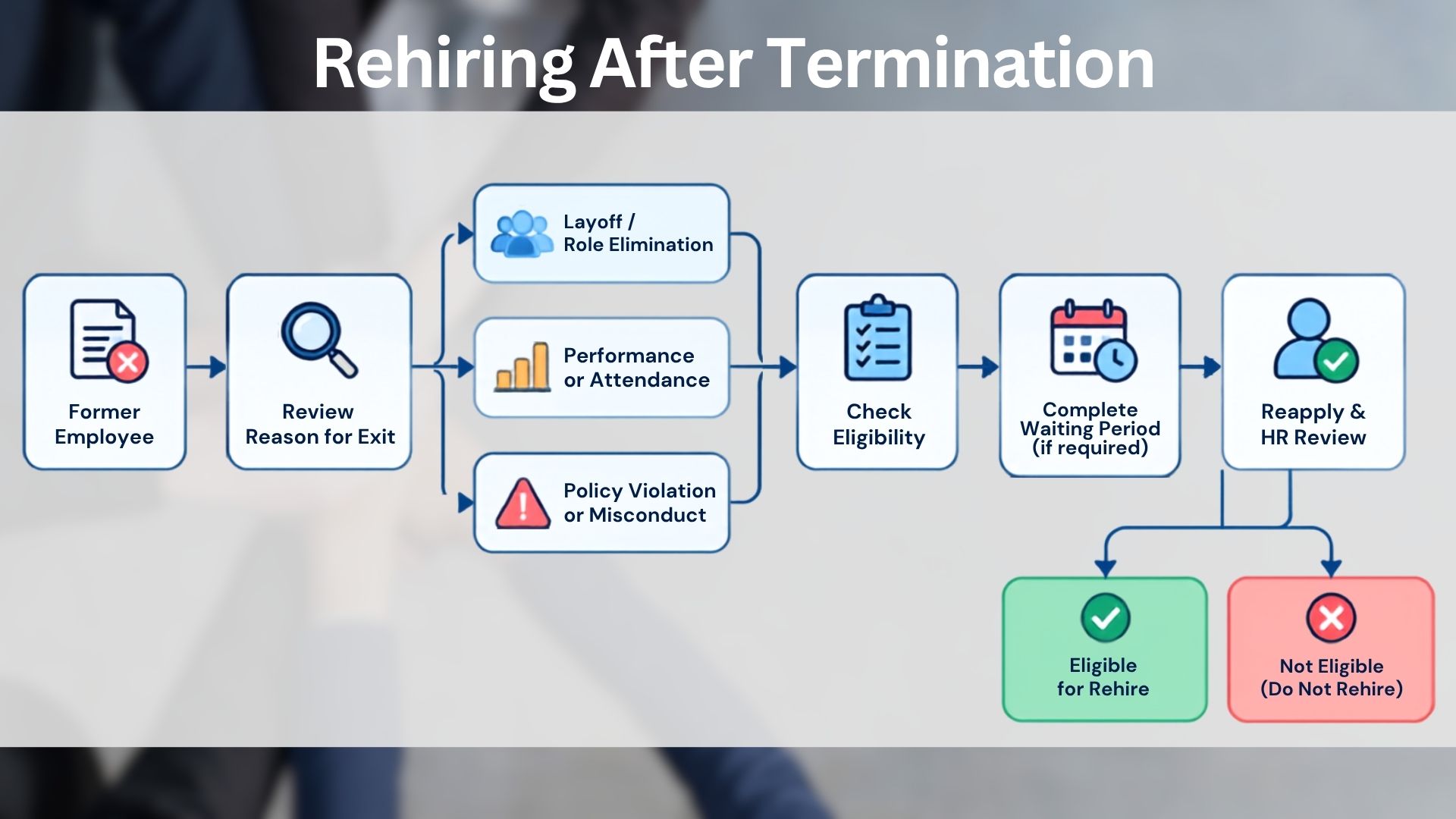
Whether it’s an attendance firing, quitting without a proper two-week notice, or a gross misconduct exit, the honest answer stays the same: documentation decides more than the calendar does.
- Layoff/Role Elimination → Check open roles → Reapply → HR review
- Minor/Performance Issue → Complete waiting period → Show improvement → Request reconsideration
- Attendance/Policy Issue → Review company decision → Provide explanation → Confirm rehire status
- Gross Misconduct → Likely do-not-rehire → Limited return options
Use this as a quick gut-check before investing time in a new application, then confirm the specifics with HR since store-level and manager discretion can still shift the outcome.
Multi-State and Industry Factors That Complicate Rehire Decisions
State law and industry regulation add another layer on top of a company’s internal policy.
|
Factor |
What It Means for Rehiring |
|---|---|
|
Personnel file access |
Some states grant broad rights to review your file, raising the bar for employers who deny re-employment |
|
Ban-the-box laws |
Several states restrict when employers can ask about criminal history tied to a past termination |
|
Healthcare |
A patient-safety or confidentiality violation can trigger licensing consequences that block rehire outright |
|
Finance |
Dishonesty-related terminations can be flagged on systems such as FINRA’s BrokerCheck, closing doors industry-wide |
|
Transportation |
DOT-regulated roles tied to a failed drug or alcohol test require a federally mandated return-to-duty process first |
Disclaimer: Employment laws vary by state and industry. This information is for general guidance only and does not constitute legal advice. For your specific situation, consult your state labor agency or an employment attorney.
Form I-9 Rules When You’re Rehired
Getting cleared to return doesn’t always mean starting your paperwork from zero. Whether you reverify your existing Form I-9 or complete a brand new one comes down to how much time has passed since you left, based on USCIS guidance for employers.
The rule splits by timing:
- If you’re rehired within three years of your original hire date, your employer can reverify your existing Form I-9 by completing Supplement B instead of filing a fresh form.
- If more than three years have passed since your last hire date, your employer must complete an entirely new Form I-9 to verify your work eligibility.
Note: This paperwork requirement runs separately from a company’s internal rehire policy. Even once you’re cleared to return, missing or outdated I-9 documentation can delay your actual start date, so it’s worth confirming this with HR ahead of your first day back.
Final Thoughts
Rehiring decisions depend more on circumstances and documentation than on a fixed countdown. A termination rarely closes every door permanently, but it puts the burden on the former employee to confirm where they stand rather than assume enough time has quietly passed.
Waiting periods, past performance notes, and the specific reason behind the exit all carry more weight than the calendar alone.
Before reapplying anywhere, ask directly how long can you get rehired after being terminated at that specific company, since the answer changes with every employer, every role, and every set of circumstances surrounding the original separation.
Frequently Asked Questions
Can HR Reverse a Termination?
Rarely, and only for a documented error, a wrongful termination finding, or a successful internal appeal. Most terminations stand once finalized.
How Long Should You Wait Before Applying Again After Being Fired?
There’s no fixed answer. Some companies allow immediate reapplication, others require six to twelve months, and severe cases may mean no return at all.
Does Being Fired Affect Future Employment Opportunities?
It can, especially if a background check or reference call reveals the reason for separation. A for-cause termination carries more weight than a layoff.
Can a Company Remove a Do Not Rehire Status?
Yes, occasionally, if new leadership reviews the record or the former employee shows the original decision was unfair or outdated.