

Many people struggle with having too much on their plate because they feel responsible for handling every detail themselves.
Knowing how to delegate tasks can help you manage your workload while giving others the chance to own meaningful work.
Delegation is not about handing off unwanted tasks. It is about understanding priorities, matching responsibilities with the right people, and creating clear expectations.
This blog explains how to delegate effectively, what tasks to assign, common mistakes to avoid, and how to build better delegation habits.
What Does Delegating Tasks Mean and Why Is It Important?
Delegating tasks means assigning responsibility for a specific piece of work to another person while remaining accountable for the final outcome.
It involves choosing the right person, explaining expectations, providing the resources they need, and checking progress at the right time. The difference between simple task assignment and delegation is ownership.
A delegated task gives someone responsibility to complete the work, make decisions within limits, and build confidence through experience.
Some benefits of effective delegation include:
- Better time management: Creates more space for planning, problem-solving, and important decisions.
- Stronger team growth: Employees gain experience when they receive opportunities to handle meaningful responsibilities, the same growth documented across these effective team dynamics examples.
- Improved productivity: Work moves faster when tasks are shared among people with suitable skills.
- Higher team confidence: Trusting others with responsibilities can improve motivation and ownership.
According to a Harvard Business Review article on delegation and leadership, effective delegation allows leaders to focus on higher-value responsibilities while helping employees grow.
How to Delegate Tasks: Step-By-Step Process
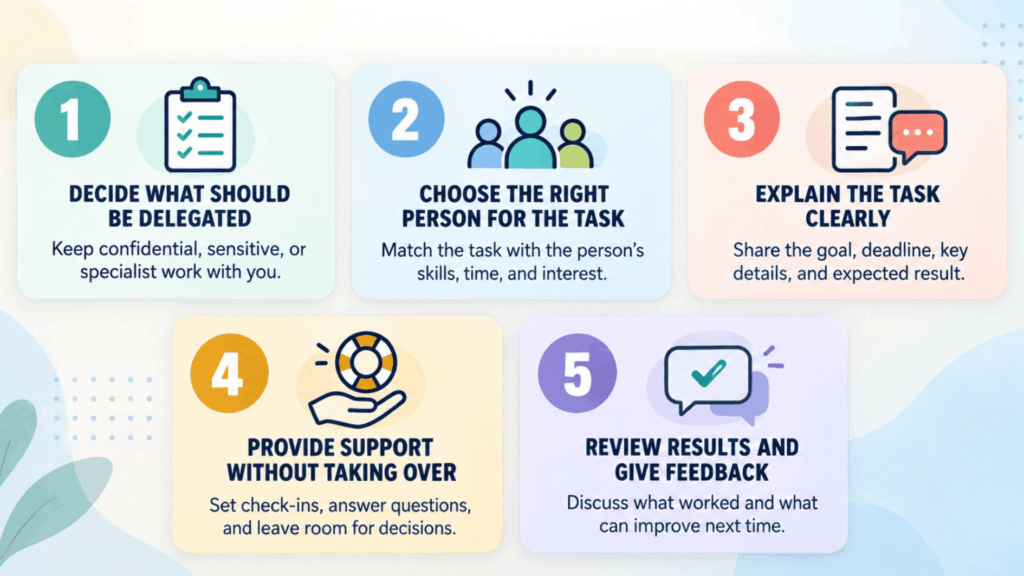
Effective delegation works best when it follows a clear process. Instead of simply asking someone to “take care of something,” use these steps to create better results.
1. Decide What Should Be Delegated
The first step is to identify tasks that do not need your direct involvement.
Review your workload and separate responsibilities that require your personal expertise from tasks that someone else can complete with proper guidance.
Some responsibilities should usually stay with you, such as confidential decisions, sensitive conversations, or work that depends on your specific experience.
2. Choose the Right Person for the Task
Delegation works best when the person receiving the task has the right mix of skills, availability, and interest.
Before assigning work, consider whether they understand similar tasks, have enough time to complete it, and may benefit from learning something new.
Choosing someone only because they are available can create unnecessary pressure.
3. Explain the Task Clearly
Many delegation problems happen because expectations are not explained properly.
Before handing over a responsibility, clearly describe what needs to be completed, why the task matters, when it should be finished, and what a successful result looks like.
Clear instructions prevent confusion and help the person make better decisions without constant clarification. Sharing key details at the front also saves time later.
4. Provide Support Without Taking Over
Delegation does not mean leaving someone completely on their own. At the same time, checking every small detail can make the person feel untrusted.
Offer support by setting check-in points, answering questions, and reviewing important stages of the work.
Give them enough space to choose their own approach and solve problems independently. The goal is to remain available without controlling every step.
5. Review Results and Give Feedback
Once the task is completed, review the outcome and discuss what went well and what could be improved next time.
Feedback helps people understand expectations better and prepares them to handle similar responsibilities with more confidence, drawing on workplace feedback examples to keep the conversation specific and constructive.
A helpful review focuses on the result, the process, and possible improvements rather than only pointing out mistakes. Each delegated task can become an opportunity for better teamwork and stronger skills
What Tasks Should You Delegate?
Not every responsibility needs to stay with one person. The right tasks to delegate are usually those where another person can complete the work successfully with proper direction.
Common examples include:
Repetitive Tasks
Routine Work Often Takes up Valuable Time.
Examples:
- Scheduling Meetings
- Organizing Files
- Updating Spreadsheets
- Preparing Regular Reports
Research-Based Tasks
Research tasks can help team members build knowledge while supporting larger projects.
Examples:
- Market Research
- Competitor Reviews
- Collecting Customer Feedback
Tasks that Build Skills
Delegation can also help employees grow.
Examples:
- Leading a Small Meeting
- Creating a First Draft
- Managing a Smaller Project
Tasks Outside Your Priority List
Some Work May Be Important but Does Not Require Your Direct Attention.
Examples:
- Formatting Documents
- Preparing Presentations
- Coordinating Routine Communication
How to Delegate without Micromanaging
Delegation is easy to understand in theory but harder to practice, especially when expectations feel undefined or trust is still being built. That gap is usually where micromanagement creeps in.
Shifting the focus toward outcomes instead of every small action, setting clear check-in points instead of hovering.
Accepting that a task can be done differently and still succeed, and giving people the room to work through problems on their own all help close that gap over time.
Real-Life Delegation Challenges: What Managers Struggle With
Discussions from managers and professionals online show that the biggest challenges are often not about assigning tasks. They are about trust, communication, and knowing when to step back.
One manager shared that they struggled to delegate because they worried about quality. They kept checking their team’s work instead of focusing on strategic responsibilities, showing how trust issues can make delegation difficult..- Reddit
Another manager explained that doing everything themselves caused stress and overload. They improved by reviewing their workload, matching tasks with team strengths, and setting clearer expectations before handing responsibilities over.-Reddit
Many workplace discussions highlight that delegation is about balance. Managers need to provide enough guidance for success while giving people the freedom to make decisions and build confidence through ownership.-Reddit
How to Improve Your Delegation Skills
Strong delegation skills develop through practice. They are not only about assigning tasks. They also involve communication, judgment, and trust.
You can improve by:
- Understanding your team: learn each person’s strengths, interests, and areas they want to grow in.
- Practicing clear communication: give complete instructions instead of assuming people understand.
- Starting small: delegate smaller tasks before assigning larger responsibilities.
- Reviewing your approach: after each task, consider what worked and what could change.
- Building trust gradually: consistent support and fair feedback create stronger working relationships.
Good delegation becomes easier when it becomes part of your regular work habits, not something you do only when you feel overwhelmed.
Final Thoughts
Learning how to delegate tasks can change the way you manage your time and responsibilities.
Effective delegation is not about avoiding work. it is about sharing ownership, helping others grow, and creating a better workflow.
The strongest delegation happens when tasks are matched with the right people, expectations are clear, and support is available when needed.
Start with one suitable task, communicate clearly, and gradually build a system that works for both you and your team.
Frequently Asked Questions
What Are the 4 Types of Delegation?
Delegation can happen at different levels, depending on how much authority and decision-making power you give. the four common types are telling, selling, consulting, and joining.
How Do You Delegate Tasks when You Think You Can Do Them Faster?
Many people avoid delegation because completing the task themselves feels quicker. A better approach is to consider the long-term benefit.
How Often Should You Check on A Delegated Task?
The right check-in frequency depends on the task and the person’s experience. New team members may need more frequent updates, while experienced employees may need only milestone reviews or a final discussion.
What Is the Difference Between Delegation and Outsourcing?
Delegation usually happens within the same team or organization, where you share responsibility with another employee. Outsourcing involves assigning work to an external person or company outside the organization.
Can Delegation Help Employees Develop Leadership Skills?
Yes. Giving people responsibility for projects, decisions, or team tasks can help them improve communication, problem-solving, and decision-making abilities.