

Ever gotten a job offer and nodded along while HR explained your “W-2 status” like you totally knew what that meant?
Most people do not actually know what W-2 employment is beyond getting a regular paycheck.
It affects how your taxes work, what protections you have, and what you are actually signing up for when you take that job.
So if you have ever wondered about these questions, like ‘what is a W2 employee’, ‘what is a W2 contract’, or what it really means for you, you are in the right place. Let us break it all down!
What is a W2 Employee?
A W-2 employee works directly for a company and receives a regular paycheck. The employer controls when, where, and how the work gets done.
Think of a cashier at a grocery store. They show up for scheduled shifts, follow store rules, and get paid every two weeks.
They have a manager, a set routine, and a defined role within the company. Their work life runs on a structure the employer builds and maintains.
Millions of Americans are employed on W-2s, including teachers, nurses, and office workers. It is one of the most common working arrangements in the country.
As an Employee, What is a W2 Contract for You?

A W-2 contract is a formal working arrangement between an employer and an employee. It sets the rules for how someone gets paid, taxed, and managed on the job.
If you’re starting a new job, this is likely the agreement behind it all.
- Employer Controls the Work: The company decides your schedule, tasks, and how the job gets done
- Taxes are Withheld Automatically: Federal, state, and Social Security taxes come out of every paycheck
- Benefits May Be Included: Health insurance, paid time off, and retirement plans are often part of the deal
- Stable, Predictable Income: You receive a regular paycheck on a set schedule
- W-2 Form at Year-End: Employer sends this tax document summarizing your annual earnings and deductions
- Legal Protections Apply: Minimum wage laws, overtime rules, and workplace protections all cover W-2 employees
- Unemployment Eligibility: W-2 employees can file for unemployment benefits if they lose their job
- Workers’ Compensation Coverage: Employers are required to carry insurance that covers on-the-job injuries
- No Self-Employment Tax Burden: Unlike freelancers, W-2 employees don’t pay the full 15.3% self-employment tax
- Onboarding and Training Provided: Employers typically invest in getting W-2 workers up to speed
- Performance Reviews and Raises: Structured evaluations and salary increases are common in W-2 roles
- Direct Deposit and Pay Stubs: Employees get detailed records of every payment and deduction made
W2 Employees Vs Other Worker Types: What Sets Them Apart
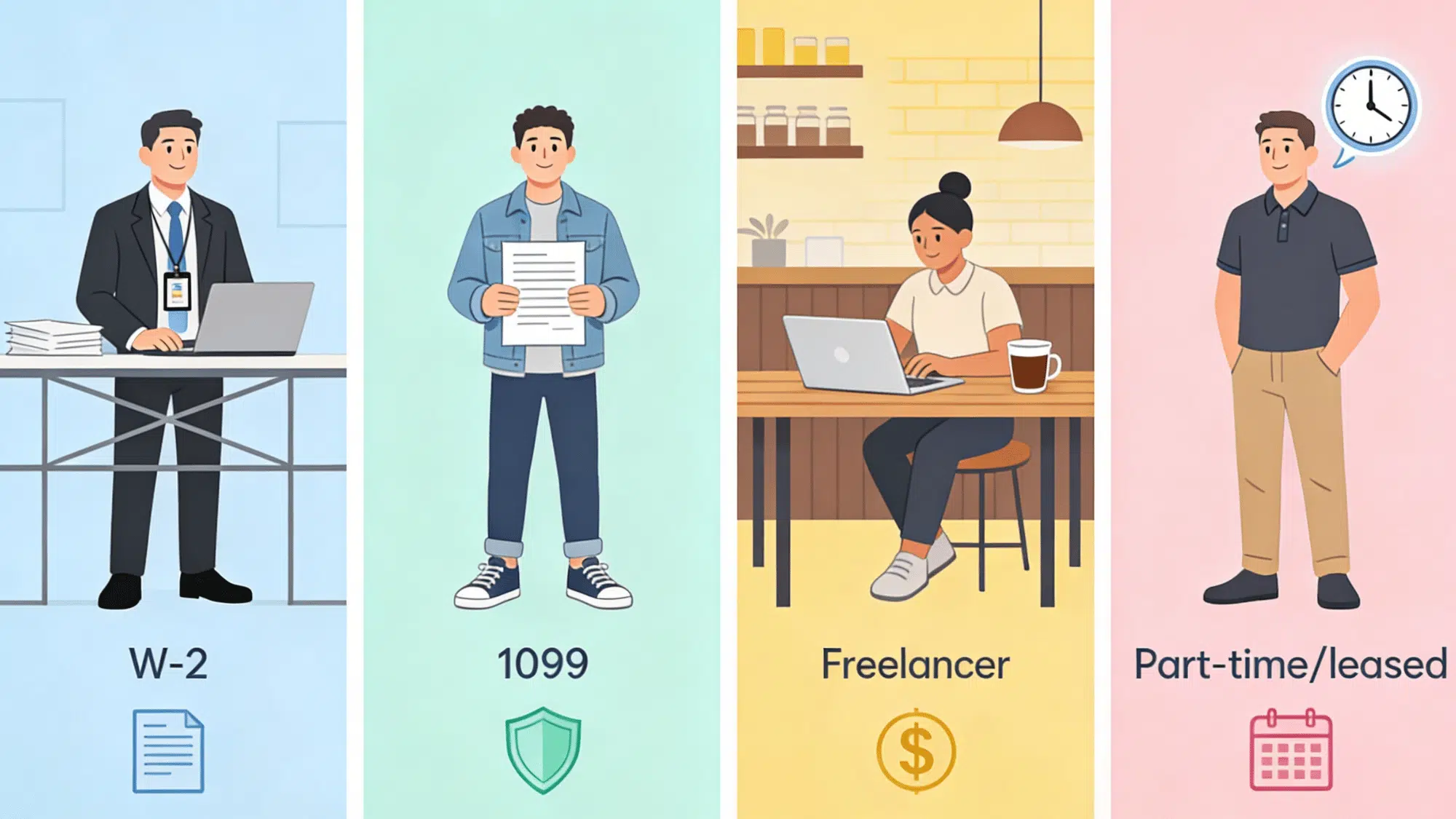
Knowing what a W2 employee is becomes much clearer when you see how they stack up against other worker types. Not everyone who works gets paid or taxed the same way.
Here is a breakdown of every key factor that sets W-2 employees apart from the 1099 contractors, freelancers, part-time workers, and leased employees:
1. Tax Withholding
Tax season looks completely different depending on how you work. The entire experience of filing, paying, and managing taxes shifts dramatically based on your worker classification.
| Tax Factor | W-2 Employee | 1099 Contractor | Others |
|---|---|---|---|
| Who withholds taxes | Employer | Nobody, self-managed | Varies by arrangement |
| Federal income tax | Auto-deducted from each paycheck | Paid quarterly via estimated taxes | Depends on worker classification |
| State income tax | Auto-deducted by employer | Self-filed and paid | Self-managed or agency-handled |
| Social Security tax | Employer covers 50%, employee pays 50% | Pays full 15.3% alone | Depends on classification |
| Medicare tax | Split equally between the employer and employee | Fully self-paid | Varies |
| Year-end tax form | W-2 form from the employer | 1099-NEC from client | W-2 or 1099, depending on setup |
| Quarterly estimated taxes | Not required | Mandatory | Required for freelancers only |
| Risk of underpayment | Very low, the employer manages it | High, easy to miscalculate | Moderate to high |
2. Work Control and Direction
Who calls the shots on the job is one of the most telling signs of any working arrangement. The degree of oversight a worker experiences shapes everything from their daily routine to their long-term career path.
| Control Factor | W-2 Employee | 1099 Contractor | Others |
|---|---|---|---|
| Who sets the schedule | Employer | Worker themselves | Varies, often self-set |
| Work location | Employer decides | Worker chooses | Depends on the arrangement |
| How work is done | Employer directs methods | The worker uses their own process | Mostly self-directed |
| Task assignment | Employer assigns daily tasks | Defined by contract scope | A mix of both, depending on the role |
| Supervision level | Direct and ongoing | Minimal, output-focused | Low to moderate |
| Flexibility | Limited, set by the employer | High, fully flexible | Moderate to high |
3. Benefits and Perks
Benefits can make or break a job offer, yet not every worker is entitled to them. The gap between what different worker types receive beyond their base pay is significant.
| Benefits Factor | W-2 Employee | 1099 Contractor | Others |
|---|---|---|---|
| Health insurance | Often employer-provided | Self-purchased | Rarely provided |
| Paid time off | Typically included | Not applicable | Limited or none |
| Retirement plan | Employer may match 401(k) | Self-funded IRA only | Rarely offered |
| Paid holidays | Usually included | Not provided | Depends on the employer |
| Life insurance | Sometimes employer-covered | Self-arranged | Rarely included |
| Sick leave | Often included | Not provided | Limited or excluded |
4. Legal Protections
What is W2 employment? Ultimately, it’s more than just pay; it’s about how protected you are at work. The level of legal coverage a worker has can affect everything from how disputes are handled to what happens if they get injured.
Workers covered under the Fair Labor Standards Act enjoy some of the strongest baseline protections available.
| Protection Factor | W-2 Employee | 1099 Contractor | Others |
|---|---|---|---|
| Minimum wage laws | Fully covered under FLSA | Not applicable | Part-time covered, others excluded |
| Overtime pay | Legally entitled | Not covered | Part-time covered, leased varies |
| Anti-discrimination laws | Fully protected | Limited coverage | Partial, depending on classification |
| Workers’ compensation | Employer required to provide | Not covered | Leased covered by the agency, others not |
| Wrongful termination | Protected | Contract-based only | Varies by arrangement |
| Unemployment insurance | Fully eligible | Not eligible | Part-time may qualify; others rarely do |
5. Income Stability
Financial security means something very different depending on the nature of your work. Some workers wake up every month knowing exactly what hits their account, while others are constantly chasing the next opportunity.
| Income Factor | W-2 Employee | 1099 Contractor | Others |
|---|---|---|---|
| Pay consistency | Fixed, scheduled paycheck | Project-based, irregular | Part-time steady, freelancer variable |
| Income gaps | Rare | Common between contracts | Seasonal gaps possible |
| Salary negotiation | At hiring or review | Per project or contract | Depends on the arrangement |
| Raise potential | Performance-based raises | Rate increase per new deal | Limited for most types |
| Financial predictability | High | Low | Moderate |
6. Equipment and Resources
Resource access affects job performance, out-of-pocket costs, and even how integrated a worker feels within a company.
| Equipment Factor | W-2 Employee | 1099 Contractor | Others |
|---|---|---|---|
| Computer and hardware | Employer provides | Self-owned | Host company or self |
| Software and licenses | Employer covers costs | Self-purchased | Varies by arrangement |
| Workspace | The employer provides an office | Self-arranged | Depends on role |
| Tool maintenance | Employer responsibility | Worker’s own cost | Mixed responsibility |
| Expense reimbursement | Often provided | Built into the contract rate | Rarely offered |
7. Unemployment and Job Security
When learning about: what is a W2 contract? one should know that it also defines what happens when the work runs out.
The safety nets available, the notice you receive, and the path back to income are shaped entirely by your working arrangement.
| Security Factor | W-2 Employee | 1099 Contractor | Others |
|---|---|---|---|
| Unemployment eligibility | Fully eligible | Not eligible | Part-time may qualify, others rarely do |
| Job continuity | Ongoing, open-ended role | Ends with contract | Seasonal or term-based |
| Layoff notice | Often legally required | Not required | Varies |
| Severance pay | Sometimes offered | Not applicable | Rarely provided |
| Rehire likelihood | Higher within the same company | Depends on the next contract | Moderate for part-time |
How Do You Know If W-2 Employment is Your Right Move?
Choosing the right work arrangement is one of the most personal career decisions you can make. The answer looks different for everyone depending on where they are in life.
Here is how to figure out which side of the fence you fall on:
W-2 Employment is Right for You If:
- You want a stable, predictable paycheck every month
- Managing your own taxes feels overwhelming or stressful
- You need employer-provided health insurance or benefits
- You prefer having clear direction, structure, and set responsibilities
- You are early in your career and want mentorship and growth tracks
- You have financial commitments like rent, a mortgage, or family expenses
- You want legal protections like overtime pay and workers’ compensation
- You value paid time off, sick leave, and paid holidays
- You want a long-term role with promotion potential
- You prefer one employer over juggling multiple clients
W-2 Employment is Not Right for You If:
- You want full control over your schedule and how you work
- You are comfortable with variable, project-based income
- You already have health coverage through another source
- You want to work with multiple clients at the same time
- You prefer setting your own rates and negotiating per project
- You are confident in managing quarterly taxes and financial planning
- You want the freedom to work from anywhere without employer approval
- You value independence over job security
- You want to scale your income beyond a fixed salary
- You are building your own business or client base on the side
Wrapping it Up
So now you actually know: what is a W2 employee? And that it is a lot more than just a tax form that shows up in January.
From how your paycheck gets handled to the protections you probably did not even know you had, being a W-2 employee shapes more of your work life than most people ever stop to think about.
If you are sizing up a new job offer, debating to go solo, or just finally getting your bearings on the whole thing, you have got the full picture now.
Consider this your cheat code for your next job conversation, offer letter, and career decision.
Frequently Asked Questions
Can a W-2 Employee Work for More than One Employer at The Same Time?
Yes, a person can hold multiple W-2 jobs simultaneously, and each employer withholds taxes separately.
Does a W-2 Employee Always Work Full Time?
No, part-time workers can also be W-2 employees depending on how the employer classifies them.
Who Decides if A Worker Is Classified as W-2 or 1099?
The employer makes that call, though misclassification can have legal and tax consequences.