

More than 80 percent of shared ownership between two companies is often enough to trigger federal retirement-plan obligations that most business owners never see coming.
That threshold sits at the center of the controlled group definition, a rule buried in the tax code that decides whether related businesses must be treated as a single employer for 401(k) purposes.
Founders who split a company into separate entities, or start a second venture with family members, often assume each business stands alone for benefits compliance. Employment law practice sees this misunderstanding repeatedly, usually after a plan has already failed testing.
Controlled Group Definition: What It Means for 401(k) Plans
A controlled group definition starts with ownership, not paperwork. In plain terms, a controlled group is two or more companies connected through common ownership, treated as one entity for specific legal purposes.
Under Internal Revenue Code Sections 414(b) and 414(c), that shared ownership sets a stricter standard for retirement plans: the IRS treats the businesses as a single employer when testing a 401(k) plan for fairness.
Separate EINs, payroll systems, or legal formation do not change this outcome; once the ownership threshold is met, the IRS evaluates employees across every entity together for coverage and nondiscrimination testing.
Advisory: A business structure that looks separate on paper may still count as one employer for benefit-plan purposes. Ownership percentages, not entity names, decide controlled group rules.
Types of Controlled Groups Under 401(k) Rules
The IRS sorts controlled groups into three ownership patterns, each triggering the same 401(k) testing obligations. Recognizing which pattern fits a set of companies is the first step toward accurate plan administration.
1. Parent-Subsidiary Group
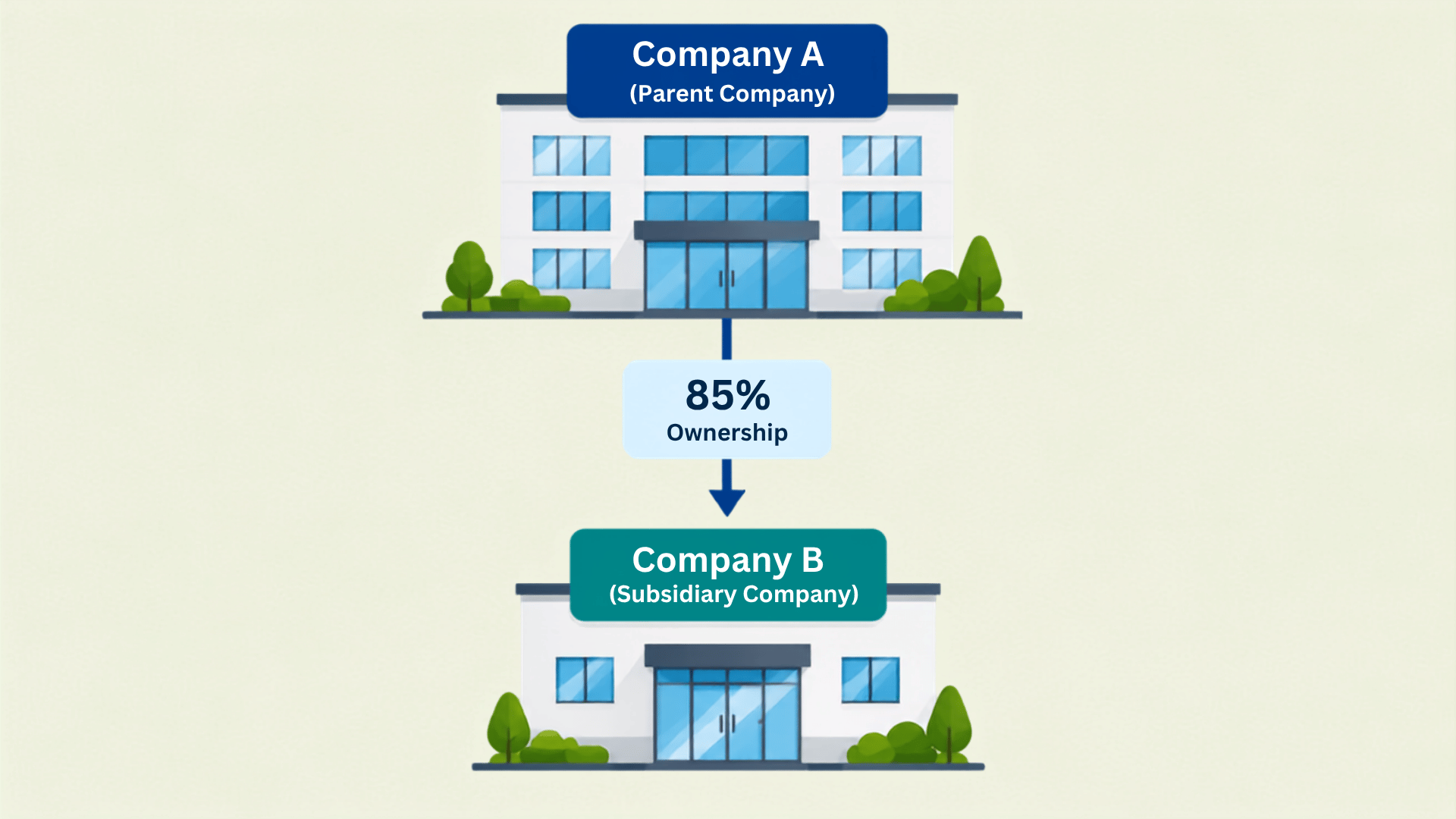
This applies when one business owns at least 80 percent of the voting power or total value of another company’s stock, and ownership chains can link several entities.
For Example: If Company A owns 85 percent of Company B, both fall under the same group. Employees of every linked entity must be counted together during 401(k) coverage and nondiscrimination testing, regardless of how the companies are branded day to day.
2. Brother-Sister Group
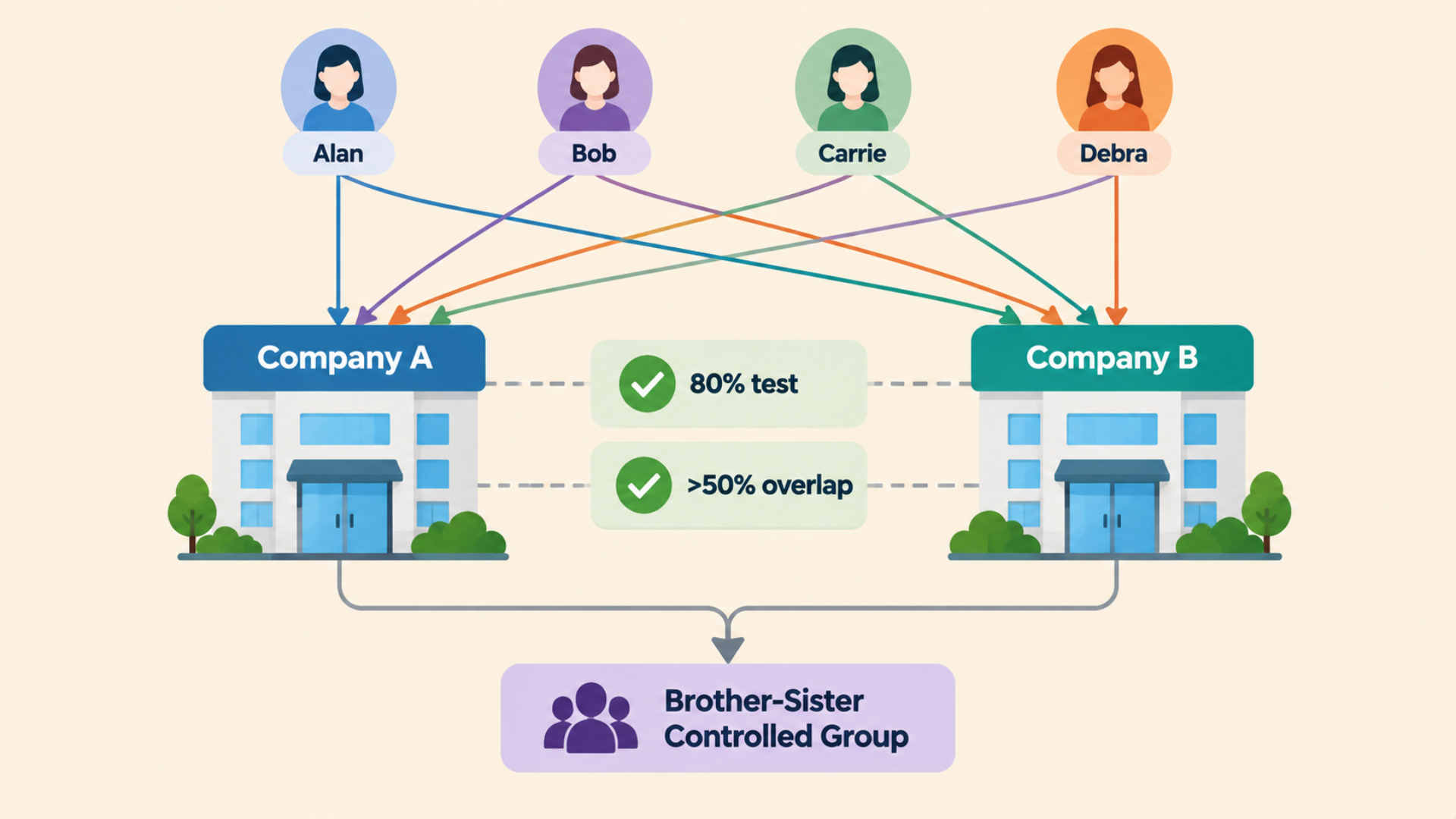
This exists when five or fewer individuals, estates, or trusts hold a controlling interest in multiple companies. Two tests apply: the same owners must hold at least 80 percent combined ownership in each company, and their identical, overlapping ownership across the companies must exceed 50 percent.
For Example: Four unrelated owners together hold 90 percent of Company A and 90 percent of Company B, with 60 percent identical ownership across both. Since both tests are met, the two companies form a brother-sister controlled group, and their employees must be tested together for the 401(k) plan.
3. Combined Group
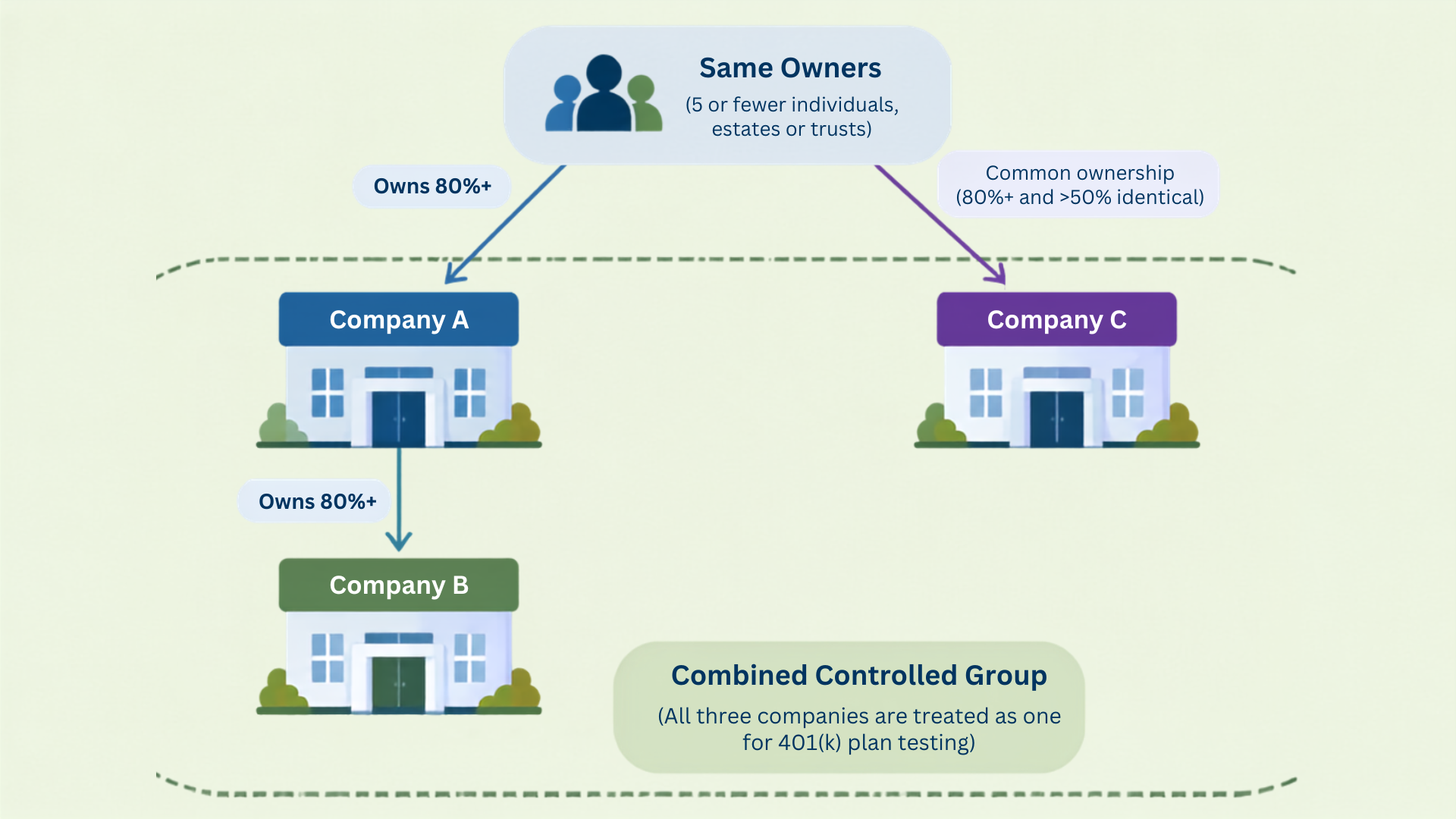
This blends parent-subsidiary and brother-sister structures across three or more companies. One entity typically acts as both a parent to one business and a co-owner, alongside others, of a second business.
For Example: Company A owns Company B, and the same individuals who control Company A also control Company C through a brother-sister arrangement. All three companies may fall into one controlled group for retirement-plan testing, even though C connects to the group only through shared ownership, not direct ownership.
4. Family Attribution and Hidden Ownership
Ownership records alone rarely tell the full story. IRS attribution rules can treat ownership held by a spouse, or a parent on behalf of a minor child, as if the other family member holds it directly.
For Example: A husband owns 100 percent of a technology company, and his wife separately owns 100 percent of a logistics company. Under attribution rules, the IRS may treat the two as a single brother-sister controlled group for 401(k) purposes, even with no direct business connection between the companies.
Recommendation: Ownership relationships should be reviewed again after a marriage, an ownership transfer, an acquisition, or the launch of a new entity. Any of these events can change controlled group status without anyone updating the retirement plan.
How to Know If Your Companies Are Part of a Controlled Group
Determining controlled group status before setting up or amending a 401(k) plan avoids costly corrections later. A short ownership review is far less expensive than a plan failure found during an IRS audit.
- List every company with any shared ownership, including minority stakes
- Confirm voting rights and exact ownership percentages for each owner
- Check whether family attribution connects otherwise unrelated owners
- Map parent, subsidiary, or affiliated-company relationships
- Track employees who move or split time between related entities
- Keep a written record of the ownership analysis with the plan files
Note: Controlled group status is not permanent. Mergers, acquisitions, ownership transfers, and new business formations can all change it, so the analysis needs revisiting whenever ownership shifts.
What Rules Apply to Controlled Group Retirement Plans?
Controlled group retirement plan rules require related companies to test and run their 401(k) plan as if they were one employer. Coverage, contribution limits, vesting, and liability all get evaluated across the whole group, not just one company.
- Coverage Testing: Whether an employee’s combined contributions across related companies stay within the IRC Section 415(c) annual limit, a limit that matters most for owners who often qualify as highly compensated employees.
- Contribution Limits: Whether an employee’s combined contributions across related companies stay within the IRC Section 415(c) annual limit.
- Vesting and Eligibility: Whether prior service at one entity is correctly credited toward eligibility and vesting at another.
- Plan Documents: Whether the plan’s records and language reflect the group’s controlled group status accurately.
- Liability: Whether every entity in the group understands it shares responsibility if the plan fails.
Do Controlled Group Rules Apply to Foreign-Owned Companies?
Yes. Controlled group rules apply even when the parent company or majority owner sits outside the United States.
A foreign-based parent with several U.S. subsidiaries must still combine the U.S. employees of those subsidiaries when assessing federal compliance requirements, including obligations under the Affordable Care Act.
Operating each subsidiary as a distinct business unit does not remove the requirement to aggregate employee counts where ownership ties the entities together.
This creates real exposure for foreign-owned subsidiaries in unrelated lines of business that may not even know sibling companies exist under the same parent. Each employer is responsible for identifying that exposure, not the parent company alone.
Compliance Risks When Controlled Groups Are Missed
Overlooking a related company rarely stays a small error. Once found, a missed controlled group connection can trigger corrections that cost far more than the original oversight.
- Failed Testing: Excluding employees from a related company can cause the plan to fail coverage or nondiscrimination testing, putting its tax-qualified status at risk.
- Corrective Contributions: Sponsors who catch the error early can often correct it through the IRS EPCRS guidance, but correction usually means funding retroactive contributions, plus earnings, for every employee left out. Some sponsors avoid this exposure altogether with a safe harbor match design built into the plan from the start.
- Audit Penalties: If the IRS finds an uncorrected error during an audit, penalties are calculated on the full tax impact of the omission, not just the missed contributions, and disputes over funding can escalate into employment litigation between the related entities.
Warning: Separate EINs, separate payroll providers, or separate office locations do not remove controlled group responsibilities once ownership connects the businesses.
Final Takeaway
Ownership, not paperwork, decides whether related companies must run one retirement plan or several. The controlled group definition exists so employees at a connected business are not left out of coverage simply because they sit on a different payroll.
Parent-subsidiary links, brother-sister ownership, family attribution, and combined structures all lead to the same result: shared testing, shared contribution limits, and shared responsibility for the plan.
Reviewing ownership before adopting a plan, and again after any ownership change, remains the most reliable way to catch a controlled group definition before an audit forces the issue.
Have recent ownership changes prompted a second look at retirement coverage at a related company? Sharing that in the comments may help other employers spot a connection worth reviewing.
Frequently Asked Questions
Can Separate Companies Share One 401(k) Plan?
Yes. Related companies can maintain a single 401(k) plan, but the correct design depends on ownership structure, employee classifications, and how the businesses are classified under IRS ownership rules.
Does Having Different EINs Avoid Controlled Group Rules?
No. Separate EINs, payroll systems, or legal entities do not automatically prevent companies from being treated as one employer once ownership ties them together.
Do Controlled Group Rules Apply to Small Businesses?
Yes. Small businesses can still fall under controlled group rules whenever ownership meets IRS thresholds, even if each individual company has very few employees.