

Every organization operates on a set of expectations that shape how people work, communicate, and make decisions.
When those expectations are clearly written and consistently applied, they become one of the most practical tools a business has.
The challenge is writing something employees will actually read and follow, rather than a generic policy that sits untouched in a handbook.
The examples in this blog cover code of conduct examples and a range of industries and formats, giving HR teams and business owners a clearer picture of what effective workplace standards look like in practice.
What is a Code of Conduct?
A code of conduct is a document that explains how people are expected to behave in an organization. It creates consistent expectations and supports a positive, trustworthy workplace.
It sets clear rules for professional behavior, ethical decision-making, and respectful interactions with coworkers, customers, and others.
A good code of conduct helps employees understand what is acceptable, what is not, and what to do if they have questions or need to report a concern.
Why Every Organization Needs a Code of Conduct?
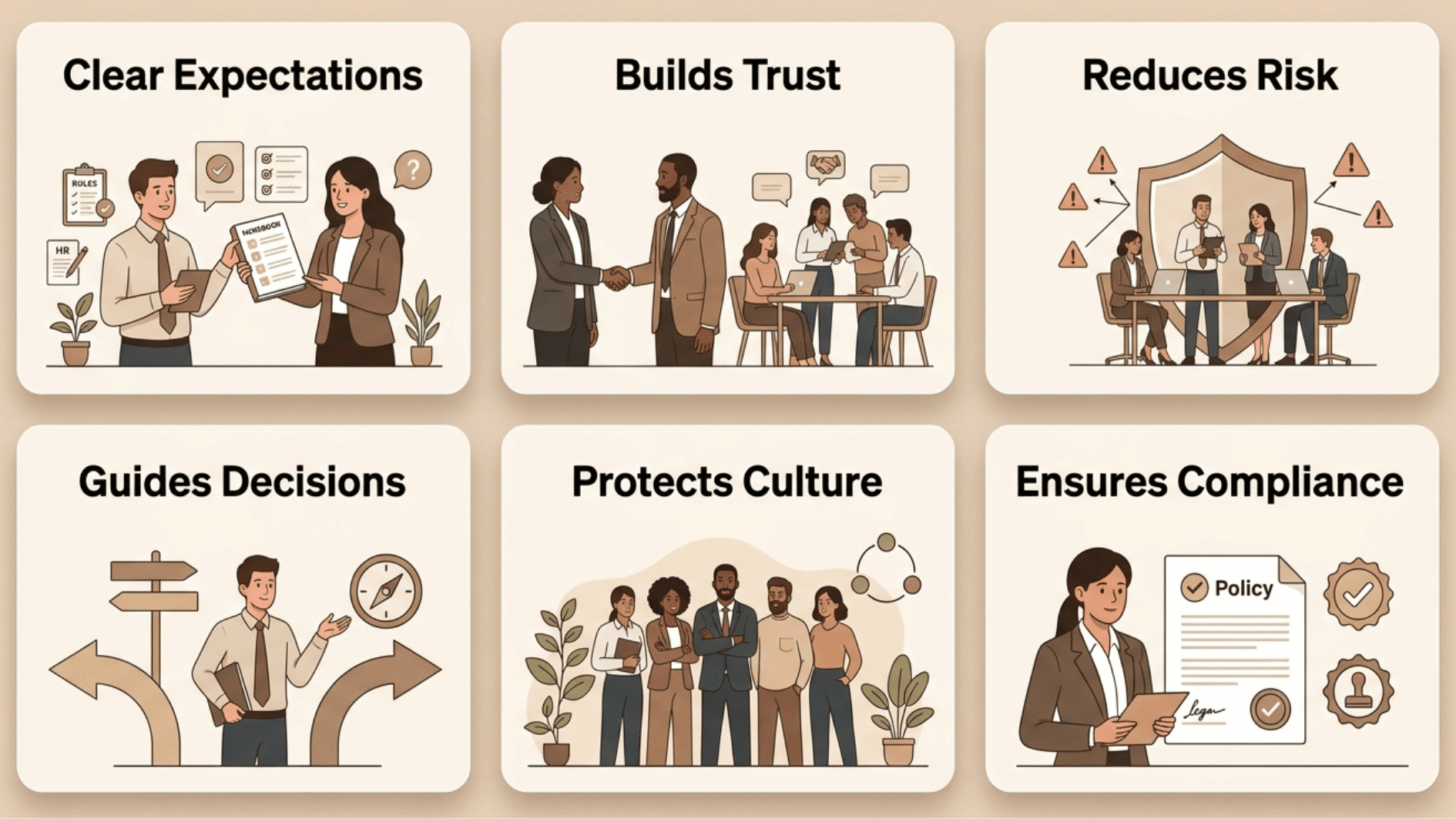
Beyond setting rules, a code of conduct provides a shared framework that helps employees work together with respect, fairness, and responsibility.
- Sets Expectations: Clearly explains the standards of behavior employees are expected to follow every day.
- Builds Trust: Promotes honesty, respect, and accountability across the workplace.
- Reduces Risk: Helps prevent misconduct, legal issues, and workplace conflicts.
- Supports Decisions: Gives employees guidance when facing ethical or difficult situations.
- Protects Culture: Reinforces company values and encourages a respectful work environment.
- Promotes Compliance: Helps employees understand and follow company policies and applicable laws.
At its core, it is one of the most practical expressions of what employee relations in the workplace is designed to protect: the day-to-day trust and accountability that keep teams functioning well.
Code of Conduct Examples to Learn From
The best code of conduct examples go beyond listing rules. The examples below each highlight a different strength that you can adapt when creating or updating your own code of conduct.
1. Google: Write in Plain Language
Google’s code of conduct is known for using straightforward, conversational language instead of dense legal terminology.
Employees can quickly understand what is expected of them because the document focuses on practical guidance rather than complicated policies.
Key lesson: Write for your employees, not your lawyers. Clear language makes a code easier to read, remember, and follow.
2. PepsiCo: Integrity and Compliance
PepsiCo’s code of conduct emphasizes integrity, respect, compliance with laws, and responsible business practices. It also encourages employees to report concerns and make ethical decisions in their daily work.
It encourages employees to make ethical decisions, avoid conflicts of interest, protect company assets, and report concerns through the appropriate channels.
Key lesson: Build a culture where ethical decisions and legal compliance are part of everyday work.
3. Visa: Use Real-Life Scenarios
Visa supports its code of conduct with realistic workplace situations that demonstrate how policies apply in everyday business.
Instead of simply stating the rules, the company explains how employees should respond in common scenarios involving gifts, conflicts of interest, or customer information.
Key lesson: Real examples help employees understand how to apply policies in practice.
4. Starbucks: Safe Reporting Channels
Starbucks places strong emphasis on reporting concerns without fear of retaliation, ensuring employees feel safe to speak up.
Its code explains where employees can report misconduct, outlines confidential reporting options, and reassures employees that raising concerns in good faith will not lead to punishment.
When employees feel unsafe raising concerns, those concerns don’t disappear; they resurface as disengagement or conflict. Understanding how to handle a disgruntled employee shows what happens when reporting channels are inadequate or absent.
Key lesson: Employees are more likely to report problems when they know the reporting process is safe and confidential.
5. L’Oréal: Make It Accessible
L’Oréal presents its code in an engaging format that includes illustrations, practical examples, and translations into multiple languages.
This makes the document easier for employees across different countries and roles to understand and apply consistently.
Key lesson: A visually engaging and accessible code increases employee participation and comprehension.
6. Best Buy: Keep It Values Driven
Best Buy connects every workplace rule back to the company’s core values, making expectations easier for employees to understand.
Instead of focusing only on prohibited behavior, the code explains why ethical conduct supports customers, coworkers, and the company’s mission.
Key lesson: Values provide context, helping employees understand the purpose behind workplace expectations.
7. Contributor Covenant: Clear Community Standards
Unlike corporate codes, the Contributor Covenant was created for open-source projects and online communities, promoting respectful and inclusive participation.
It clearly defines respectful behavior, unacceptable conduct, reporting procedures, and possible consequences for violations.
Key lesson: Every code should clearly explain acceptable behavior and what happens when standards are not met.
8. Microsoft: Respect and Inclusion
Microsoft’s code emphasizes creating an inclusive workplace where employees treat one another with dignity and respect.
It addresses discrimination, harassment, diversity, accessibility, and equal opportunity throughout the organization.
Key lesson: A strong code of conduct should promote an environment where everyone feels respected and included.
9. Apple: Protect Confidential Information
Apple places significant importance on protecting confidential business information, customer privacy, and intellectual property.
Employees are expected to safeguard sensitive information both inside and outside the workplace, at all times and locations.
Key lesson: Clearly explain what information is confidential and how employees should protect it.
10. Netflix: Freedom With Responsibility
Netflix is known for giving employees considerable autonomy while expecting them to exercise sound judgment.
Rather than relying on excessive rules, the company encourages employees to make responsible decisions that support the business.
Key lesson: Trust employees while clearly defining the responsibilities that come with greater freedom.
11. Intel: Speaking Up Without Fear
Intel encourages employees to report ethical concerns, legal violations, or misconduct through multiple reporting channels.
The company also explains its commitment to protecting whistleblowers from retaliation, encouraging employees to report concerns confidently.
Key lesson: Employees need confidence that concerns will be taken seriously and handled fairly.
12. IKEA: Sustainability and Ethics
IKEA integrates environmental responsibility and ethical sourcing into its code of conduct.
Expectations extend beyond employees to suppliers and business partners, encouraging responsible practices throughout the supply chain.
Key lesson: Include sustainability commitments if they reflect your organization’s mission and operations.
13. Adidas: Human Rights Commitment
Adidas emphasizes respect for internationally recognized human rights, fair labor practices, and responsible sourcing.
The company’s code outlines expectations for employees while also establishing standards for suppliers and contractors.
Key lesson: A code of conduct can demonstrate a company’s commitment to ethical business practices beyond the workplace.
14. Patagonia: Environmental Responsibility
Patagonia’s code reflects its long-standing commitment to environmental protection and social responsibility.
Employees are encouraged to consider the environmental impact of business decisions and support sustainable practices.
Key lesson: Align your code with the values that define your organization’s identity.
15. Deloitte: Professional Integrity
As a professional services firm, Deloitte focuses heavily on honesty, independence, confidentiality, and compliance with professional standards.
Employees are expected to act ethically even when faced with difficult business situations, protecting client trust and professional standards.
Key lesson: Integrity should guide every decision, especially in industries built on trust and professional judgment.
16. Marriott International: Hospitality Standards
Marriott’s code emphasizes treating guests, coworkers, and business partners with courtesy, fairness, and respect.
It also covers workplace safety, anti-harassment policies, and compliance with laws affecting the hospitality industry.
Key lesson: Tailor your code to the unique responsibilities of your industry while maintaining universal ethical standards.
17. Costco: Ethical Business Practices
Costco’s code highlights honesty, customer trust, fair dealing, and compliance with laws, supporting ethical decisions across the organization.
Employees are encouraged to maintain ethical relationships with customers, suppliers, and fellow team members while protecting the company’s reputation.
Key lesson: A strong ethical culture begins with consistent expectations for every business relationship.
18. HubSpot: Culture-Focused Expectations
HubSpot’s culture code complements its employee conduct policies by emphasizing transparency, continuous learning, confidentiality, and accountability.
Rather than relying solely on rules, it encourages behaviors that strengthen company culture and everyday workplace relationships.
Key lesson: Behavioral expectations should reinforce the culture you want employees to build every day.
19. Salesforce: Trust and Accountability
Salesforce builds its code of conduct around trust, ethical leadership, and accountability. Its code reinforces that every employee is responsible for maintaining the company’s reputation.
The company encourages employees to act honestly, protect customer data, comply with laws, and speak up when they see unethical behavior.
Key lesson: Build accountability into your code by making every employee responsible for acting ethically and reporting concerns.
What Should a Code Include?
A strong code of conduct should cover the key topics employees need to understand. Focus on clear, practical guidance instead of trying to address every possible situation.
- Company Values: Explain the principles that guide decisions and workplace behavior.
- Behavior Standards: Define how employees should act toward coworkers, customers, and partners.
- Respect and Inclusion: Set expectations for a workplace free from discrimination and harassment.
- Conflict Rules: Explain how to handle personal interests that could affect work decisions.
- Gifts Policy: Clarify what gifts, favors, or hospitality are acceptable.
- Social Media: Provide guidance on discussing work or the company online.
- Reporting Process: Explain how employees can safely report concerns or misconduct.
- Disciplinary Actions: Describe the consequences for violating the code of conduct.
Code of Conduct vs. Code of Ethics
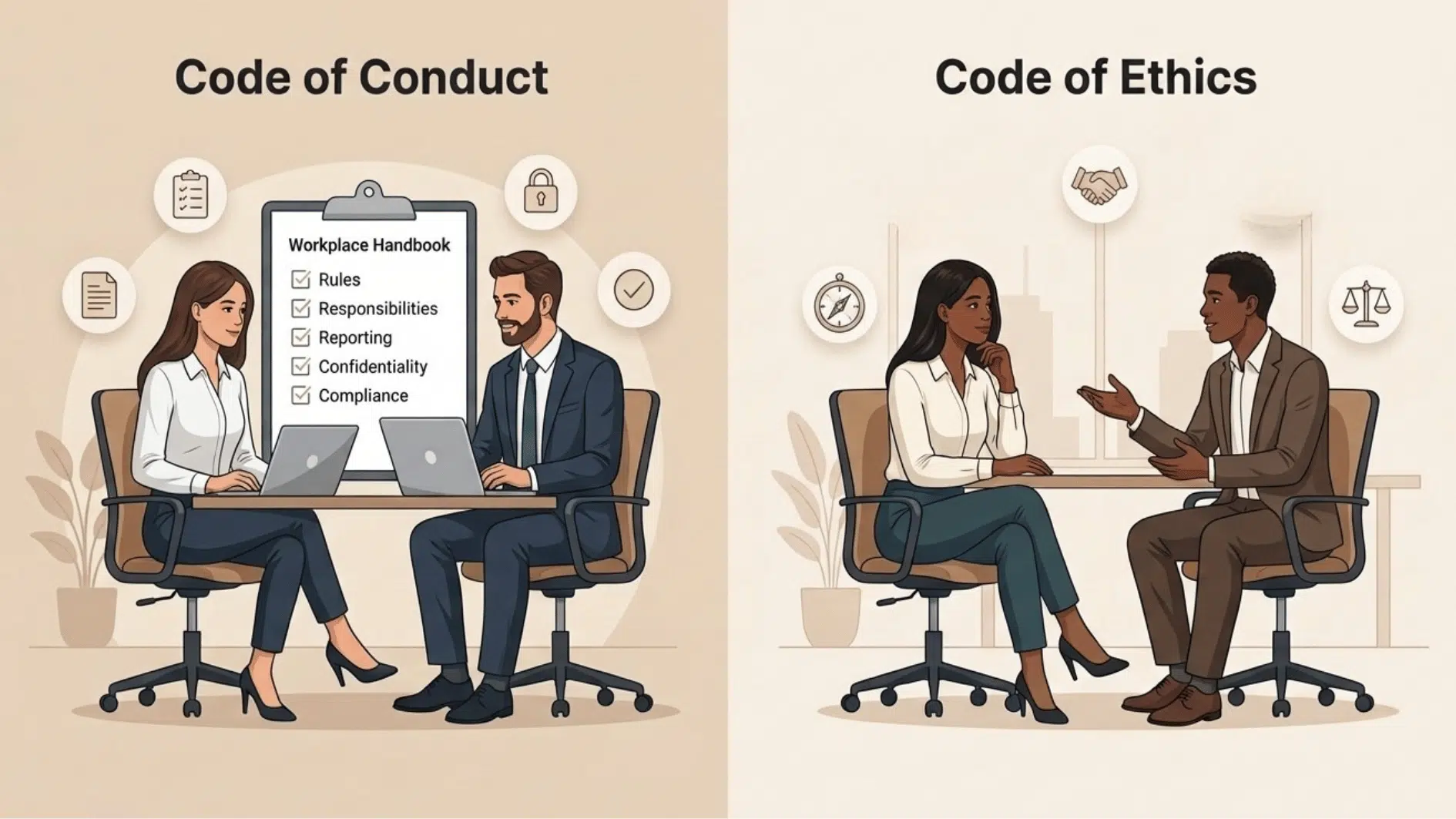
While both documents promote ethical behavior, they have different roles. A code of ethics focuses on guiding principles, while a code of conduct explains the specific rules employees are expected to follow.
| Feature | Code of Conduct | Code of Ethics |
|---|---|---|
| Purpose | Sets clear rules for workplace behavior. | Defines the organization’s values and ethical principles. |
| Focus | Explains what employees should and should not do. | Guides employees when making ethical decisions. |
| Content | Covers behavior, reporting, confidentiality, and compliance. | Covers honesty, integrity, fairness, and respect. |
| Approach | Rule-based with specific expectations. | Principle-based with broader guidance. |
| Example | “Report conflicts of interest immediately.” | “Act with honesty and integrity in every decision.” |
How is a Code Enforced?
A code of conduct is only effective when employees understand it, and the organization applies it consistently.
- Employee Training: Train employees on the code so they understand the expected standards of behavior.
- Policy Acknowledgment: Ask employees to review and acknowledge the code after joining the organization.
- Issue Reporting: Provide clear and confidential ways for employees to report concerns or misconduct.
- Fair Investigations: Investigate reported violations promptly, consistently, and without bias.
- Appropriate Discipline: Apply disciplinary actions fairly based on the severity of the violation.
- Regular Reviews: Update the code periodically to reflect legal, business, and workplace changes.
Can Small Businesses Use the Same Code?
Yes, but they should not copy it word for word. Large companies often have detailed codes because they have thousands of employees, multiple offices, and complex legal requirements.
A small business usually needs a shorter and simpler version. The key is to include the same basic topics, such as company values, workplace behavior, confidentiality, reporting concerns, and disciplinary actions.
Remove anything that does not apply to your business and use clear language that employees can easily understand.
A code of conduct should match the size, industry, and daily operations of your organization. A simple, practical document is often more effective than a long policy that employees rarely read.
Common Code of Conduct Mistakes
Avoid these common mistakes to make your code clear, practical, and easy to follow.
- Copied Policies: Don’t copy another company’s code without adapting it to your organization and workplace.
- Complex Language: Use plain language instead of legal jargon so employees can understand the expectations.
- Vague Rules: Clearly explain acceptable and unacceptable behavior rather than using broad statements.
- Missing Reporting: Include simple, confidential ways for employees to report concerns or misconduct.
- Outdated Content: Review and update the code regularly to reflect new laws and workplace changes.
- Limited Coverage: Make sure the code applies to remote workers, contractors, and global teams where relevant.
Conclusion
The best code of conduct examples show that an effective policy is clear, practical, and aligned with an organization’s values.
If you’re writing a code for a global company, a nonprofit, or a small business, focus on simple language, realistic expectations, and consistent enforcement.
Use the examples and tips in this guide to create a code that employees can understand, follow, and trust.
Which code of conduct example did you find most useful, and what would you include in your own? Share your thoughts in the comments.
Frequently Asked Questions
Is a Code of Conduct Legally Required?
In most cases, no, but some industries and public companies must have one. Even when it is optional, a written code helps defend a business in harassment or fraud disputes.
Who Writes a Code of Conduct?
Usually HR or leaders draft it, often with legal review. In small companies, the owner writes it. Input from regular staff makes the final rules more realistic.
How Long Should a Code of Conduct Be?
Length depends on company size. A small business can use one or two pages. A global firm may need 20 or more. Shorter and clearer almost always beats long and dense.