

People have different needs when it comes to work. Some people want a steady role, while others prefer shorter projects or the chance to try something new.
For these workers, a contract job is often the first option.
Knowing the basics first can help you decide if it suits you. In this blog, you will learn how the process works, the main types, and how it compares with other work setups. You will also find tax basics and what to check before you sign.
What is a Contract Job?
A contract job is work done for a set period or a single project under a written agreement.
The agreement outlines your pay, duties, and end date. Once the term or project is finished, the job usually ends too.
Companies like this setup because they get the skills they need without making a permanent hire.
The word “contract” describes how long the job lasts and what it requires; it doesn’t indicate a single tax status.
Types of Contract Work
Contract roles come in several forms. The type you choose decides who pays you, how long you stay, and how your taxes are handled.
-
1099 Independent Contractor: You invoice the client directly and handle your own taxes.
-
W-2 Through a Staffing Agency: The agency pays you and withholds your taxes while you work for its client.
-
Short-Term Project Roles: Hired for one clear deliverable, such as a website or campaign, and the work ends when it is done.
-
Part-Time or Flexible Contracts: You work fewer than full-time hours, often for a startup or small business that needs your skills but not a full-time hire.
-
Contract-To-Hire: Employees start on a trial basis, so both sides can test the fit before a permanent offer.
In July 2023, the Bureau of Labor Statistics counted 862,000 workers provided by contract firms and 945,000 temp agency workers, against 11.9 million independent contractors.
How Do Contract Jobs Work?
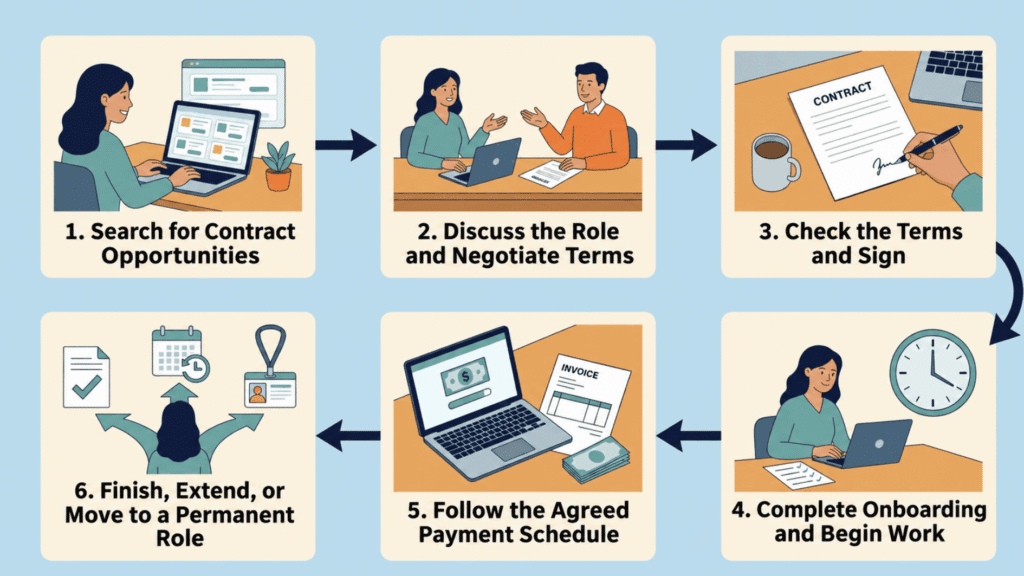
Whatever contract type you choose, the process follows a similar path. Here is how it runs, from the first listing to the final day.
1. Search for Contract Opportunities
Contract roles reach workers in a few ways. A company may post the opening on a job board, or a recruiter or staffing agency may find you and send it your way.
Some roles come through your own network.
The listing usually names the project, the length, and the pay range. Read it closely, because these details show whether the role fits your skills, schedule, and income needs.
2. Discuss the Role and Negotiate Terms
The hiring process looks a lot like it does for any job. You may speak with a recruiter first, then the hiring manager.
Expect questions about your past projects and how fast you can start. If the company likes your answers, it sends an offer with the pay rate, start date, and length. Ask questions now, since this is the best time to negotiate.
3. Check the Terms and Sign
Once you agree on terms, you sign a written contract. It spells out the scope of work, your rate, and the start and end dates. It may also cover notice for ending early and who owns the work you create.
Tip to keep in mind: Read every line before you sign. If something is unclear, ask for it in writing, or have a lawyer review it.
4. Complete Onboarding and Begin Work
After onboarding, you begin the work. Your day-to-day depends on your status.
Agency workers on a W-2 often work more closely under the client’s direction. Either way, you log hours on a timesheet or track your work to build an invoice, so keep clear records from day one.
5. Follow the Agreed Payment Schedule
Pay follows the schedule written in your contract. Agency workers are paid through the agency’s payroll, with taxes already withheld.
Independent contractors usually send an invoice and wait for payment, which may arrive on a set date or after a milestone is met.
Some roles pay by the hour or day, while others pay a flat project fee. Know your pay terms early so you can plan your budget.
6. Finish, Extend, or Move to a Permanent Role
When the end date arrives, three things can happen. The company may let the contract end, extend it, or offer a permanent role.
Extensions are common, so ask early about the possibility. Start talking about next steps a few weeks before the end date so you are not left guessing.
Who is Best Suited to Contract Work?
Contract jobs suit people who value choice over routine. If you want to pick your projects and plan breaks between them, the setup gives you that control.
It also works well for professionals who want to build new skills fast, since each assignment adds experience and contacts.
Those who already have health coverage through a partner or another source find the trade easier. Self-employed 1099 workers can also deduct business expenses, which lowers their taxable income.
Contract work is a poor fit for people who need a steady monthly paycheck. It also does not suit anyone who dislikes handling invoices, taxes, and the search for the next role.
What Happens If You Quit a Contract Job Early?
The outcome depends on what your contract says. Many agreements include a notice clause, which tells you how many days of warning you must give before leaving.
An independent contractor who walks away without finishing the work may be held liable, so the client could withhold payment or seek damages.
Agency workers on a W-2 should check the staffing firm’s terms, since leaving early may affect future placements.
Quitting can also hurt your reputation and cost you a reference. If you must leave, give written notice, offer to hand off your tasks, and finish what you can.
For high-value agreements, ask a lawyer to review your options.
Contract vs. Full-Time vs. Freelance vs. Part-Time
|
Factor |
Contract |
Full-Time |
Freelance |
Part-Time |
|---|---|---|---|---|
|
Length |
Fixed term or project |
Ongoing, no set end date |
Project by project |
Ongoing, no set end date |
|
Who sets the schedule |
Client or contract terms |
Employer, usually about 40 hours a week |
You set the schedule |
Employer, fewer hours a week |
|
Pay style |
Hourly, daily, or project rate |
Salary or hourly wage |
Per project or per hour |
Hourly or salary, based on hours worked |
|
Benefits |
Often none for 1099 workers; some agency W-2 roles offer them |
Usually health coverage, paid time off, retirement plan |
None, you arrange your own |
Depends on the employer |
|
Taxes |
W-2: withheld by agency. 1099: you pay your own |
W-2: withheld by employer |
1099: you pay your own |
W-2: withheld by employer |
|
Job security |
Low, ends at the contract date |
Highest |
Low, depends on finding clients |
Moderate |
Popular Fields for Contract Jobs in Today’s Market
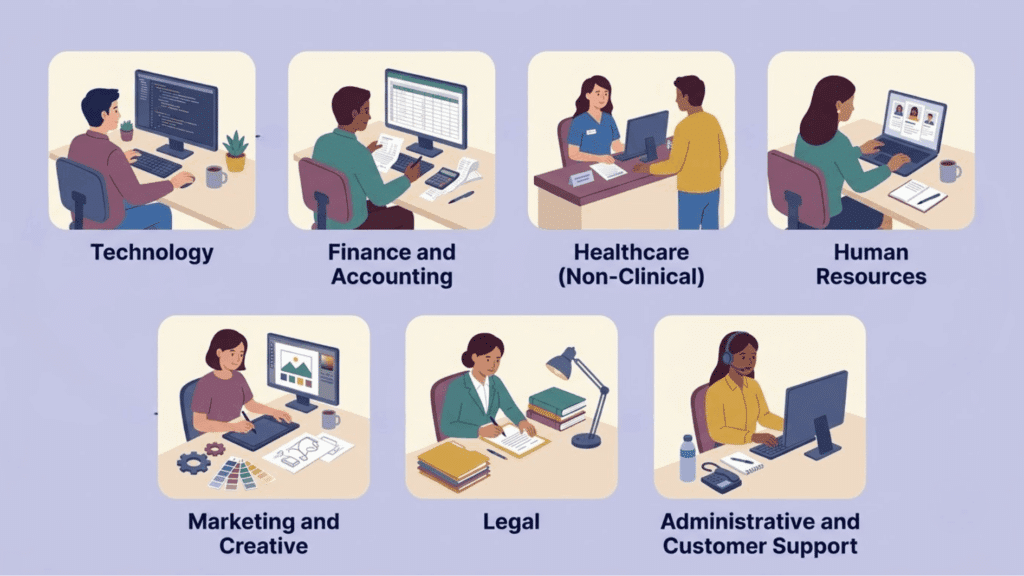
Employers in many fields bring in contract talent to fill skill gaps and finish projects.
-
Technology: Software engineers, data engineers, full stack developers, and AI/ML engineers are hired to build and launch products on a deadline.
-
Finance and Accounting: Staff accountants, business analysts, accounting specialists, and AP/AR specialists help during audits, busy seasons, and system changes.
-
Healthcare (non-Clinical): Patient access specialists and other admin roles keep offices running. Robert Half found 59,700 administrative healthcare job postings in 2025, up 15% from 2024.
-
Human Resources: Recruiters and HR coordinators fill short-term hiring needs. Robert Half reports that 50% of HR leaders plan to increase contract or temporary hiring in the second half of 2026.
-
Marketing and Creative: Designers, writers, and campaign managers are brought in for launches and one-time projects.
-
Legal: Firms and companies use contract professionals for document review, compliance work, and caseload surges.
-
Administrative and Customer Support: Administrative assistants and customer service specialists cover peak periods and staff shortages.
The Bottom Line
A contract job offers a set term, agreed pay, and more choice over which projects you take, but with less security and fewer benefits.
It can run through a staffing agency on a W-2 or on your own as a 1099 contractor, and each path changes how you are paid and taxed.
Contract work suits people who value choice and fast skill growth, but not those who need a steady paycheck. Before you sign, read the pay terms, end date, tax setup, and exit rules.
Frequently Asked Questions
Will Contract Work Look Bad on Your Resume?
Usually not. List each role with the client, dates, and results, and employers will see skills and variety, not gaps. A short note such as “contract” next to the title keeps it clear.
What is the Usual Length of a Contract Role?
Check the end date and renewal terms in your agreement.
Should You Give Up a Full-Time Job for Contract Work?
It depends on your finances and goals. It can make sense if you have savings, health coverage, and in-demand skills. If you need a steady paycheck, think twice.