

A team can have skilled people and clear goals, yet projects still stall because decisions get delayed and employees hesitate to raise problems. Often, the problem isn’t skill or strategy. It’s culture.
This guide covers What Organizational Culture is, Its Characteristics, how to build it, its types, and its impact.
What Is Organizational Culture, and What Shapes It?
Organizational culture is the shared beliefs, values, and unwritten rules that guide how people work together.
It shows up in what gets praised, what gets ignored, and what gets quietly corrected.
No single person creates it. Founders set the first habits, and early leaders repeat them until they stick.
Hiring brings in people who either fit those habits or stretch them. Onboarding teaches newcomers what is really expected, beyond the handbook. The industry adds its own pressures, like heavy regulation or tight deadlines.
The country’s broader culture also plays a part. Past wins and failures also shape how people act.
Characteristics of Organizational Culture and Why It Matters
Culture is easier to spot once you know its main traits and what it changes at work:
-
Shared by the group: It lives in how teams act together, not in any one person’s habits.
-
Visible and hidden layers: You can see how meetings run and how work is organized, but the deeper assumptions behind them usually go unspoken.
-
Leadership tone: How leaders communicate and make decisions sets the standard everyone else follows.
-
Guides judgment calls: It steps in where written policies stop, shaping choices no rule covers.
-
Sets the pace of work: It affects how fast decisions move and how early problems come to light.
-
Drives engagement: Employees with a strong connection to their company’s culture are 4.3 times as likely to be engaged, based on a Gallup analysis.
Culture matters most when no one is giving instructions, because it guides the everyday judgment calls that policies cannot cover. As companies grow, they need to make culture explicit.
It is not a substitute for sound strategy, fair pay, or effective management, but it influences how people carry them out.
Types of Organizational Culture
The most widely used model is the Competing Values Framework by Kim Cameron and Robert Quinn, which categorizes cultures into four types. The framework identifies four broad types:
|
Type |
Focus |
Leader style |
Often found in |
|---|---|---|---|
|
Clan |
Teamwork and loyalty |
Mentor |
People-first organizations |
|
Adhocracy |
Innovation and risk-taking |
Innovator |
Software and consulting |
|
Market |
Results and competition |
Driver |
Sales-led companies |
|
Hierarchy |
Rules and stability |
Coordinator |
Government agencies |
The vast majority of organizations blend elements of a number of the types. A company might have a hierarchy in place for its safety procedures, while at the same time being very much an adhocracy in terms of product development.
These categories work best for understanding workplace patterns rather than as labels for every team or individual.
Consider which behaviors are the most prevalent and whether they actually serve the organization’s aims.
How to Build a Strong Organizational Culture
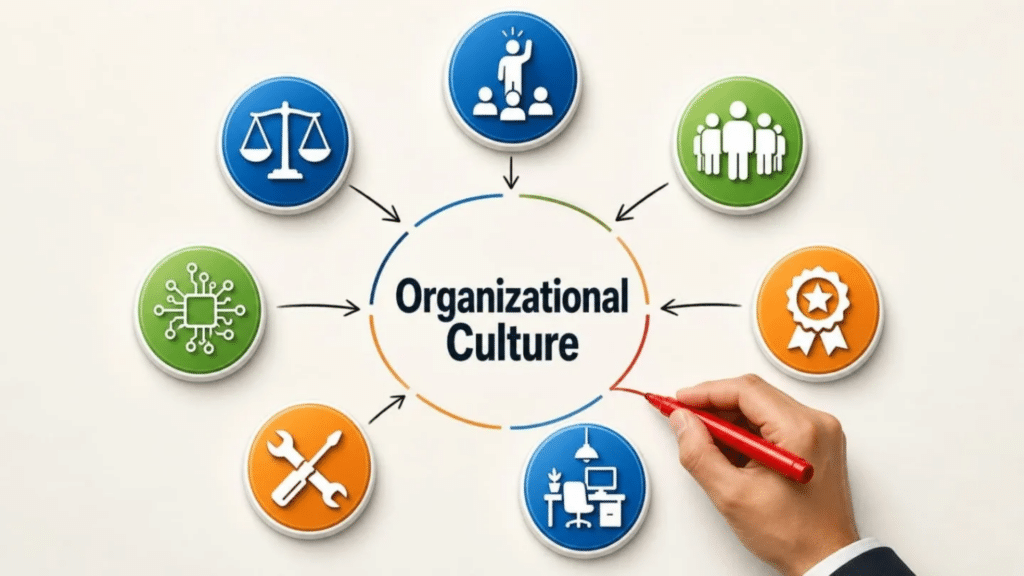
Set expectations early, because real culture change is usually measured in years, not months.
You can set the organization’s direction, but employees build the culture through their day-to-day interactions and decisions.
1. Define the Culture You Want
Pick a small set of values aligned with the organization’s purpose and priorities.
A short list is easier to remember and use. Make each value specific enough to drive behavior. Rather than “be collaborative,” say “share information early and involve affected teams in decisions.” Write down what each value does not mean, too.
Then test it with a real scenario. If two managers would act differently, rewrite it.
2. Model the Expected Behaviors
Values only feel real when leaders live them first.
If you want open communication, hold regular Q&A sessions and answer the hard questions. Explain the reasons behind big decisions. When someone disagrees, thank them and respond to the point, not the person.
Admit your own mistakes openly. Small, repeated actions matter more than one big speech.
People quickly notice when leaders break the rules they set.
3. Equip Managers to Lead It
Managers carry culture into every team meeting and one-on-one.
Give them a short guide that explains each value with real examples.
Train them to coach, give useful feedback, and handle conflict calmly. Hold regular check-ins where managers share what is working and what isn’t. Add culture goals to their own performance reviews each year.
Support struggling managers early, before their teams start feeling the strain.
4. Align Workplace Systems
Every system sends a message about what the organization truly values. Start with promotions. If results count but teamwork doesn’t, people will chase results alone. Add your values to performance reviews.
Check bonus rules, budget approvals, and meeting norms, too. Remove policies that punish the behavior you want.
A slow approval chain, for example, can quietly undo months of talk about speed and ownership.
5. Make It Safe to Give Feedback
Offer employees clear routes through which they can raise issues and suggestions.
Mix open forums with anonymous options, since some people won’t speak up in a group.
Managers should listen without rushing to defend a decision. Then explain what can or cannot change, and why. Thank people who raise hard issues. Never punish honest input, even when it stings. One bad reaction can silence a team.
6. Turn Feedback into Visible Action
Pick two or three improvements, not twenty. Give each one an owner and a deadline.
For example, if staff report that project decisions are unclear, name the decision maker and how decisions will be announced. Post progress where everyone can see it. Mark each fix as done, in progress, or dropped, with a reason.
Visible follow-through proves the feedback mattered and encourages people to speak up again.
7. Review Progress Regularly
Culture will change as the teams and the business needs change.
Set a fixed review rhythm and stick to it. Ask the same core questions each time so results are easy to compare.
Track one or two behaviors per value, such as how often teams share updates early. Celebrate clear wins publicly.
Drop changes that aren’t working and try something else. Consistent, practical actions beat sporadic culture campaigns.
What Culture Looks Like Day to Day
Culture is very hard to define, as it’s made up of both the visible and the invisible. Look for patterns in areas such as:
-
Unwritten expectations about how people behave, from how meetings run to how a team handles deadlines.
-
The tone leaders set through how they communicate, make decisions, and support their teams.
-
Some organizations prefer a very close collaborative approach; others give people much more freedom.
-
Staff understand how responsibilities are allocated and how commitments are tracked.
-
A culture may encourage experimentation and flexibility, or it may value stability and the established way of doing things.
-
Team traditions, regular meetings, and the way we recognize each other all contribute to a sense of identity and belonging.
Healthy Vs Unhealthy Organizational Culture
A healthy culture doesn’t mean everyone agrees or that every day is smooth sailing.
It means people can work through differences in a respectful way, raise issues, and understand how their contribution fits in with the wider aims of the organization.
|
Healthy culture |
Unhealthy culture |
|---|---|
|
Employees can ask questions and raise concerns |
People stay silent because they fear blame |
|
Leaders act consistently with stated values |
Rules change depending on who is involved |
|
Feedback is specific and respectful |
Feedback is avoided, personal, or only critical |
|
Mistakes are reviewed to find lessons |
Mistakes are hidden or used to shame people |
|
Expectations and responsibilities are clear |
Priorities are confusing or constantly shifting |
|
Recognition reflects meaningful contributions |
Credit is inconsistent or based on favoritism |
A culture can have both healthy and unhealthy patterns.
For instance, a team could be great at working together but struggle to make decisions. Identifying the specific behaviors makes it far easier to deal with the problem without having to label the whole organization.
Strong doesn’t always mean healthy. The stronger a culture, the harder it is to change.
How to Measure Organizational Culture
You cannot understand organizational culture from a single survey score. Use multiple sources to identify patterns, then compare what staff say with what actually happens in the workplace.
Practical ways to assess culture include:
-
Skip the single score: One survey number can’t explain a culture.
-
Watch for climate: Surveys often capture how people feel right now, not the deeper beliefs underneath.
-
Run employee surveys: Ask about trust, communication, belonging, recognition, workload, and confidence in leadership.
-
Keep questions neutral: Use straightforward wording that doesn’t steer people toward an answer.
-
Hold listening sessions: Small groups or confidential interviews add the context behind survey results.
-
Review workplace data: Check retention, absenteeism, internal promotions, referrals, and training participation.
-
Observe daily practice: Notice how meetings run, who gets a say, and how managers handle problems.
-
Compare values with reality: Check whether policies and leaders’ behavior match the culture the organization wants.
-
Close the loop: Share what you learned and what happens next, because feedback with no action damages trust.
Share what you’ve learned with the staff and explain what will happen next.
Collecting feedback without communicating the results and taking no action can actually damage trust.
Negative Impact of Organizational Culture and How to Handle It
Culture can work against a company just as easily as it can help. The damage usually builds slowly, so it’s easy to miss.
-
Groupthink: when no one questions a popular idea.
-
Us-versus-them rivalry between departments.
-
Bad behavior is excused because the person hits targets.
-
Ethical shortcuts that quietly become the norm.
-
Contractors and new hires left out of decision-making.
To handle it, start with one pattern, not all of them. Find out what rewards it. Then fix it at the source:
-
Hold top performers to the same conduct rules.
-
Assign someone to challenge big decisions.
-
Mix people across teams on shared projects.
End Note!
Knowing the definition is the easy part.
The more useful question is whether the way your organization works helps people do their jobs well and supports its goals.
Use employee feedback and everyday workplace experiences to see what is working and what isn’t.
Then choose a few practical changes, follow through, and check whether they make a difference.
Frequently Asked Questions (FAQs)
What is the Difference Between Organizational Culture and Workplace Culture?
Organizational culture often refers to the culture across the whole organization, while workplace culture may also refer to the experience within a particular team or location.
What are Organizational Subcultures?
Subcultures are smaller groups within an organization that share their own norms. Some reinforce the dominant culture, while others add separate values that do not conflict with it.”
Who is Responsible for Organizational Culture?
Leaders influence culture through their decisions and behavior, but everyone contributes to it through daily interactions.
How Often Should an Organization Measure Its Culture?
Use regular feedback methods, such as brief surveys or team discussions, and check culture after major changes. The key is to respond to what you learn.