

A paycheck can look identical every week and still hide a separate payment inside it.
From night shift premiums to federal night pay rules under 5 CFR 550.121, a few key factors decide who qualifies, how much gets added, and whether the law requires it at all.
This blog will state what differential pay is, its types, how it’s calculated, and the federal provisions that apply to certain workers.
What is Differential Pay?
Differential pay is extra compensation added to your regular wage for working hours or conditions that fall outside the norm, like night shifts, holidays, hazardous duty, or using a special skill on the job.
It’s not a raise or a change to your base salary.
It’s a separate add-on, paid either as a flat dollar amount per hour or as a percentage of your base pay, set by your employer, a union contract, or in some cases, federal pay rules.
Shift differential is one type of differential pay, and the two terms aren’t interchangeable, since differential pay is the broader category that covers shift, hazard, geographic, and skill-based pay.
What are the Types of Differential Pay?
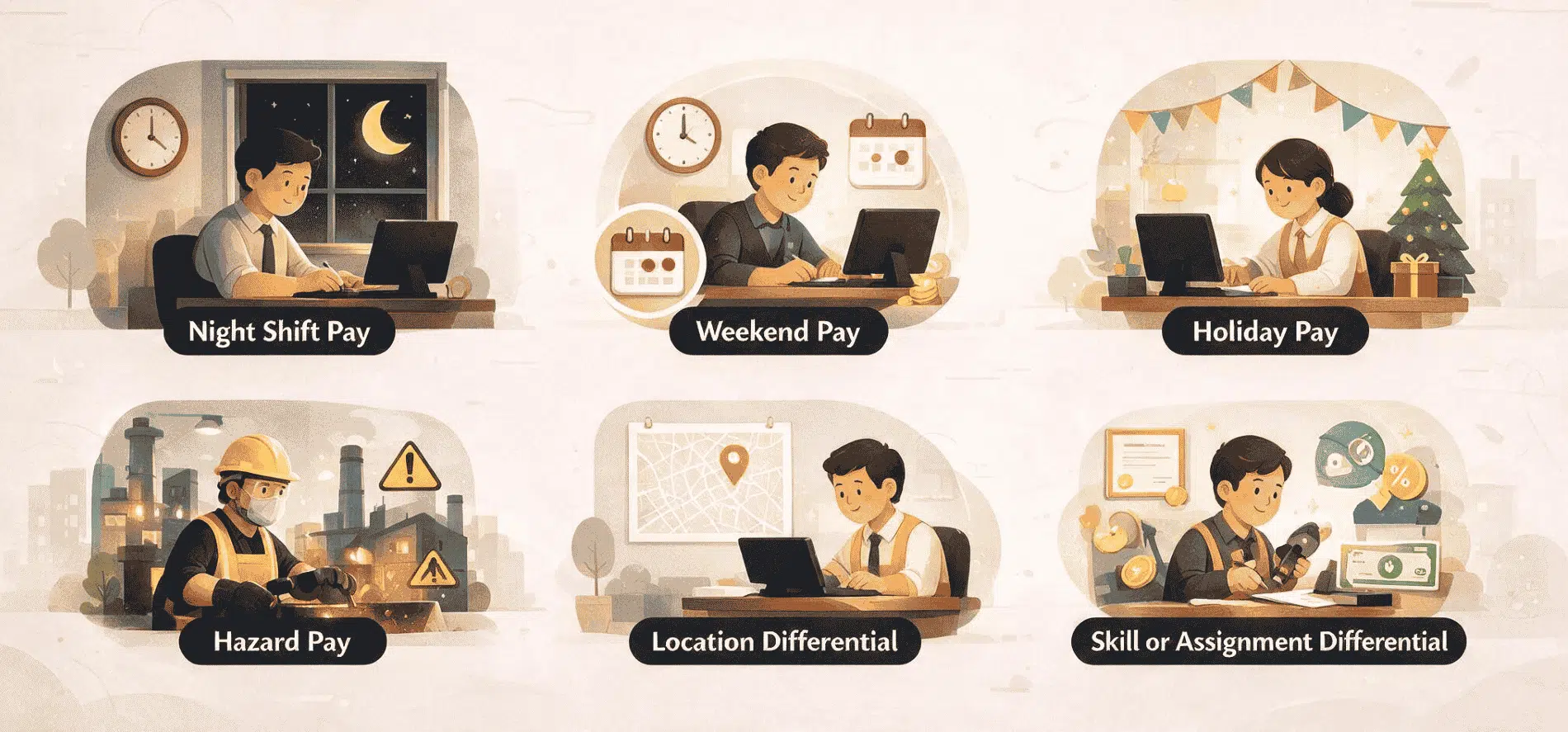
Each differential pay type compensates for a different kind of burden, whether that burden is inconvenient hours, physical risk, constant availability, location, or specialized skill.
1. Shift Differential Pay
Shift differential is additional pay given to employees who work outside standard daytime business hours, such as evenings, nights, or overnight shifts.
Employers add extra compensation to an employee’s regular base pay for working less desirable or nonstandard hours. It is the most widely used form of differential pay.
It appears most often in industries that operate around the clock, including healthcare, manufacturing, and customer support.
Employers typically structure this pay as a percentage of the base wage, often between 5 and 15 percent, or as a flat hourly addition, commonly ranging from $2 to $7 per hour. This is a common range, which can vary.
2. Hazard Pay Differential Pay
Hazard pay differential compensates employees for performing work that involves physical risk or exposure to unsafe conditions.
This can include handling hazardous materials, working in extreme temperatures, or performing duties in environments with elevated safety risks.
When comparing hazard pay with how shift differential works, the key difference is the reason for the extra compensation.
The amount of hazard pay can vary based on the employer, job duties, working conditions, and severity of the risk involved.
3. On-Call Pay Differential Pay
On-call pay differential provides additional compensation to employees.
It is for those who must remain available to work on short notice, even when they are not actively performing job duties.
This type of differential is common in fields such as information technology, healthcare, and utility services, where continuous coverage is essential.
4. Geographic or Locality Pay Differential
Geographic, or locality, pay differential adjusts an employee’s compensation based on the cost of living or staffing difficulty in a particular location.
This form of differential pay is especially relevant in federal employment. Here, locality pay tables adjust base salaries according to the metropolitan area.
Private employers also use geographic differentials when hiring for roles in high-cost cities or hard-to-staff regions.
5. Skill-Based or Bilingual Pay Differential
Skill-based or bilingual pay differential rewards employees who possess a specific certification, language ability, or specialized competency required for their role.
Common examples include a bilingual customer service representative who communicates with non-English-speaking customers, or a healthcare worker holding a rare or advanced certification.
This differential acknowledges the added value the skill brings to the position, not the hours or location involved.
How Do You Calculate Differential Pay?
Differential pay is calculated using one of two methods: a flat dollar amount added to the base wage, or a percentage increase on the base wage.
Flat Dollar Method
- The employer adds a fixed dollar amount to the base hourly wage for every hour worked on the qualifying shift.
- Example: A warehouse worker has a base rate of 16 dollars per hour. The employer pays a flat 1.25 dollar differential for the overnight shift, from 10 pm to 6 am.
Calculation

Base rate: 16 dollars

Differential rate: 1.25 dollars

Hourly rate with differential: 16 + 1.25 = 17.25 dollars

Gross pay for an 8-hour shift: 17.25 x 8 = 138 dollars
Percentage Method
- The employer calculates the differential as a percentage of the base wage, then adds it on top.
- Example: A hospital scheduler has a base rate of 18 dollars per hour on the day shift. The employer offers a 15 percent differential for the weekend night shift.
Calculation

Base rate: 18 dollars

Differential rate: 18 x 0.15 = 2.70 dollars

Hourly rate with differential: 18 + 2.70 = 20.70 dollars

Gross pay for an 8-hour shift: 20.70 x 8 = 165.60 dollars
Factoring in Overtime
- Under the Fair Labor Standards Act, any differential earned must be folded into the regular rate of pay before overtime is calculated. Overtime is one and a half times that regular rate, not the base wage alone.
- Example: Using the hospital scheduler above, the regular rate for differential hours is 20.70 dollars. In one week, this employee works 45 hours, all on the differential shift.
Calculation

First 40 hours: 40 x 20.70 = 828 dollars

Remaining 5 hours at overtime: 20.70 x 1.5 = 31.05 dollars per hour

Overtime pay: 5 x 31.05 = 155.25 dollars

Total weekly gross pay: 828 + 155.25 = 983.25 dollars
What are the Legal Rules for Differential Pay?
According to the U.S. Department of Labor, the FLSA does not require extra pay for night or weekend work. Such pay is generally based on an agreement, company policy, or union contract.
| Rule | Explanation |
| No federal mandate | The Department of Labor does not require employers to pay shift, hazard, or holiday differential pay under any federal law. |
| Non-discrimination applies | Employers cannot apply differential pay unevenly among employees working the same shift if the reason is discriminatory. |
| FLSA overtime rule | Employers must include differential pay in a non-exempt employee’s regular rate of pay before calculating overtime. |
| State exceptions | Some states require specific types of premium pay, such as reporting-time pay, so employers should check local requirements. |
| Contracts override defaults | If differential pay is written into a union agreement or employment contract, it becomes legally enforceable under that agreement. |
However, when shift differential is paid, it usually must be included in the employee’s regular rate when calculating overtime, as explained in DOL Fact Sheet #54. State laws and rules for government workers may differ.
Who is Eligible for Differential Pay?
Eligibility depends on employer policy, the type of differential, and sometimes a union contract or federal pay schedule.
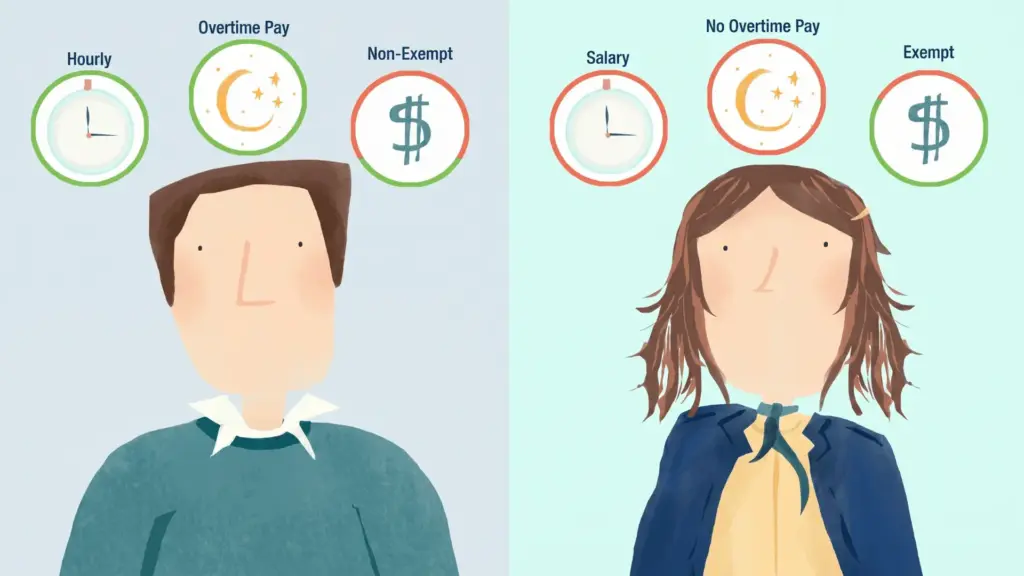
- Non-exempt hourly employees are the most common recipients, since differential pay ties to hours worked under FLSA protections.
- Exempt, salaried employees are usually excluded, as they’re paid a fixed amount regardless of shift.
- Shift assignment matters. Employees qualify for shift differential only if regularly scheduled or assigned to a qualifying shift.
- Union contracts can guarantee eligibility, often spelling out exact terms and removing employer discretion.
- Job classification affects hazard and skill-based pay. These apply only to roles with direct risk exposure or a required certification.
- Temporary or on-call staff may or may not qualify, depending on employer policy.
- Federal employees follow set rules. GS employees qualify for night pay only if regularly scheduled between 6 pm and 6 am; FWS employees qualify based on their majority shift.
Special Federal Wage Provisions for Differential Pay
Federal employees follow specific differential pay rules set by law, not employer choice.
General Schedule (GS) Night Pay
GS employees earn a 10 percent night pay differential for scheduled work between 6 pm and 6 am. It’s based on basic pay plus locality pay and covers only nonovertime hours.
Federal Wage System (FWS) Night Shift Differential
FWS employees earn 7.5 percent for second shift (mostly 3 pm to midnight) and 10 percent for third shift (mostly 11 pm to 8 am). This amount becomes part of basic pay, so it also affects overtime and retirement deductions.
Reservist Differential (USERRA)
Reservists called to active duty get a payment covering the gap between their civilian basic pay and their military pay and allowances. It ends once active duty ends.
How Supreme Court Expanded Differential Pay Eligibility
On April 30, 2025, the Supreme Court broadened eligibility for federal reservist differential pay in Feliciano v. Department of Transportation, 605 U.S. 38 (2025).
In a 5-4 decision, the Court ruled that qualifying active-duty service need only occur during a declared national emergency. Reservists do not have to prove that their specific assignment was connected to that emergency.
This reversed the Federal Circuit’s narrower interpretation and may affect eligibility for past qualifying periods as well.
Private employers aren’t bound by any of these three rules. They apply only to federal civilian and military-connected pay.
The Bottom Line
Understanding what is differential pay comes down to your worker type, any union or company policy, and whether you work for the federal government or a private employer.
Federal employees may get set extra pay for certain shifts.
Private employers do not always have to offer it, so check your handbook or union agreement for terms like shift differential, premium pay, or hazard pay.
The next step for you is to compare your last three pay stubs with the hours you worked. If the extra pay does not match your policy or contract, ask HR about it.
Frequently Asked Questions
How Much is a 10% Pay Differential?
A 10 percent differential adds one-tenth of the base wage. For example, a $20 hourly wage becomes $22 per hour with the differential applied.
What Does Differential Salary Mean?
Differential salary means extra pay added to a base salary for working non-standard hours, hazardous conditions, or specialized duties, rather than a permanent raise to base compensation.
Do You Get Taxed on Shift Differential Pay?
Yes. Shift differential pay is treated as regular taxable income, subject to the same federal, state, and payroll taxes as an employee’s base wages.
What is a Good Shift Differential Pay?
Most shift differentials range from 5 to 15 percent of base pay, or $2 to $7 per hour, depending on industry, shift type, and local labor market demand.