


A salary may look like a fixed deal on paper, but the rules behind overtime tell a different story. In U.S. wage law, pay structure alone doesn’t decide who gets extra compensation for long hours.
The real distinction sits in how a job is classified and what the work actually involves on a daily basis.
This is where many employees and employers misread the system, assuming salary automatically means exemption.
Once the underlying criteria are understood, it becomes clear that overtime eligibility is less about how someone is paid and more about how their role functions within the workplace structure.
The Federal Framework Behind Overtime Pay for Salaried Employees
Overtime eligibility in U.S. wage law is not tied to a single label like “salaried” or “hourly.” Instead, it is built on a two-layer classification system that determines how pay protections apply in practice.
The first layer looks at how the employee is paid, focusing on whether compensation follows a fixed salary structure.
The second examines the nature of the work itself, specifically whether the role involves higher-level responsibility, independent judgment, or operational execution.
These two conditions are not interchangeable. A role moves outside overtime coverage only when both the pay structure and job responsibilities align with exemption standards. If either layer breaks the pattern, overtime protections remain active.
Who Is Typically Considered Exempt from Overtime Pay for Salaried Employees?

Exemption is not decided by job title, but by the level of control a role carries and the kind of judgment it requires daily.
Roles that often fall under exemption include:
- Executive positions responsible for directing teams and making staffing or operational decisions
- Administrative roles that involve shaping business processes or applying independent judgment on key tasks
- Professional roles that rely on specialized education, training, or licensing to perform core duties
Even within these categories, classification is not automatic. The real test is how the job functions in practice, not how it is labeled in an offer letter or internal HR system.
Salary Threshold and Its Role in Classification
A salary level acts as an initial screening point under federal wage rules, helping separate lower-paid roles that are typically non-exempt from higher-paid positions that require deeper review.
Employees earning below the established threshold are generally treated as non-exempt, meaning overtime protections apply regardless of their responsibilities.
Once earnings move above that line, eligibility does not disappear. Instead, the focus shifts to job duties, where factors like authority, independence, and decision-making power determine whether overtime is required.
When Salaried Employees Still Qualify for Overtime
A salary does not automatically remove overtime protection. In many cases, the deciding factor is how the job is structured, not how pay is issued.
Overtime rights often remain in place when:
- The role lacks duties that meet exemption standards under wage law
- Daily work is centered on repetitive or production-style tasks rather than strategic responsibility
- Authority is limited, with little or no control over staffing, budgeting, or final decisions
- The employee has been placed in a salaried category that does not match actual job functions
When these conditions appear, hours worked beyond the standard 40-hour week can still be legally compensable.
State Laws That Change the Outcome
Federal rules set the foundation, but state-level laws can significantly shift how overtime applies in practice.
These differences often show up through:
- Higher minimum salary levels required to qualify for exemption
- Expanded interpretations of what counts as non-exempt work
- Stronger enforcement mechanisms, including penalties for incorrect classification
In situations where both federal and state rules apply, the standard that offers greater protection to the employee is the one that generally takes priority.
How to Calculate Overtime Pay for Salaried Employees?
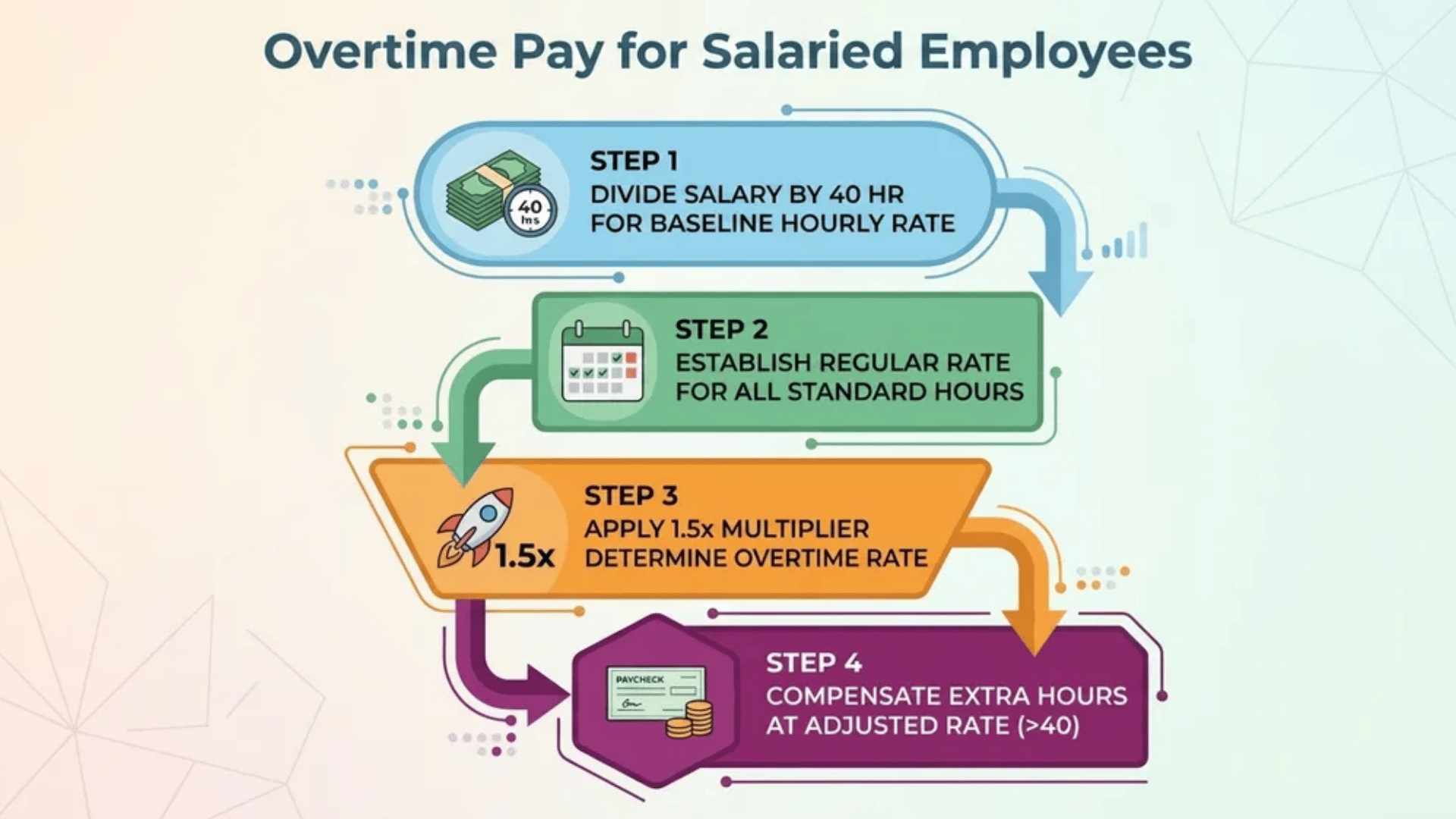
When a salaried employee falls under non-exempt status, overtime is not treated as an exception, it is built into the pay structure once hours cross the weekly limit. The fixed salary is first converted into an hourly equivalent to establish a baseline rate of pay.
Calculation Breakdown
| Step | Method |
|---|---|
| Step 1 | Divide weekly salary by 40-hour standard workweek to set baseline hourly rate |
| Step 2 | Establish the regular rate used for all standard hours worked |
| Step 3 | Apply 1.5× multiplier to determine overtime rate for extra hours |
| Step 4 | Compensate all qualifying hours beyond 40 at the adjusted rate |
Once this conversion is applied, overtime shifts from a salaried expectation into a clearly defined wage adjustment tied directly to additional time worked.
Solved Example
Assume an employee earns an average U.S. salary of $65,000 per year.
- Weekly salary = $65,000 ÷ 52 = $1,250
- Hourly rate = $1,250 ÷ 40 = $31.25 per hour
- Overtime rate = $31.25 × 1.5 = $46.88 per hour
Now assume the employee works 10 overtime hours in a week:
- Overtime pay = 10 × $46.88 = $468.80
- Total weekly pay = $1,250 + $468.80 = $1,718.80
This example shows how overtime shifts compensation upward quickly once hours move beyond the standard 40-hour structure.
Common Misclassification Patterns
Misclassification rarely shows up as an obvious mistake. It usually builds over time through job titles, shifting expectations, and roles that evolve without a formal update in classification.
The result is a mismatch between how a position is labeled and how it actually functions on a day-to-day basis.
- Employees given “manager” titles but limited or no real authority over hiring, firing, or supervision
- Salaried workers absorbed into production-heavy or routine task cycles that mirror hourly roles
- Fixed-pay positions where extended hours become routine rather than occasional
- Role descriptions that remain static while actual responsibilities expand beyond original scope
Over time, these inconsistencies create a clear divide between official designation and practical work reality, which is often where compliance issues begin to surface.
Conclusion
Overtime rules for salaried employees ultimately come down to how a role operates in practice, not how it is labeled on paper.
Once the structure behind classification is understood, the difference between exempt and non-exempt work becomes less about assumptions and more about defined criteria that shape pay rights.
Many disputes start when this line is blurred or overlooked during hiring and role changes. For employees and employers alike, clarity around duties and classification helps prevent gaps in compensation and expectations.
If you’ve experienced confusion around salaried pay and overtime rules, share your situation or thoughts in the comments, real examples often make these rules easier to understand.
Frequently Asked Questions
Is It Legal to Work 60 Hours a Week on Salary?
It is legal, but only if you are classified as “exempt” from overtime under the Fair Labor Standards Act (FLSA) or state laws. If you are a non-exempt salaried employee, your employer must pay you time-and-a-half for those 20 extra hours.
Who Is Not Entitled to Overtime Pay?
Under the Fair Labor Standards Act (FLSA), employees classified as “exempt” are not entitled to overtime pay.
Can I Legally Say No to Overtime?
Yes, but it depends on your state, industry, and contract. For most at-will employees, saying “no” to overtime means your employer can legally discipline or terminate you.