
When an employee, contractor, or partner leaves, businesses can face the risk of losing valuable clients, key employees, and important relationships they worked hard to build. Without clear boundaries, these connections may become difficult to protect.
A non-solicitation agreement helps businesses set reasonable boundaries around client, employee, and partner relationships while respecting an individual’s ability to pursue new opportunities.
It provides clarity on expectations, reduces potential conflicts, and helps protect legitimate business interests.
From understanding key terms to avoiding common enforceability issues, this article covers the essential factors businesses should consider before creating or signing an agreement.
What Is a Non-Solicitation Agreement?
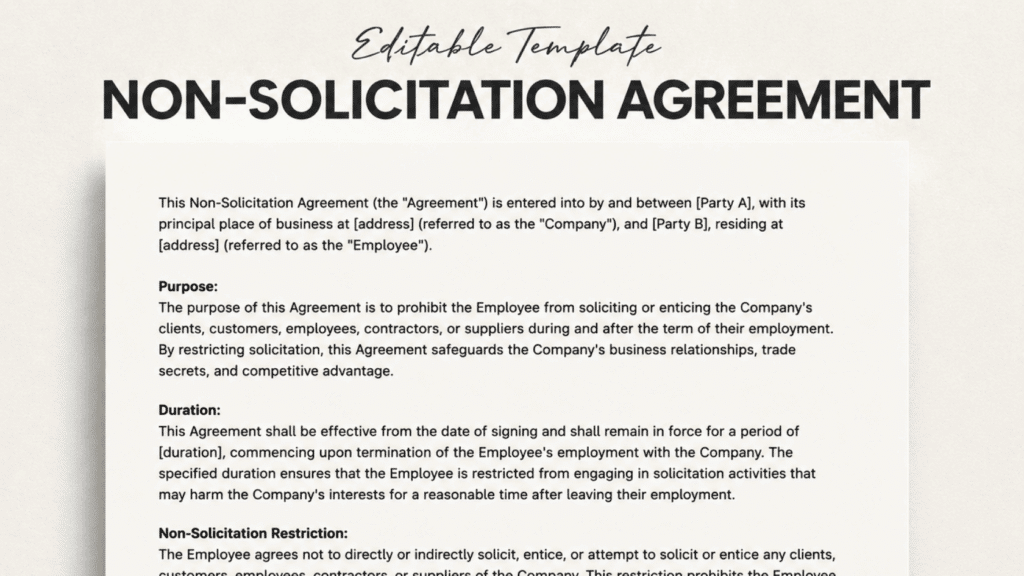
A non-solicitation agreement is a legal contract that prevents individuals from soliciting a company’s employees, clients, or customers after leaving. It may be a standalone agreement or part of another contract.
It is commonly used in sales and service industries where client relationships and skilled employees are valuable. The agreement helps protect important business connections.
It usually applies to former employees, contractors, and business partners. They are restricted from approaching the company’s clients, employees, or vendors.
Unlike non-compete or confidentiality agreements, it focuses only on protecting business relationships. It does not restrict future employment or the sharing of confidential information.
Types of Non-Solicitation Agreements

Anon-solicitation agreement isn’t a single, one-size-fits-all document; it typically comes in a few distinct types, each designedto protect a different business relationship.
Here’s how they differ:
- Employee Non-Solicitation Agreements:Stop former employees from recruiting current staff members to join a competing company, particularly important in industries where specialized skills and institutional knowledge are difficult to replace.
- Customer and Client Non-Solicitation Agreements:Protect a company’s relationships with the clients and customers it has worked hard to build, typically preventing former employees or partners from reaching out to clients they served during their time with the company.
- Vendor and Supplier Non-Solicitation Agreements:Protect a business’s supply chain by preventing former employees from diverting vendors or suppliers to a new venture, helping maintain operational stability.
Understanding which type applies, or whether a company needs a combination of all three, is the first step toward drafting an agreement that actually protects what matters most.
Key Provisions of a Non-Solicitation Agreement
A legally sound non-solicitation agreement isn’t just a vague promise not to compete; it’s built from specific, enforceable clauses that define exactly who is restricted, for how long, and what happens if the agreement is broken.
Here are the core provisions that make an agreement both clear and enforceable:
1. Customer and Client Non-Solicitation
This provision prevents former employees from using their insider knowledge and established relationships to lure away existing or prospective clients.
- Targeted scope: Courts generally strike down blanket bans on “all former customers.” Instead, the clause should be specific, covering clients the employee worked with, supervised, or had contact with during the final 12 to 24 months of employment.
- Active vs. passive solicitation: The agreement should clarify what counts as a violation, for example, whether a former client who reaches out to the ex-employee unprompted is exempt from the restriction.
2. Employee Non-Solicitation (Anti-Poaching)
This clause prohibits a departing worker from inducing, recruiting, or encouraging current staff to leave and join them at a competing venture.
- Restricted parties: Usually applies to both direct subordinates and other staff members the employee had access to during their tenure.
- Exceptions: Routine, public job advertisements are typically permitted, while targeted, one-on-one headhunting of the team violates the clause.
3. Duration and Geographic Restrictions
To be enforceable, the restriction must be reasonable in both time and geography so as not it impose undue hardship on the former employee’s ability to earn a living.
- Timeframe: Restrictions typically last between six months and two years post-employment; anything longer usually raises red flags in court.
- Geographic scope: Often applied only to customer-facing roles, limiting the restriction to a specific radius around the former employer’s location or the employee’s sales territory.
4. Remedies and Enforcement
This section outlines what happens if the agreement is breached, giving the company a clear path to act quickly.
- Injunctive relief: The employee acknowledges that any breach would cause “irreparable harm,” thereby allowing the employer to seek an immediate court order halting the prohibited solicitation.
- Damages and forfeitures: The former employee may be liable for financial damages or forfeit deferred compensation, bonuses, or severance payouts.
5. Consideration
For the agreement to be a legally binding contract, the employee must receive something of value in exchange for signing it.
-
New hires: The initial offer of employment is usually sufficient consideration, and this typically applies even if the new hire is still working through a probation period.
- Existing employees: Many jurisdictions require additional consideration, such as a promotion, a cash bonus, or specialized training, for an agreement signed mid-employment to be enforceable.
6. Governing Law and Severability
This provision defines which legal framework applies and protects the agreement if part of it doesn’t hold up.
- Jurisdiction: Identifies exactly which state’s laws govern the contract and which court handles disputes, since local laws vary widely; non-solicitation clauses are strictly scrutinized or largely unenforceable in some states, like California.
- Severability: States that if a judge finds one specific provision (such as an overly broad geographic zone) unenforceable, the rest of the agreement remains valid.
Including these six provisions is what separates a non-solicitation agreement that actually holds up in court from one that’s easily challenged.
Clear scope, reasonable limits, proper consideration, and a solid legal foundation all work together to protect legitimate business interests.
How Does a Non-Solicitation Agreement Work?

A non-solicitation agreement legally binds individuals, such as former employees or partners, from contacting or recruiting specific parties linked to a previous employer for a set period.
- Client/Customer Non-Solicitation: Prohibits a former employee from reaching out to former clients, preventing them from leveraging relationships and inside knowledge to redirect business toward their new employer.
- Employee Non-Solicitation (Anti-Poaching): Stops a departing employee from recruiting former colleagues to a new venture, protecting the company from losing key talent to a competing business shortly after their exit.
- Enforceability depends on reasonableness: Courts uphold these agreements only when duration (typically 6 to 24 months), scope, and consideration are reasonable, with clearly defined restricted parties and something of value exchanged for signing.
- Breach triggers a clear response: Companies gather evidence like emails or messages, issue a cease-and-desist letter, and may pursue injunctive relief or financial damages if the breach caused measurable losses.
Understanding these mechanics is what makes a non-solicitation agreement enforceable rather than just a formality on paper.
How Do Non-Solicitation Agreements Differ From Other Contracts?
Non-solicitation agreements often get confused with similar-sounding restrictions, but each protects something different.
| Contract Type | What It Restricts | Can You Take a New Job? |
| Non-Solicitation | Poaching clients or coworkers | Yes, same field allowed |
| Non-Compete | Working for a rival at all | No, restricted entirely |
| Non-Dealing | Any contact with old clients, even client-initiated | Yes, but no dealings allowed |
| NDA | Sharing confidential info, not relationships | Yes, unrelated to employment |
Courts generally favor narrower restrictions, which is why non-solicitation agreements are far more likely to hold up in court than a broad non-compete or non-dealing clause.
What Activities Are Restricted Under a Non-Solicitation Agreement?
A non-solicitation agreement limits actions that could divert a company’s clients, employees, or business relationships after someone leaves.
It may prevent former employees from contacting clients or customers to move their business elsewhere, recruiting former colleagues, or approaching vendors and suppliers.
These agreements can also cover indirect solicitation, such as using another person or third party to make contact on the restricted individual’s behalf.
Legal Considerations for Companies

Companies relying on non-solicitation clauses need to keep several legal factors in mind:
- Enforceability varies by state: Some states, such as California, impose strict limits on these agreements, so companies should consult legal counsel familiar with local law.
- Reasonableness matters: Courts evaluate the duration, geographic scope, and overall scope of the restriction to ensure it doesn’t go beyond protecting legitimate business interests.
- Consideration is required: For the agreement to be binding, the restricted party must receive something of value in exchange, such as continued employment or additional compensation, which can sometimes include non-cash fringe benefits.
- Clarity reduces disputes: Vague or overly broad language can render an agreement unenforceable or invite legal challenges.
- Consistency across contracts: Non-solicitation clauses should align with other agreements, like confidentiality or employment contracts, to avoid conflicting terms.
A well-drafted non-solicitation agreement balances business protection with legal fairness by ensuring clear terms, reasonable limits, proper consideration, and compliance with applicable state laws.
Are There Exceptions to Non-Solicitation Agreements?
Yes, though it depends heavily on the jurisdiction. Many states enforce non-solicitation agreements broadly, but some, like California, restrict them significantly to protect an individual’s right to work freely, allowing only a handful of narrow exceptions.
These exceptions typically cover three situations: agreements designed specifically to protect a company’s trade secrets, non-solicitation clauses tied to the sale of a business, and restrictions between partners agreeing not to solicit clients or each other after a partnership dissolves.
Even in restrictive states, these carve-outs allow businesses to protect specific, legitimate interests without imposing a blanket ban on someone’s ability to work in their field.
Conclusion
A well-drafted non solicitation agreement gives businesses a practical way to protect important relationships while setting clear expectations for employees, contractors, and partners.
These agreements work best when they create fair boundaries around client, employee, and vendor interactions while meeting applicable legal requirements.
Careful drafting helps reduce conflicts and supports smoother transitions when professional relationships change.
A properly prepared non-solicitation agreement can provide long-term protection without creating unnecessary restrictions. Consult a legal professional to ensure your agreement aligns with your business goals and applicable laws.
What has been your experience with non-solicitation agreements? Share your thoughts in the comments below.
Frequently Asked Questions
Can I Work For A Competitor If I Signed A Non-Solicitation Agreement?
A non-solicitation agreement usually does not prevent you from working for a competitor. It typically limits contacting or taking clients, employees, or business relationships from your former employer, depending on the terms of the agreement and state laws.
Which States Ban Non-Solicitation Agreements?
California is the most notable state to restrict employee non-solicitation agreements, especially those that limit employee mobility. Other states may impose specific restrictions, so enforceability depends on the language of the agreement, the type of worker, and applicable state regulations.
What Is A Non-Solicitation Clause In A Contract?
A non-solicitation clause is a contract provision that prevents certain actions, such as contacting clients or recruiting employees after leaving a company. It can appear inside employment, severance, partnership, or other business agreements.