

A job offer lands on your desk, and buried in the paperwork is a clause you didn’t know about. Before you sign anything, you want to know exactly what you’re agreeing to and how much it could limit you later.
Most people sign these under a deadline, with no legal background and little time to think it through. That’s why the fine print matters: skimming it now can cost you options later.
This blog covers what is a non compete agreement, how it works in practice, and if courts actually enforce these contracts.
What is a Non Compete Agreement?A non-compete agreement is a contract between an employer and an employee. It limits where and how the employee can work after leaving the job, usually to stop them from joining a rival or starting a competing business. Employers ask staff to sign these at hiring, or later when someone gets a raise or promotion. The goal is to protect trade secrets, client lists, and other details the employee picked up on the job. At its core, it’s a legal tool built around one purpose: keeping valuable business knowledge from walking out the door with the employee. |
How Does a Non Compete Agreement Work?
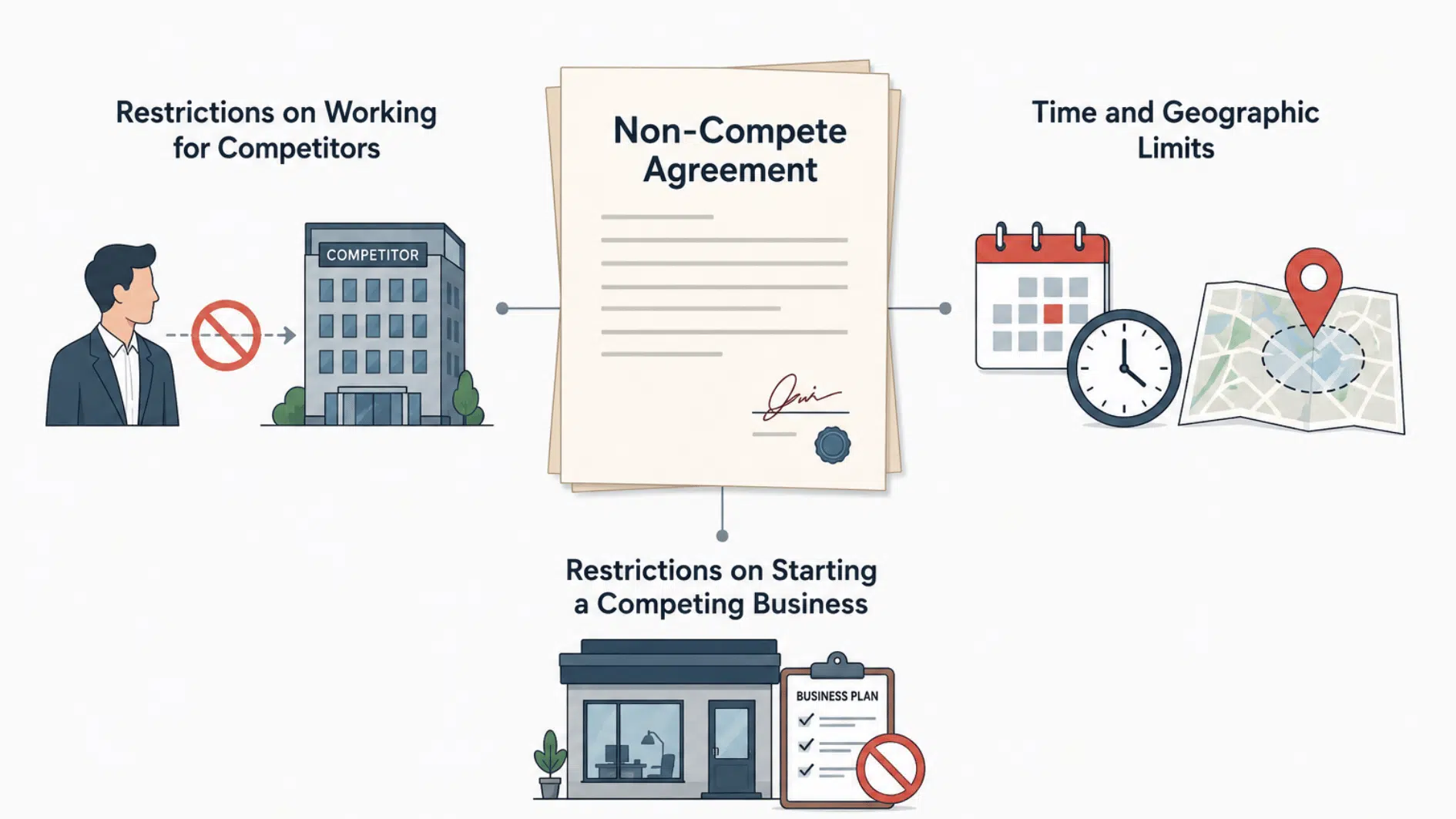
A non-compete agreement sets three limits: what you can’t do, where you can’t do it, and for how long.
These limits usually protect trade secrets or the money spent training you. Break the terms, and the former employer can take legal action.
1. Restrictions on Working for Competitors
The agreement names the work that’s off-limits. Some ban you from joining any rival outright. Others only block specific roles, like sales or product development.
Many also add a related rule: no reaching out to former clients or coworkers to bring them along. This can apply even if your new role sits outside the main restriction, and even after the core non-compete period ends.
2. Time and Geographic Limits
Most non-compete agreements last six months to two years and may cover a city, state, or larger area. Remote work has shifted attention toward where employees actually work.
Restrictions tied to business sales are often longer because they protect the value the buyer purchased.
3. Restrictions on Starting a Competing Business
Some agreements go further and stop you from launching your own competing company, not just working for one. This matters most for people who leave to start a business in the same field.
A few contracts even limit who you can invest in or hold equity with. Quietly backing a friend’s competing startup could break the agreement, even if you have no active role in the business.
What Should You Check Before Signing a Non-Compete?
Read the full document before signing, not just the summary a manager gives you. You already know what to look for: duration, geography, competing work. The question is if those numbers fit your situation, or stretch past it.
- Ask for a copy in advance: This gives you time to review it away from the signing table.
- Check your state’s rules: Since enforcement varies widely from state to state.
- Negotiate the terms: Especially the time period and geographic scope, before you sign.
- Get a second opinion: From an employment attorney if the agreement covers broad work or a long time period.
- Watch for the same severance agreement : Red flags if a non-compete shows up as part of an exit package rather than at hiring.
Which States Restrict or Ban Non-Competes?
Non-compete laws shift by state. Some ban them outright, some allow them only above a set salary, and the rest enforce them case by case. Check your state’s current statute before assuming a contract applies as written.
| Category | States | What the Law Says |
|---|---|---|
| Full ban for most workers | California, North Dakota, Oklahoma, Minnesota | Voids nearly all employee non-competes, with narrow exceptions like business sales |
| Salary or wage threshold | Washington, Illinois, Colorado, Maine | Enforceable only above a set pay level; void for anyone earning below it |
| General enforcement (with limits) | Texas, Florida, New York, Georgia | Enforced case by case if the time, area, and scope are reasonable |
Do Non Competes Hold Up in Court?
No, not always. Whether a non-compete holds up in court depends on the state law covered above, plus the exact terms written into the contract.
Judges weigh the same factors that decide enforceability, covered next, against the specific facts of each case.
One that’s too broad, too long, or covers too much ground gets struck down or narrowed, even in states that generally enforce these agreements. The same contract could be upheld in one state and thrown out in another.
| Note: Non-compete laws differ by state and can change through new statutes or court decisions. As of August 2026, the FTC’s nationwide Noncompete Rule is not in effect or enforceable. This information is general and not legal advice. An employment attorney can review the contract under the law that applies to the specific job. |
What Makes a Non-Compete Enforceable or Unenforceable?
Whether a non-compete survives a legal challenge depends on how it was written and how it’s used, not just whether the employer wanted it enforced. Courts weigh several factors, and a contract can fail on just one.
Reasonable, Clearly Written Restrictions
The time, area, and role limits must match the real risk to the business, and the wording must be specific, not vague or overly broad.
Legitimate Business Interest
The employer needs a real reason tied to trade secrets, client ties, or training. A general desire to block competition isn’t enough.
Impact on The Employee
Courts weigh whether the restriction would stop the person from earning a living in their field. A non-compete that blocks someone from working at all in their line of work rarely survives review.
Consideration and Timing
The employee needs something of value in exchange for signing, like a job offer, a raise, or a bonus, and courts favor agreements signed at hiring over ones added later with no new benefit.
State and Job-Type Rules
Some states void non-competes for entire groups of workers, like low-wage or hourly staff. Some of these same protections come up in at-will employment disputes, since both hinge on what a state allows an employer to restrict.
Blue-Pencil Rules
Some states let a court trim an overly broad clause down to something reasonable instead of tossing it out entirely. Others void the whole agreement if any part fails.
Material Change in Role
If your job changed significantly after you signed, and you didn’t sign a new agreement to match it, some courts treat the original non-compete as no longer valid.
What Happens If You Break a Non-Compete?
Violating the terms can trigger a lawsuit from your former employer. They may seek a court order to block the new job or business, and may ask for money to cover claimed losses.
If you’re weighing that risk, it helps to understand how wrongful termination claims actually play out, since both disputes often move through similar courts and evidence.
The outcome depends on the state and the contract terms. Weak-enforcement states like California rarely uphold these lawsuits; stronger-enforcement states may grant an order forcing the worker out of the new role.
New employers can get pulled into the dispute too, especially if they knew about the non-compete before hiring.
The Bottom Line
A non-compete agreement can limit your next move long after you leave a job, but the terms aren’t fixed in stone.
You’ve got the checklist and the state table. The only step left is to hold your actual contract up against them and see where it stretches too far.
If you’re already bound by one and eyeing a new role, get it reviewed before you hand in your notice, not after.
Frequently Asked Questions
Does a Non-Compete Still Apply if You’re Fired?
Often, yes. Most non-competes apply no matter who ended the job, unless the contract specifically excludes termination without cause. Read the exact wording before assuming you’re free of it.
Is a Non-Compete the Same as a Non-Solicitation Agreement?
No. A non-compete blocks you from working for a rival. A non-solicitation agreement only stops you from pursuing former clients or coworkers, though both often appear in the same contract.
Can You Get Out of a Non-Compete Agreement?
Sometimes. You can negotiate a release with your former employer, challenge the terms in court, or lean on state law that bans non-competes.
Can a Company Still Enforce a Non-Compete After Being Sold?
Usually, yes, if the buyer took over the original contract terms during the sale. Some states require the new company to offer fresh consideration for the non-compete to stay valid.