

Every year, thousands of small business owners get an unwelcome letter from their plan administrator: their 401(k) failed IRS testing, and now they owe refunds to their highest-paid employees.
It’s a frustrating, avoidable problem. This is exactly what a safe harbor match is designed to prevent.
If you’re a plan sponsor tired of testing surprises, this blog walks you through what is safe harbor match, how it works, the different formulas you can choose, and how it stacks up against a standard match.
You’ll also find what to consider before setting one up, the design rules that come with it, and if it actually makes sense for your business.
What is Safe Harbor Match?
A safe harbor match is a set contribution you make to employees’ 401(k) accounts. In return, your plan skips the IRS’s yearly nondiscrimination testing.
Normally, that testing checks if your plan favors owners and top earners too much. If you fail, you may have to refund money to your highest-paid staff. A safe harbor match removes that risk entirely.
This is why many owners build it into their broader total rewards strategy instead of treating it as an afterthought.
You pick a match formula and commit to it. A common one: 100% match on the first 3% an employee saves, plus 50% on the next 2%.
All of it vests immediately; employees keep it even if they leave the next day.
How Does a Safe Harbor Match Work?
You pick one formula, tell employees about it, and match their contributions all year based on that formula.
The formula determines how much you owe and how much employees need to save to get the full match, regardless of how they split their pre-tax or Roth savings.
1. Basic Safe Harbor Match
You match 100% of the first 3% an employee saves, plus 50% of the next 2%. Max match: 4% of pay. Employees who save 5% or more get the full match.
Example

Priya earns $50,000 a year and saves 5% ($2,500)

First 3% saved ($1,500): matched at 100% = $1,500

Next 2% saved ($1,000): matched at 50% = $500

Total you contribute: $2,000
2. Enhanced Safe Harbor Match
You match at least as much as the basic formula, but in one flat rate. A common version: 100% match on the first 4% saved. Employees hit the max match sooner at 4% instead of 5%.
Example

Priya saves 4% ($2,000)

Matched at 100% = $2,000

Same total as the basic formula, but she only needed to save 4% instead of 5%
3. QACA Safe Harbor Match
This version pairs with auto-enrollment. The match is smaller, say 100% on the first 1%, plus 50% on the next 5%. Employees can be auto-enrolled, and their savings rate rises automatically each year unless they opt out.
Example

Priya is auto-enrolled at 6%

First 1% saved ($500): matched at 100% = $500

Next 5% saved ($2,500): matched at 50% = $1,250

Total you contribute: $1,750
Her savings rate also rises automatically each year unless she opts out.
4. Non-Elective Contribution
Skip matching altogether. Instead, give every eligible employee 3% of their gross pay, whether they save anything or not. This costs more upfront but is the simplest to run.
Example

Priya gets 3% of her $50,000 salary

She contributes: $0 (opted not to save)

You still contribute: $1,500

Costs more per employee on average, but nothing to track
Safe Harbor Match vs Employer Match: What’s the Difference?
A safe harbor match is required and locked into a set formula. A regular employer match is optional, and you decide the rate and can change it whenever you want.
|
Feature |
Safe Harbor Match |
Standard Employer Match |
|
Required by law |
Yes, once you adopt a safe harbor plan, the contribution is mandatory every year. |
No, employers can choose not to offer any match at all. |
|
Match formula |
You must use a fixed formula, such as basic, enhanced, or QACA. |
You set your own rate and structure, with no fixed formula required. |
|
IRS nondiscrimination testing |
Your plan is exempt from yearly ADP/ACP and top-heavy testing. |
Your plan must pass these tests every year to stay compliant. |
|
Vesting |
Employees own 100% of the match the moment it’s contributed. |
You can require employees to stay a set number of years before they fully own it. |
|
Annual notice to employees |
You must send a written notice to all eligible employees each year. |
No annual notice is required. |
|
Can change mid-year |
Changes are limited and often require advance notice or a plan amendment. |
You can raise, lower, or end the match at any time. |
|
Best for |
Owners and highly paid staff who want to save more without worrying about failed testing. |
Employers who want full control over match cost and plan design. |
Compliance Benefits of a Safe Harbor 401(k)
A safe harbor match lets your plan skip the yearly IRS tests that check if it favors owners and top earners over regular staff.
No ADP Test
This test compares how much highly paid employees save versus everyone else. If the gap is too wide, you fail. Safe harbor skips this check entirely, so you never have to run the numbers each year.
No ACP Test
Similar idea, but it looks at matching contributions instead of savings. Skipped too, which removes another yearly calculation from your plate.
No Top-heavy Test
This checks if owners and key employees hold too large a share of the plan’s total money. Usually skipped if safe harbor is your only contribution, saving you from a separate asset review.
No Refunds to Owners
Fail either test without safe harbor, and you must return money to highly paid staff. Safe harbor removes that risk, so contributions stay put once they’re made.
Owners Can Save the Max
Without these tests capping them, owners and top earners can contribute up to the full IRS limit each year, regardless of what lower-paid staff chooses to save.
Less Year-end Work
Skipping these checks means less paperwork for you or your plan administrator, and it’s one less item to track on your compliance checklist each plan year.
What Should Employers Consider Before Setting Up a Safe Harbor Match?
Setting up a safe harbor match isn’t just picking a formula. A few practical steps decide if it runs smoothly.
Adoption Deadlines
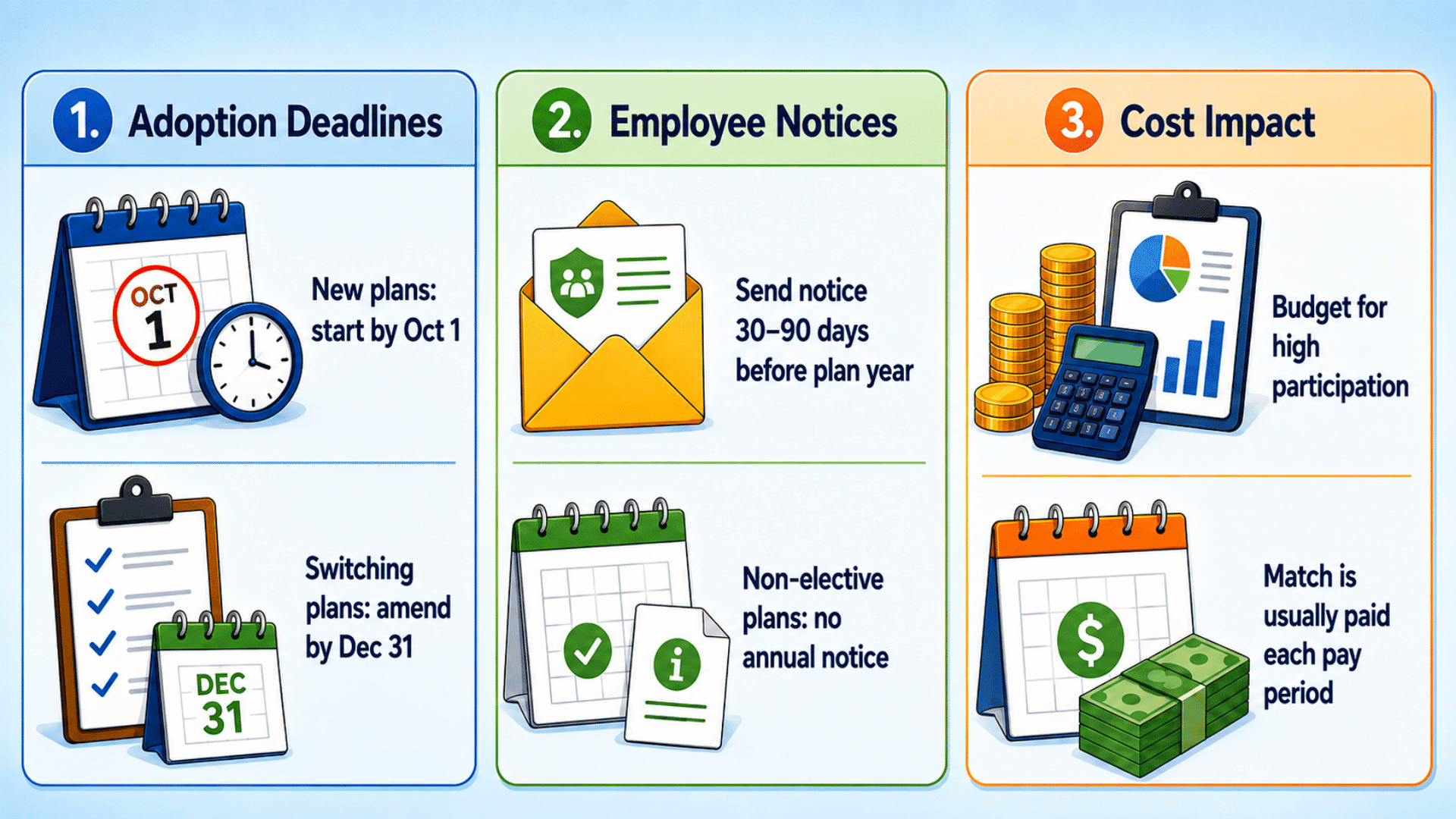
A newly established safe harbor 401(k) plan generally must remain in effect for at least three months during its first plan year. For a calendar-year plan, October 1 is usually the latest effective date.
Employers should begin setup earlier to allow time for document preparation, payroll changes, and employee enrollment.
Employee Notices
The IRS notice rules treat delivery 30 to 90 days before the plan year as timely. For a calendar-year plan, employers should normally send it between early October and early December.
Send it 30 to 90 days before the plan year starts. Non-elective plans are exempt from this notice, per the SECURE Act update.
Cost Impact
A safe harbor formula creates a required employer expense, so calculate costs before adopting the plan.
Estimate contributions using eligible payroll, expected participation, employee deferral rates, hiring plans, raises, bonuses, and the annual compensation limit.
Match-based costs change with employee participation, while nonelective contributions generally apply to every eligible employee, including those who contribute nothing themselves.
Key Plan Design Rules for a Safe Harbor Match
Beyond picking a formula, a few design rules shape how your plan runs day to day.
| Design Rule | What It Means |
| Vesting | Basic and enhanced match vests immediately, with no waiting period. QACA match can use a 2-year cliff schedule instead, per IRS guidance. Extra match on top of the required amount can follow its own separate schedule. |
| Eligibility | Every employee who meets your eligibility rules gets the contribution, regardless of department. You can set a minimum age of up to 21 and a minimum of 1 year of service. |
| Coverage | Once an employee is eligible, you can’t carve out or exclude specific groups from the safe harbor contribution. |
| Mid-year notice | Any mid-year change requires an updated notice 30 to 90 days before it takes effect, per IRS Notice 2016-16. |
| Election window | Employees get at least 30 days after that notice to adjust their deferral elections. |
| Vesting changes | You can’t extend how long QACA contributions take to vest, even mid-year. |
| Reducing or stopping the match | This is only allowed for a genuine business hardship, and it still requires its own notice and election period. |
Is a Safe Harbor Match Right for Your Business?
A safe harbor match fits best if you’re an owner or highly paid employee who wants to save the most without taking on risk. It also works well if most of your staff already save close to the match rate, since the extra cost stays small.
It fits less if you have high turnover or low participation, since contributions vest immediately and lock in a fixed cost even for short-term employees.
If retention is already a challenge, it’s worth pairing this decision with a look at your broader employee retention strategies before you commit to a formula.
Company size plays a role too. Larger businesses with a wide pay gap between owners and staff tend to fail testing more often, so they gain the most from safe harbor. Smaller, evenly paid teams sometimes pass standard testing anyway.
Before deciding, compare your safe harbor cost against your current match, and weigh that against the risk and hassle of annual testing.
Frequently Asked Questions
What are the Disadvantages of A Safe Harbor 401(k)?
You’re locked into a fixed contribution every year, even during slow periods. Contributions vest immediately, so you can’t use vesting schedules to encourage retention like with a standard match.
How Do I Know if I Qualify for Safe Harbor?
Any employer offering a 401(k) plan can adopt safe harbor. You just need to pick a formula, meet adoption deadlines, and send the required employee notice on time.
How Does a Safe Harbor Match Work?
You match employee contributions using a fixed formula, such as 100% on the first 3% saved plus 50% on the next 2%. The match vests immediately.
Who is Eligible for The Safe Harbor Plan?
All employees who meet your plan’s age and service requirements, typically up to 21 years old and one year of service, must receive the safe harbor contribution.