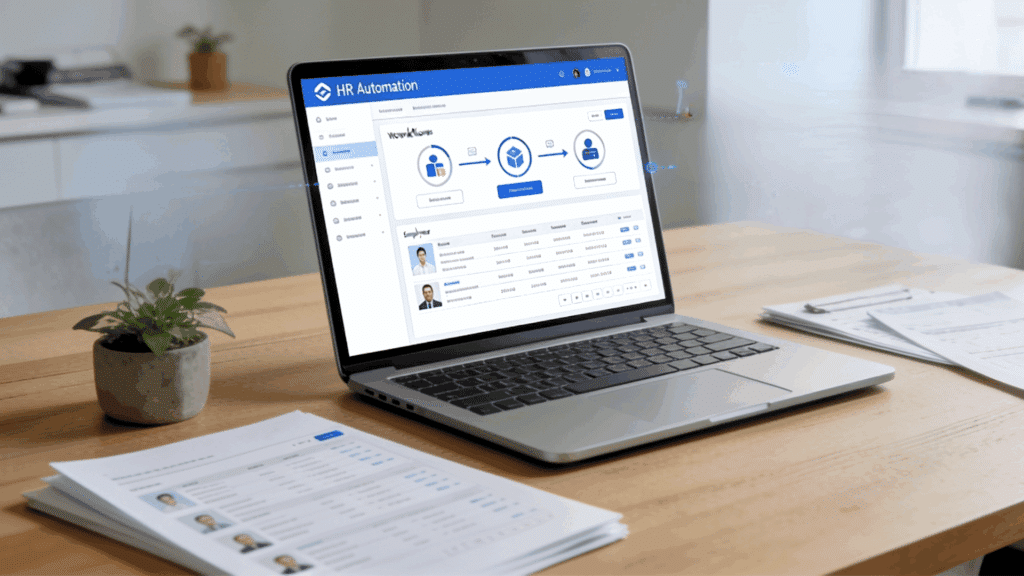

Managing HR manually can quickly become overwhelming, especially as teams grow.
Tasks such as payroll, onboarding, attendance tracking, hiring, and employee communication take time and often result in repetitive work.
That’s where HR automation software becomes useful. With so many platforms available, choosing the right one can feel confusing.
This blog breaks down popular HR automation tools into clear categories so you can compare features and find the best fit for your business needs.
What is HR Automation Software?
HR automation software helps businesses manage repetitive HR tasks using digital tools and automated workflows.
Instead of handling everything manually, companies can use these platforms to simplify payroll, onboarding, attendance tracking, hiring, employee records, and performance management.
Some tools are designed specifically for small businesses, while others support large enterprises with advanced reporting and compliance features.
As businesses grow, these systems help HR teams stay organized and focus more on employee experience and long-term planning rather than routine paperwork.
Benefits of HR Automation Software
Most HR automation tools are designed to reduce repetitive administrative work and make HR processes faster, more accurate, and easier to manage.
- Reduces Manual Paperwork and Data Entry: Automation minimizes repetitive tasks, such as filling out forms, updating employee records, and processing documents.
- Improves Payroll Accuracy and Compliance: Many platforms automate salary calculations, tax deductions, and compliance updates, reducing payroll errors.
- Speeds Up Onboarding and Hiring: HR software can streamline recruitment, document collection, training, and new hire orientation workflows.
- Simplifies Attendance and Leave Tracking: Automated systems make it easier to monitor work hours, PTO requests, and employee attendance in one place.
- Helps HR Teams Focus on Strategic Tasks: By reducing routine admin work, HR teams can spend more time on employee engagement, culture, and workforce planning.
All-in-One HR Automation Platforms
These platforms cover the full employee lifecycle in a single system, from hiring to offboarding, making them the go-to choice for teams that want to consolidate tools and automate across every HR function at once.
1. BambooHR
BambooHR is a cloud-based HRIS designed for small and mid-sized companies. At an 180-employee company, BambooHR reduced HR administrative time by 68%.
It’s known for its clean interface and simplicity, offering onboarding automation, time-off tracking, performance reviews, and employee self-service in one place.
- Best for: Small to mid-sized businesses (up to 500 employees) wanting an easy-to-deploy HRIS
- Pricing: Quote-based; estimates around $6–8 per employee/month; payroll and ATS modules priced separately
- Key limitation: Payroll and benefits automation are limited unless you add on extra modules
2. Rippling
Rippling is a workforce management platform that unifies HR, IT, and finance in a single system.
Its Workflow Studio lets you build custom automated workflows for onboarding, offboarding, and enforcing the policies set out in your employee handbook, and any change to the employee database is automatically synced across all connected systems.
- Best for: Tech-forward companies (25–1,000 employees) that want deep automation across HR and IT
- Pricing: Starts at $8 per user/month
- Key limitation: Feature-rich but complex, smaller teams or non-tech businesses can feel overwhelmed
3. HiBob
HiBob is a people management platform built for HR teams, managers, and employees. It automates onboarding, time tracking, performance reviews, and reporting, while its AI-powered tools provide instant answers and workforce trend analysis to help leaders make smarter decisions faster.
- Best for: Mid-sized businesses looking for a modern, employee-first HR platform with AI capabilities
- Pricing: Custom pricing, contact the HiBob team for a quote
- Key limitation: Some advanced features are still being developed; integration with third-party tools can be challenging
4. Workday HCM
Workday is an enterprise-grade human capital management platform that handles end-to-end HR automation, from payroll and benefits to workforce analytics and strategic planning.
It combines financial and workforce data in a single system, giving large organizations a genuinely unified view of their people and costs.
- Best for: Large enterprises (1,000+ employees) with complex, global HR requirements
- Pricing: Enterprise contracts only, typically negotiated; not publicly disclosed
- Key limitation: High implementation cost and complexity; requires a dedicated HRIS team and 12–18 months for full rollout
5. Darwinbox
Darwinbox delivers enterprise-grade HR automation across recruitment, onboarding, payroll, attendance, and performance management, all in a mobile-first, AI-powered platform with up to 40% lower total cost of ownership than Workday and SAP SuccessFactors.
- Best for: Large enterprises and high-growth organizations in Asia-Pacific, the Middle East, and global markets; strong in manufacturing, BFSI, retail, and tech
- Pricing: Custom subscription pricing based on the number of employees and modules selected
- Key limitation: Can slow down with large data volumes; customization is possible, but complex and time-consuming
6. Factorial
Factorial has steadily expanded beyond its origins as a core HRIS into a comprehensive platform that supports HR, operations, and finance teams.
It covers time tracking, payroll, performance reviews, shift scheduling, expense management, and e-signatures, all in one clean interface built specifically for small and mid-sized businesses.
- Best for: Small to mid-sized businesses looking for an all-in-one HRIS with strong automation and GDPR-compliant workflows
- Pricing: Starts at $8 per employee/month; custom bundles available
- Key limitation: Some users find modules like payroll and reporting less developed than dedicated tools; limited customization in certain areas
Payroll and Benefits Automation Software
Payroll errors are expensive. These tools are built specifically to automate salary calculations, tax compliance, and benefits management, reducing manual work and the risk of costly mistakes.
7. ADP Workforce Now
ADP Workforce Now covers payroll, benefits, time tracking, talent acquisition, and compliance in one platform, with strong support for companies managing complex payroll needs across multiple states or countries.
- Best for: Mid to large businesses needing a reliable, full-featured payroll and HR system
- Pricing: Quote-based; contact ADP for pricing based on company size
- Key limitation: Can feel complex and expensive for smaller businesses; some reporting features receive mixed reviews
8. Paycor
Paycor offers a suite of modules to automate the entire HR process, including a pulse survey tool to monitor employee engagement alongside core payroll, benefits, and talent functions.
It’s tailored to work across eight specific verticals, including healthcare, manufacturing, and nonprofits, which makes it a strong choice for industry-specific needs.
- Best for: Small to enterprise businesses in specialized industries; most of its base is at smaller organizations
- Pricing: Starts around $6.19 per user/month, depending on the plan and modules selected
- Key limitation: Some users find the reporting features difficult to use; international features aren’t always clearly documented
9. Paycom
Paycom is a well-established payroll and HR platform built entirely in-house rather than through acquisitions, which gives it a consistent, integrated experience across all its modules.
One standout feature is its employee-driven payroll option, which allows employees to process and verify their own payroll before submission, reducing errors at the source.
- Best for: Companies that want a consistently integrated platform with innovative payroll options
- Pricing: Custom quote-based pricing
- Key limitation: Some users report that the reporting feature is difficult to use; clarity on features available outside the US could be improved
10. Gusto
Gusto is a payroll, benefits, and HR platform built specifically for small businesses.
It automates federal, state, and local tax filings, new-hire reporting, and benefits administration through a simple, intuitive interface that doesn’t require any payroll expertise to operate.
- Best for: Small businesses (under 100 employees) that want simple, automated payroll without a steep learning curve
- Pricing: Starts at $40/month plus $6 per person/month
- Key limitation: Limited functionality for larger or more complex organizations; not ideal if you need enterprise-level HR features
11. Keka
Keka combines workforce analytics with payroll and attendance data, giving leaders actionable insights instead of fragmented reports, and every HR task, from leave requests to goal updates, can be managed directly from the Keka app.
- Best for: Growing companies with 50–500 employees, particularly strong for India-based teams needing local payroll compliance
- Pricing: Starts from ₹9,999/month for up to 100 employees; contact for US/global pricing
- Key limitation: Mobile app has reported bugs; not ideal for large global teams needing multi-country payroll at scale
Recruitment and Applicant Tracking Software
Hiring is one of the most time-intensive parts of HR. These tools automate job posting, candidate screening, interview scheduling, and communication, so your team can move faster and focus on the candidates that actually matter.
12. Greenhouse
Greenhouse is one of the most widely used applicant tracking systems in the market, known for its structured hiring approach and deep customization.
It automates job postings, candidate pipeline management, interview scheduling, and offer letters, with built-in tools for reducing bias in the hiring process.
- Best for: Mid to large companies that want a structured, data-driven recruitment process
- Pricing: Custom pricing based on company size. Contact Greenhouse for a quote
- Key limitation: Pricing is on the higher end; some smaller teams find the feature set more than they need
13. Recruitee
Recruitee is a collaborative applicant tracking system focused on team hiring. It automates job posting across multiple boards, manages candidate pipelines, handles email responses, and includes customizable evaluation tools that make it easy for multiple team members to assess candidates consistently.
- Best for: Growing teams that want collaborative, structured recruitment without covering full HRIS needs
- Pricing: Starts at around $199/month for the Launch plan
- Key limitation: Doesn’t cover post-hire HR needs; it’s purely a recruitment tool
14. Lever
Lever combines an ATS and candidate relationship management (CRM) system in one platform.
It automates sourcing, nurturing, and tracking candidates throughout the recruitment process, making it particularly strong for companies that want to build talent pipelines and hire proactively rather than reactively.
- Best for: Companies doing high-volume or proactive recruitment that want CRM and ATS in one tool
- Pricing: Custom pricing, contact Lever for a quote
- Key limitation: Reporting can be complex; some users find the UI takes time to learn
15. Workable
Workable is an all-in-one recruitment platform that automates job posting, candidate sourcing with AI-powered recommendations, interview scheduling, and offer management.
It also includes a database of over 700 million searchable candidate profiles for outbound sourcing.
- Best for: Small to mid-sized companies that want a comprehensive recruiting tool with AI sourcing built in
- Pricing: Starts at $189/month for the Starter plan
- Key limitation: Performance management and onboarding features are basic compared to full HRIS platforms
Global HR and Workforce Management Software
These tools are built specifically to handle global payroll, contractor management, and cross-border compliance.
16. Deel
Deel is a cloud-based global HR and payroll solution built for international hiring and contractor management.
It automates compliance, payments, and documentation across borders, and offers Employer of Record (EOR) services that allow companies to hire in countries where they don’t have a legal entity.
- Best for: Remote-first or distributed companies hiring across multiple countries
- Pricing: Contractor management from $49/month per contractor; EOR services from $599/month per employee
- Key limitation: Operates more like a service platform than pure SaaS; pricing and included features can be unclear
17. UKG Pro
UKG Pro is an AI-powered HR solution built for large, complex workforces. Its UKG Bryte AI Agents use large action models to give personalized recommendations and improve HR decision-making across scheduling, payroll, compliance, and talent management.
- Best for: Large enterprises with complex scheduling, compliance, and workforce management needs
- Pricing: Custom pricing, contact UKG for a quote
- Key limitation: Implementation is complex and time-consuming; best suited to organizations with dedicated HR tech resources
18. SAP SuccessFactors
SAP SuccessFactors is an enterprise HCM suite that covers the full employee lifecycle, from recruitment and onboarding to payroll, learning, and succession planning. It’s most powerful for large global organizations already operating within the SAP ecosystem.
- Best for: Large enterprises (especially SAP-heavy environments) needing end-to-end global HR automation
- Pricing: Enterprise contracts, not publicly disclosed; typically significant implementation investment
- Key limitation: High cost and complexity; not ideal without specialized SAP support or a large IT team
19. Oracle HCM Cloud
Oracle HCM Cloud is a comprehensive human capital management suite designed for global enterprise organizations.
It covers HR, payroll, talent management, and workforce analytics, and integrates seamlessly with Oracle’s broader finance and ERP ecosystem for organizations already in the Oracle environment.
- Best for: Large global enterprises operating within the Oracle ecosystem
- Pricing: Enterprise contracts, not publicly disclosed
- Key limitation: Steep learning curve and significant implementation cost; best suited to organizations with a dedicated HRIS team
Workflow Automation and Integration Tools
Not every team needs a full HRIS overhaul. These tools focus on automating specific HR workflows, connecting your existing systems, or providing targeted automation for particular HR tasks.
20. Zapier
Zapier is not a traditional HR platform; it’s an automation layer that connects your existing HR tools so they work together as one cohesive system.
When someone is marked as “hired” in your ATS, Zapier can automatically create an offer letter, notify the hiring manager in Slack, log the new hire in your HRIS, and more, all without manual intervention.
- Best for: Teams that want to connect and automate across existing HR tools without switching platforms
- Pricing: Free plan available; paid plans from $19.99/month
- Key limitation: Requires existing tools to connect, not a standalone HR system; complex multi-step workflows can require technical setup
21. Kissflow
Kissflow is a low-code process automation tool that supports HR automation through customizable workflow builders.
It covers app development, process automation, case management, and digital transformation, making it a strong choice for HR teams that want to build and automate their own processes without relying on IT.
- Best for: Mid to large companies that want to build custom HR workflows with minimal coding
- Pricing: Starts at $1,500/month
- Key limitation: Pricing is high for smaller teams; the UI and UX can be complex in certain areas
22. Zoho People
Zoho People is a modular HRIS that’s part of the larger Zoho business suite. It offers workflow automation for attendance, time-off, onboarding, and performance management. It integrates natively with other Zoho tools, such as Zoho CRM, Zoho Payroll, and Zoho Recruit, for a joined-up experience.
- Best for: Small to mid-sized companies already using the Zoho ecosystem
- Pricing: Starts at $1.25 per employee/month; most automation features available from the $2.50/month tier
- Key limitation: Best value within the Zoho ecosystem; standalone, it may feel limited compared to dedicated HRIS platforms
23. TalentHR
TalentHR is a streamlined HR automation platform that combines ATS software, onboarding automation, time-off tracking, talent management, e-signatures, and employee self-service into a single easy-to-use tool.
Its free plan supports up to 10 users, making it one of the most accessible entry points in the market.
- Best for: Small businesses or teams without a dedicated HR department looking for an affordable all-in-one tool
- Pricing: Free for up to 10 users; premium tier at $4 per user/month
- Key limitation: Some advanced features are still being rolled out; less robust than enterprise-grade platforms
24. FlowForma Process Automation
FlowForma is a process automation platform with specific features for HR workflows. It’s designed to help organizations automate manual HR processes without a developer, covering onboarding, document management, approval workflows, and compliance reporting in a no-code environment.
- Best for: HR teams that want to automate specific manual processes without full HRIS implementation
- Pricing: Available in Essentials, Professional, and Enterprise tiers. Contact FlowForma for pricing
- Key limitation: Has a learning curve despite the no-code approach; some users report performance issues in complex workflow configurations
25. Applaud HR
Applaud is an AI-native employee experience layer that sits on top of your existing HRIS, connecting tools like Workday, SAP, and Oracle into a single, intuitive employee portal, with agentic AI automatically handling routine requests.
- Best for: Large enterprises already using Workday, SAP, or Oracle that want to modernize the employee experience without replacing their core systems
- Pricing: User-based subscription starting from 500 users; custom pricing based on organization size
- Key limitation: Not a standalone HRIS; dependent on underlying systems for functionality; not suited to small businesses without existing enterprise HR infrastructure
Performance and Engagement Automation
These platforms go beyond core HR administration to automate performance reviews, goal tracking, continuous feedback, and employee engagement, helping organizations build a culture of continuous improvement.
26. Engagedly
Engagedly is an AI-driven talent management platform that helps organizations manage performance, develop talent, and boost engagement from one intelligent system, combining performance reviews, OKRs, engagement surveys, learning paths, and social recognition.
- Best for: Mid-sized organizations that want a fully integrated performance, engagement, and learning platform in one system at a competitive price point
- Pricing: From $5 per user/month with approximately $7,500 annual minimum; free trial available
- Key limitation: The breadth of features can feel overwhelming during initial setup; best results require time investment in configuring workflows and survey cycles
27. Personio
Personio covers the full employee lifecycle, recruiting, onboarding, payroll, attendance, and performance, in a single GDPR-compliant system, and is consistently ranked among the top HR platforms for European teams by G2 and Capterra.
- Best for: European SMBs (10–2,000 employees) that need a compliant, all-in-one HR system with strong local payroll support
- Pricing: Custom pricing based on company size and selected modules
- Key limitation: Less suited to US-based or large global organizations; some users find payroll setup complex for non-standard employment structures
Final Takeaway
The best HR automation software depends on what your business needs most, whether that’s payroll, hiring, employee management, or scheduling.
The key is to focus on software that saves time, reduces manual work, and improves the employee experience.
By carefully comparing features, you can choose an HR solution that supports both your current operations and future growth without adding unnecessary complexity.
Already using an HR automation tool? Share your experience or favorite platform in the comments.
Frequently Asked Questions
Is HR Being Replaced By AI?
No, AI is automating repetitive HR tasks like screening, data entry, and answering routine questions, not replacing HR teams. It frees staff to focus on strategy, culture, and employee experience, which still need human judgment.
Which SAP is Useful for HR?
SAP SuccessFactors is one of the most commonly used SAP solutions for HR management. It helps businesses manage hiring, payroll, employee performance, and workforce planning.
What is an HR Employer Bot?
An HR chatbot is an AI-powered virtual assistant that helps with HR-related questions and tasks. These bots can handle tasks such as leave requests, onboarding assistance, policy questions, and recruitment support.