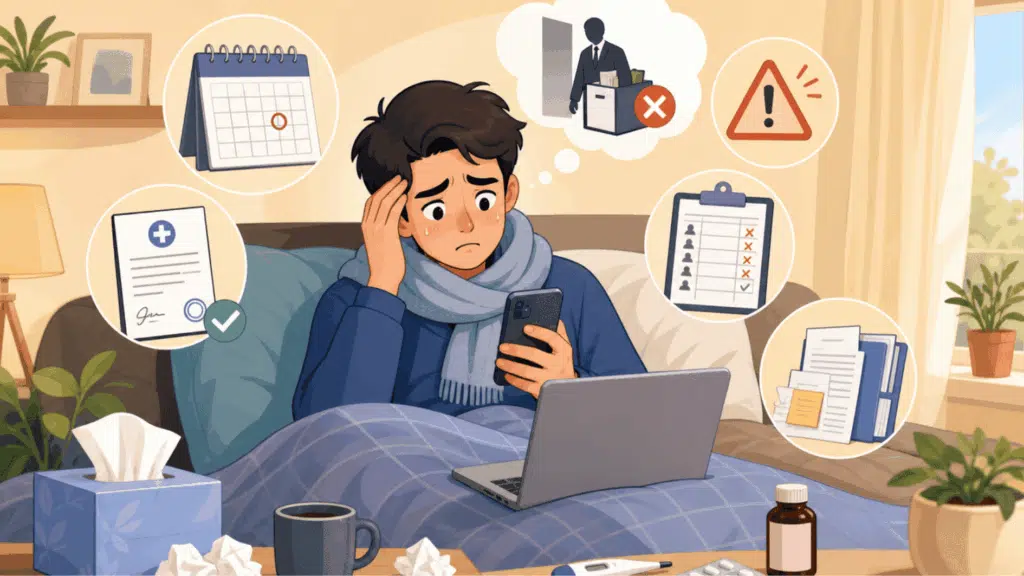

Most people call in sick and then spend the day worrying about the job.
If you are asking if you can get fired for calling in sick, the answer depends on why you were absent, which laws apply to you, and if you followed your employer’s call-in policy.
Being sick by itself does not always protect your job.
At the same time, an employer may violate the law if it fires or punishes you for taking medical leave protected by federal, state, or local rules.
In this blog, you will walk through your legal rights and employer policies around taking sick days without facing termination.
Can You Get Fired for Calling in Sick?
Yes, in many situations. In many workplaces, an employer may discipline or fire an employee for an absence that is not legally protected, especially if you have used your available leave or missed a step in the company’s attendance rules.
At-will employment generally allows either you or your employer to end the working relationship at almost any time. In most states, repeated absences can be a lawful reason for termination.
But at-will employment has limits. An employer cannot fire you for a reason prohibited by law, including properly using protected medical leave.
Below, you will learn the legal perspective on protection against termination because of sickness.
What Laws Protect You From Being Fired for Being Sick?
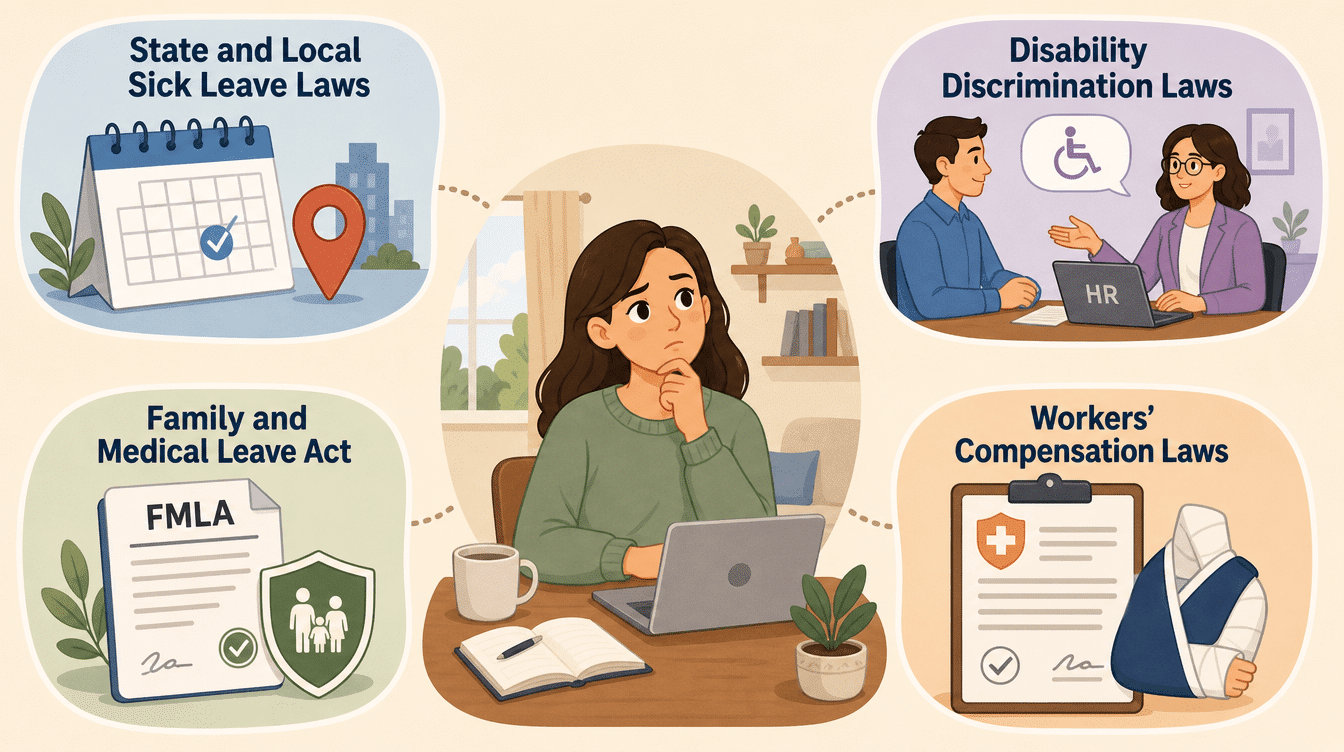
Several laws may protect you from being fired for illness. You may have job protection through sick leave laws, FMLA, the ADA, workers’ compensation, or an employment contract.
Your rights depend on why you missed work, where you work, your employer’s policies, and the leave protections that apply to you.
1. State and Local Sick Leave Laws
If your state or city gives you protected sick leave, your employer may not be allowed to discipline or fire you for legally using that time.
Because sick leave rules differ by location, check your state labor department and local laws before assuming a sick day can be counted against you.
Federal law does not generally guarantee paid sick leave, but many states and localities have their own requirements.
2. Disability Discrimination Laws
If your illness qualifies as a disability under the ADA, your employer may need to consider a reasonable accommodation before taking action over disability-related absences.
An accommodation may include medical leave or a modified schedule.
A strict attendance policy does not always remove this obligation, although employers do not have to accept unlimited or unreliable attendance.
EEOC guidance on reasonable accommodation explains how these rules can apply.
3. Family and Medical Leave Act
If you qualify for FMLA, eligible medical absences can be job-protected, and it’s worth knowing some of these workplace limits for bosses upfront, since a manager cannot simply deny qualifying leave once you meet the criteria.
You generally need to meet all three of these conditions:
- At least 12 months of employment with your current employer
- At least 1,250 hours worked in the prior 12 months
- A worksite where the employer has 50 or more employees within 75 miles
Eligible employees generally have the right to return to the same or an equivalent job after protected leave. Department of Labor FMLA protections explain these rights in more detail.
4. Workers’ Compensation Laws
If you become ill or injured because of your job, workers’ compensation may provide benefits while you recover.
The rules vary by state, so a work-related absence should not automatically be treated like an ordinary sick day.
Check USAGov’s workers’ compensation information and your state’s rules to understand the benefits that may apply.
5. Employment Contracts and Union Agreements
Your employer’s own rules can also affect your the at-will job security.
An employment contract or union agreement may give you additional sick leave rights, set attendance limits, or require warnings and other steps before termination.
Check these terms along with the employee handbook before assuming your employer can fire you for an absence.
6. Protection From Retaliation
Using a protected workplace right should not become the reason you lose your job.
For example, an employer cannot legally punish you for exercising or trying to exercise FMLA rights, and this kind of firing is one of the more common grounds for wrongful termination employees pursue in court.
Timing is often the strongest evidence. If attendance points, discipline, or termination appear shortly after you request or return from protected leave, that sequence deserves closer review.
When Can an Employer Fire You for Being Sick?
An employer may fire you if your sick leave is not legally protected, you have used all available leave, or you cannot perform essential job duties with reasonable accommodation.
Common situations where termination may be lawful include:
Your absence is not protected by FMLA
Eligible employees can receive up to 12 workweeks of job-protected leave for qualifying medical and family reasons. If you do not qualify or your leave is not covered, FMLA may not protect the absence.
You have used all available protected leave
After protected leave ends, an employer may be able to enforce its normal attendance policy. Disability law may still require the employer to consider additional leave or another reasonable accommodation in some cases.
You cannot perform essential job duties
Under the ADA, a qualified employee must be able to perform the essential functions of the job with or without reasonable accommodation. An employer does not have to remove essential job duties as an accommodation.
The termination is for a separate lawful reason
Protected medical leave does not prevent an employer from taking action for a legitimate reason unrelated to the employee’s illness or protected leave.
How to Protect Your Job When Calling in Sick
If you are too sick to work, follow your employer’s call-in rules and give notice as soon as possible.
- Notify your employer promptly. Tell your manager or HR that you cannot work and follow the required call-in method.
- Check your sick leave policy. Review how much leave you have available and any notice or documentation requirements.
- Provide required documentation. Submit a doctor’s note or medical certification if your employer lawfully requests one.
- Ask about protected leave. If your condition is serious, ongoing, or disability-related, find out if FMLA, ADA accommodations, or state sick leave protections apply.
- Keep written records. Save leave requests, approvals, emails, texts, attendance records, and other relevant communication about your absence.
Final Takeaway
So, can you get fired for calling in sick? Yes, sometimes. So, when you need a sick day, focus on protecting your record.
Follow your employer’s call-in policy, keep proof of your notice, and check if the FMLA, disability law, state sick leave rules, or your workplace policy protects the absence.
FMLA generally requires employees to follow normal call-in procedures unless unusual circumstances prevent it.
If you are disciplined or fired after using protected leave, save your records and consider getting legal advice about your specific situation.
Frequently Asked Questions
Is It Possible to Be Fired for Calling in Sick?
Yes, you could get fired for an unprotected absence. But an employer cannot lawfully punish you for properly using protected FMLA leave or other applicable legal protections.
Can My Boss Say No to Me Calling in Sick?
It depends. Ordinary sick leave may be controlled by state law and workplace policy, but an employer cannot simply deny qualifying FMLA leave when you are eligible and meet the requirements.
Will I Get Fired If I Keep Calling in Sick?
Possibly, if the absences are not protected or you fail to follow attendance rules. Protected FMLA leave cannot lawfully be used to punish you for exercising FMLA rights.
Do I Need to Say Sorry When I Call in Sick?
No apology is necessary. What matters more is notifying your employer promptly and following the required call-in procedure.