
Onboarding a new employee involves more steps than you might expect.
You need to handle paperwork, coordinate with different people, and help the new hire settle in and learn how things work.
A new hire checklist brings everything together in one place, so you don’t have to depend on memory or scramble with last-minute emails.
Below, you will see the steps to take, the documents you will need, and a printable checklist you can start using right away.
What is a New Hire Checklist?
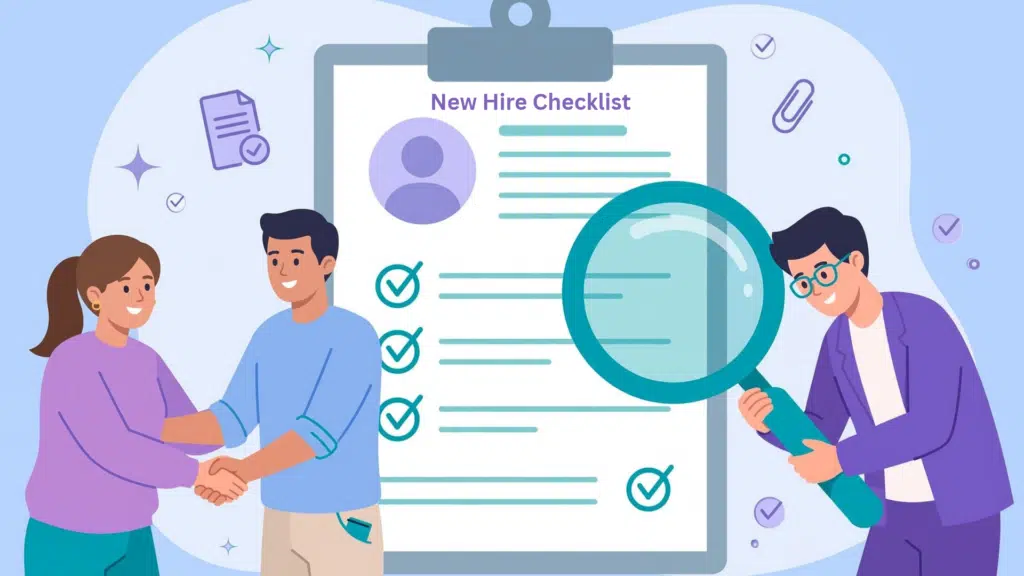
A new hire checklist is a written list of every task needed to bring an employee into a role.
Each item names the task, the person responsible, and when it should be done.
HR covers paperwork and compliance. Hiring managers handle training and goals. IT sets up devices and logins.
The new employee completes forms and asks questions.
Unlike orientation, which is a single event, the checklist spans multiple phases. Most teams maintain a master version and add tasks for specific roles, locations, or remote setups. It can be stored in a spreadsheet, an HR system, or a printed form.
New Hire Checklist
Use this checklist to organize the steps before an employee’s first day and support their transition into the role.
Preboarding Checklist
Preboarding starts after a candidate accepts the offer and continues until their first day.
Use this time to prepare for their arrival and help them feel informed before they begin.
-
☐ Send a welcome message with the start date, arrival time, location, and dress expectations.
-
☐ Confirm the employee has accepted the offer and share any forms they need to complete before starting.
-
☐ Prepare their workspace, equipment, and access to company systems.
-
☐ Let the team know when the employee is joining and share their role.
-
☐ Plan the first-day schedule, including time with their manager and key teammates.
First-Day Checklist
The first day sets the tone for the role, so keep it organized and leave room for questions.
-
☐ Welcome the employee, in person or on a welcome call, and introduce them to the team.
-
☐ Pair them with a buddy or mentor who can answer day-to-day questions.
-
☐ Walk through the first-day schedule.
-
☐ Collect day-one paperwork.
-
☐ End the day with a short check-in.
Onboarding Checklist
Onboarding begins when the employee starts and continues as they settle into their role.
Use these steps to guide training, clarify expectations, and provide support as they learn how the team works.
-
☐ Explain the role’s main responsibilities, priorities, and early goals.
-
☐ Review workplace policies, communication norms, and where to find key resources.
-
☐ Provide role-specific training and time to practice new tasks.
-
☐ Schedule regular check-ins, plus formal reviews at points such as 30, 60, and 90 days, to discuss progress and feedback.
Remote and Hybrid Employee Onboarding Checklist
Remote and hybrid employees may need different setup steps than office-based staff.
-
☐ Confirm the employee’s work location and any required in-office days.
-
☐ Arrange equipment delivery or prepare devices for pickup before the start date.
-
☐ Share instructions for connecting to company systems and getting technical help.
-
☐ Explain which channels to use for updates and questions.
-
☐ Schedule virtual introductions with teammates and key contacts.
-
☐ For hybrid employees, explain office access, desk or room booking, and what to bring on office days.
Download this complete new-hire checklist so you don’t miss anything important.
Important Documents to Collect During New Hire Onboarding
The documents needed during onboarding depend on the employee’s location, role, and employment arrangement.
Share a clear list before the employee’s start date, and collect only what is required for their situation.
Common documents and forms may include:
-
Signed offer letter or employment agreement
-
Tax and payroll forms required in the employee’s location
-
Work authorization or identity documents, where required by law
-
Payroll details, such as direct-deposit information
-
Emergency contact information
-
Benefits enrollment forms, if applicable
-
Policy acknowledgments, such as confirmation that the employee has reviewed workplace policies
-
Role-specific credentials, such as required licenses, certifications, or training records
If you hire in the US, the two federal forms are Form I-9, Employment Eligibility Verification, and Form W-4, which lets the employer withhold the correct federal income tax from the employee’s pay. That’s how the IRS describes Form W-4.
Your state may require its own withholding or new-hire forms, so check with your state agency.
Employees complete Form I-9 Section 1 on their first workday; employers complete Section 2 within three business days of the start date. Those are the deadlines in the USCIS Handbook for Employers, so put both dates on the checklist.
Handle personal information securely, and check local requirements to confirm which documents apply.
Why a New Hire Checklist Matters
Onboarding passes through several hands, so small tasks are easy to drop.
A checklist turns that work into one shared record. Managers spend less time answering the same questions, because the answers sit in one place. New hires reach real work sooner, since access and training arrive in order.
The finished list also gives you a dated record of what was done and when, which helps if a step is ever questioned.
When you hire several people at once, it shows at a glance who is behind.
And when HR staff change, the next person can pick up exactly where onboarding stopped.
Final Thoughts
A new hire checklist works best when you use it, not when you save it in a folder and forget it.
Go through it with every hire, tick off each task as it’s done, and change anything that doesn’t suit your team. The goal isn’t a perfect process from the start. It’s the first few weeks that feel planned, not pieced together.
Get that right, and your new hires can spend their energy learning the job instead of chasing answers.
Frequently Asked Questions (FAQs)
Should the New Employee Get Their Own Copy?
Sharing a copy can help the employee understand what to expect and keep track of their own tasks. Leave internal notes or sensitive information out of the version you share.
What Should a Manager Do if a Checklist Task Is Delayed?
Identify who owns the task, tell the new employee what to expect, and set a new completion date. Prioritize anything that prevents them from accessing essential tools or starting their work.
How Often Should You Update Your Onboarding Checklist?
Review it when onboarding processes, tools, or company policies change. Feedback from recent hires and managers can also help reveal steps that are unclear or missing.