

A 403(b) is a tax-advantaged retirement savings plan for employees of public schools, certain nonprofit organizations, and some religious institutions.
Its assets may be held in annuity contracts, custodial accounts invested in mutual funds, or retirement income accounts for certain church employees.
If you see the term tax-sheltered annuity (TSA) on older paperwork, it basically refers to a 403(b).
The IRSallows 403(b) plans for:
-
Employees of public schools
-
Employees of certain 501(c)(3) organizations (tax-exempt groups), including private colleges, nonprofit hospitals, and charities
-
Employees of certain cooperative hospital service organizations
-
Certain ministers, including self-employed ministers and those employed by qualifying tax-exempt organizations
-
Eligible public education employees of Indian tribal governments
Not every public or nonprofit employee qualifies. For example, many state and local government employees outside public schools participate in 457(b) plans instead.
|
Note: Your employer must also sponsor a 403(b), and its plan may have specific participation rules. Check your benefits documents or ask HR to confirm eligibility. |
|---|
How 403(b) Contributions are Made and Invested
A 403(b) usually works through an employer’s payroll system. The employee chooses how much to contribute, and the money is directed into the retirement account according to the plan’s rules.
-
Choose a contribution amount: Employees decide how much of their salary to put into the plan, within the annual limits set by the IRS.
-
Contributions come from payroll: The plan deducts the selected amount from each paycheck and sends it directly to the 403(b) account. It usually appears as a separate line when you check your pay stub deductions.
-
Select from available investments: The money goes into the plan’s investment options. These can include mutual funds and certain annuity contracts.
-
Employer money may be added: Some plans also allow the employer to contribute. The amount and conditions depend on the specific workplace plan.
-
Savings stay in the account for retirement: The invested balance can change over time based on contributions, investment performance, fees, and withdrawals.
The Tax Advantages of a 403(b)
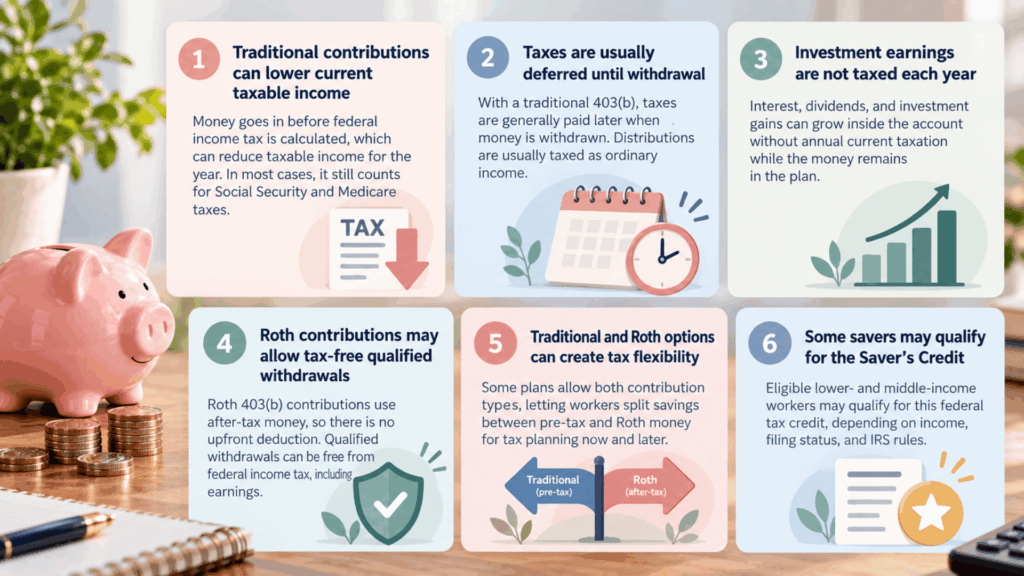
The tax benefit of a 403(b) depends on the type of contribution used. Traditional and Roth contributions follow different tax rules, which can affect when you pay taxes and how withdrawals are treated later.
1. Traditional Contributions Can Reduce Current Taxable Income
Money contributed to a traditional 403(b) is taken from pay before federal income tax is calculated. This can lower taxable income for the year, which may reduce the federal income tax owed.
The contribution still counts as compensation for Social Security and Medicare taxes (FICA) in most cases, so the tax benefit mainly applies to federal income tax.
2. Taxes on Traditional Contributions are Deferred
A traditional 403(b) does not eliminate taxes. Instead, the tax is usually deferred until you withdraw money from the account.
This can help workers who want the tax benefit while earning income and pay tax later when taking retirement distributions.
Withdrawals are generally treated as taxable income when you receive them.
3. Investment Earnings Are Not Taxed Each Year
Money inside the account can earn interest, dividends, or investment gains without being taxed annually while it remains in the plan.
This allows the full invested balance to stay in the account instead of losing part of the yearly return to current income taxes. For traditional 403(b) money, you generally pay tax when you withdraw those earnings.
4. Roth Contributions Can Lead to Tax-Free Qualified Withdrawals
A Roth 403(b) uses after-tax money, so there is no tax deduction when the contribution is made.
Qualified Roth withdrawals can be free from federal income tax, including the investment earnings, if IRS requirements are met.
This can let workers pay tax on the money now instead of in retirement.
5. Traditional and Roth Contributions Can Offer Tax Flexibility
Some workplace plans allow both traditional and Roth contributions. When both are available, employees may split their money between pre-tax and Roth contributions instead of choosing only one.
One portion may provide a tax break now, while the Roth portion may provide tax-free qualified withdrawals later.
6. Some Workers May Qualify for the Saver’s Credit
Certain lower and middle-income workers may qualify for the Retirement Savings Contributions Credit, also called the Saver’s Credit.
Eligible 403(b) contributions can count toward this credit.
The amount depends on your adjusted gross income, filing status, and other IRS rules, so not everyone will qualify.
Starting in 2027, the Saver’s Match replaces the Saver’s Credit for retirement contributions. It can add up to $1,000 per year directly to your retirement account.
How Much Can You Contribute to a 403(b)?
The amount you can contribute to a 403(b) depends on the type of contribution, age, compensation, and any applicable catch-up rules.
Standard Employee Contribution Limit
In 2026, an employee can contribute up to $24,500 through salary deferrals. This is the limit for money taken from pay and directed into the plan.
Age 50 and Older Catch-Up
Employees who are at least 50 by the end of 2026 may be able to contribute an additional $8,000 if the plan allows catch-up contributions. This amount is added to the regular employee limit.
Higher Catch-Up for Ages 60 to 63
Employees who are ages 60, 61, 62, or 63 during 2026 can have a higher catch-up limit of $11,250 instead of the standard $8,000 catch-up.
This rule comes from changes under SECURE 2.0.
Total Employee and Employer Limit
The combined amount added to the account is limited to the lesser of $72,000 in 2026 or 100% of the employee’s includible compensation for the most recent year of service.
This total can include employee deferrals, employer contributions, and certain other additions.
Special 15-Year Service Rule
Some employees with at least 15 years of service with the same qualifying employer may be able to contribute extra money.
If the plan allows it, the additional amount is generally limited to the smallest of $3,000, a lifetime calculation based on earlier use of the rule, or another amount based on years of service and past contributions.
Limits May Apply Across More than One Plan
The employee salary-deferral limit can be affected when someone contributes to more than one workplace retirement plan, such as both a 403(b) and a 401(k).
403(b) vs Other Retirement Plans
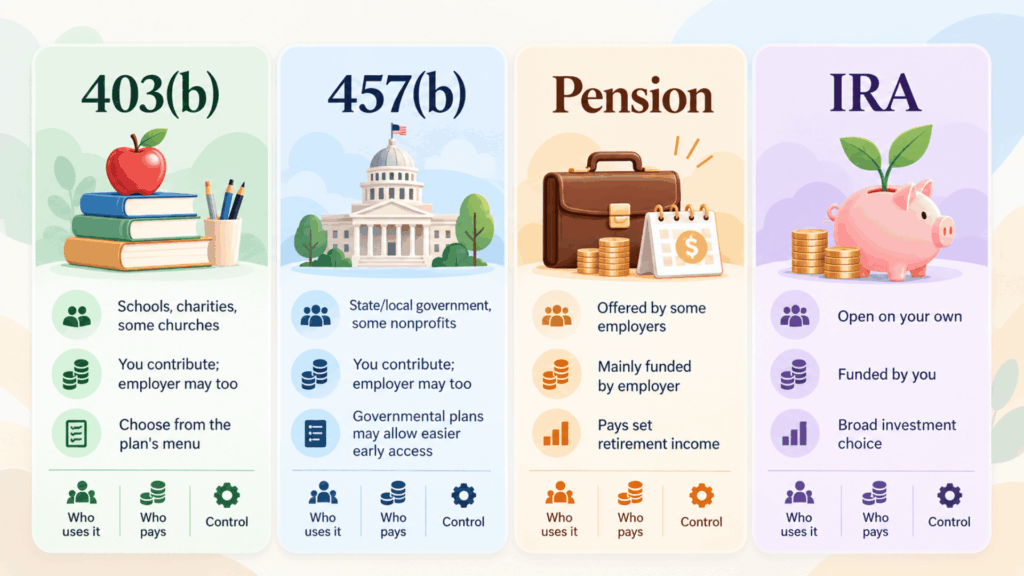
A 403(b) is one of several plans a worker may see in a benefits packet. The main differences are who offers the plan, who funds it, and how much control you have over the money.
|
Features |
403(b) |
457(b) |
Pension |
IRA |
|---|---|---|---|---|
|
Who can use it |
Public schools, certain 501(c)(3)s, some churches |
State and local governments, some nonprofits |
Employers that offer one |
Anyone with earned income |
|
Who pays in |
You, plus your employer if the plan allows |
You, plus your employer if the plan allows |
Mainly the employer |
You only |
|
2026 limit |
$24,500, plus catch-ups (including the 15-year rule) |
$24,500, separate from a 403(b) limit, with its own catch-up |
None; payout set by a formula |
$7,500, plus $1,100 if 50 or older |
|
Roth option |
If the plan offers it |
If the plan offers it |
No |
Yes, with income limits |
|
Investments |
You choose from the plan’s menu |
You choose from the plan’s menu |
The plan manages it |
You choose freely |
|
Early access |
A 10% penalty before 59 1/2 |
No 10% penalty after leaving a governmental job |
Monthly income after age or service rules |
A 10% penalty before 59 1/2 |
Note: A 401(k) works much like a 403(b), with the same contribution limit and a similar Roth option, but it is offered by private-sector, for-profit employers rather than public schools and nonprofits.
When Can You Withdraw Money From a 403(b)?
A 403(b) is meant for retirement, so you can’t always take money out whenever you need it. The IRS allows distributions after certain events, but the exact options also depend on what the employer’s plan permits.
-
After reaching age 59 1/2: A plan may allow withdrawals once the employee reaches age 59 1/2, even if employment has not ended. Traditional 403(b) withdrawals are included in taxable income.
-
After leaving the employer: A distribution may become available after retirement, resignation, termination, or another severance from employment. The worker may be able to take the money or roll an eligible distribution into another retirement plan.
-
After becoming disabled: Some plans permit access when the participant meets the applicable disability requirements. The plan documents should explain how disability is defined and what paperwork is needed before the plan can approve a distribution.
-
For certain financial hardships: A plan may allow a hardship distribution for an immediate and heavy financial need. Hardship withdrawals are not automatically available in every 403(b), and money taken this way is generally not repaid to the account.
-
Following the participant’s death: Money remaining in the account can be distributed according to the plan’s beneficiary and distribution rules after the participant dies.
The Bottom Line
A 403(b) can be useful when it fits the benefits offered by an eligible workplace and matches the way someone wants to save for retirement.
The key is to look beyond the account name and check the details that affect the final balance, such as fees, investment choices, employer contributions, vesting rules, and withdrawal conditions.
Those details can vary from one plan to another. Before making changes, read the plan documents and carefully compare the available options.
If anything is unclear, contact the plan administrator or a qualified financial professional for help with the specific rules that apply.
Frequently Asked Questions
Can You Roll a 403(b) Into an IRA?
Yes, you can roll an eligible 403(b) distribution into an IRA or another eligible retirement plan. A direct rollover can help avoid having the distribution paid to the participant first, which may affect tax withholding.
Can You Have More Than One 403(b)?
Yes, a worker may have more than one 403(b), especially after changing employers. However, the IRS can apply contribution limits across multiple accounts, so you need to track contributions carefully to avoid exceeding the annual limit.
What Happens to a 403(b) When You Change Jobs?
The money already in the account usually remains there unless the plan requires a different action. Depending on the plan and balance, the participant may leave the money in the old plan, roll it into another eligible retirement account, or take a distribution.
Quick ReferenceAcronyms and Abbreviations
Essential Terminology
|
|---|