

Not every legal problem comes with a price tag that fixes it. Some situations move too fast, cut too deep, or risk doing damage that can’t be undone later. In those moments, courts don’t wait around for the final tally of losses.
Instead, they step in with a different kind of power, one that focuses on control, not compensation.
This is where injunctive relief comes into play: a legal tool designed to stop actions in their tracks or require someone to take immediate steps before the situation escalates further.
What Is Injunctive Relief?
Injunctive relief is what a court uses when “just paying for the damage” doesn’t solve the problem.
Instead of waiting for harm to play out, the court steps in early and sets clear boundaries on what someone can or cannot do.
It can work in two ways: it may block a person or business from continuing a certain action, or it may require them to take a specific step to fix or prevent the issue.
The focus is not on compensation after the fact, but on stopping the situation from getting worse in real time.
What Is Equitable Relief?
Equitable relief is a court-ordered remedy that directs conduct instead of awarding money, and injunctions are just one form of it alongside specific performance, rescission, and reformation.
Who decides equitable relief?
A judge does, not a jury, using discretion to grant it only when standard legal remedies would leave the wrongdoing inadequately resolved.
The Core Idea Behind Injunctions
Injunctions are not about settling scores after damage is done. They step in at the right moment, when actions can still be controlled and outcomes shaped.
This makes them among the most practical tools courts use when situations start to go in the wrong direction.
Prevention Over Compensation
Courts don’t treat every dispute as something to be paid off later. In some cases, waiting for a final judgment allows harm to grow or become irreversible. Injunctions interrupt the action itself.
Instead of calculating losses after the fact, the focus is on stopping behavior before it crosses a point of no return.
Equity in Action
Injunctions fall under equity, meaning decisions are guided by fairness rather than strict formulas. This makes rulings more situational than mechanical.
Judges look beyond technical violations and consider what outcome feels balanced in real terms. If strict legal rights create an unfair result, equity allows the court to adjust the response to fit the situation.
The goal is simple: control the situation while it still can be controlled.
What Are the Four Factors for Injunctive Relief?
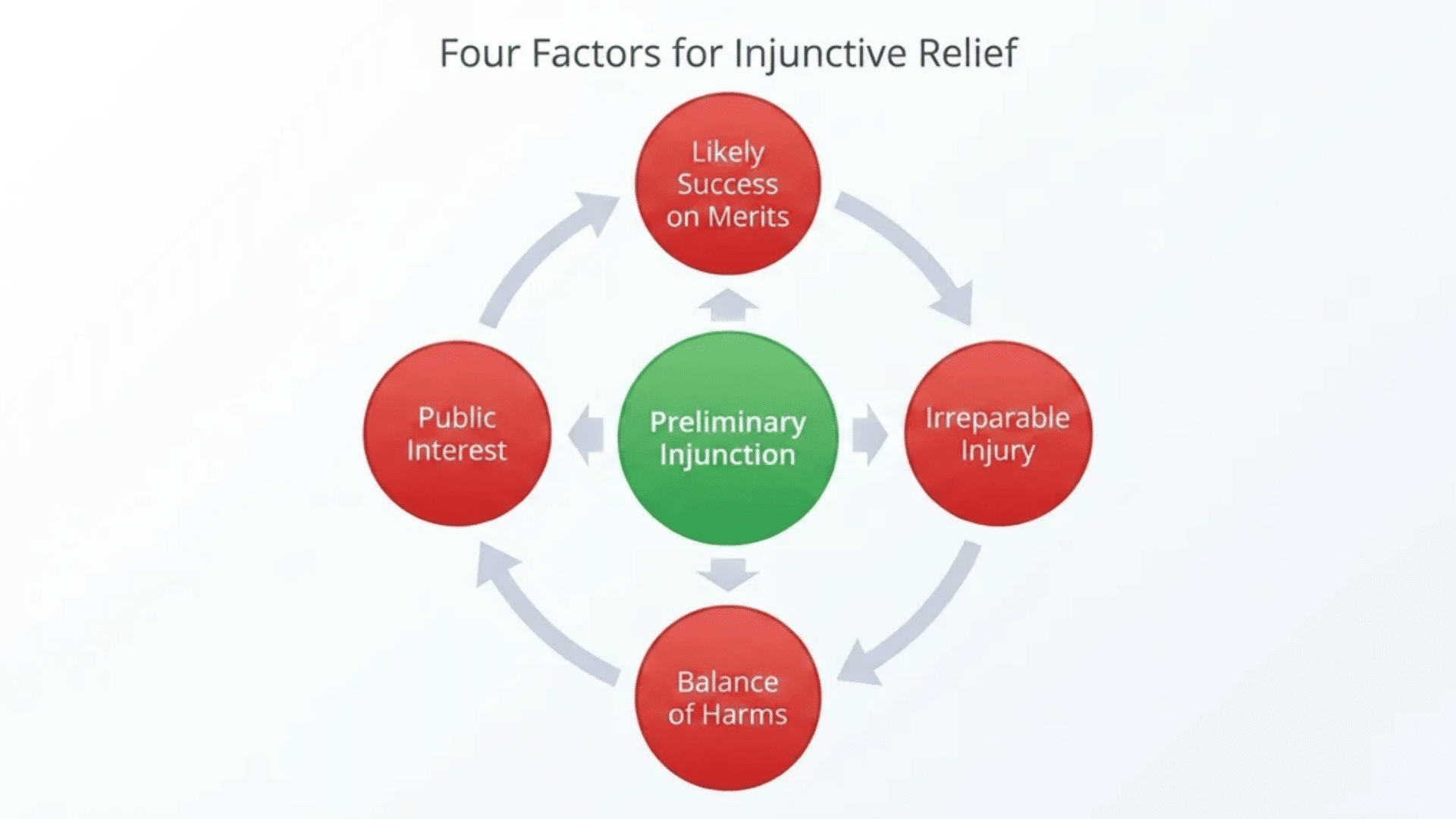
To obtain a preliminary injunction, a plaintiff must generally satisfy four key requirements before a court agrees to step in and restrict or direct conduct. These factors help the judge decide whether immediate intervention is justified.
First, the plaintiff must show a likelihood of success on the merits, meaning there is a strong legal basis to believe they will ultimately win the case.
Second, there must be irreparable injury, where the harm cannot be adequately fixed with money or later remedies.
Third, the court weighs the balance of harms, comparing the impact on both sides to see who would suffer more if the injunction is granted or denied.
Finally, the court considers the public interest, ensuring that the decision aligns with broader societal fairness and not just private advantage.
Types of Injunctive Relief You’ll See in Court
Not all court orders work on the same timeline. Some act instantly, some hold things steady, and others stay in place long after the case ends.
Injunctive relief comes in different forms depending on how urgent the situation is and what the court needs to control.
| Type | What It Does | When It’s Used |
| Temporary Restraining Order (TRO) | Acts as an immediate pause button on a situation before things escalate further | When something urgent needs to be stopped right away, even before a full hearing |
| Preliminary Injunction | Holds the situation steady while the case is still being decided | During an active lawsuit to prevent changes that could complicate the final outcome |
| Permanent Injunction | Locks in a long-term rule after the court reaches a final decision | At the end of a case when the court decides ongoing restriction or action is necessary |
Each type serves a different stage of urgency, but the purpose stays the same: prevent harm from continuing or becoming irreversible while the legal process runs its course.
When Courts Actually Use It?
Injunctive relief comes into play when waiting for a final judgment would quietly make the problem worse. It’s the legal system stepping in early to keep a situation from tipping over before it can be properly sorted out.
You’ll typically see it surface in cases where control matters more than compensation.
- Intellectual property misuse, where ideas, designs, or content are being used without permission
- Breaches of NDAs or non-compete agreements, especially when confidential information is at risk of spreading
- Property or construction disputes, where work may need to pause until ownership or boundaries are clear
- Harassment or custody-related matters, where immediate protection or restriction is necessary
In each of these, the focus isn’t just on what happened, it’s on what could happen next if nothing is stopped in time.
What Courts Look At Before Granting It
Courts treat injunctions like a high-stakes decision, not a routine fix. Before stepping in, they test whether the situation truly calls for immediate intervention rather than waiting for a final outcome.
They usually weigh a few core questions:
- Whether the damage would be permanent or impossible to fully undo later
- Whether the requesting side has a strong chance of winning the underlying case
- How the impact compares on both sides if the order is granted or denied
- Whether stepping in aligns with broader public interest, not just private gain
It’s less about reacting to conflict and more about deciding whether the clock itself has become part of the problem.
Why Injunctive Relief Is an “Extraordinary” Remedy

Courts don’t hand out injunctive relief like a routine fix. It’s reserved for moments where waiting for the usual legal process would make things worse in a way that can’t easily be undone.
Think of it as the court stepping in early and saying: “This needs to stop, or start, right now.” That kind of urgency is exactly why it sits outside the normal flow of compensation-based outcomes.
Before granting it, judges look closely at whether the situation truly calls for immediate intervention rather than a future payout after harm has already played out. It’s not about convenience; it’s about preventing damage that can’t be reversed once it happens.
Injunctive Relief vs Regular Legal Damages
In simple terms, these two remedies solve problems in completely different ways. One is about controlling behavior, while the other is about settling the aftermath.
| Aspect | Injunctive Relief | Monetary Damages |
| Core Function | Directs actions in real time | Compensates after harm occurs |
| Timing of Relief | Works while the issue is unfolding | Applies after the dispute is decided |
| Legal Focus | Stops or compels conduct | Translates harm into financial value |
| Practical Effect | Changes what happens next | Settles what already happened |
Conclusion
Injunctive relief shows how the legal system can shift gears when situations demand more than a payout. Instead of waiting for outcomes to settle, it allows courts to step directly into ongoing disputes and shape what happens next.
That ability to pause, redirect, or require action makes it one of the most immediate tools in civil law.
But its use always comes with careful scrutiny, since it can reshape real-world behavior before a final decision is reached. That balance between urgency and restraint is what makes it so powerful.
Have you ever come across a situation where stopping something early would have changed everything? Share your thoughts in the comments below.
Frequently Asked Questions
What Is the Difference Between Damages and Injunctive Relief?
Unlike monetary damages, which compensate for past harm, injunctive relief is focused on preventing future harm, particularly when monetary remedies would be insufficient.
How Long Does Injunctive Relief Last?
An injunction generally may be temporary or permanent. A temporary injunction preserves the status quo and the rights of the parties until the court issues further orders. A permanent (or final) injunction may continue after an action concludes, either perpetually or until a specified date.
What Happens if An Injunction Is Ignored?
Financial Penalties: Courts may impose monetary sanctions on those who ignore an injunction. Additional Legal Action: If a person or business continues to violate an injunction, the opposing party may pursue further legal remedies, such as requesting stronger enforcement measures.