

Many HR teams struggle with scattered data and reports that don’t lead to clear decisions. That’s where HRmetrics help.
They turn workforce data into simple signals for hiring, performance, and retention. This makes it easier to spot issues early and take action with confidence.
Here’s what HR metrics are, why they matter, and how they improve hiring, engagement, and workforce decisions.
What are HR Metrics and What Do They Actually Measure?
HR metrics are quantitative measures that track workforce activity and outcomes, providing leaders with a data-driven view of people operations.
Drawn from systems such as HRIS, ATS, and payroll, these metrics capture hiring, retention, and performance data, with common examples including headcount, time-to-fill, absenteeism, and cost per hire.
Raw data only becomes a metric when given meaning through comparison with past periods, benchmarks, or targets.
Their real value lies not in reporting, but in guiding decisions around hiring, retention, and workforce planning.
What Types of HR Metrics Exist, and How Do They Differ from HR Analytics?
It measures workforce activity, while HR analytics interpret what the numbers mean. Metrics are the input; analytics turns them into decisions.
| Type | Question It Answers | Example |
|---|---|---|
| Descriptive | What happened? | Turnover rate last quarter |
| Diagnostic | Why did it happen? | Exit data showing manager-related attrition |
| Predictive | What may happen next? | Flight risk scores using engagement trends |
| Prescriptive | What should be done? | Recommended actions to reduce attrition risk |
Which HR Metrics Matter Most in Real Organizations?
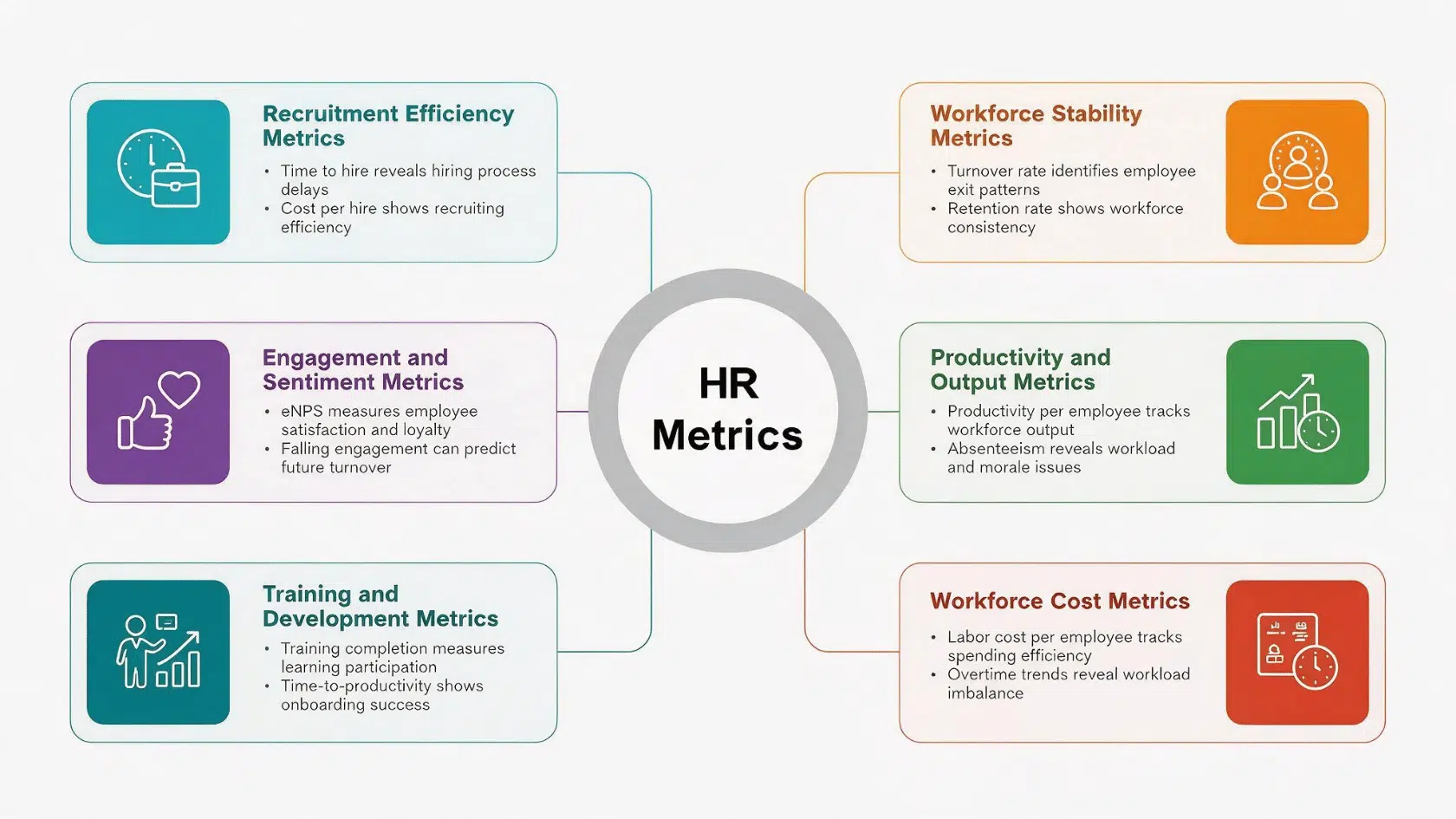
No single HR metric tells the full story. Turnover, engagement, and time to hire work together to reveal patterns of workforce strain that individual metrics alone cannot show.
1. Recruitment Efficiency Metrics
Time to hire measures the days between a job opening and an accepted offer. A rising number signals bottlenecks in sourcing, screening, or approvals that slow down team capacity.
Cost per hire tracks total recruiting spend divided by hires made. High costs paired with high turnover indicate a recruitment process that is not attracting the right candidates.
2. Workforce Stability Metrics
Turnover rate measures the percentage of employees who left during a set period, split into voluntary and involuntary exits. Voluntary turnover often points to management, pay, or culture issues.
Retention rate tracks the percentage of employees who stayed. A high retention rate alongside low engagement scores can signal that employees are staying but are not performing at full capacity.
3. Engagement and Sentiment Metrics
eNPS asks employees how likely they are to recommend the company as a place to work. Scores below zero consistently signal cultural or leadership problems that affect both retention and output.
Falling eNPS scores often precede turnover increases. Tracking both together helps organizations catch workforce dissatisfaction early, before it shows up in resignation numbers.
4. Productivity and Output Metrics
Productivity per employee is calculated by dividing total output or revenue by headcount. A declining figure alongside stable headcount points to engagement, process, or workload distribution problems worth investigating.
Absenteeism rate tracks unplanned absences over time. Rising absenteeism combined with low eNPS and high turnover is a reliable signal of broader workforce health issues across teams.
5. Training and Development Metrics
Training completion rate measures the percentage of employees who complete assigned learning programs within a set period. Low completion rates often point to poor program design, scheduling conflicts, or low manager accountability.
Time-to-productivity measures how long it takes a new hire to reach full output. A long ramp-up period paired with high early turnover signals gaps in onboarding structure or role clarity.
6. Workforce Cost Metrics
Labor cost per employee is the total workforce spend divided by headcount. A rising figure without a corresponding increase in output points to inefficiencies in team structure, overtime use, or compensation planning.
Overtime hours tracked by department reveal problems in workload distribution. Consistently high overtime among specific teams often precedes burnout, absenteeism, and voluntary turnover in those teams.
What Advanced HR Metrics Give Deeper Insight Into Workforce Behavior?
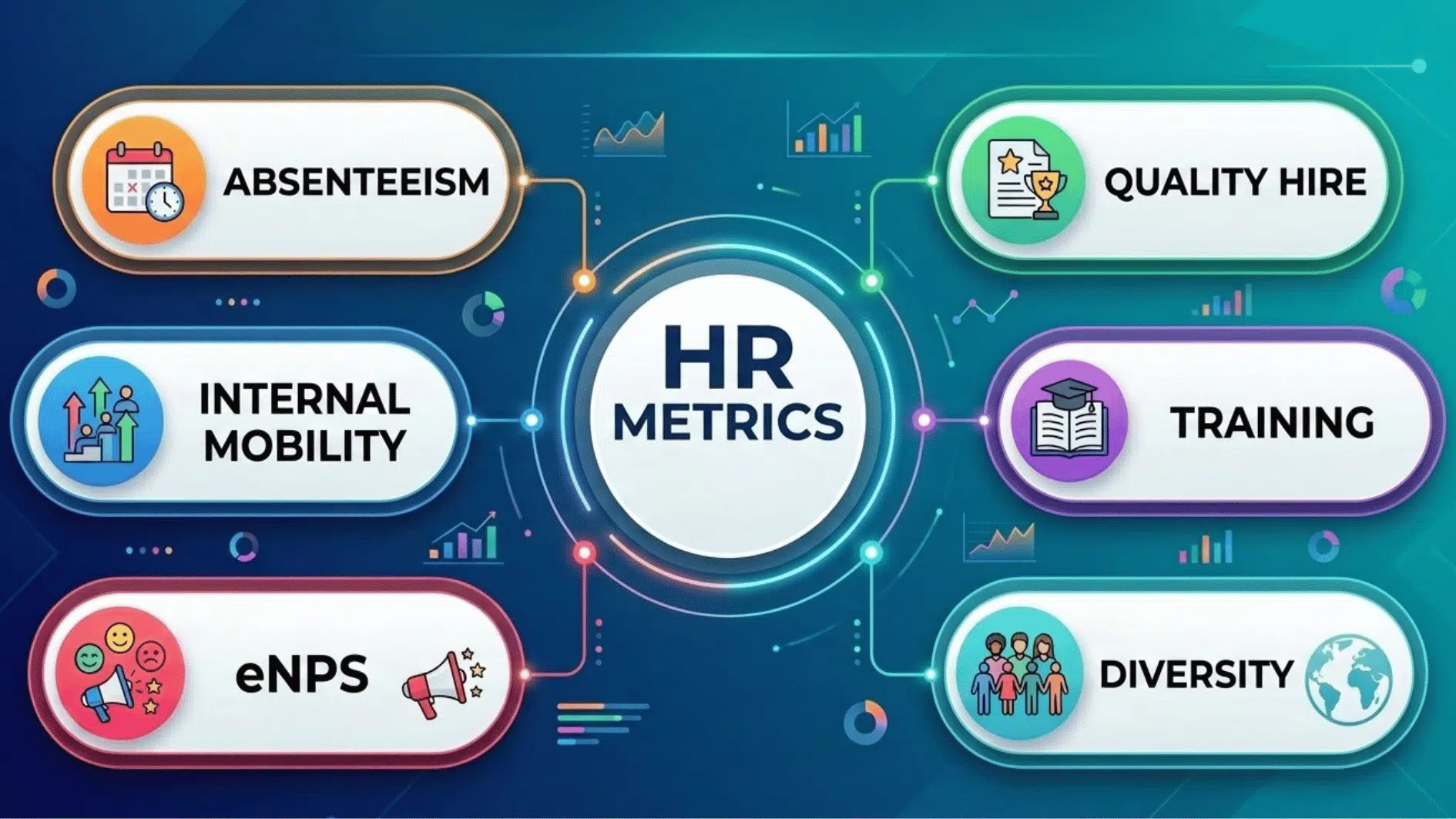
These deeper workforce insights help HR teams identify hidden trends, improve decision-making, and understand what influences employee experiences.
1. Absenteeism Rate and Engagement Risk
The absenteeism rate tracks unplanned absences over a set period, often revealing problems before they surface as formal complaints or resignations.
- Rising absence frequency in specific teams can signal early disengagement or burnout
- Patterns matter more than totals, especially frequent short absences from high performers
- Combined with falling engagement scores, these patterns point to workload or management issues
Catching these signals early lets HR step in before absenteeism turns into turnover.
2. Quality of Hire and Long-Term Hiring Effectiveness
Quality of hire measures how successful a hiring decision really is, looking beyond recruitment speed and cost to whether an employee actually performs and fits in.
- Tracks how well a new employee performs in their role over time
- Shows whether they fit the culture and stay with the company beyond the first year
- Combines performance ratings, retention data, and manager feedback to reveal the true picture
It helps HR move from simply filling roles to making smarter, higher-impact hiring decisions.
3. Internal Mobility Rate and Talent Development Strength
Internal mobility rate tracks how often employees move into new roles, teams, or levels within the organization, offering a clear signal of growth opportunities.
- A low rate often points to unclear growth paths or managers not developing their people
- Strong internal mobility typically correlates with lower voluntary turnover
- Employees who see a path forward are less likely to look for opportunities outside
This reduces hiring costs and prevents the loss of institutional knowledge when people leave.
4. Training Effectiveness and Skill Development ROI
Training effectiveness focuses on whether learning programs actually improve real on-the-job performance, not just attendance or completion.
- Training effectiveness measures real improvement in workplace performance
- Completion rates show participation, not skill application
- Pre- and post-training scores plus manager feedback reveal true impact
It helps HR identify which training programs deliver real value and which need improvement or replacement.
5. Employee Net Promoter Score (eNPS)
eNPS is a quick and simple way to measure how employees feel about working at an organization and whether they would recommend it to others.
- Measures the likelihood that employees would recommend the organization as a workplace
- Offers a quick sentiment signal without needing a full, lengthy survey
- A drop in eNPS often signals rising disengagement before turnover actually increases
This makes eNPS an early indicator of employee sentiment and potential retention risks.
6. Diversity and Inclusion Metrics in Workforce Composition
DEI metrics measure representation and equity across hiring, promotion, pay, and leadership levels within an organization.
- DEI metrics track representation across hiring, promotion, pay, and leadership levels
- They uncover structural gaps hidden by overall workforce averages
- They can reveal weak retention or progression for underrepresented groups at specific levels
DEI metrics help organizations identify patterns of inequality and improve fairness in workforce outcomes.
Note: Predictive and AI-driven workforce signals, including attrition modeling and engagement forecasting, are evolving rapidly. Any benchmarks or thresholds used in these models should be validated against current data systems before informing major workforce decisions.
How Do HR Metrics Drive Decisions and Business Outcomes?
It follow a clear sequence: data collection, metric calculation, trend analysis, benchmarking, insight generation, HR intervention, and outcome measurement.
Many organizations collect data but fail to act on it.
| Stage | What it means |
|---|---|
| Data collection | HRIS, ATS, and payroll capture workforce data. |
| Metric calculation | Data becomes metrics like turnover and cost per hire. |
| Trend analysis | Time-based comparison shows workforce changes. |
| Benchmarking | Results are compared with industry standards. |
| Insight generation | Patterns highlight issues or risks. |
| HR intervention | Actions are taken in hiring, retention, or training. |
| Outcome measurement | Results show whether actions worked. |
HR systems fail when data is poor or disconnected. Metrics only create value when insights lead to action.
How Do You Choose the Right HR Metrics for Your Organization?
It should be chosen based on clear decision logic: align them with business goals first, then adjust for company size, industry, growth stage, and workforce model.
- Builds Confidence: Practicing different acrylic techniques helps you gain control over the medium and paint with greater confidence.
- Creates Unique Textures: From smooth blends to thick, raised strokes, each technique adds a distinct visual effect to your artwork.
- Improves Color Control: Learning layering, glazing, and blending helps create richer colors, realistic shadows, and vibrant highlights.
- Expands Creative Possibilities: Combining multiple techniques lets you achieve a wide range of artistic styles and finishes.
- Works for Every Skill Level: Most acrylic techniques are beginner-friendly yet offer plenty of room for advanced experimentation.
- Makes Paintings More Dynamic: Using varied brushwork and textural techniques adds depth, movement, and visual interest to every composition.
Final Thoughts
HR metrics give organizations the clarity needed to move from guesswork to grounded workforce decisions.
Tracking the right numbers across hiring, retention, engagement, and performance helps leaders act earlier, spend smarter, and build teams that actually hold together over time.
The difference between organizations that struggle and those that grow consistently often comes down to how well they read and act on their workforce data.
Start with a small set of meaningful HR metrics tied to your current business goals, and build from there.
Have questions or thoughts about HR metrics? Drop them in the comments below.
Frequently Asked Questions
What Is the Ideal Number of HR Metrics a Company Should Track at One Time?
Most experts recommend tracking 8 to 12 metrics tied directly to active business goals. More than that creates noise rather than clarity.
Can Small Businesses Benefit from Tracking HR Metrics the Same Way Large Companies Do?
Yes. Even three to five consistent metrics can help small businesses catch hiring and retention problems before they become costly.
How Often Should HR Metrics Be Reviewed and Updated Across an Organization?
Most organizations review core metrics monthly and audit their full set of metrics quarterly to keep them aligned with current business goals.