

Change leadership is the ability to inspire employees, set a clear vision, and guide teams through uncertainty and organizational transformation.
Unlike routine administration, it focuses on the human side: building trust, creating urgency, and helping people adopt new mindsets and behaviors.
Common Models and Frameworks Behind Change Theory
Change leadership has evolved from Kotter’s step-by-step model into a flexible, people-centered approach that emphasizes continuous change. Alongside Kotter’s framework, the following two models are widely referenced.
Lewin gives the big picture, Kotter gives the steps for leaders, and ADKAR shows how individuals experience change.
What Roles Does Leadership Play in Organizational Change?
Leaders shape whether a change succeeds or stalls, and common leadership weaknesses like poor communication are often what slows it down.
Drawing on Kotter’s widely cited 1995 Harvard Business Review article on why transformation efforts fail, their role comes down to five actions:
-
Set the Vision and Explain the “why”: People support change when they understand the reason for it and where it leads.
-
Build a Coalition of Supporters: A group of committed allies carries the change further than one leader can alone.
-
Remove Obstacles: Leaders apply practical management strategies to clear away outdated processes, unclear structures, or resistant systems that block progress.
-
Model the New Behavior: Teams follow what leaders do, not just what they say, which is the heart of transformational leadership.
-
Celebrate Early Wins: Visible progress, paired with recognizing employee contributions, builds confidence and maintains momentum.
How to Build Effective Change Leadership Skills
Great change leadership starts with simple, repeatable habits. Use these six steps to build trust and help people move forward with confidence.
1. Define the Case for Change
Start by explaining why the change is needed and what will improve because of it. When people understand the reason, they are far more likely to support it.
Even the U.S. government treats this as a core skill: OPM’s leadership competency framework expects senior federal managers to lead with vision and manage change.
Keep the message simple, honest, and easy to repeat.
Example: A company is moving to a new project management tool. Instead of just announcing the switch, the leader explains that missed deadlines are costing client trust and the new tool will give everyone one clear view of tasks.
2. Name Visible Sponsors
Choose senior leaders who openly back the change and are seen supporting it.
Their presence shows that the change is a real priority. It also gives employees someone to turn to with questions or concerns, much like an open-door policy.
Example: During a company-wide restructure, the department head joins team meetings, answers questions in person, and shares progress updates. Employees see the change has real leadership backing.
3. Involve Employees Early
Bring people into the process before decisions are final. Ask for their ideas, include a few employee engagement survey questions, listen to their concerns, and use their input where you can.
People support what they help build, so early involvement reduces resistance.
Example: Before rolling out a new customer support system, a manager invites frontline agents to test it and share feedback. Their suggestions shape the final setup, and they become early supporters of the change.
4. Communicate Often and in Both Directions
Share updates regularly, and don’t wait until everything is settled. Just as important, create ways for employees to ask questions and give feedback.
Example: During a merger, leaders send a short weekly update and hold open Q&A sessions. When employees raise worries about job roles, leaders respond openly instead of letting rumors spread.
5. Train Managers to Lead Their Teams Through It
Managers are the people employees turn to first during change.
Give them the knowledge, tools, and confidence to explain the change and support their teams. When managers feel prepared, their teams feel more secure.
Example: Before a new performance review process launches, HR trains all team managers on how it works and how to answer common questions.
6. Measure Adoption, Not Just Completion
Finishing a project doesn’t mean people are actually working in the new way.
Track whether employees are using the new process, tool, or behavior in daily work.
Example: A new software system goes live on schedule, but a month later, leaders notice most teams still use old spreadsheets. By tracking usage, they find the gap and offer extra training and support.
Change Leadership vs. Change Management
The two terms sound alike, but they do different jobs. This table shows where they differ and how they work together.
| Feature | Change Leadership | Change Management |
|---|---|---|
| Focus | Vision, direction, and motivating people | Plans, processes, and getting tasks done |
| Scope | The human side of change: mindset, trust, and commitment | The practical side of change: timelines, budgets, training, and tools |
| Who Owns It | Senior leaders and sponsors, supported by managers | Project teams, change managers, and HR |
| Time Horizon | Long-term, from the first idea to lasting culture shift | Short to medium term, within the project timeline |
| Approach | Flexible and people-centered | Structured and step-by-step |
| Key Activities | Setting vision, building buy-in, modeling new behavior | Scheduling, risk tracking, training delivery, reporting |
| Measure of Success | People believe in the change and adopt it | The change is delivered on time, on budget, and as planned |
Are There Any Drawbacks of Change Leadership?
Yes, change leadership has a few drawbacks. It is hard to measure, takes time, and can fall short when it is not backed by solid planning and follow-through.
-
Hard to Measure: Trust and buy-in are difficult to turn into clear numbers.
-
Takes Time: Building trust and winning people over can’t be rushed.
-
Over-Reliance on the Leader: Change can lose momentum if it depends on one person.
-
Vision without Follow-Through: Inspiring messages fall flat without a plan to deliver.
-
Risk of Leader Burnout: Carrying the emotional weight of change can be exhausting.
-
False Confidence: Enthusiasm at the top can hide real problems below.
Overall, these drawbacks are best managed by pairing change leadership with strong change management, so vision and execution work together.
The Change Leadership Role is Expanding Today
Change now happens all the time because of new technology, remote work, and fast-moving markets. Leaders can no longer treat change as a single project with a start and an end.
As a result, the role now covers much more than sharing plans. Leaders help people learn new tools, including AI, and get used to new ways of working.
They listen to feedback, build trust, and support teams through one change after another.
The role is also more widely shared. Managers and team leads now lead change in their own teams, not just senior executives.
What are the 5 C’s of Change (A Simple Framework for Leaders)
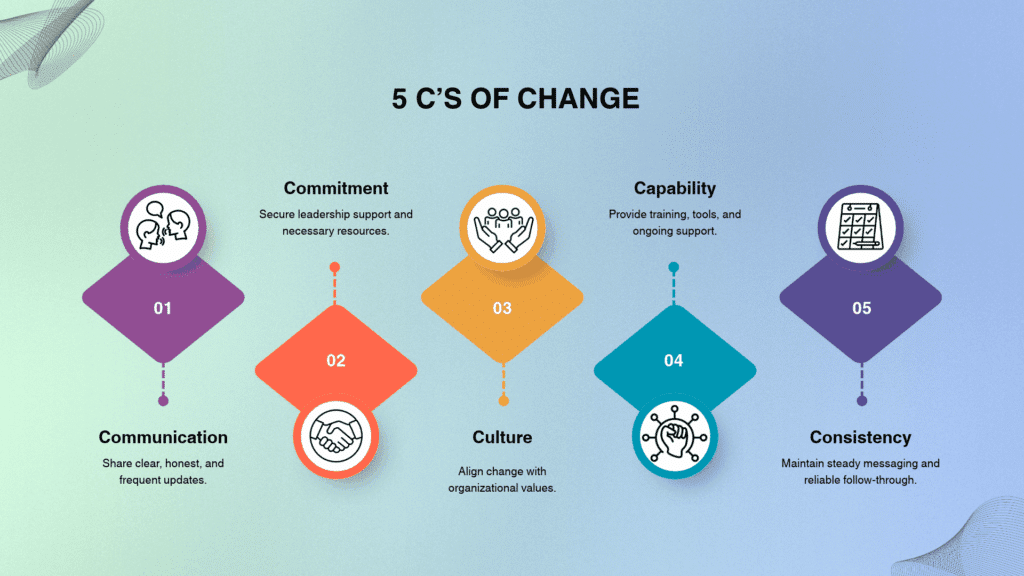
For organizations facing a major shift, the 5 C’s of change management provide a practical framework that keeps the focus on people, not just processes.
Versions vary slightly, but the most common one covers the following five core elements:
-
Communication: Share clear, honest updates often so employees understand why the change is happening and how it affects their work.
-
Commitment: Get visible backing from leaders and stakeholders, including the time, budget, and resources the change needs to succeed.
-
Culture: Connect the change to your company’s values and everyday norms so it feels like a natural fit, not a disruption.
-
Capability: Spot skill gaps early and provide the training, tools, and support people need to work confidently in new ways.
-
Consistency: Keep your messages, actions, and follow-through steady to build trust and stop teams from slipping into old habits.
Conclusion
Determining what is change leadership gives you more than a definition. It gives you a practical way to help people trust a new direction, adopt new habits, and keep going when plans shift.
Teams that feel heard resist less, managers who feel prepared lead with confidence, and organizations that track real adoption see lasting results.
The practical takeaway is simple: pick one change your team is facing now, explain the why, and invite people in early. Start small, measure usage, and build from there.
Ready to lead your next change with confidence? Share this guide with your leadership team and map your first step today.
Frequently Asked Questions
Can Change Leadership Skills Be Learned?
Yes. Most change leadership skills, like clear communication, active listening, and coaching, improve with practice. Workshops, mentoring, and programs such as Prosci certification can speed up the learning curve.
How Do You Lead Change in a Remote or Hybrid Team?
Use video calls for big announcements, keep updates in one shared channel, and schedule regular one-on-ones. Remote employees need more frequent check-ins because they miss hallway conversations and informal cues.
How Do You Show Change Leadership in a Job Interview?
Share a specific story using the STAR method: the situation, your task, the actions you took to win support, and the measurable result, such as faster adoption or fewer complaints.