
Some workplace problems fade with time. Others grow quietly, chipping away at your paycheck, your schedule, or your sense of fairness.
Speaking up feels risky, and staying quiet rarely helps.
The difference often comes down to how you raise the issue. Before you decide your next move, it helps to understand what a grievance is and when your concern counts as one.
What is a Grievance?
A grievance is a formal objection an employee raises when they believe their employer has broken a rule meant to protect them.
That rule can come from an employment contract, a company handbook, a union agreement, or a law such as the federal Fair Labor Standards Act.
The key test is whether the employer violated a specific employee right.
Disliking a coworker’s attitude rarely qualifies on its own, but a manager ignoring a written policy that applies to you usually does.
Any employee can raise a grievance, whether or not they belong to a union.
What are the Common Types of Workplace Grievances?
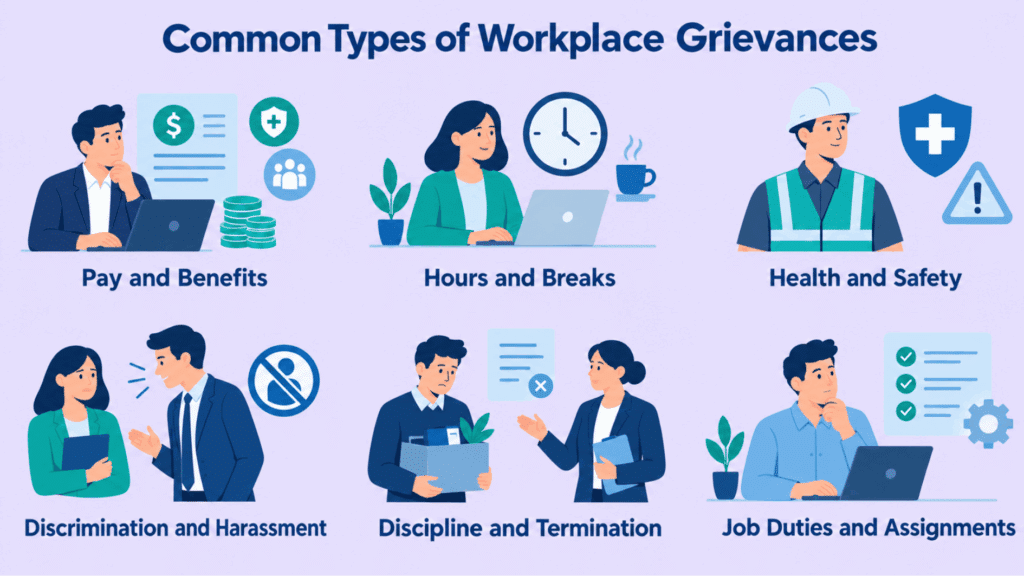
Common workplace grievances fall into a handful of categories. Each one ties back to a right set by a contract, policy, or law.
-
Pay and Benefits: Incorrect paychecks, unpaid commissions, or a denied vacation payout after leaving a job.
-
Hours and Breaks: Weekend or holiday shifts handed out unevenly, or meal and rest breaks cut short.
-
Health and Safety: Missing protective gear, faulty equipment left unrepaired, or hazard reports that go ignored.
-
Discrimination and Harassment: Unequal treatment based on race, sex, religion, age, or disability, which Title VII, the ADEA, and the ADA prohibit.
-
Discipline and Termination: Warnings, suspensions, or firings an employee believes lacked just cause.
-
Job Duties and Assignments: Tasks outside your job description, or transfers that skip over seniority rules.
Grievance Vs Complaint
A complaint is an informal expression of dissatisfaction, usually raised in conversation and settled on the spot. A grievance carries more weight because it moves through an official channel and builds a documented case.
|
Factors |
Grievance |
Complaint |
|---|---|---|
|
Basis |
Requires a specific violation of a stated right |
Can be about anything, such as office temperature or parking |
|
How it’s raised |
Submitted through a form or letter |
Mentioned verbally, in a quick email, or during a meeting |
|
Who handles it |
HR, senior management, or a grievance committee |
Usually the direct supervisor |
|
Process |
Follows set stages with deadlines |
No fixed stages or timeline |
|
Documentation |
Kept on file and can serve as evidence later |
Often goes unrecorded |
What is a Union Grievance?
A union grievance is a dispute over whether an employer has followed the terms of its union contract. Unlike a grievance in a non-union workplace, the union itself is a party to the case and decides how far it goes.
The process covers a large share of the U.S. workforce.
According to the Bureau of Labor Statistics report released in February 2026, 16.5 million wage and salary workers were represented by a union in 2025.
Some of those workers are covered by a contract without being members, and they can still access the same grievance procedure.
A claim can be filed on behalf of an individual worker, a group of workers affected by the same issue, or the union itself when a policy change affects the entire bargaining unit.
Although the union can decline to pursue weak claims, its duty of fair representation means it cannot reject or abandon a case for arbitrary or discriminatory reasons.
How Does the Grievance Procedure Work?
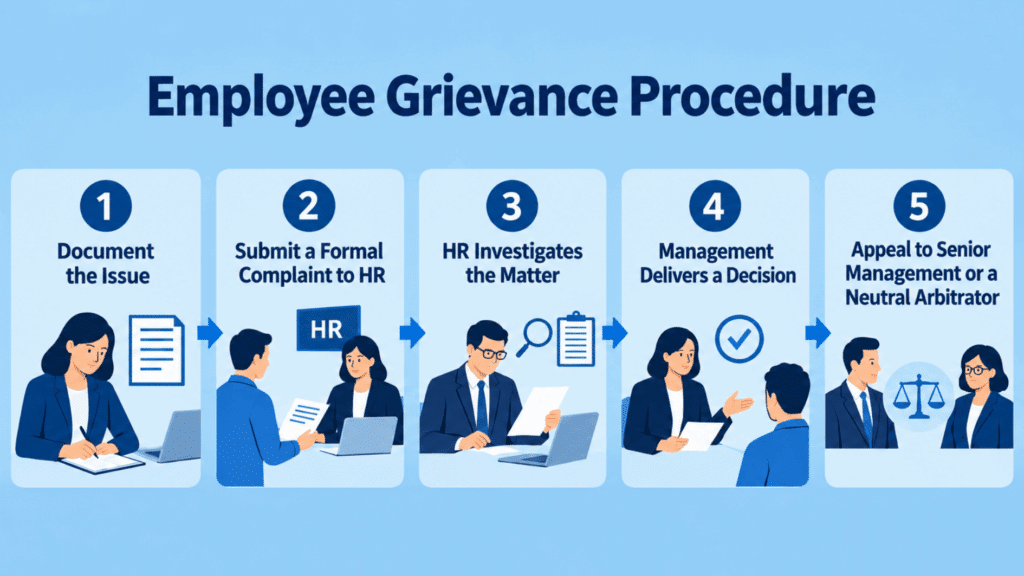
A grievance procedure is the set of steps an employer uses to receive, investigate, and resolve an employee’s concern.
Most companies outline it in an employee handbook or HR policy, with each stage giving both sides a chance to settle the issue before it escalates.
Step 1: Identify and Document the Issue
Start by pinpointing what happened and which policy, contract term, or law it breaks.
Record dates, times, and the names of anyone who saw it, and save supporting proof such as emails, timesheets, or text messages.
Notes made the same day carry more weight than ones pieced together weeks later.
Step 2: Submit the Grievance
Check your handbook for who receives grievances, since it may be HR, your manager’s supervisor, or a designated officer.
Keep a dated copy of what you send and ask for confirmation of receipt. Some employers set a filing window, so acting quickly protects your claim. Union contracts tend to have the strictest time limits.
Step 3: Review and Investigate the Grievance
The employer assigns someone, ideally a person not involved in the dispute, to investigate.
This usually means interviewing you, the person you raised concerns about, and any witnesses, along with reviewing relevant records.
You may be invited to a meeting to explain your side, and some employers allow a coworker to attend with you.
Step 4: Receive a Decision or Resolution
Once the investigation ends, the employer shares its decision, usually in writing, with the reasons behind it.
Read it closely and check whether it addresses every point you raised. If it doesn’t, you can take it further.
Step 5: Appeal or Request Arbitration
If you disagree with the decision, most policies let you appeal to a more senior manager or a panel not involved in the first review. Appeals usually have their own short deadline.
Arbitration, where a neutral third party makes the final call, applies only when an employment contract or signed arbitration agreement requires it. In unionized workplaces, binding arbitration is typically the last step.
How to Write a Formal Grievance at Work
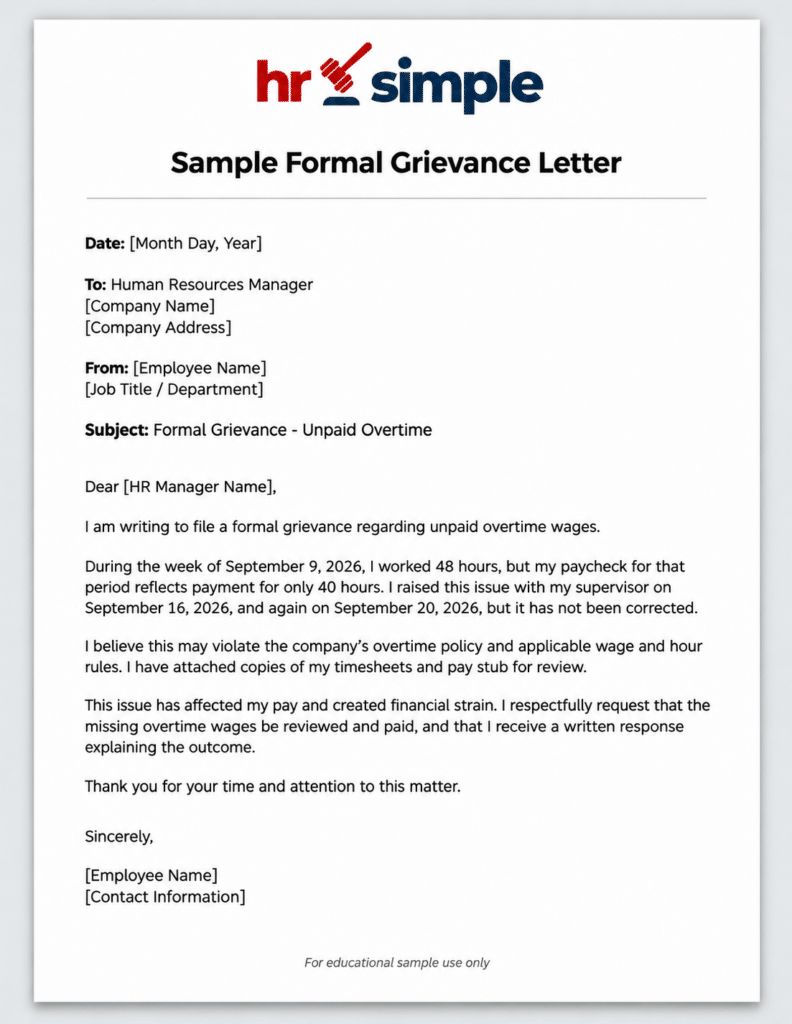
A formal grievance letter states the problem, the rule it breaks, and the fix you want. Keep it to one or max two pages. Write it like a business letter, in a calm, factual tone.
Don’t forget to include these essential parts:
-
Subject line: Use “Formal Grievance – (Your Name), (Date)” so it isn’t mistaken for a routine email.
-
What happened: Give a short, date-by-date account.
-
The rule broken: Name the handbook section, contract clause, or law, such as “Article 12, Section 3 of union contract.”
-
The impact: Say what it cost you, like lost wages or a missed promotion.
-
Your requested remedy: Ask for something specific, such as back pay or removal of a warning.
Possible Outcomes of a Workplace Grievance
A workplace grievance can end in a deal, a fix, or a denial. The result depends on your proof and on what the policy or contract allows.
Informal Settlement or Mediation
Many workplace grievances are resolved through discussion before reaching a formal decision.
If the employee and employer cannot agree, a neutral third party or mediator can help both sides understand the issue and reach a mutually acceptable solution.
Correction of Pay, Benefits, or Records
The employer pays back wages, restores lost leave, or fixes an error in your personnel file.
Changes to Workplace Practices
A grievance may reveal problems that affect other employees. The employer may respond by updating workplace policies, providing manager training, or changing shift schedules and other work practices to prevent similar issues.
Reversal or Change of Discipline
A warning gets removed, a suspension gets shortened, or a fired worker gets their job back.
Rejection with an Explanation
Sometimes, the employer may reject a grievance if the investigation finds insufficient evidence of wrongdoing. However, the employee should receive a clear explanation of the decision and be informed of any available appeal process.
Can an Employer Retaliate Against an Employee for Filing a Grievance?
No, Federal law protects employees from retaliation when they file complaints about workplace discrimination or exercise their union rights.
Under the EEOC’s retaliation guidelines, retaliation can include demotion, reduced hours, unfair disciplinary action, or a negative performance review in response to protected activity.
Petty slights and minor annoyances generally do not qualify.
The National Labor Relations Act also protects employees who participate in union activities or act together to address workplace concerns, even without a union.
Your employer can still discipline you for legitimate reasons unrelated to the complaint.
If you believe you have faced retaliation, document what happened, review what makes retaliation cases strong, and consider contacting the appropriate agency or seeking legal advice.
The Bottom Line
A grievance won’t fix every frustration at work, and it isn’t meant to.
What it does is give a real problem a paper trail and a deadline for someone to respond. That matters most when a conversation has already gone nowhere.
For outside help, the Department of Labor handles pay issues, OSHA handles safety, and the EEOC handles discrimination.
Frequently Asked Questions
Can I File a Workplace Grievance Anonymously?
Yes, some employers accept anonymous grievances, but anonymity may limit their ability to investigate or resolve the issue. Check your company’s grievance policy for details.
How Long Does an Employer Have to Resolve a Workplace Grievance?
There is no universal deadline. The timeframe depends on company policy, employment agreements, or union contracts. Check the applicable procedure for specific response deadlines.
Can I Withdraw a Grievance After Filing It?
Yes, you can generally request to withdraw a grievance. However, in unionized workplaces, the union may decide whether to continue pursuing a case, particularly if it affects other employees.
Quick ReferenceAcronyms and Abbreviations
Essential Terminology
|