

The PI Behavioral Assessment, also known as the Predictive Index, often comes up during hiring when employers want more context on how a candidate may approach work.
For applicants, seeing a behavioral assessment in the recruitment process can raise questions about what it measures and how much the results may influence the final decision.
Knowing what employers are looking for can make the process easier to interpret and help candidates see where PI results fit alongside interviews, experience, and other hiring information
Role of PI Behavioral Assessment in Hiring
The PI Behavioral Assessment is a workplace behavior assessment designed to show how a person naturally approaches work, one piece of a much larger process covered in this guide on how to hire employees.
It looks at behavioral needs related to independence, communication, pace, consistency, and structure, helping employers understand patterns that may not be obvious from a resume or standard interview.
During hiring, employers can compare a candidate’s behavioral pattern with the demands of a specific role. This can help them see how a candidate’s natural work style aligns with the position.
The results are usually considered alongside experience, skills, qualifications, and interview performance. This helps them make the hiring decision.
What Does the PI Behavioral Assessment Measure?
PI Behavioral Assessment results show how the four behavioral drives relate to one another. It helps employers understand the strength and combination of a person’s workplace needs.
- Strength of each drive: Factors farther from the midpoint generally indicate stronger behavioral preferences.
- Behavioral flexibility: Factors closer to the midpoint may indicate greater flexibility depending on the work situation.
- Combined work style: The relationship between Dominance, Extraversion, Patience, and Formality provides more context than any single factor.
- Different patterns, different behaviors: Two candidates with higher Dominance may still work differently if their Formality, Patience, or Extraversion levels vary.
Understanding the Four Behavioral Drives
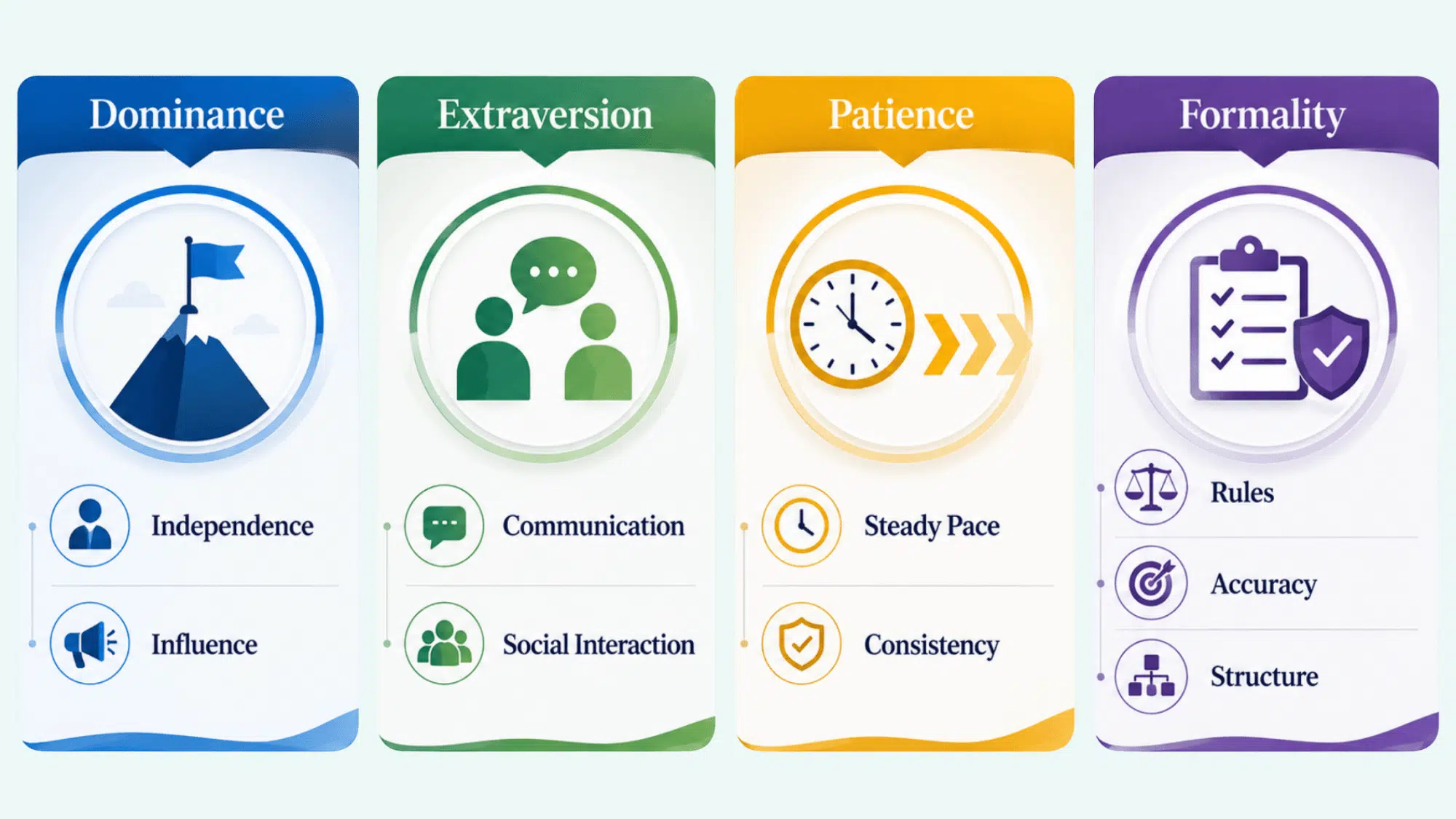
You do not need to memorize complicated profile categories to understand the assessment. The four factors provide the foundation for interpreting the results.
Dominance
Dominance reflects the need to influence people, situations, or outcomes. Someone with higher Dominance may prefer independence, competition, and greater control over decisions.
Someone with lower Dominance may feel more comfortable with cooperation, shared responsibility, and guidance.
For Example
Question: A project needs a quick decision. What would feel more natural?
- A: Take ownership and decide the direction.
- B: Discuss the options and reach a shared decision.
Answer meaning: A may reflect higher Dominance, while B may reflect lower Dominance.
Extraversion
Extraversion measures the need for social interaction. Higher Extraversion may indicate a preference for frequent communication, relationship building, and interaction with others.
Lower Extraversion may point toward privacy, reflection, and more time to process information before responding.
For Example
Question: During a team meeting, how would you usually respond?
- A: Speak openly and build ideas through conversation.
- B: Listen first and think before sharing an opinion.
Answer meaning: A may reflect higher Extraversion, while B may reflect lower Extraversion.
Patience
Patience reflects the need for stability and consistency. Higher Patience may suit people who prefer predictable routines, a steady pace, and continuity.
Lower Patience may indicate greater comfort with changing priorities, variety, and faster-paced work.
For Example
Question: Which work setting feels more comfortable?
- A: A steady pace with familiar routines.
- B: A fast pace with frequent changes.
Answer meaning: A may reflect higher Patience, while B may reflect lower Patience.
Formality
Formality reflects the need for rules and structure. Higher Formality may be associated with clearly defined expectations, accuracy, and established processes.
Lower Formality may indicate a preference for flexibility and greater freedom in deciding how work gets completed.
Predictive Index explains that high and low factor results represent different behavioral needs. One side is not automatically stronger or more desirable.
For Example
Question: How do you prefer to complete an unfamiliar task?
- A: Follow clear instructions and check each detail.
- B: Choose a flexible method and adjust while working.
Answer meaning: A may reflect higher Formality, while B may reflect lower Formality.
What is Factor E in PI Results?
PI results can also include Factor E, known as Objectivity. Factor E can help employers understand how a candidate may approach decisions alongside their broader behavioral pattern.
For example, it may indicate a stronger preference for factual, objective information or a greater reliance on personal judgment and situational cues.
Factor E provides information about decision-making style and how someone may use objective or subjective information.
Current Predictive Index documentation separates Objectivity from Dominance, Extraversion, Patience, and Formality.
What Happens When You Take the PI Behavioral Assessment
Candidates respond to two adjective-based prompts.
The first asks which words describe how they believe others expect them to behave at work. Predictive Index calls this the Self-Concept.
The second asks candidates to choose words that describe how they believe they naturally behave. This is called the Self.
PI analyzes these responses to create an individual behavioral pattern, which typically aligns with one of several recognized Predictive Index profile types, each with its own general tendencies.
PI analyzes these responses to create an individual behavioral pattern. The assessment uses a free-choice format, so candidates are not choosing from traditional right-or-wrong answers.
How PI Results Influence Candidate Evaluation
PI results help employers compare a candidate’s natural work style with a role’s behavioral demands, highlighting areas of alignment and topics to explore during interviews.
- Compare candidate fit: Employers can use PI results to compare a candidate’s natural work style with the behavioral demands of a specific role, alongside the broader job qualities employers seek beyond behavioral fit.
- Define a Behavioral Target: Before reviewing applicants, the hiring team can set a Behavioral Target based on the role’s responsibilities, pace, communication demands, and required level of structure.
- Assess alignment: The candidate’s assessment pattern is compared with the Behavioral Target to identify areas of close alignment.
- Identify interview topics: Strong alignment may indicate that certain job demands match the candidate’s natural preferences, while differences can point to areas that need further discussion, often drawing directly from a set of common screening interview questions built around the role.
- Set role-specific requirements: Predictive Index’s Behavioral Target documentation explains how employers can define behavioral requirements for individual roles.
What Does the PI Match Score Indicate?
PI Hire gives a Match Score from 1 to 10 based on how closely a candidate aligns with the Job Target.
| Element | Meaning | Hiring Note |
|---|---|---|
| Higher Score | Closer behavioral match | Not a performance score |
| Role-Specific | Based on one Job Target | Can vary by role |
| 1–10 Scale | Shows level of alignment | 9 is not always “better” than 6 |
| Match Score Use | Supports candidate comparison | Should not decide hiring alone |
| Other Factors | Skills and experience still matter | Use with interviews and qualifications |
| A Note About PI Match Scores: The PI Match Score measures behavioral alignment with a specific Job Target, not a candidate’s overall ability or future performance. Use it alongside interviews, work experience, skills, qualifications, and other job-related information when making hiring decisions. |
Can a Behavioral Mismatch Affect Hiring?
Yes, but a mismatch does not always mean automatic rejection.
A difference between the candidate’s natural tendencies and the job target can give an employer something specific to discuss during the interview.
Suppose a position involves strict documentation and repeated processes. A candidate’s results suggest a preference for flexibility and frequent change.
The candidate’s answer may show that they have developed effective working habits even when the job demands differ from their natural preferences.
Final Thoughts
The PI Behavioral Assessment measures four workplace drives that help describe how someone may naturally approach independence, communication, pace, and structure.
Employers can compare those results with a Behavioral Target, review the Match Score, and use differences to support more focused interviews, all of which fit into broader recruitment strategies for hiring rather than replacing them.
For candidates, the key point is simple. A behavioral pattern is not a grade on your personality. Its meaning depends on the needs of the particular job.
Frequently Asked Questions
How Long Does the PI Behavioral Assessment take?
The assessment is untimed and usually takes only a few minutes to complete. Predictive Index states that the average completion time is about six minutes.
Is the PI Behavioral Assessment a Personality Test?
It is a workplace behavioral assessment rather than a traditional personality test focused on every part of someone’s personality. Its purpose is to identify behavioral needs and preferences that may influence how a person works.
Can Two Candidates with Similar PI Results Still Perform Differently?
Yes. Behavioral results are only one part of candidate evaluation. Skills, experience, knowledge, motivation, training, management, and the work environment can all affect actual job performance