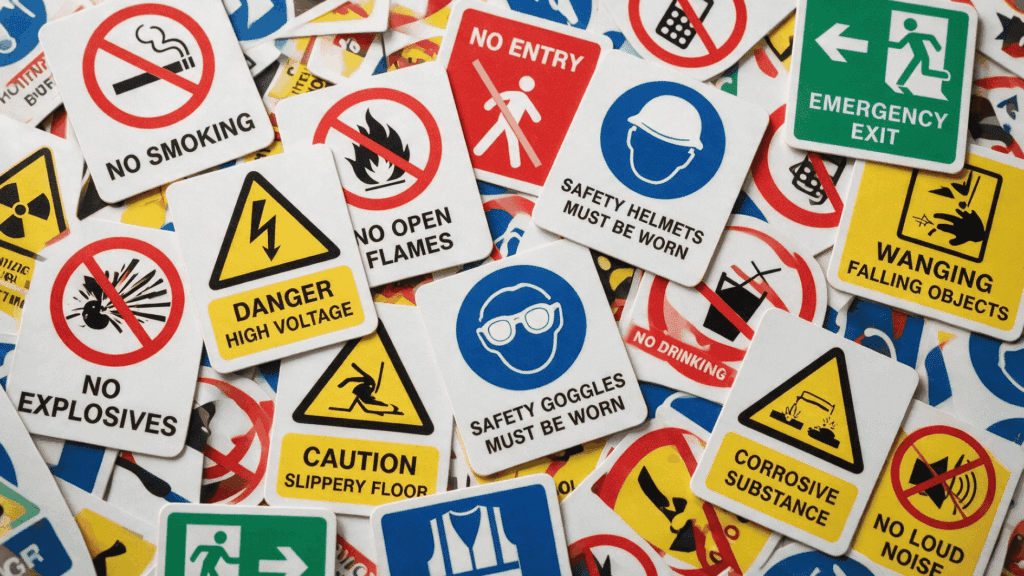

A worker walks past a chemical storage room every day. One missing sign there could mean the difference between a quick exit and a serious injury.
That’s why safety signs are a core part of workplace safety: they warn and instruct people before an accident happens, not after.
Warehouses, factories, hospitals, and construction sites all rely on the same basic system of colors and shapes, even though the hazards on each site look nothing alike.
This post covers the main sign types, what OSHA and ISO require, and what each color and symbol means on site.
What Are Safety Signs in the Workplace?
Safety signs are visual tools placed in work areas to warn people of hazards, tell them what to do, or point them toward help in an emergency.
They rely on color, shape, and symbols, so the message lands before anyone reads a word.
A sign only helps if a worker can react to it in a second or two, which is why every sign type below is built around one clear color and one clear job.
These signs are different from labels stuck directly on a machine or container. A label usually gives operating steps.
A sign covers the area around a hazard, not the hazard itself, so it needs to be readable from a distance before someone gets close.
What Do OSHA and ISO Say About Workplace Safety Signs?
OSHA and ISO both set rules for how signs should look and where they belong. Each one covers different ground.
- OSHA 29 CFR 1910.145: Requires signs for hazards that could cause injury or death. Sets exact wording for “Danger,” “Warning,” and “Caution.”
- ANSI Z535.2: Defines the sign layout OSHA signs typically follow. This covers header color and message panel placement.
- ISO 7010: The international symbol standard. It’s used so a sign means the same thing in any country.
- Employer duty: Post required signs, train staff on their meaning, and replace any that get damaged. Skip this, and you’re inviting the exact unsafe working conditions you were trying to prevent.
- Global sites: Facilities in more than one country often pair ISO 7010 symbols with OSHA-style wording. The two standards are built to share the same sign layout.
What Are the Main Types of Safety Signs in the Workplace?
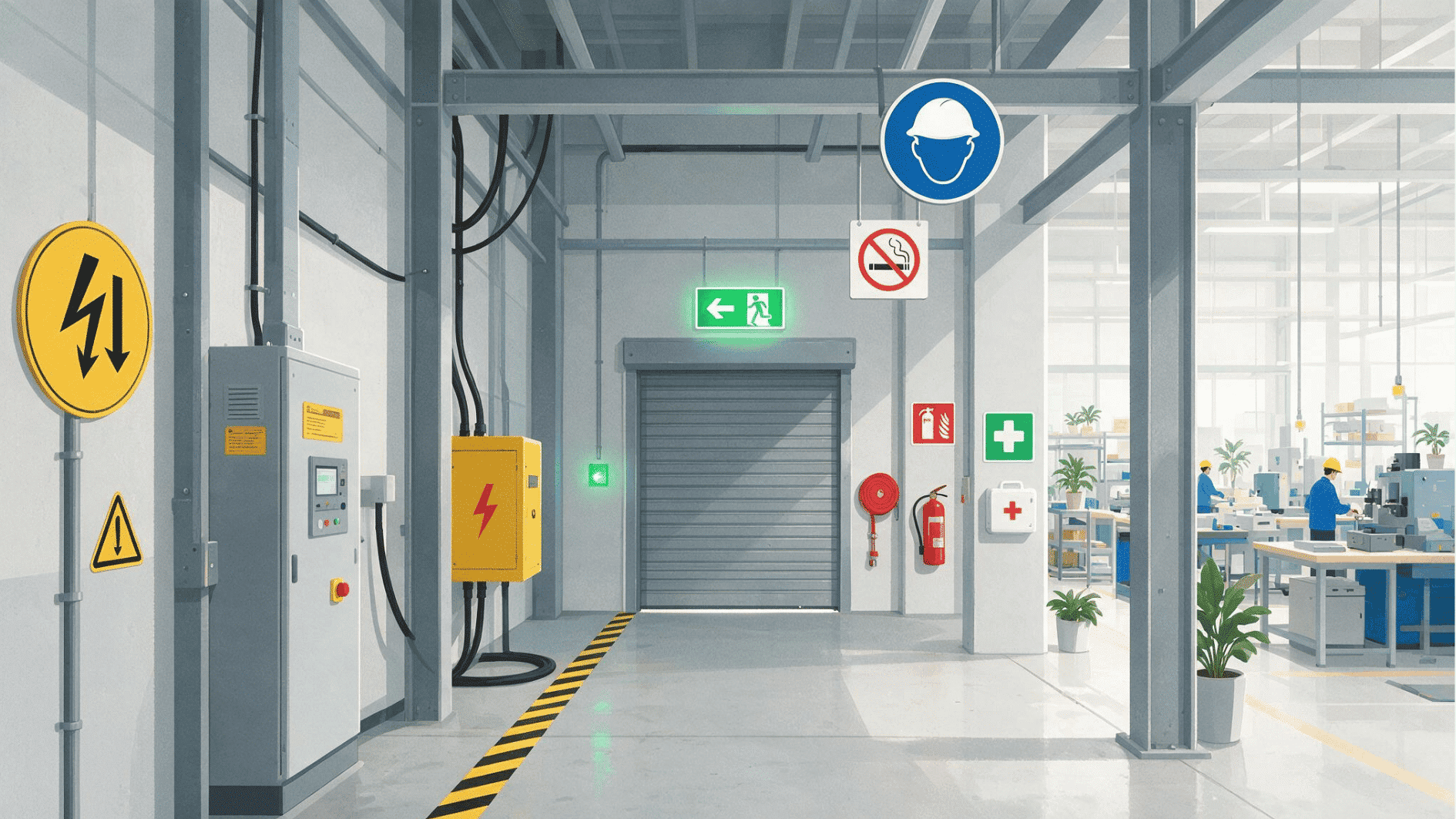
Every job site relies on six sign categories, each covering a different kind of risk. Telling them apart at a glance can be the difference between reacting in time and reacting too late.
1. Prohibition Signs
A prohibition sign, sometimes called a “Do Not” sign, exists to forbid an activity. It’s built on a circular shape, the same one mandatory signs use, so shape alone won’t tell the two apart.
Its job is to stop a behavior before it puts someone at risk. That risk might reach the surrounding area or other workers nearby too.
- No Smoking: Bans smoking near flammable materials or gases.
- No Entry: Blocks access to a restricted or hazardous area.
- No Naked Flames: Prohibits open flames around combustible substances.
- No Pedestrian Access: Keeps people out of vehicle-only zones.
- Do Not Touch: Warns against contact with live or moving parts.
2. Mandatory Signs
A mandatory sign works in the opposite direction from a prohibition sign, though it shares the same circular shape. Instead of forbidding an action, it requires one before a worker can move forward.
- Wear Safety Helmet: Requires individuals to wear a safety helmet.
- Wear Eye Protection: Mandates safety glasses or goggles.
- Wear Ear Protection: Requires earplugs or earmuffs.
- Wear Safety Shoes: Mandates safety shoes or boots.
- Wear Gloves: Requires individuals to wear gloves.
3. Warning Signs
A warning sign flags a hazard that calls for caution. Its triangular shape is what sets it apart from a prohibition or mandatory sign at a glance, even before color registers. It doesn’t suggest the risk is severe enough to threaten life.
- Forklift Traffic: Warns of powered vehicles operating nearby.
- Slippery Surface: Flags wet or slick flooring underfoot.
- High Voltage: Alerts workers to live electrical equipment.
- Hot Surface: Warns of surfaces that can cause burns.
- Trip Hazard: Marks uneven flooring or obstacles in the path.
4. Danger Signs
A danger sign carries far more weight than a warning sign. It’s used only where a hazard could realistically cause death or serious injury if ignored.
That’s why OSHA reserves this category for the most severe risks a site can have.
- High Voltage – Keep Out: Marks equipment that can cause fatal shock.
- Confined Space: Warns of low oxygen or toxic gas buildup.
- Toxic Chemicals: Flags substances fatal if inhaled or swallowed.
- Explosive Materials: Marks storage of highly combustible substances.
- Deep Excavation: Warns of a fall risk into an open pit or trench.
5. Emergency Signs
An emergency sign guides people to safety after something goes wrong. Using a green square or rectangle with a white symbol, it points toward exits, first aid, and assembly points so help is found fast.
- Emergency Exit: Points to the nearest safe way out.
- First Aid Station: Marks where medical supplies are kept.
- Assembly Point: Shows where to gather after evacuation.
- Emergency Eye Wash: Locates the station for flushing eyes.
- Emergency Shower: Marks the safety shower for chemical exposure.
6. Fire Safety Signs
A fire safety sign serves a narrower purpose than an emergency sign. Rather than directing an escape, it marks the location of equipment used to fight a fire directly.
- Fire Extinguisher: Marks the location of a portable extinguisher.
- Fire Alarm Call Point: Shows where to raise the alarm manually.
- Fire Hose Reel: Shows the location of the hose reel for larger fires.
- Fire Blanket: Marks where a blanket is stored for small fires.
- Sprinkler Valve: Identifies the control for the fire-suppression system.
What Do Workplace Safety Sign Colors Mean?
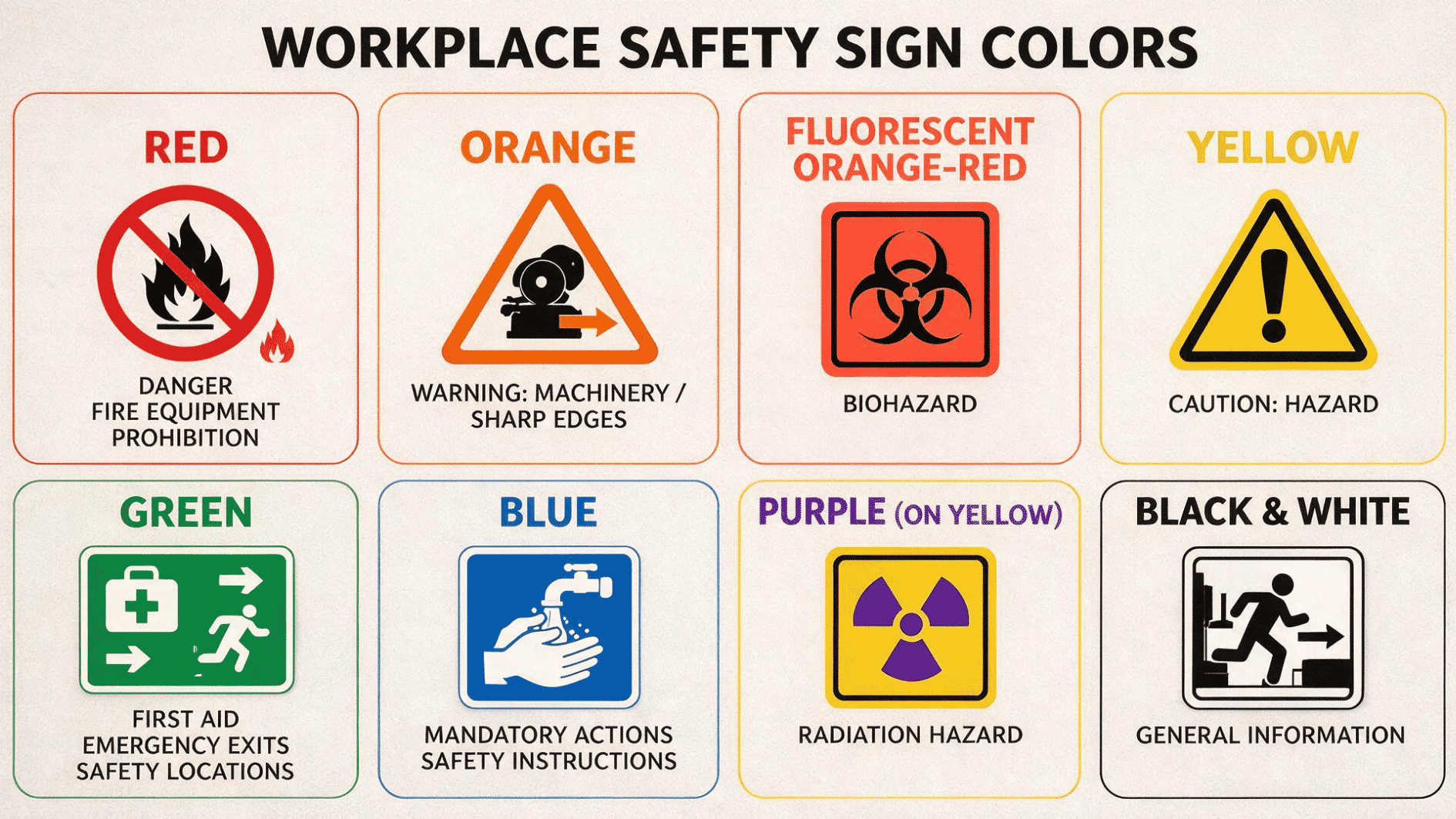
Color is often the first thing a worker notices, faster than any text on the sign.
| Color | Meaning |
|---|---|
| Red | Danger, fire equipment, or prohibition |
| Orange | Moderate risk warning, such as machine hazards or sharp edges |
| Fluorescent orange or orange-red | Biological hazard |
| Yellow | Caution or a general hazard warning |
| Green | Safe condition, first aid, or an exit |
| Blue | A required action, or equipment taken out of service |
| Purple | Radiation hazard, typically shown on a yellow background |
| Black and white | Plain information, no hazard attached |
Why Do Safety Signs Use Specific Colors, Shapes, and Symbols?
Safety signs use specific colors, shapes, and symbols to trigger a fast, near-automatic reaction, often before a worker finishes reading a word. Each element carries a separate layer of meaning that works together.
Color registers fastest. Red signals stop or danger, yellow flags caution, and green marks safety, exits, and first aid.
Shape adds a wordless second cue that holds up in poor light: circles give orders (prohibition and mandatory), triangles warn, and squares inform.
Symbols cross language gaps, so a high-contrast pictogram is recognized faster and remembered longer than text, which is why ISO 7010 standardizes them worldwide.
Layering all three builds redundancy. Miss one cue and the others still carry the message across distance, dim light, and a split-second glance.
How Should Workplace Safety Signs Be Displayed?
Placement determines whether a sign is seen in time.
- Height: Mount at eye level, roughly 60 to 70 inches from the floor.
- Timing: Place the sign before the hazard, not next to or after it.
- Visibility: Keep signs clear of shelving or equipment, and light the area well.
- Upkeep: Check on a set schedule and swap out any sign that’s faded or cracked. It’s the same discipline an OSHA-compliant first aid kit needs.
- Language: Add a second language if the workforce isn’t all fluent in one.
- Material: Use weather-resistant aluminum or vinyl outdoors, since paper or standard plastic signs fade and warp fast.
Conclusion
Safety signs in the workplace only work when they’re the right type, in the right place, and kept in good shape.
A missing or faded sign doesn’t just look sloppy. It removes the one-second warning a worker might need to avoid an injury. It can also draw an OSHA citation during an inspection.
Treat signage as part of routine maintenance, not a one-time setup task. Walk your site this week and check every sign against the rules above. If one looks faded, missing, or out of place, that’s your next fix.
Frequently Asked Questions
Are Workplace Safety Signs Legally Required?
Yes. OSHA requires signs for hazards that could cause injury or death, under 29 CFR 1910.145. Employers who skip required signs can face fines during an inspection.
Do Safety Signs Need Both Words and Symbols?
Not always, but it helps. Symbols work across language gaps, while words add detail. ANSI and ISO both suggest pairing them when there’s room.
When Should Workplace Safety Signs Be Replaced?
Swap a sign out as soon as it fades, cracks, or gets hard to read from a normal distance. Many sites set a yearly check to catch these issues early.