

I get this question all the time from sole proprietors: can you actually hire someone without turning your business into an LLC or corporation first?
That uncertainty alone stalls hiring plans for weeks, sometimes months.
The truth involves a specific sequence of federal and state registrations, tax filings, and compliance steps you need to lock in before your new hire’s first day.
Here, I’ll break down those requirements in order, plus the tax obligations, payroll rules, and mistakes I see most often when business owners move from working solo to managing a team.
Can a Sole Proprietor Have Employees?
Yes, a sole proprietor can hire employees directly, with no separate legal filing required.
There is no cap on the number of employees a sole proprietor can hire, whether that means one part-time worker or a full staff.
Hiring also makes the owner a legal employer, subject to the same federal and state requirements that apply to any other business detailed in the sections below.
It is also worth distinguishing between an employee and an independent contractor.
Employees work under the owner’s direction and are placed on payroll, while contractors operate their own business and are paid per job.
Both arrangements are legal, but each carries distinct tax and compliance rules.
Now, Let’s Know What is a Sole Proprietorship
A sole proprietorship is a business structure in which one person owns and operates the business, with no legal separation between the two.
Anyone who sells goods or offers a service without filing formation paperwork is automatically classified as a sole proprietor.
The structure requires no additional filings or state fees to establish. Income and expenses are reported on the owner’s personal tax return using Schedule C.
The structure’s simplicity comes with a tradeoff: because the owner and the business are treated as a single legal entity, personal assets, not just business assets, are exposed to debts, unpaid bills, or lawsuits.
What Labor Laws Apply to a Sole Proprietor With Employees?
Once you hire, several federal laws apply.
The Fair Labor Standards Act (FLSA) sets minimum wage, overtime, and child labor standards for nearly every employer, including full-time hour standards that later determine benefits eligibility, and OSHA requires a reasonably safe workplace from the first hire.
Broader protections, like Title VII and the ADA, only apply once a business reaches 15 employees, and the Family and Medical Leave Act applies at 50, alongside other common leave of absence obligations owners tend to overlook.
For most sole proprietors with a small team, FLSA and OSHA apply well before the others do.
Steps to Hire an Employee as a Sole Proprietor
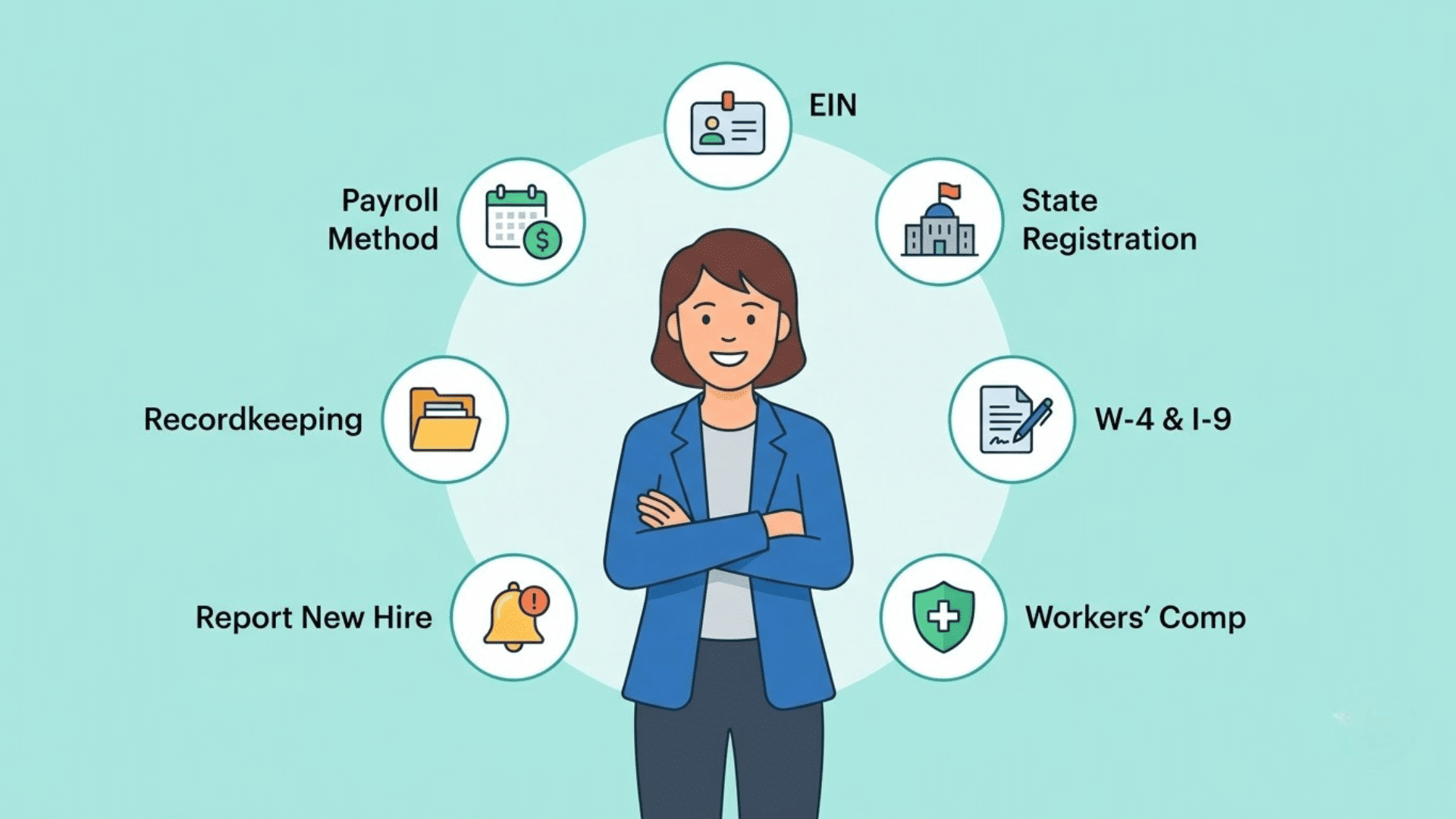
Before you bring someone on board, there are a few things you need to set up first.
Think of it like getting your paperwork in order before opening the door to a new teammate. Here’s exactly what you need to do.
1. Get an EIN (Employer Identification Number)
An EIN functions as an identification number for the business, similar in purpose to a Social Security number for an individual.
The IRS issues EINs at no cost, and the number is used for all tax and payroll filings. Applications can be completed online through the IRS EIN application portal.
2. Register With Your State
After obtaining an EIN, registration with the state is also required to remit state taxes and unemployment insurance on behalf of the employee.
Requirements vary by state, so it is advisable to confirm the specific process through the state’s official website.
3. Collect Form W-4 and Form I-9
Before the employee’s first day, two forms must be completed: Form W-4, which determines the amount of tax withheld from each paycheck, and Form I-9, which verifies eligibility to work in the United States through the USCIS Form I-9 portal.
Both forms should be retained on file and reviewed periodically rather than filed away permanently. , and the personal data collected in the process is exactly why employment identity theft risks rise once a business starts adding staff.
4. Get Workers’ Compensation Insurance
Most states require workers’ compensation insurance once a business has even one employee. This coverage addresses medical costs and lost wages resulting from workplace injuries.
State-by-state requirements are outlined on the U.S. Department of Labor’s workers’ compensation page.
Securing this coverage before the employee’s start date, rather than after, is standard practice and often a legal requirement.
5. Report Your New Hire to the State
Most states require new hires to be reported within a set window after their start date, typically around 20 days.
This reporting supports state tracking of obligations such as child support enforcement and can generally be completed online in a few minutes.
6. Set Up a Recordkeeping System
Maintain an organized file for each employee, including pay rate, hours worked, tax withholdings, and signed documentation.
Consistent recordkeeping simplifies compliance if records are ever requested for verification.
7. Choose a Payroll Method
A payroll schedule must be determined, whether weekly, biweekly, or monthly. Payroll can be processed manually, though this increases the risk of tax calculation errors.
Many small business owners rely on payroll software instead, which automates calculations and filing deadlines, some HR automation tools go a step further and handle onboarding and new-hire reporting in the same place.
Forms and Documents You’ll Need on File
Beyond the setup steps, you’ll need to keep a few key forms on hand for every employee you hire. Here’s a quick rundown of what each one does.
| Form/Document | Purpose |
|---|---|
| Form W-4 | Tells you how much federal income tax to withhold from an employee’s paycheck |
|
Form I-9 |
Confirms the employee is legally allowed to work in the country |
| Form W-2 | Issued to each employee at year-end, summing up wages paid and taxes withheld |
| Offer Letter/Employment Agreement | Outlines the role, pay, and terms of employment |
| Employee Handbook Acknowledgment | Confirms the employee has read and agreed to company policies |
|
State Withholding Form |
Some states require this in addition to the federal W-4 |
|
Direct Deposit Authorization |
Gives permission to pay wages directly into the employee’s bank account |
How Does Hiring Employees Affect Your Taxes?
Once you hire, your tax duties grow beyond just your own income.
You’ll pay a matching share of Social Security and Medicare taxes, about 7.65% of each employee’s wages, along with what you withhold from their paycheck.
You’ll also owe federal unemployment tax (FUTA): 6% on the first $7,000 of each employee’s yearly wages, though state credits usually lower this.
Most states charge their own unemployment tax (SUTA) too, with rates varying by location. You’ll also need to file regular reports: Form 941 quarterly, Form 940 annually, and W-2s for employees at year-end
Note: Hiring employees doesn’t remove your own self-employment tax. You’ll still pay that separately on your personal earnings.
How Do Sole Proprietors Pay Employees?

Once your setup is done, paying employees comes down to a simple, repeatable process. Here’s how it works, step by step.
Calculate Gross Pay
Multiply hours worked by the hourly rate, or divide the annual salary by the number of pay periods.
Withhold Pre-Tax Deductions
Subtract any contributions toward health insurance or retirement plans, if offered.
Withhold Statutory Taxes
Take out federal income tax, FICA (Social Security and Medicare), and any state or local taxes.
Withhold Post-Tax Deductions
Deduct anything like wage garnishments or voluntary benefit contributions.
Pay Net Wages
Send the remaining amount to your employee through direct deposit, paycard, or a paper
Special Rules for Hiring a Spouse or Children
Bringing family onto your payroll comes with a few extra rules you won’t find with other employees. Here’s what changes when it’s your spouse or your kids on the team.
Rules for Spouse
- If your spouse works in the business as a partner, they’re not an employee; you both earn through an owner’s draw instead of wages.
- If your spouse works specific tasks and isn’t a partner, you must put them on payroll like any other employee.
- You don’t have to pay Federal Unemployment Tax (FUTA) on your spouse’s wages.
- Your spouse still pays federal income tax and FICA (Social Security and Medicare) taxes on what they earn.
Rules for Children
- Children under 18 don’t have FICA taxes taken out of their pay.
- Children under 21 are exempt from FUTA tax.
- Regardless of age, you must still withhold federal income tax from their wages.
- Even though tax rules are lighter, they should still be paid a fair, reasonable wage for real work
Should a Sole Proprietor Form an LLC Before Hiring?
An LLC, or Limited Liability Company, is a business structure that creates legal separation between the owner and the business.
Forming an LLC is not a prerequisite for hiring, but the decision becomes more relevant as a business grows.
Switching structures is worth considering when liability exposure increases, employee headcount grows, contract values rise, or added credibility becomes a business priority.
An LLC protects personal assets from business debts, though it introduces additional paperwork and filing fees. For businesses with limited risk, a sole proprietorship remains a practical option.
Common Mistakes to Avoid When Hiring as a Sole Proprietor
Hiring your first employee is exciting, but a few common slip-ups can lead to penalties or headaches down the road. Here’s what to watch out for.
Misclassifying employees as contractors
If you control how, when, and where someone works, they’re likely an employee, not a contractor. Calling them a contractor just to skip payroll taxes can lead to back taxes and fines if the IRS disagrees.
Skipping state registration
Some owners set up federal requirements like an EIN and assume that’s enough. But you also need to register with your state for withholding and unemployment insurance before your first payday, not after.
Delaying workers’ compensation coverage
Waiting to get this insurance until later is risky. If an employee gets hurt before you’ve set it up, you could end up covering the costs yourself and facing fines.
Underestimating the true cost of an employee
Wages are just part of the picture. You also owe employer taxes, insurance, and possibly benefits on top of that paycheck. Budgeting for wages alone often leads to cash flow surprises.
Handling payroll manually without a system
Doing payroll by hand might feel manageable at first, but small errors in tax withholding or missed deadlines add up fast. A simple payroll service can catch mistakes before they become costly problems.
Wrapping It Up
A sole proprietorship imposes no barrier to hiring, but it does carry real responsibility.
Once you bring on staff, you take on an employer’s full set of tax, insurance, and record-keeping obligations that fall under broader employment law compliance.
Meeting those before an employee’s first day protects both the business and the person you hire.
If you need one part-time helper or plan to build a full team, the structure itself won’t hold you back; preparation will determine how smoothly the transition goes.
Frequently Asked Questions
Can Sole Proprietors Have 1099 Employees?
Yes, sole proprietors can hire independent contractors and pay them via Form 1099-NEC once payments hit $600 a year.
How Many Employees Can a Sole Proprietor Have?
There’s no legal cap on how many people a sole proprietor can hire. The bigger factor is usually your comfort with the added responsibility, not any rule stopping you.
Can a Sole Proprietor Pay Themselves a Salary?
No, they take an owner’s draw instead and pay self-employment tax on their earnings. There’s no W-2 or paycheck involved since they aren’t technically an employee.
Do Sole Proprietors Need Workers’ Compensation Insurance?
Yes, most states require it once you hire your first employee, and it should be active before day