

Your paycheck has several deductions, but two of the most common are Social Security and Medicare taxes. If you have noticed these withholdings on your pay stub, you have seen the impact of FICA taxes.
FICA stands for the Federal Insurance Contributions Act, a law that requires employees and employers to contribute to Social Security and Medicare programs.
These taxes are automatically deducted from wages to help fund benefits for retirees and eligible individuals. This blog explains what FICA wages are, how FICA tax rates work, and how these deductions affect your paycheck.
What are FICA Wages?
Federal Insurance Contributions Act (FICA) is a U.S. payroll tax that helps fund Social Security and Medicare programs.
The tax is collected from employees’ paychecks and matched by employers through required contributions, separate from the withholding elections made on a W-4 form, which determines federal income tax withholding instead.
FICA supports important benefits, including retirement income, disability benefits, and healthcare coverage for eligible individuals.
The purpose of FICA is to provide a steady source of funding for these programs and ensure they continue to support millions of Americans.
Both workers and employers share responsibility for contributing to FICA taxes.
The Role of FICA Wages in Payroll
FICA wages matter because they determine how much an employee contributes to Social Security and Medicare through payroll taxes.
The amount of FICA wages reported affects the taxes withheld from a paycheck and can influence future Social Security benefits.
For example, if an employee earns $3,000 in regular wages and receives a $500 bonus, both amounts may count as FICA wages and be subject to payroll taxes.
Understanding FICA wages helps employees track deductions and helps employers accurately calculate and report payroll taxes.
What Types of Wages are Subject to FICA Taxes?

Knowing which wages are subject to FICA taxes helps employees and employers calculate withholding accurately.
While most compensation counts toward FICA wages, the specific rules vary depending on how the pay is structured or delivered.
1. Standard Compensation
Hourly wages, annual salaries, and piece-rate pay all count as FICA wages.
Regardless of how compensation is structured, whether paid per hour, as a fixed salary, or based on units produced, it’s subject to Social Security and Medicare withholding.
This forms the base of most employees’ FICA wages and is calculated before most deductions are applied.
2. Supplemental Pay
Bonuses, commissions, severance pay, and vacation payouts are all treated as taxable FICA wages.
Even though this compensation isn’t part of regular base pay, the IRS doesn’t distinguish it from standard wages for FICA purposes.
Employers must withhold Social Security and Medicare taxes on supplemental pay the same way they would on a normal paycheck.
3. Tips
All tips reported by employees are subject to both Social Security and Medicare taxes. This includes tips received directly from customers and those distributed through employer-managed tip pools.
Employees are required to report tips to their employer, who then withholds the appropriate FICA taxes, the same as with wages or salary.
4. Fringe Benefits
Most non-cash compensation is still subject to FICA.
This includes taxable prizes, employee awards, and employer-paid moving expense reimbursements that don’t meet IRS exclusion requirements, details also covered in a broader fringe benefits guide.
The taxable value of these benefits gets added to an employee’s wages before Social Security and Medicare withholding is calculated, just as it would for cash compensation.
5. Pre-Tax Deductions
Salary reductions for retirement plans, such as 401(k) or 403(b) contributions, and health insurance premiums are still subject to FICA.
While these deductions lower taxable income for federal income tax purposes, they don’t reduce the wages used to calculate Social Security and Medicare taxes, a distinction that often surprises employees reviewing their pay stubs.
Disclaimer: Not every fringe benefit is treated the same way under IRS rules. For a full breakdown of which benefits are taxable versus exempt, the IRS provides a detailed chart in Publication 15-B, Table 2-1.
What is the FICA Tax Rate and How Does it Work?
Before breaking down individual wage categories, it helps to understand the actual percentages involved, since every dollar of eligible pay ties back to these fixed rates.
The FICA tax rate in 2026 is 15.3% total on most wages, split evenly between employees and employers at 7.65% each.
FICA taxes are collected through payroll deductions and help fund Social Security and Medicare programs. Employees and employers both contribute to these taxes based on eligible wages. This covers two separate programs.
- Social Security Tax: Funds retirement, disability, and survivor benefits for eligible individuals. It is calculated as a percentage of FICA wages up to an annual wage limit.
- Medicare Tax: Helps fund healthcare coverage for eligible individuals. It is calculated on covered wages, with an additional Medicare tax applying to certain higher earners.
High earners pay more. Once wages exceed $200,000 for single filers or $250,000 for those married filing jointly, an additional 0.9% Medicare surtax applies, but only to the employee’s share.
Employers never match this additional 0.9%; it’s withheld solely from the employee once the income threshold is crossed, per IRS guidance.
| How FICA Is Deducted: FICA deductions are automatically processed through payroll, affecting take-home pay while supporting federal benefit programs. This process is covered in detail in the Employee vs. Employer FICA Responsibilities table below, which breaks down exactly how withholding, reporting, and contributions work for each side. |
Exceptions to FICA Taxes
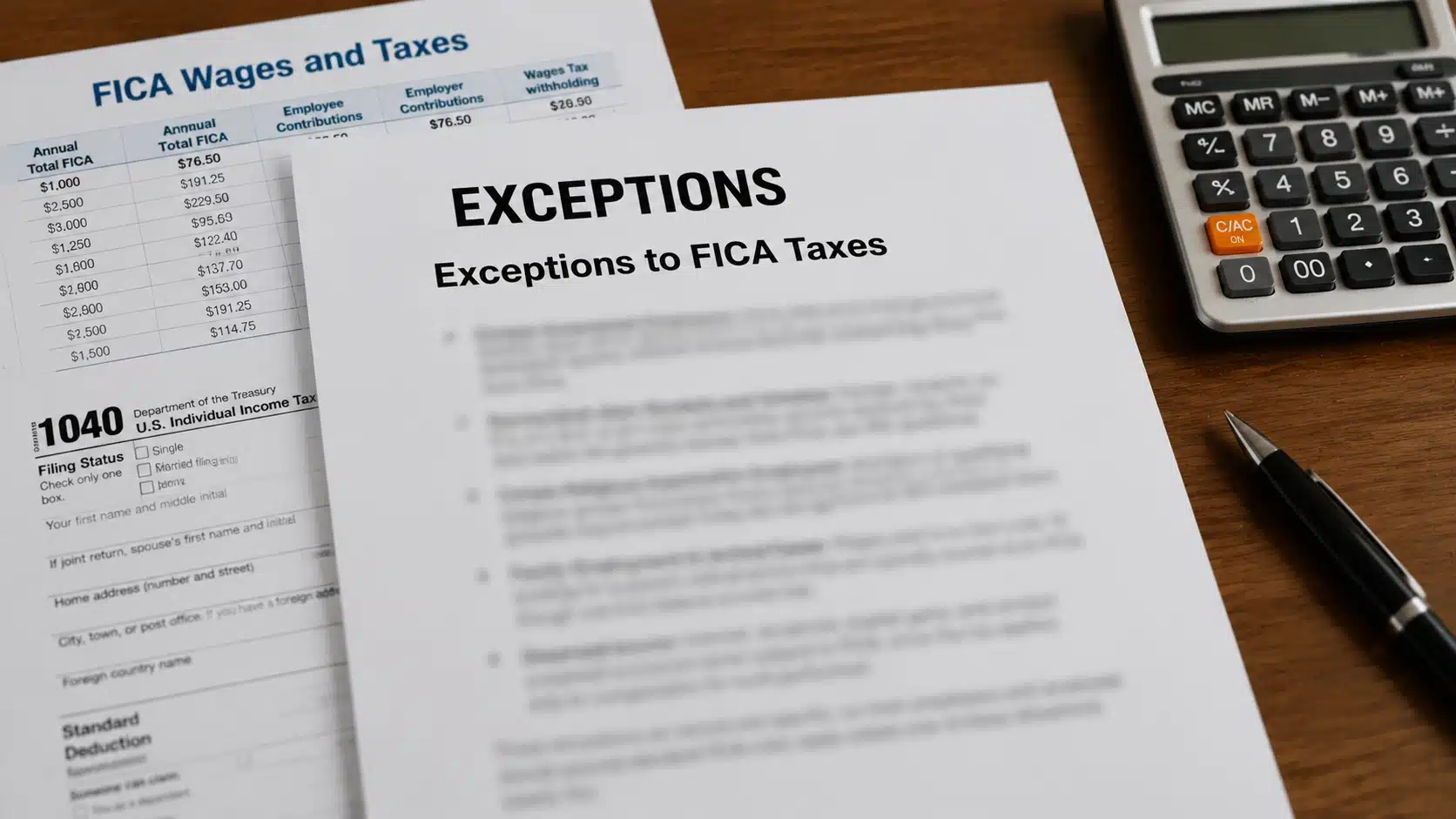
While most earned income is subject to FICA, a small number of specific worker categories and income types are exempt under IRS rules.
Certain Government Employees
Some state and local government workers hired before specific dates may be covered under alternative retirement systems instead of Social Security, exempting them from FICA.
Nonresident Alien Students and Scholars
Foreign students on F-1, J-1, M-1, or Q-1 visas performing services allowed by their visa status are generally exempt from FICA, per IRS guidelines.
Certain Religious Organization Employees
Members of qualifying religious groups that oppose Social Security benefits on religious grounds may be exempt if they file the appropriate IRS exemption form.
Family Employment in Limited Cases
Wages paid to a child under 18 working for a parent’s sole proprietorship are typically exempt from FICA, though not from federal income tax.
Unearned Income
Interest, dividends, capital gains, and similar unearned income are never subject to FICA, since the tax applies only to compensation for work performed.
These exceptions are narrow and specific, so most employees and employers should assume standard FICA rules apply unless one of these situations clearly fits.
Employee Vs Employer FICA Responsibilities
FICA taxes aren’t paid by employees alone; employers share equal responsibility for Social Security and Medicare contributions, though the specific obligations differ between the two parties.
| Responsibility | Employee | Employer |
| Tax Rate Paid | 6.2% Social Security + 1.45% Medicare = 7.65% of FICA wages | Matches the employee’s 6.2% Social Security + 1.45% Medicare = 7.65% |
| Additional Medicare Tax | An extra 0.9% applies once wages exceed $200,000 (single) or $250,000 (married filing jointly) | No employer match required; only the employee pays this portion |
| How It’s Withheld / Reported | Automatically deducted from each paycheck by the employer | Must accurately report FICA wages and deposit both employee and employer portions with the IRS |
| Where to See It / Filing Requirement | Listed separately as Social Security tax and Medicare tax on pay stubs | Reports wages and withholding on Form 941 (quarterly) and Form W-2 (annually) |
| Refund Possibility / Compliance Risk | Excess Social Security tax withheld (e.g., from multiple employers) may be refunded when filing a tax return | Penalties apply for under-withholding, late deposits, or misclassifying employees |
Source: IRS Topic No. 751 – Social Security and Medicare Withholding Rates
Both sides carry real financial and reporting obligations, though employers ultimately bear more compliance risk since they manage withholding, deposits, and filing accuracy.
How to Calculate the FICA Tax Rate (2026 Rates)
To calculate FICA tax, multiply gross wages by 7.65% for the employee’s share (6.2% Social Security + 1.45% Medicare), and match that amount as the employer.
For 2026, Social Security tax applies only up to $184,500 in wages; the maximum an employee or employer will pay toward Social Security is $11,439 each. Medicare tax has no cap, so every dollar earned is taxed at 1.45%.
If an employee’s wages exceed $200,000 (single) or $250,000 (married filing jointly), an additional 0.9% is withheld from the employee’s Medicare portion only, with no matching employer contribution.
Source: IRS Publication 926, 2026; Social Security Administration Wage Base Announcement
Disclaimer: Tax rates and wage bases are set annually and may change. Always confirm current-year figures directly with the IRS or Social Security Administration before filing or processing payroll.
Final Thoughts
FICA wages are the earnings subject to Social Security and Medicare taxes, which are deducted from employee paychecks through payroll.
These taxes help support essential programs that provide retirement, disability, and healthcare benefits to eligible individuals.
Understanding FICA wages helps employees identify which earnings are taxed and how payroll deductions are calculated.
Reviewing paycheck details allows workers to track their contributions, understand their take-home pay, and ensure their payroll records are accurate.
Frequently Asked Questions
Are 401(k) Contributions Subject to FICA Taxes?
Yes. Traditional 401(k) contributions reduce taxable income for federal income tax purposes, but they still count as FICA wages, meaning Social Security and Medicare taxes apply before the deferral is taken out.
Is FICA the Same as Federal Income Tax?
No. FICA funds Social Security and Medicare specifically, while federal income tax funds general government operations. Both appear on a pay stub, but they’re calculated separately and serve entirely different purposes.
What Does “FICA Med” Mean on My Paycheck?
“FICA Med” refers specifically to the Medicare portion of FICA withholding, currently 1.45% of covered wages. It’s listed separately from Social Security tax so employees can see each deduction individually.
Are FICA Wages the Same as Gross Wages?
Not always. Gross wages include all earnings before deductions, while FICA wages exclude certain pre-tax benefits or contributions. Most paychecks show FICA wages as a slightly lower figure than gross pay.