
In creative and commercial work, ownership is not always as straightforward as it seems.
A project may begin with clear expectations, yet the question of who holds the rights can be determined long before the work is completed.
This is where work for hire plays a critical role, establishing legal authorship based on the nature of the relationship rather than the act of creation itself. It quietly defines control, usage, and long-term rights, making it essential to understand before any agreement is signed or any work begins.
What Is “Work for Hire”?
Work for hire is a copyright rule that settles ownership before the work even exists.
Normally, the person who creates something owns the copyright. Work for hire flips that.
Once the conditions are met, the hiring party is deemed the legal author from the moment the work is made, not the person who actually performed the work.
There’s no separate transfer and nothing to sign over afterward. The rights sit with the employer or client from day one. What decides it is the working relationship and what the contract spells out.
Core Idea Behind Work for Hire
At its heart, work for hire is about who gets the final say over a piece of work, not just who makes it.
In this setup, the employer or client is treated as the official author in the eyes of copyright law, even if they never touch the actual creation process.
The creator still does the work, but ownership is baked into the arrangement from day one, shaped entirely by the contract and the type of working relationship in place.
What Is the Difference Between Independent Contractor and Work for Hire?
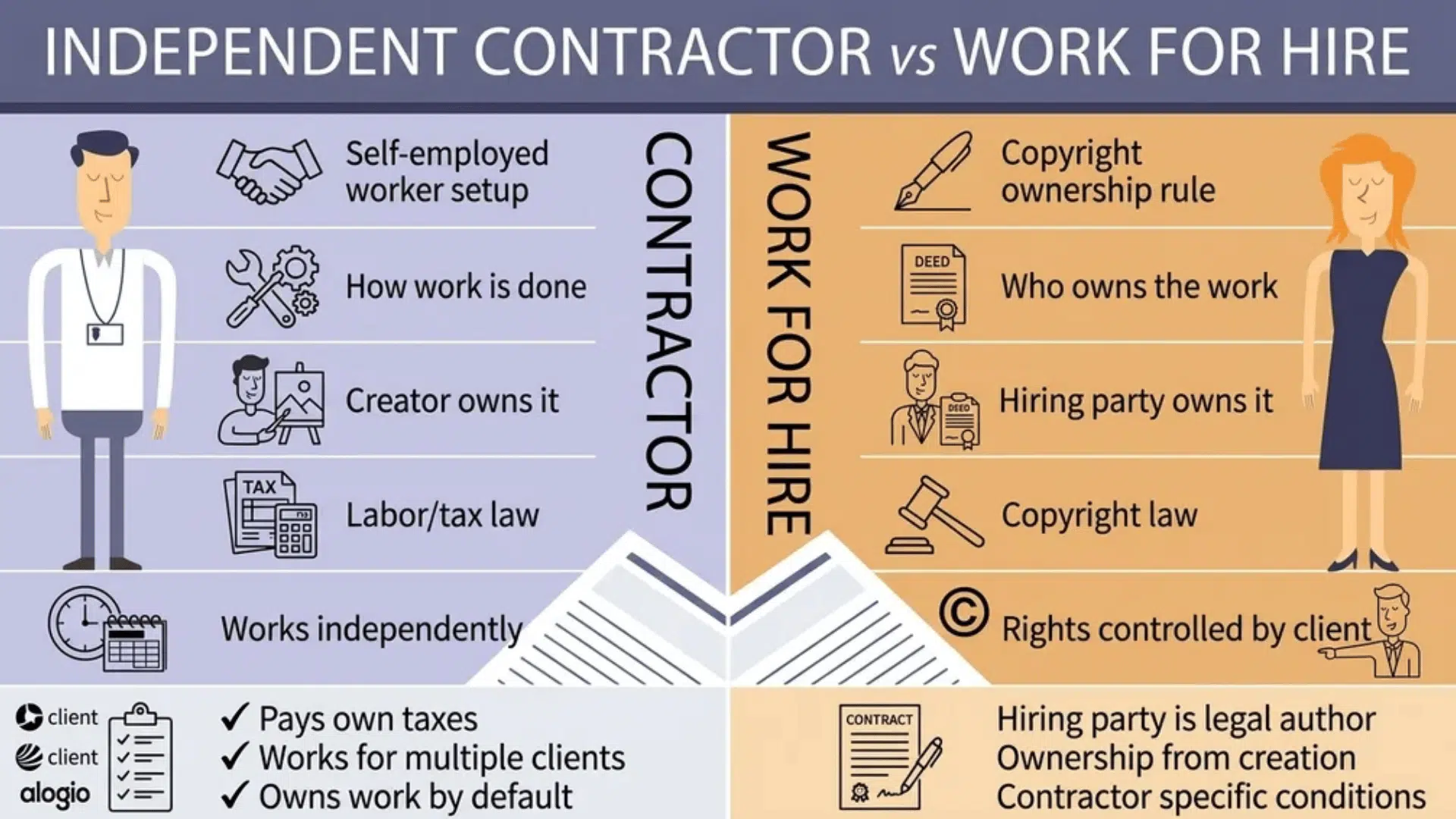
These two terms are often confused, but they deal with completely different things. One defines work status, while the other defines ownership of creative output.
Quick Comparison:
| Aspect | Independent Contractor | Work for Hire |
| Meaning | Self-employed worker setup | Copyright ownership rule |
| Focus | How work is done | Who owns the work |
| Default ownership | Creator owns it | Hiring party owns it |
| Legal area | Labor/tax law | Copyright law |
| Control | Works independently | Rights controlled by client |
Independent Contractor
An independent contractor is a self-employed worker who provides services under a contract.
- Works independently and manages own schedule
- Can work for multiple clients
- Pays own taxes and receives no employee benefits
- Owns the work by default unless stated otherwise in the contract
Work for Hire
Work for hire is a legal rule that assigns authorship to the hiring party.
- Employer or client becomes a legal author
- Ownership starts from creation
- Applies to employees automatically in job duties
- Contractors only qualify under specific legal conditions + written agreement
The Legal Categories That Decide Eligibility
Not every freelance project can be pulled into a work for hire setup. U.S. law keeps this tightly boxed into specific creative and structured formats.
If the work doesn’t fit one of these lanes, ownership usually stays with the creator unless it’s formally assigned through another agreement.
Here’s where work-for-hire status is typically allowed for contractors:
- Collective works: Think of pieces that sit within a larger publication, such as anthology contributions or magazine-style collections where multiple creators contribute to a single final product.
- Audiovisual productions: Anything built for screen or playback, including film segments, video content, or structured visual media.
- Translations: Converting content from one language to another when commissioned under a qualifying contract.
- Supplementary materials: Add-on creative assets like forewords, charts, diagrams, illustrations, or supporting editorial content.
- Compilations or datasets: Organized collections of information where structure and selection matter as much as individual entries.
- Instructional or training content: Educational material designed to teach, guide, or train within a formal system or program.
- Test or assessment material: Questions, answer keys, and evaluation content created for exams or testing systems.
- Atlases or map-based works: Geographic or spatial compilations where mapping and layout are central to the output.
- Specially commissioned compilations: Curated groupings created under a written agreement that clearly defines ownership from the start.
How Long Does Work for Hire Copyright Last?
A work made for hire is protected for 95 years from the date it’s first published, or 120 years from the date it’s created, whichever comes first. That’s the rule under U.S. copyright law (17 U.S.C. § 302).
It’s different from standard copyright, which lasts for the creator’s life plus 70 years. A work for hire has no individual author to base that on, so the term attaches to the work itself.
There’s also no reversion. Normally, rights can go back to the creator or their estate after a set period. With work for hire, that doesn’t happen.
The hiring party keeps the copyright for the full term and can license, adapt, or reuse the work throughout, without needing anyone’s permission.
Common Mistakes in Work for Hire Deals
Most problems don’t start with intent; they start with assumptions. A contract might look simple on the surface, but small gaps can quietly decide who actually owns the final work.
- Loose wording in contracts can fail to legally establish work for hire status, even if both parties think it does.
- Hiring freelancers for non-qualifying work types creates ownership confusion from day one.
- Relying on verbal agreements leaves no enforceable proof when disputes show up later.
- Skipping eligibility checks may mean the project does not even meet the legal definition of work for hire.
- Mixing up “assignment” and “work for hire” often leads to mistaken beliefs about who owns what and when.
A clean agreement removes ambiguity; a vague one leaves room for conflict.
Ending Note
At the end of the day, work for hire is less about who presses “create” and more about who holds the steering wheel once the work enters the world.
A small clause can quietly shape ownership, usage, and even the future value of something that might look simple on the surface.
That’s why clarity in agreements matters more than assumptions or handshake understanding. Before any project begins, knowing how rights are assigned can prevent surprises later and keep expectations aligned on both sides.
Have you ever come across a situation where ownership of creative work felt unclear or disputed? Share your experience in the comments.
Frequently Asked Questions
What Does “Work for Hire” Mean in Music?
In this context, an agreement in which a songwriter composes a musical work within the scope of their employment for another entity and does not retain copyright or publishing ownership over the work.
Is Work for Hire Freelance?
The client owns the copyright to whatever the artist creates, from the very moment the work is created, it’s owned by the client or the employer. the freelancer will receive a W-2 from the employer as an employee of the company.
What Is the 80% Rule for Hiring?
In hiring, the “80% rule” (also known as the four-fifths rule) is a statistical guideline used by the Equal Employment Opportunity Commission (EEOC) to determine if an employer’s hiring practices or selection procedures are unintentionally discriminating against a protected group.