

Businesses today don’t always need bigger teams; they need flexible ones that can adjust quickly. Projects change, deadlines shift, and skill needs keep evolving. Sticking to a fixed team size doesn’t always make sense anymore.
That’s why this term is getting more attention. Still, many people aren’t clear on the meaning of staff augmentation or how it fits into real business needs.
Learning this concept can help companies handle workload spikes, fill skill gaps, and stay efficient without overcommitting.
In this guide, you’ll get a clear breakdown of how it works and when it actually makes sense to use it.
What Is Staff Augmentation?
The concept is pretty straightforward. It’s the practice of hiring external professionals on a temporary basis to support your in-house team.
Think of it as plugging skill gaps without going through a full hiring process.
These external professionals work alongside your existing team, follow your processes, and report to your managers. You stay in control of the project the whole time.
The best part? You only bring in talent when you actually need it. Got a big product launch coming up? Hire for it. Project wraps up? You’re not stuck with extra headcount.
Key Benefits
- Faster hiring and quicker onboarding
- Access to global, skilled talent
- Better cost control and efficiency
- Flexible team scaling as needed
- Lower hiring risk with pre-vetted professionals
Types of Staff Augmentation Models
Not all setups work the same way. Depending on your business needs, the model you choose can look quite different.
- Short-Term Augmentation: Built for urgent or temporary needs. Best when you need quick support for a product launch, a seasonal spike, or a time-bound project without any long-term commitment.
- Long-Term Augmentation: Designed for ongoing projects or extended support. Augmented staff becomes a consistent part of your team for months, giving you stability without permanent contracts.
- Skill-Based Augmentation: Focused on bringing in professionals with specific expertise, like developers, designers, or data analysts. Useful when your in-house team lacks a particular skill set.
- Project-Based Augmentation: A team is built around one specific project with a clear goal and timeline. Once the project wraps up, the engagement ends naturally and cleanly.
How Staff Augmentation Works in Real Life?
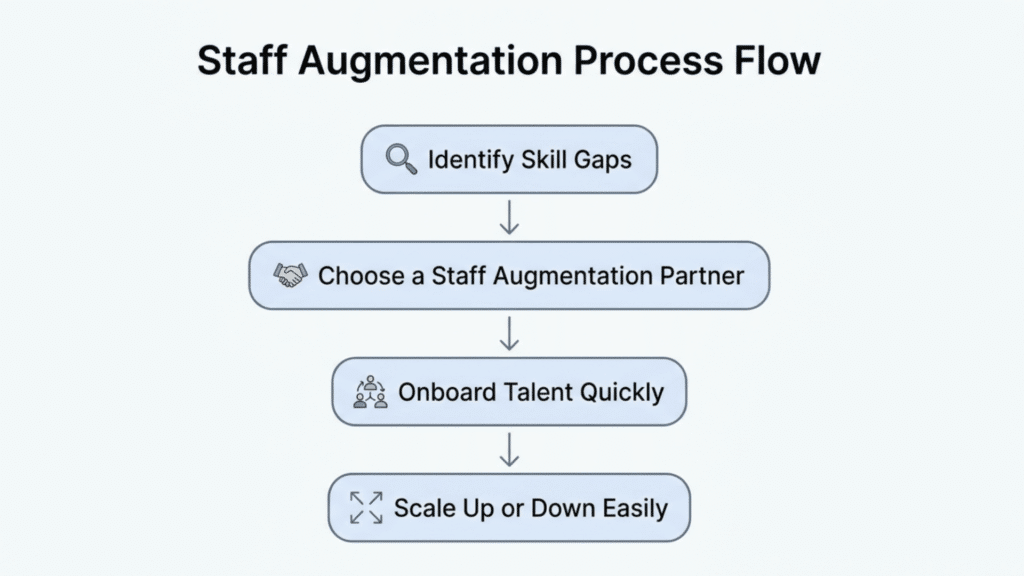
Knowing the concept is one thing; seeing how it plays out in practice is another. Here’s a simple step-by-step breakdown of the process.
Step 1: Identify Skill Gaps
Every project has moments where your current team just doesn’t have enough hands or the right expertise. Maybe you need a React developer for three months, or your QA team is overwhelmed.
The process starts with being honest about what’s missing. Whether it’s a specific skill set or just extra capacity, clearly identifying that gap shapes everything that comes next.
Step 2: Choose a Staff Augmentation Partner
Once you know what you need, you find a vendor who can deliver it. A good partner maintains a pool of pre-vetted professionals ready to step in quickly.
You skip the long recruitment cycles, background checks, and interview rounds. The vendor handles that groundwork so you can focus on the actual work. It saves time and gets the right people in front of you faster.
Step 3: Onboard Talent Quickly
After selecting the right professionals, they join your existing team without much friction. They follow your workflows, use your tools, and report directly to your managers.
There’s no separate chain of command to manage. The augmented staff integrates into your setup and starts contributing quickly.
You stay in control of how the work gets done, which is a big reason why this model works so well.
Step 4: Scale Up or Down Easily
This model really shows its value. If your project grows, you can bring in more professionals without restarting the process. If things wind down, you reduce the team size just as easily.
There’s no long-term commitment holding you back. You build the team your project needs, right now, and adjust as things change.
It’s a level of flexibility that traditional hiring simply can’t offer.
Staff Augmentation Vs Traditional Hiring
A quick comparison makes it easier to see how both approaches differ in real situations.
| Aspect | Staff Augmentation | Traditional Hiring |
|---|---|---|
| Hiring Time | Fast (days/weeks) | Slow (months) |
| Flexibility | High, easy to scale | Low, fixed team |
| Cost | Pay as needed | Ongoing expenses |
| Commitment | Short-term | Long-term |
| Skill Access | Quick, specialized talent | Limited, slower access |
| Risk | Lower, easy to replace | bigger, costly mistakes |
When Should You Use This?
This model is not a one-size-fits-all solution, but it fits a surprising number of situations really well. Here’s how you know it might be the right call for your business:
- When you’re working against tight project deadlines and need extra hands fast
- When your current team has skill gaps that are slowing the project down
- When seasonal workload spikes make full-time hiring impractical and expensive
- When your budget doesn’t support permanent hires, but the work still needs to get done
- When you need specialized expertise for a specific phase of a project
Final Thoughts
By now, staff augmentation meaning should feel much clearer. It’s not just a hiring trend. It’s a practical, flexible way to build the right team for the right project, without the weight of long-term commitments.
Businesses that get this right move faster, spend smarter, and stay competitive. And honestly, that’s the whole point.
If your team is stretched, if you lack key skills, or face a tight deadline, this approach can be just what you need. It’s designed for how modern businesses actually operate.
If you’re ready to take the next step, consult a trusted IT staff augmentation company and bring the right talent on board.