
Running a business means juggling a hundred things at once, and managing HR and payroll should not be the part that slows everything down. That is exactly where HRMS payroll software comes in.
By bringing human resource management software and payroll processing under one roof, it eliminates the hassle of switching between multiple systems, reduces costly errors, and saves valuable time that could be spent growing the business.
Whether managing a small team or an entire workforce, the right HRMS payroll software can completely change the way a business operates, making every process smoother, faster, and far more efficient from day one.
What is HRMS Payroll Software and How Does it Work?
Human resource management software and payroll software are a complete solution that combines Human Resource Management Systems (HRMS) with payroll processing.
It allows businesses to manage office finance, employee data, salaries, attendance, and compliance from a single platform. Instead of using multiple tools, everything is connected, making operations more organized and efficient.
It simplifies HR tasks while ensuring payroll is processed accurately and on time. HRMS payroll software centralizes all employee-related data in a single system.
It tracks attendance, calculates salaries, manages deductions, and automatically processes payments. The system also integrates with leave management and tax regulations, ensuring compliance.
With real-time updates and reporting, businesses can monitor payroll and HR activities without manual effort.
Key Features of HRMS Payroll Software
These features are what make HRMS payroll software a powerful and efficient solution, helping businesses simplify complex tasks while maintaining accuracy and control.
- Employee Data Management: Stores all employee information, including personal details, roles, salary structures, and documents, in a centralized system for easy access and updates.
- Payroll Automation: Automatically calculates salaries, deductions, bonuses, and taxes, reducing manual effort and minimizing errors.
- Attendance & Leave Integration: Connects attendance and leave records directly with payroll to ensure accurate salary processing based on working days.
- Tax & Compliance Management: Handles tax calculations, statutory deductions, and ensures compliance with labor laws and regulations.
- Employee Self-Service Portal: Allows employees to view payslips, update personal information, and access payroll details without HR intervention.
- Benefits & Compensation Management: Manages employee benefits, including bonuses, incentives, reimbursements, and other compensation components.
- Reporting & Analytics: Provides detailed reports on payroll, expenses, and workforce data to help in better decision-making.
- Data Security & Access Control: Ensures sensitive payroll and employee data is protected with secure access and role-based permissions.
Types of HRMS Payroll Software
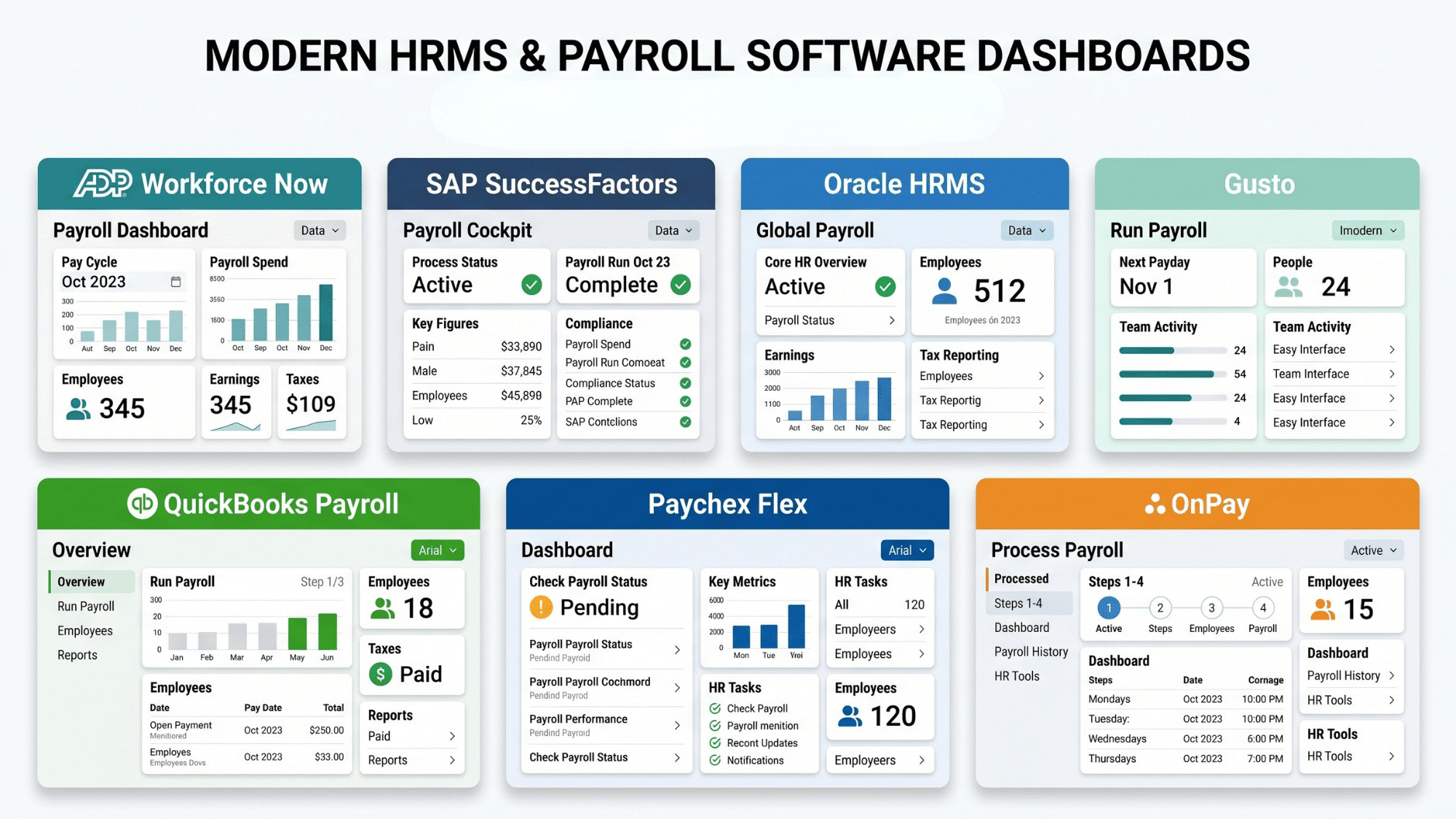
Human resource management software comes in different types, each designed to meet specific business needs, offering varying levels of flexibility, control, and integration.
1. Cloud-Based HRMS Payroll Software
Cloud-based HRMS payroll software is hosted online and can be accessed from anywhere with an internet connection.
It is ideal for modern businesses, especially those with remote or distributed teams, as it offers flexibility and real-time updates.
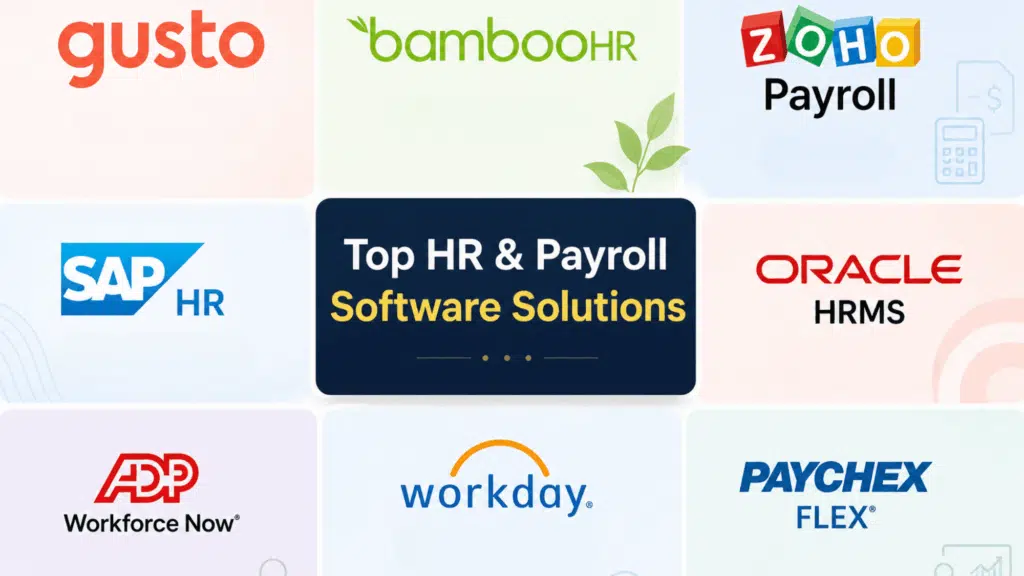
They also provide strong data backup and security features. Popular examples include Gusto, BambooHR, and Zoho Payroll, which are widely used for their accessibility and ease of use.
2. On-Premise HRMS Payroll Software
On-premise HRMS payroll software is installed directly on a company’s internal servers. This type of system gives businesses complete control over their data and customization options.
It is often preferred by large organizations that require strict data security and have dedicated IT teams to manage the system. However, it may involve higher upfront costs and ongoing maintenance.
Examples include SAP HRand Oracle HRMS, both known for their robust, customizable solutions.
3. Integrated HRMS Payroll Software
Integrated HRMS payroll software combines multiple HR functions such as recruitment, attendance, performance management, and payroll into a single platform.
This eliminates the need for multiple tools and ensures a smooth flow of data across departments.
It improves efficiency by consolidating all HR processes into a single place, making it easier to manage the entire employee lifecycle.
Examples include ADP Workforce Now, Workday, andPaychex Flex, which offer comprehensive HR and payroll solutions in one system.
What to Look for in HRMS Payroll Software?
Choosing the right HRMS payroll software is essential to ensure smooth operations, accuracy, and long-term efficiency for your business.
- Ease of Use: The system should be simple, intuitive, and easy for your team to adopt
- Automation Capabilities: Look for features that automate payroll, taxes, and repetitive tasks
- Integration: It should seamlessly connect with accounting, attendance, and other HR tools
- Scalability: The software should grow with your business and support future expansion
- Compliance Features: Ensure it handles tax laws and labor regulations accurately
- Data Security: Strong security measures to protect sensitive employee and payroll data
HRMS Payroll Software vs Traditional Payroll Systems
Understanding the differences between HRMS payroll software and traditional payroll systems helps businesses choose a more efficient, scalable solution for managing their workforce.
| Aspect | HRMS Payroll Software | Traditional Payroll Systems |
|---|---|---|
| Process | Automated and digital | Manual or semi-manual |
| Accuracy | High, minimal errors | Error-prone |
| Time | Fast and efficient | Time-consuming |
| Data | Centralized | Scattered |
| Compliance | Automated updates | Manual tracking |
| Scalability | Easily scalable | Limited |
| Integration | Works with other tools | Limited or none |
| Reporting | Real-time insights | Manual or limited |
Wrapping It Up
Human resource management software is no longer just a nice-to-have; it is an essential tool for any business that values efficiency, accuracy, and growth.
By bringing HR and payroll together in one powerful system, it eliminates unnecessary complexity and gives businesses the clarity and control they need to operate at their very best.
From automating time-consuming tasks to keeping employee data organized and payroll running without a hitch, the right HRMS software has the power to completely change the way a business functions.
The only question left is finding the right one, and once that decision is made, there is no looking back.
Which HRMS payroll feature do you find most useful? Let us know in the comments!
Frequently Asked Questions
How Long Does It Take to Implement HRMS Payroll Software?
Implementation typically takes a few days to several weeks, depending on business size, data complexity, and the chosen system. Cloud-based solutions are generally faster to set up than on-premise systems.
Can HRMS Payroll Software Integrate with Biometric Systems?
Yes, most modern HRMS payroll software integrates with biometric devices to track employee attendance accurately. This ensures reliable data syncing directly with payroll, reducing manual errors and improving overall workforce management efficiency.
Does HRMS Payroll Software Support Multi-Location Businesses?
Yes, most modern HRMS payroll platforms are built to manage employees across multiple locations. They centralize data, standardize processes, and ensure compliance across different regions, making multi-location workforce management simple and efficient.