
Waiting after a job interview can feel uncertain. You may replay your answers, wonder how the conversation went, and think about whether sending another message would help or hurt your chances.
A simple follow-up can feel tricky because you want to show interest without sounding impatient. Knowing how to send a follow-up email after an interview helps you handle this stage professionally.
The purpose is not to pressure the hiring team for a decision. Instead, it gives you a chance to thank the interviewer, mention something meaningful from the conversation, and confirm your interest in the position.
Why Is a Follow-Up Email After an Interview Important?
A follow-up email shows appreciation for the time an interviewer set aside for you, which comes across as basic professionalism that many candidates still skip.
It also keeps your interest clear and gives the interviewer one more reason to remember your conversation. It creates another point of contact too, letting you add anything relevant you forgot to mention during the interview.
Finally, it helps you stand out. Plenty of candidates never send anything, so a short, thoughtful message puts you in a smaller group who followed through.
Key Elements of a Strong Follow-Up Email:
- Tone: Keep it warm and genuine, focused on the connection rather than chasing an immediate answer.
- Timing: Send it within 24 hours while the conversation is still fresh.
- Structure: Thank the interviewer, reference the conversation, and confirm your interest.
- Personalization: Mention a specific detail the interviewer shared that connects to the role.
What Should a Follow-Up Email After an Interview Include?
A strong message does not need to be long. Each part serves a specific purpose, from the first line someone sees to the sentence that closes things out. Below are the key parts with a short sample for each.
1. Subject Line: Keep it clear and specific so the interviewer immediately knows why you are writing.
Key points:
- Mention the role or the interview
- Avoid vague openers like “checking in”
- Keep it short
|
Sample:
|
2. Greeting: Address the interviewer by name to show you remember who you spoke with.
Key points:
- Use their name, not a generic opener
- Match the formality they used
- Keep it warm
|
Sample:
|
3. Appreciation Opening: Thank the interviewer directly and reference the specific meeting.
Key points:
- Thank them for their time
- Mention the day or role
- Keep the tone sincere
|
Sample:
|
4. Interview Reference: Bring up one specific detail from the conversation.
Key points:
- Mention a project, challenge, or plan discussed
- Keep it genuine
- Use it to jog their memory
|
Sample:
|
5. Interest and Fit Statement: Confirm your interest and briefly connect your background to the role.
Key points:
- Restate your interest clearly
- Link one strength to the role’s needs
- Avoid repeating your full resume
|
Sample:
|
6. Closing Message: Offer anything else they need and close politely.
Key points:
- Offer to share more information
- Leave the door open for a reply
- End on a professional note
|
Sample:
|
Once the structure feels familiar, writing the actual message gets much easier. The next step is adjusting the wording based on your specific interview, since a short phone screen and a three-hour panel interview call for slightly different approaches.
Follow-Up Email Templates for Different Interview Situations
Not every interview calls for the same kind of message. A short conversation, a long meeting, and a panel with multiple interviewers each need their own approach, and here is how to adjust for each one.
1. Follow-Up Email After a Short Interview
Subject: Thank you for your time
Email Body:
Dear Ms. Bennett,Thank you for taking a few minutes to speak with me today about the retail associate role. I enjoyed our conversation and appreciated learning more about how the team operates and what a typical day in the role looks like.
Even though our time together was brief, it gave me a good sense of what the position involves, and I remain very interested in the opportunity. My background in customer service and my comfort with fast-paced environments seem like a strong match for what your team needs.
Please feel free to contact me if I can provide you with any further information or samples of my work. I look forward to hearing from you.
Thanks again,
Alex Morgan
555-0148
alexmorgan@gmail.com
2. Follow-Up Email After a Long Interview
Subject: Thank you for the conversation today
Email Body:
Dear Mr. Alvarez,Thank you for taking the time to speak with me today about the operations manager role. I really enjoyed learning about the team’s plans for the new warehouse rollout and how much thought has gone into streamlining that process across departments.
Hearing about the challenges the team is currently tackling made me even more confident that my background in logistics and cross-functional coordination would be genuinely useful here. I particularly appreciated your insight into how the role works closely with both the supply chain and customer service teams.
Please feel free to contact me if I can provide you with any further information or samples of my work. I look forward to hearing from you.
Thanks again,
Rachel Bennett
555-0173
rachelbennett@gmail.com
3. Follow-Up Email After a Panel Interview
Subject: Thank you for including me in the panel interview
Email Body:
Dear Mr. Okafor,
Thank you for including me in yesterday’s panel interview for the project coordinator role. I appreciated the chance to meet with you and the rest of the team, and I especially enjoyed our conversation about how the team handles client onboarding.That discussion lined up closely with work I have done in previous roles, and it gave me a clearer picture of how collaborative the team’s process really is. I remain very interested in the opportunity and would welcome the chance to bring my experience to the work you all are doing.
Please feel free to contact me if I can provide you with any further information or samples of my work. I look forward to hearing from you.
Thanks again,
Daniel Osei
555-0199
danielosei@gmail.com
4. Follow-Up Email After No Response
Subject: Following up on the customer success interview
Email Body:
Dear Ms. Delgado,I hope you are doing well. I wanted to check in regarding the customer success role we discussed on July 2nd, since I was not sure if there had been any updates on the hiring timeline since our conversation.
I remain very interested in the opportunity and would genuinely welcome the chance to contribute to your team. I understand that hiring decisions can take time, and I appreciate you keeping me in mind as the process continues.
Please feel free to contact me if I can provide you with any further information or samples of my work. I look forward to hearing from you.
Best regards,
Nina Foster
555-0126
ninafoster@gmail.com
5. Follow-Up Email to Stay in Touch
Subject: Staying in touch
Email Body:
Dear Mr. Whitfield,I hope this message finds you well. I enjoyed our conversation a while back about the design associate role, and I wanted to check in, as I remain very interested in Horizon Studio and any future openings that might arise.
Since we last spoke, I completed a certification in UX design, which has strengthened my skills in areas we discussed during the interview. I would genuinely welcome the chance to reconnect if a suitable role opens up on your team down the line.
Please feel free to contact me if I can provide you with any further information or samples of my work. I look forward to hearing from you.
Best Regards,
Leah Kim
555-0184
leahkim@email.com
What Do Job Seekers Say About Sending Follow-Up Emails?
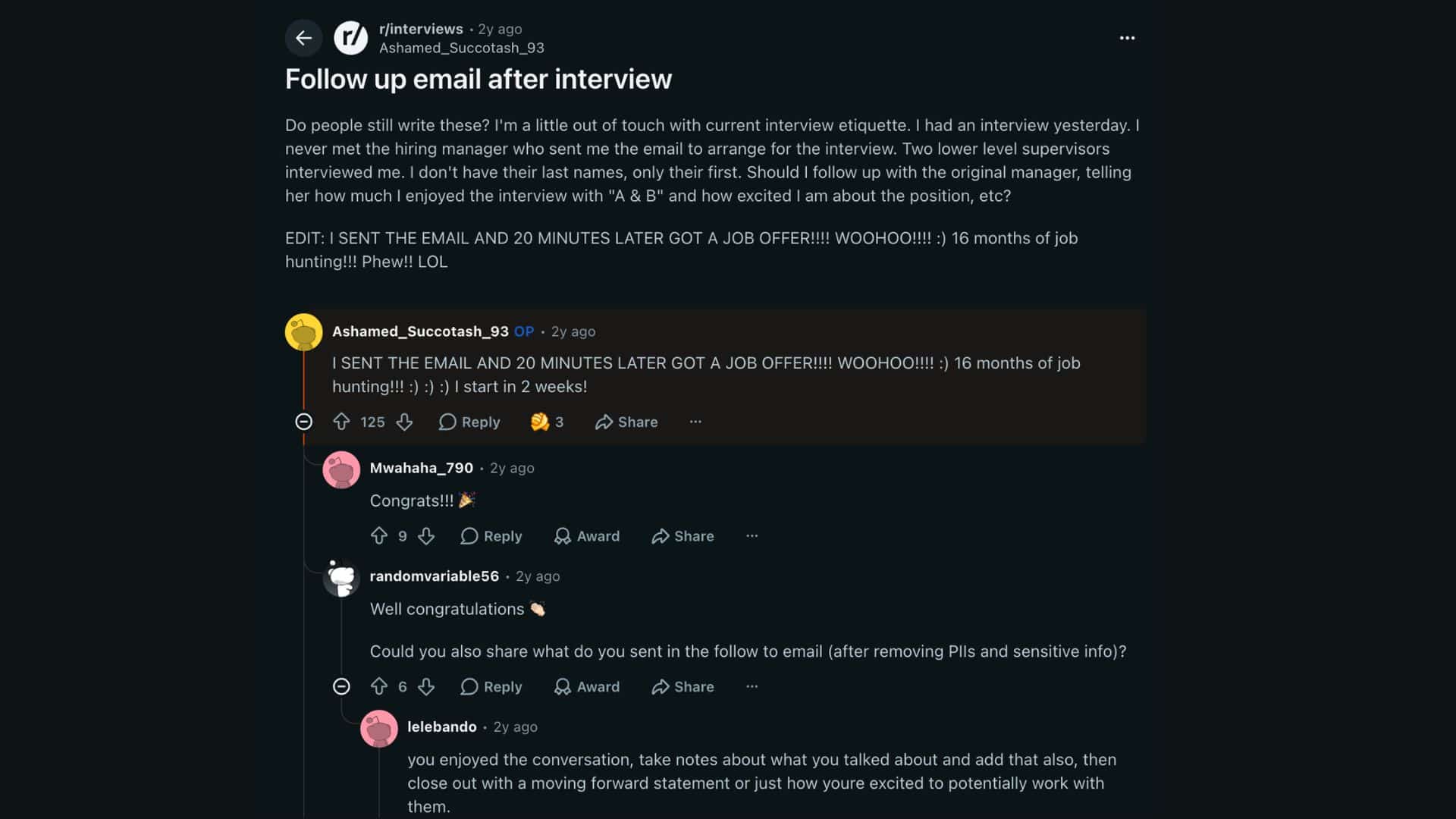
Real hiring experiences shared in job seeker communities often reveal more than generic advice ever could. In one widely discussed Reddit thread, a candidate unsure about current etiquette asked whether people still send follow-up emails, especially when only knowing interviewers’ first names.
After sending a short thank-you message, that person received a job offer within twenty minutes, sparking similar success stories in the replies.
A long-time hiring manager who joined the thread explained that a well-written follow-up rarely decides a hire outright, but can tip the scales when two candidates are closely matched.
Several users echoed this, noting that mentioning specific interview details, rather than generic enthusiasm, made their messages stand out.
The discussion also covered panel interviews and following up through a recruiter when a hiring manager’s email was unavailable.
What Mistakes Should You Avoid in Follow-Up Email?
A follow-up email can genuinely help your application, but a careless approach can just as easily work against you. Knowing which habits to skip makes the difference between a message that builds trust and one that quietly damages it.
- Sending a generic message: Avoid reusing the same email for every interview you’ve done. Specific details make the message believable.
- Write less: Keep it focused rather than retelling the entire conversation. A few sentences say plenty.
- Asking for immediate results: Pushing for a fast decision can come across as impatient rather than eager.
- Forgetting to proofread: A careless typo can undercut an otherwise thoughtful message.
A good follow-up stays simple, thoughtful, and respectful of the reader’s time. Getting these small details right often matters more than the length or wording of the message itself.
Closing Notes
A thoughtful follow-up email after an interview can help maintain a professional connection with a potential employer. It shows appreciation, keeps your interest visible, and gives you another chance to leave a positive impression.
When decidinghow to send a follow-up email after an interview, focus less on finding perfect wording and more on being clear, respectful, and specific.
A short message that reflects your actual conversation will usually feel stronger than a long email filled with general statements.
If you have recently sent a follow-up email during your job search, share what approach worked for you. Your experience may help other candidates handle this part of the hiring process with more confidence.
Frequently Asked Questions
Can I Send A Follow-Up Email If I Forgot To Ask Questions During The Interview?
Yes, you can still send a follow-up email if you forgot to ask questions. Use the message as an opportunity to thank the interviewer and politely ask one or two relevant questions you better understand the role without unnecessarily extending the conversation.
Should I Send A Follow-Up Email After A Virtual Interview?
Yes, a follow-up email is appropriate after a virtual interview. Treat it the same as an in-person meeting by thanking the interviewer, mentioning a specific discussion point, and showing continued interest in the position. A thoughtful message can help maintain professional communication after the conversation.
What Should I Do If The Interviewer Never Responds To My Follow-Up Email?
If the interviewer does not respond, avoid sending multiple messages too quickly. Wait a reasonable amount of time, then send one brief check-in email. If there is still no response, continue applying to other opportunities while keeping the communication professional.