


Ever tried working remotely without any rules in place? One person is online at 7 am, another logs in at noon, and nobody really knows who is doing what.
Deadlines get missed, messages go unanswered, and what started as “flexibility” quietly turns into confusion.
That confusion has a direct impact on employee experience, and it compounds quickly when there is no policy in place to prevent it.
And if your company does not have one yet, or the current one feels outdated, you are in the right place. Read on to find out exactly what goes into building a remote work policy that actually works.
What is a Remote Work Policy?
A remote work policy is a set of rules that a company creates for employees who work outside the office. It tells workers what is expected of them when they are at home or another location.
The policy covers topics such as work hours, staying in touch with the team, and which tools to use. It also explains who is allowed to work remotely and under what conditions.
Without it, employees are left guessing, and when people guess, things fall through the cracks.
How to Create Your Own Remote Work Policy Step by Step?

Creating a remote work policy becomes much easier when you break the process into smaller, practical steps. Instead of trying to write everything at once, focus on building a policy that matches how your team actually works.
Step 1: Define Why the Policy Exists
Start by identifying the main reason behind the policy before writing any rules. Some companies focus on flexibility, while others prioritize consistency, security, or smoother collaboration across teams.
For example, a SaaS company hiring employees across multiple states may create a policy to standardize remote work expectations.
A smaller business may simply want to reduce confusion around availability and communication.
Step 2: Build Around Real Team Workflows
Your remote work policy should reflect how employees actually work day to day, not how you think remote work should look in theory.
Consider communication styles, team structure, and operational challenges before setting expectations.
For instance, a distributed marketing team may rely heavily on async updates because employees work across different time zones. Meanwhile, a sales team may need more real-time collaboration throughout the day.
Step 3: Keep the Language Simple
A remote work policy should feel easy to read, not overly formal or legal-heavy. Employees are far more likely to follow guidelines when the language sounds clear, direct, and human.
Instead of writing “employees shall maintain operational accessibility,” simply say “employees should stay reachable during work hours.
Short sentences and conversational wording make policies easier to scan quickly.
Step 4: Get Feedback from Different Teams
Even a strong draft can miss practical issues if only one person writes it. Sharing the policy with HR, legal, IT, and department managers helps catch gaps before rollout.
For example, HR may identify compliance concerns while engineering managers may point out that excessive check-ins interrupt focused work. Early feedback usually leads to a much stronger final policy.
Step 5: Introduce the Policy Properly
A remote work policy should not live solely in an email attachment.
Employees need a simple rollout process that explains how the policy works, where to find it later, and how communication expectations connect with your company’s open-door policy.
Many companies introduce policies through onboarding sessions, short walkthroughs, internal FAQs, or Slack announcements. The easier the policy is to access, the more likely employees are to actually use it.
Step 6: Update the Policy Regularly
Remote work expectations continue changing as companies grow, tools evolve, and employee needs shift. A policy that worked two years ago may already feel outdated today.
For example, many businesses recently updated their policies to include AI usage guidelines, home office stipends, and flexible scheduling expectations.
Reviewing the policy regularly helps keep it practical and relevant.
Use This Remote Work Policy Template as Your Starting Point
Now that you know how to structure and approach your policy, let’s look at a complete
1. Policy Information
This section provides basic details about the policy and helps employees quickly identify who manages it and who it applies to. It also keeps the document organized for future updates and reference.
Here are the key details this section should include.
- Policy name
- Effective date
- Last updated date
- Policy owner or HR contact
- Employees covered under the policy
- Applicable work arrangements
2. Purpose of the Remote Work Policy
The purpose section explains why the company created the policy and what employees should expect from it. It sets the foundation for how remote work will function within the organization.
This section should typically include the following.
- Overall policy objective
- Productivity expectations
- Communication goals
- Flexibility and accountability standards
- Business continuity goals
3. Scope of the Policy
The scope defines who the policy applies to and under which situations remote work is permitted. This helps avoid misunderstandings around eligibility and expectations.
Include the following details in this section.
- Eligible employee types
- Departments covered
- Remote and hybrid work arrangements
- Temporary work-from-home situations
- Geographic limitations, if applicable
4. Eligibility for Remote Work
Not every position may qualify for remote work, so this section is important for setting boundaries and approval requirements.
This section should cover:
- Eligible job roles
- Performance requirements
- Manager approval process
- Employment status requirements
- Conditions for revoking remote privileges
5. Work Schedule & Availability
Employees need clear expectations around work hours and availability to maintain smooth collaboration across teams and time zones.
This section can include:
- Standard working hours
- Core collaboration hours
- Break expectations
- Time zone requirements
- Overtime policies
- Availability during work hours
6. Communication Expectations
Strong communication is essential for successful remote teams. This section explains how employees should stay connected and collaborate effectively.
Important communication guidelines may include:
- Approved communication tools
- Email and message response times
- Meeting participation expectations
- Status update requirements
- Video conferencing guidelines
7. Meetings & Collaboration Standards
This section outlines how teams should collaborate remotely while maintaining productivity and alignment across departments.
Below are common points companies include here.
- Meeting attendance expectations
- Scheduling practices
- Collaboration tool usage
- Documentation standards
- Team coordination guidelines
8. Productivity & Performance Expectations
Remote employees should understand how performance will be measured and what standards they are expected to maintain.
A structured approach to tracking employee performance helps managers stay aligned with their teams without resorting to micromanagement.
This section should generally include:
- Performance metrics
- Deliverable expectations
- Deadline management
- Accountability standards
- Productivity tracking methods
- Review and feedback processes
9. Equipment & Technology
Employees need the right tools and technology to work efficiently from home. This section explains equipment responsibilities for both employees and employers.
This section may include:
- Company-issued devices
- Software access guidelines
- IT support availability
- Equipment maintenance rules
- Approved technology usage
10. Home Office & Internet Requirements
A secure and professional work environment helps employees stay productive while minimizing disruptions during remote work.
This section should cover:
- Reliable internet expectations
- Workspace setup requirements
- Noise and distraction management
- Professional meeting environment standards
- Workspace safety expectations
11. Data Security & Confidentiality
Remote work increases cybersecurity risks, underscoring the need for robust data protection policies to safeguard sensitive company information.
Key security guidelines may include:
- VPN usage requirements
- Password management rules
- Secure Wi-Fi expectations
- Confidential information handling
- Device sharing restrictions
- Security incident reporting procedures
12. Expense Reimbursement Policy
Some remote work expenses may be reimbursable under company policy and applicable laws.
This section can include:
- Internet reimbursement policies
- Home office stipends
- Equipment reimbursement guidelines
- Expense approval process
- Submission deadlines for reimbursement requests
13. Leave & Time Off Policies
Remote employees should follow the same leave procedures and attendance expectations as in-office employees.
This section typically includes:
- Vacation request procedures
- Sick leave policies
- Paid holidays
- Emergency leave guidelines
- PTO approval process
14. Compliance & Legal Requirements
Companies must ensure remote work arrangements comply with employment laws, tax regulations, and workplace requirements.
This section should address:
- Labor law compliance
- Wage and overtime rules
- Multi-state employment regulations
- Tax considerations
- Employee classification guidelines
15. Policy Violations & Disciplinary Action
Employees should understand the consequences of violating remote work expectations or security requirements.
This section may include:
- Examples of policy violations
- Misuse of company equipment
- Attendance-related issues
- Security breaches
- Disciplinary procedures
- Revocation of remote work privileges
16. Policy Review & Updates
Remote work policies should evolve over time as business needs, employee expectations, and workplace technologies change.
This section should include:
- Policy review timelines
- Update procedures
- Employee notification process
- Feedback collection methods
- Version tracking practices
17. Employee Acknowledgment
The acknowledgment section confirms employees have read, understood, and agreed to follow the company’s remote work policy.
Important elements may include:
- Employee acknowledgment statement
- Employee signature section
- Date of acknowledgment
- HR representative approval section
Example Template
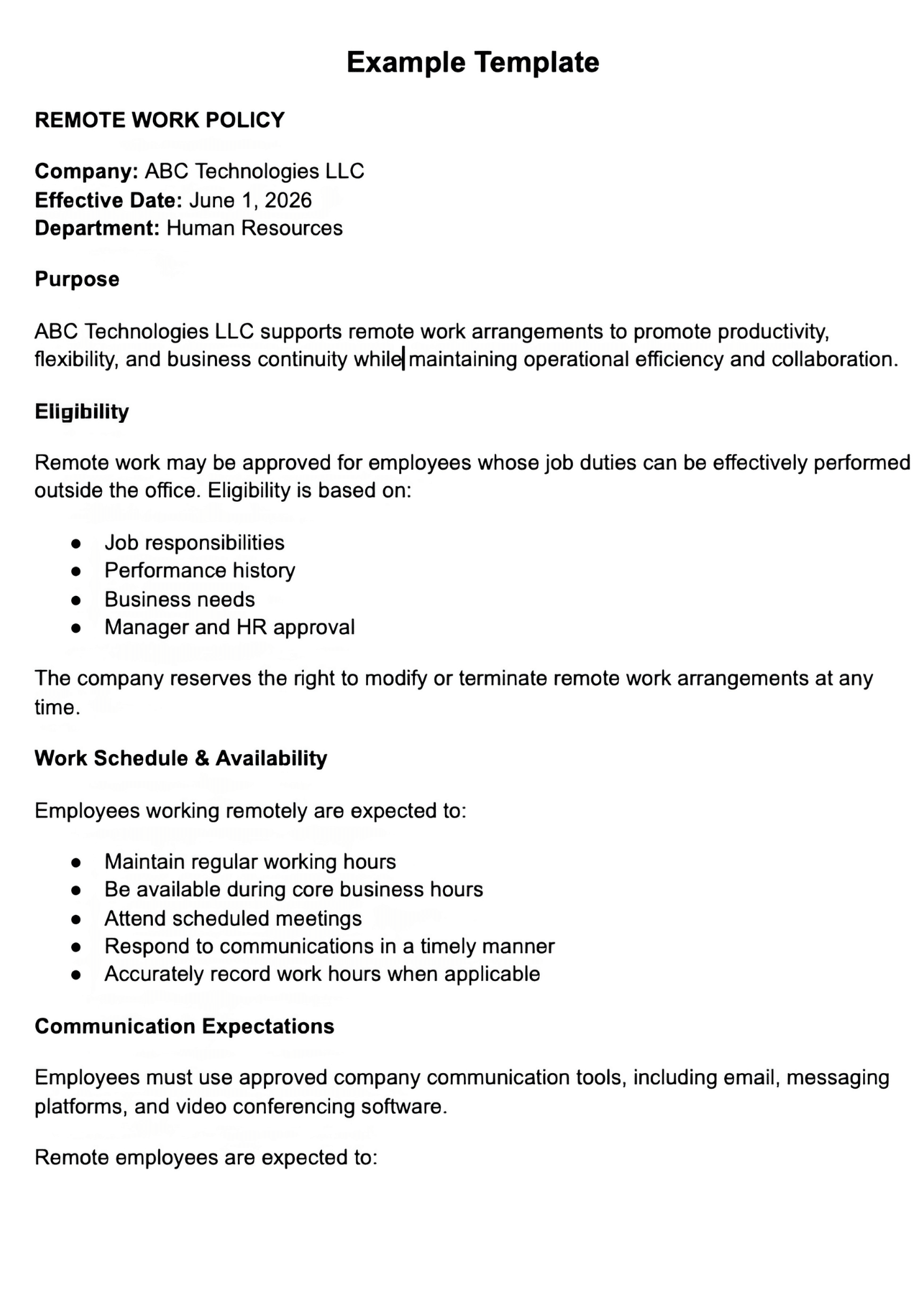
REMOTE WORK POLICY
Company: ABC Technologies LLC
Effective Date: June 1, 2026
Department: Human Resources
Purpose
ABC Technologies LLC supports remote work arrangements to promote productivity, flexibility, and business continuity while maintaining operational efficiency and collaboration.
Eligibility
Remote work may be approved for employees whose job duties can be effectively performed outside the office. Eligibility is based on:
- Job responsibilities
- Performance history
- Business needs
- Manager and HR approval
The company reserves the right to modify or terminate remote work arrangements at any time.
Work Schedule & Availability
Employees working remotely are expected to:
- Maintain regular working hours
- Be available during core business hours
- Attend scheduled meetings
- Respond to communications in a timely manner
- Accurately record work hours when applicable
Communication Expectations
Employees must use approved company communication tools, including email, messaging platforms, and video conferencing software.
Remote employees are expected to:
- Maintain regular communication with managers and team members
- Participate in meetings and collaborative activities
- Provide updates on work progress as required
Equipment & Technology
The company may provide necessary equipment and software for remote work. Employees are responsible for:
- Protecting company equipment
- Using company-approved systems and software
- Reporting technical issues promptly
- Returning company property upon request
Data Security & Confidentiality
Employees must comply with all company security and confidentiality requirements while working remotely, including:
- Using secure internet connections
- Protecting passwords and company information
- Using VPN access when required
- Reporting security concerns immediately
Performance Expectations
Remote employees are expected to maintain the same level of productivity, professionalism, and work quality as office-based employees.
Performance will be evaluated based on job responsibilities, communication, responsiveness, and overall results.
Expense Reimbursement
Approved business-related remote work expenses may be reimbursed in accordance with company expense policies and applicable laws.
Policy Compliance
Employees working remotely must comply with all company policies, including attendance, conduct, confidentiality, and information security policies.
Failure to comply with this policy may result in disciplinary action, including revocation of remote work privileges.
Policy Review
ABC Technologies LLC reserves the right to update or modify this policy at any time based on business or legal requirements.
Employee Acknowledgment
I acknowledge that I have read and understood the Remote Work Policy and agree to comply with its requirements.
Employee Name: ___________________________
Employee Signature: ________________________
Date: ____________________________________
Click here to download the complete template
Remote Work Policy Examples Worth Learning From

Not every company figures out remote work the same way, and that is exactly what makes studying real
| Company | Policy Type | Key Features | What Makes It Stand Out |
|---|---|---|---|
| GitLab | Fully Remote | Async-first communication, no physical offices, public workflow documentation | Built one of the world’s most transparent remote work systems |
| Dropbox | Virtual First | Remote work by default, Flexible work schedules, quarterly team off-sites | Rebuilt its workplace strategy around remote work |
| Atlassian | Distributed | Work from 10,000+ locations, in-person gatherings yearly | 92% say it has increased productivity, with an increase in the workforce |
| Spotify | Flexible Remote | Home or office flexibility, manager-approved schedules, coworking support | Flexibility is built into the company culture |
Wrapping It Up
So there you have it, everything you need to build a remote work policy that actually does its job. You can no longer have “wait, are we supposed to be online right now?” moments.
A solid policy does not just set rules; it sets your team up to work better, communicate clearly, and stay on the same page no matter where everyone is logging in from. The hard part is not writing it, but putting it off.
So take the template, borrow from the examples, follow the steps, and build something your team can actually use. Your future self, and your entire remote team, will thank you for it.