
Employers often understand the reasons behind an employee’s resignation only after the person has left.
Without clear feedback, HR teams may struggle to identify what led to the decision or recognize workplace issues that could affect other employees. This makes it harder to address recurring concerns and prevent similar resignations in the future.
Asking the right exit interview questions can help employers avoid these gaps.
It gives HR teams a better understanding of employee experiences and helps them make informed decisions about workplace improvements and retention strategies.
What is an Exit Interview?
An exit interview is a final conversation between a departing employee and the employer, usually held during the employee’s last week or shortly after they leave.
It is typically led by an HR representative rather than the employee’s direct manager, so the employee can speak more openly.
Most exit interviews focus on employees who resign voluntarily, though some companies also hold them for retirements or contract endings. The session can take place face to face, over a video call, or through a written exit survey.
Unlike the rest of the offboarding process, which covers paperwork, final pay, and returning equipment, an exit interview is about gathering the employee’s honest view of their time with the company.
What Do Employers Gain from Exit Interviews?
A well-run exit interview turns a routine departure into information employers can act on.
-
Honest Feedback without Fear: Current staff often avoid criticizing a manager they rely on for reviews and raises. Departing employees no longer face that pressure.
-
Patterns Across Departures: When the same complaint comes up in several exits, HR can tell a one-off issue from a wider problem.
-
Early Warning on Legal Risk: Departing employees may raise concerns about common forms of workplace harassment, discrimination, or unpaid wages, giving HR a chance to act before these issues become formal claims.
-
Stronger Employer Reputation: A respectful exit makes people more likely to recommend the company, return later, or leave fair online reviews.
What are the Best Exit Interview Questions to Ask Employees?
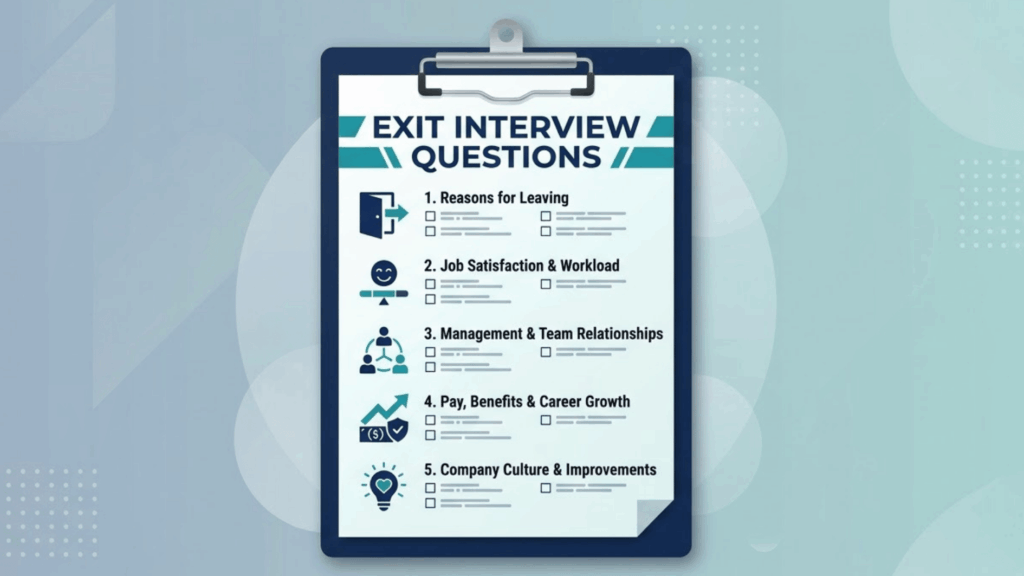
The best exit interview questions are open-ended and specific, so the employee explains what happened instead of giving a yes or no.
Grouping them by topic keeps the conversation focused and makes sure no major part of the job gets skipped.
Questions to Understand Why Employees Leave
These questions help identify the main trigger behind the resignation and what pulled the employee toward a new role.
1. What first made you start looking for a new job?
This helps HR understand what initially led the employee to consider leaving the organization.
2. What is the main reason you decided to leave?
Asking for one main reason helps separate the deciding factor from smaller complaints.
3. Was there a specific event that shaped your decision?
A single incident, such as a denied request or a reorganization, can explain a sudden exit.
4. What does the new role offer that you couldn’t get here?
This shows exactly where competitors are winning, whether in flexibility, title, or scope.
5. What could we have done to keep you?
The response tells HR whether the departure was preventable.
Questions About Job Satisfaction and Workload
These questions show how the day-to-day work felt and whether the role was set up for success.
6. Did your role match the job description you were hired for?
A gap between the posting and the real job is a common source of early turnover.
7. What did you enjoy most about your work here?
Positive answers show which parts of the role are worth protecting.
8. How manageable was your workload in a typical week?
Repeated mentions of overtime or uneven task loads signal a staffing problem.
9. Did you have the tools and training to do your job well?
Outdated software or weak onboarding practices can quietly drain motivation.
10. Did you feel your contributions were recognized?
Employees who feel unnoticed often slip into silent quitting long before they resign.
Questions About Managers and Team Relationships
These questions examine the working relationships that shape an employee’s daily experience.
11. How would you describe your relationship with your direct manager?
This open prompt lets the employee raise concerns in their own words.
12. Did your manager set clear expectations and give regular feedback?
Vague goals and rare check-ins point to a coaching gap.
13. How well did your team work together?
The answer can reveal conflict, poor communication, or a strong team worth noting.
14. Did you feel comfortable raising concerns with your manager or HR?
A “no” suggests problems that never reached the people who could fix them.
15. What is one thing your manager should keep doing, and one thing they should change?
This balanced format produces practical, less defensive feedback.
Questions About Pay, Benefits, and Career Growth
These questions test whether compensation and growth opportunities matched what the employee expected.
16. Did you feel fairly paid for your role and experience?
Comparing answers with market pay data shows whether pay is a real gap.
17. Which benefits did you value most, and which did you rarely use?
This helps HR spend benefits budgets where they matter.
18. Did you have chances to learn new skills or take on new responsibilities?
A lack of stretch work often pushes ambitious employees out.
19. Did you see a clear path to promotion here?
Unclear promotion criteria can make capable employees look elsewhere.
20. Was your career development discussed during performance reviews?
This shows whether reviews focus on growth or only on past results.
Questions About Company Culture and Workplace Improvements
These questions capture the employee’s view of the wider workplace and what should change.
21. How would you describe our company culture to a friend?
Informal wording often brings out more candid answers.
22. Did you feel included and respected by your coworkers?
Responses can highlight issues with belonging, fairness, or team cliques.
23. Did leadership explain company decisions clearly?
Poor communication from the top often fuels rumors and distrust.
24. What is one change that would make this a better place to work?
Limiting it to one change pushes the employee to name their top priority.
25. Would you recommend this company to a friend looking for a job? Why or why not?
The reasoning behind the answer matters more than the yes or no.
Practical Tips for an Effective Exit Interview
HR should run an exit interview as a planned, private conversation with a clear purpose and a consistent structure. A few simple steps help the employee feel safe enough to share details and give HR reliable answers.
Schedule the Interview in Advance
Arrange the interview a few days before the employee’s last working day. This gives them time to prepare and reflect on their experiences.
Explain the Purpose and Confidentiality
Tell the employee why the interview is happening, who will see their answers, and that their feedback won’t affect final pay or references.
Choose a Private Setting
Conduct the interview in a quiet room or through a private video call. Make sure the employee can speak freely without worrying that coworkers will overhear the conversation.
Set a Reasonable Time Limit
Keep the interview around 30-45 minutes. This gives employees enough time to share their thoughts while keeping the conversation focused.
Listen without Becoming Defensive
Allow employees to express their concerns without interrupting or justifying company decisions. Use simple follow-up questions such as “Can you tell me more?” to understand their feedback better.
Use a Standard Set of Questions
Prepare a consistent set of exit interview questions for every departing employee. This makes it easier to compare feedback, identify common concerns, and maintain consistent records.
Record Feedback Accurately
Take notes during the conversation and record important points in the employee’s own words wherever possible. Store the feedback securely and limit access to appropriate HR personnel.
End on a Positive Note
Thank the employee for their time and honest feedback. Acknowledge their contribution to the organization and wish them well in their next role.
Exit Interview Questions Employers Should Avoid
Not every question suits an exit interview. Leading, personal, or accusatory questions can make employees uncomfortable and discourage honest feedback.
HR teams should use neutral wording that allows employees to share their experiences freely.
|
Question to Avoid |
Why to Avoid It |
Better Alternative |
|---|---|---|
|
“You’re leaving because of the low pay, right?” |
It suggests an answer instead of letting the employee share their real reason. |
“How did compensation factor into your decision to leave?” |
|
“Why didn’t you tell us about these problems sooner?” |
It sounds blaming and may make employees defensive. |
“What would have made it easier to share these concerns earlier?” |
|
“Are you leaving because of health or family issues?” |
It asks for private information that the employee may not want to share. |
“Did the role’s schedule or demands affect your decision to leave?” |
|
“Which coworkers were the hardest to work with?” |
It encourages negative comments about coworkers rather than useful feedback. |
“How could teamwork and communication have been improved?” |
|
“Don’t you think you’ll miss working here?” |
It pushes the employee towards a positive response instead of honest feedback. |
“How would you describe your overall experience here?” |
How Can Employers Use Exit Interview Feedback to Improve Retention?
Start by looking at responses across several departures rather than one at a time. If multiple people mention salary, management, workload, or limited growth, that’s a real problem worth fixing, not a one-off complaint.
The right fix depends on what people are saying. Complaints about managers usually point to a need for leadership training and better communication.
If pay keeps coming up, check your salaries against industry benchmarks.
When employees leave because they can’t see a future at the company, clearer promotion paths and training opportunities can help, and if burnout is the theme, it may be time to look at staffing levels or offer more flexible schedules.
Finally, track whether the changes are working by comparing exit feedback and turnover rates over time. If fewer people leave for the same reasons, your employee retention strategies are paying off.
The Bottom Line
An employee’s exit is not necessarily the end of their relationship with an organization.
The way employers handle the exit interview can influence how former employees remember the company and what they share about their experience with others.
A respectful exit process can leave the door open for future referrals, professional connections, and even employees returning to the organization.
Making every exit interview a positive experience is an important part of building a strong employer reputation.
Frequently Asked Questions
Are Exit Interviews Mandatory for Employees in the USA?
No, exit interviews are generally voluntary in the USA. Employees are not usually legally required to participate unless a specific contractual or organizational policy applies.
What Happens if an Employee Refuses to Participate in an Exit Interview?
HR should respect the employee’s decision without applying pressure. Employers can offer an optional written survey or feedback form instead.
How Should Employers Handle Negative Feedback During an Exit Interview?
Employers should document feedback objectively, avoid becoming defensive, and investigate serious concerns such as harassment, discrimination, or workplace misconduct through appropriate HR procedures.