
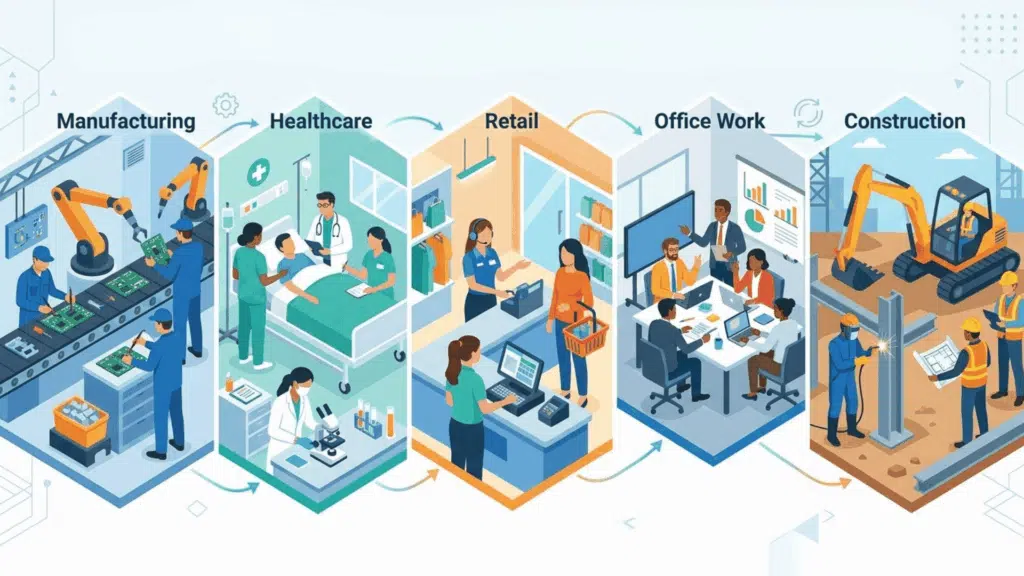

Every successful business relies on an organized way of getting work done.
From factories and hospitals to offices and retail stores, tasks need to be shared efficiently to keep operations running smoothly.
As organizations grow, managing responsibilities becomes more important for maintaining productivity and meeting goals. This is where division of labor plays a key role.
Understanding its role can help businesses improve efficiency, make better use of employee skills, and achieve stronger results.
What is the Division of Labor?
It is the practice of breaking a large job into smaller, specialized tasks and assigning each to a different person.
The logic is straightforward: people get faster and more accurate at the things they repeat. Splitting work by specialization lets that improvement compound across an entire operation.
It applies just as much to a five-person startup (where one person owns marketing, another owns operations) as it does to a 50,000-employee manufacturer.
Factors Affecting Division of Labor
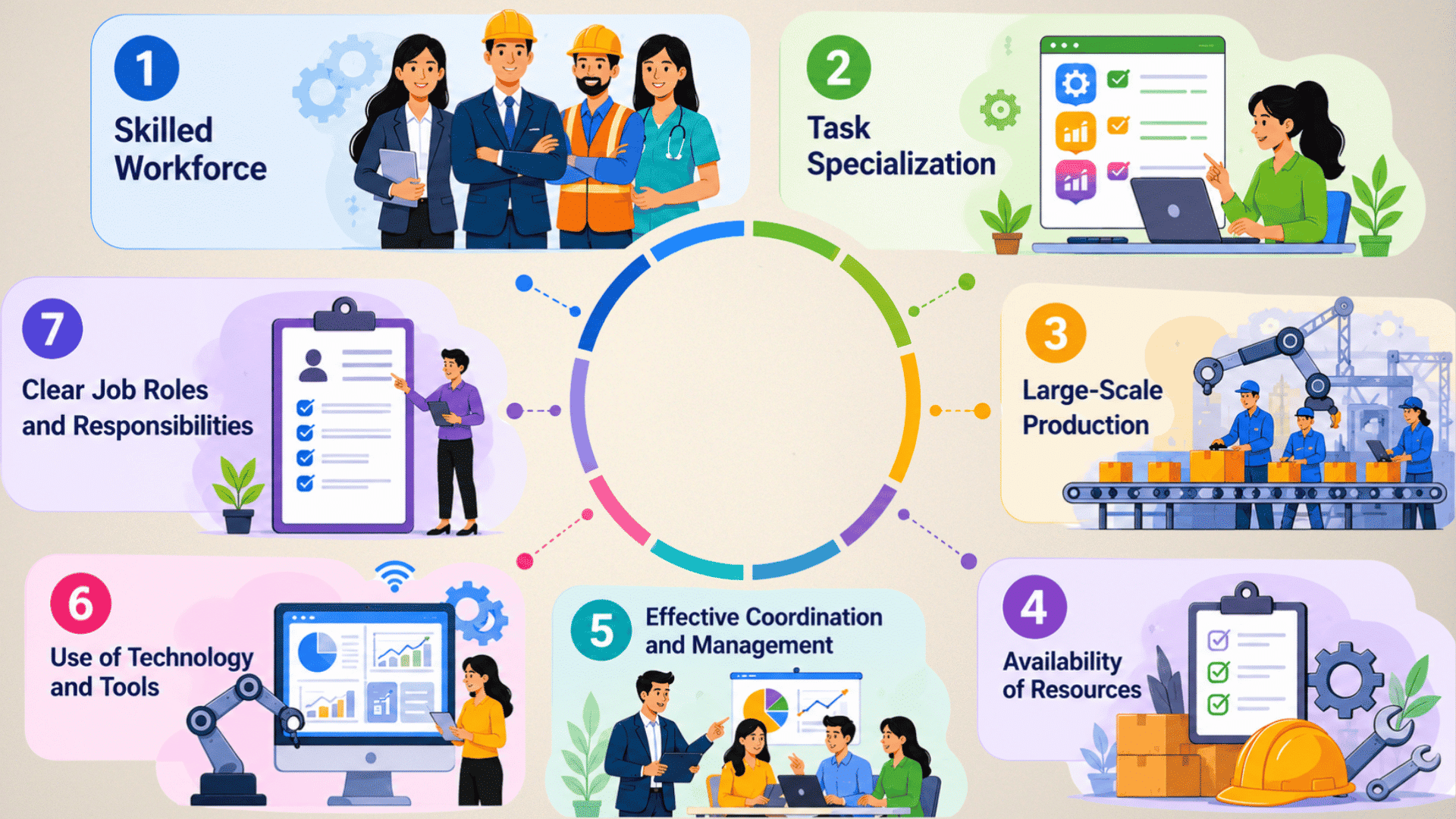
The success rate depends on certain workplace conditions. When these factors are present, organizations can distribute work more effectively and achieve better results
1. Skilled Workforce
A skilled workforce is one of the most important requirements. Employees need the right knowledge, training, and abilities to perform their assigned tasks effectively.
When workers have the necessary skills, they can complete their responsibilities with greater accuracy and efficiency.
2. Task Specialization
It depends on task specialization, where different individuals focus on specific activities.
By concentrating on a particular task, employees can develop expertise and perform their work more efficiently. This also helps improve the overall quality of output.
3. Large-Scale Production
It is most effective in organizations that handle large amounts of work or production.
When there are many tasks to complete, dividing responsibilities among multiple employees helps save time and increase productivity.
4. Availability of Resources
Organizations must have the necessary resources, such as equipment, materials, and workspace, to support different tasks.
Without adequate resources, employees may struggle to complete their assigned duties, thereby reducing the effectiveness.
5. Effective Coordination and Management
Since multiple people work on different parts of the same process, proper coordination is essential.
Managers and team leaders must ensure that tasks are organized, monitored, and completed in the correct order to maintain a smooth workflow.
6. Use of Technology and Tools
Technology and workplace tools support by making tasks easier and more efficient.
Software, machinery, and communication tools help employees perform their specific responsibilities while improving collaboration across teams.
7. Clear Job Roles and Responsibilities
Employees should clearly understand their duties and expectations.
Well-defined job roles help prevent confusion, reduce duplication of work, and ensure that every task is assigned to the right person. This creates a more organized and productive work environment.
Advantages and Disadvantages
Like any workplace strategy, this offers both benefits and challenges. Understanding these can help organizations decide how to apply them effectively.
| Category | Advantage | Disadvantage |
|---|---|---|
| Productivity | Increases productivity | Work becomes repetitive |
| Efficiency | Improves efficiency | Lower job satisfaction |
| Skill Development | Encourages specialization | Limited skill variety |
| Quality | Enhances quality | Employee boredom |
| Time Management | Reduces production time | Depends on teamwork |
| Cost | Lowers costs | Coordination issues |
| Organization | Clear responsibilities | Less flexibility |
| Resource Use | Better resource use | Delay sensitivity |
Examples of Division of Labor
It can be seen in many industries where tasks are divided among employees based on their skills, responsibilities, and areas of expertise. Here are some common examples:
Manufacturing
In a car factory, different workers handle part assembly, painting, quality checks, and packaging, rather than a single person completing the entire process.
Healthcare
Doctors diagnose and treat patients, nurses provide care, pharmacists dispense medications, and lab technicians conduct medical tests.
Retail Businesses
Sales associates help customers, cashiers process payments, inventory staff manage stock, and store managers oversee daily operations.
Modern Offices
Human resources teams manage hiring and employee relations, marketing teams handle promotions, finance departments manage budgets, and IT teams maintain technology systems.
Restaurants
Chefs prepare food, servers take orders and serve customers, cashiers process payments, and managers supervise restaurant operations.
Construction Projects
Architects design buildings, engineers plan structures, electricians handle wiring, and construction workers carry out building tasks.
Wrapping Up
Division of labor has become a key part of how modern organizations operate, helping teams manage work more effectively.
While this approach can improve productivity, organizations must also address challenges such as repetitive work and communication gaps.
When implemented thoughtfully, it can contribute to smoother operations and better teamwork.
By understanding where and how it is used, businesses can create a healthy work environment that supports long-term growth.
Frequently Asked Questions
What is the Division of Labor According to Adam Smith?
Breaking production into specialized tasks, with each worker repeatedly performing one job, significantly boosts efficiency and output.
What is Division of Labor in One Word?
The simplification of work is labor, one word.
What is a Fancy Word for Labor?
Toil, travail, or exertion, with “travail” being the most elevated and literary synonym for labor.