

Harassment is a term used frequently in legal, workplace, and social contexts, but its boundaries are often unclear.
Many people confuse conflict, criticism, or discomfort with harassment, which leads to misreporting and, in other cases, under-reporting of genuine incidents.
This blog breaks down the official definitions, legal standards, and distinctions so you don’t have to ask yourself, what is harassment and what is not?
What is Harassment?
Harassment refers to any unwanted, repeated, or severe behavior that causes harm, fear, or significant discomfort to another person.
According to the U.S. EEOC, harassment becomes unlawful when it creates a hostile environment or results in an adverse employment decision.
It is not defined by the offender’s intent alone; the impact on the recipient is central to the definition.
At its core, harassment involves three elements:
- Unwanted: the behavior is not invited or welcomed by the recipient
- Harmful or distressing: it causes emotional, psychological, or physical harm
- Directed at a person: it targets an individual or group, often based on a protected characteristic
What Counts as Harassment?

Not every uncomfortable interaction constitutes harassment. Specific criteria must be present. Below are the legally and professionally recognized markers:
1. Repeated Unwanted Behavior
A single incident may not always meet the legal threshold, but a pattern of unwanted conduct, even if each instance seems minor, can collectively constitute harassment.
Courts assess frequency, duration, and the cumulative effect on the targeted individual.
2. Offensive or Abusive Language or Actions
Language or conduct that a reasonable person would find offensive, humiliating, or threatening qualifies as harassment, particularly when tied to a protected characteristic.
Here is a clear categorization for some of them:
- Verbal abuse: slurs, name-calling, and derogatory comments directed at an individual
- Written abuse: offensive emails, threatening messages, or other harmful written communication
- Physical aggression: shoving, blocking movement, or unwanted physical contact
- Symbolic conduct: displaying offensive material that targets a person or group
3. Behavior That Creates a Hostile Environment
Under U.S. law, a hostile work environment exists when conduct is so severe or pervasive that it alters the conditions of employment and creates an abusive atmosphere.
This does not require a single dramatic event. Consistent low-level targeting, exclusion, mockery, or undermining that builds a hostile climate qualifies.
4. Power-Based Misuse (Boss, Teacher, Authority Figure)
When someone in a position of authority, a manager, teacher, supervisor, or government official, uses that position to coerce, threaten, or mistreat someone with less power, it constitutes a distinct and serious form of harassment.
This is often referred to as quid pro quo harassment and is explicitly prohibited under employment and education law.
Examples of Harassment
The following examples of harassment reflect conduct that meets the legal and professional threshold for harassment, drawn from recognized workplace standards and documented case patterns across different settings.
1. Real Workplace Harassment: When Reporting Makes It Worse
A 29-year-old office worker faced persistent verbal harassment from colleagues across multiple workplaces, ranging from overt abuse to subtle intimidation. Complaints were dismissed or penalized by management, and leaving was not financially viable.
2. When Documentation Becomes Your Most Powerful Tool
A probationary teacher targeted by her principal through excessive PIPs and contradictory feedback responded by documenting every incident and filing regular grievances. Her persistence contributed to the principal’s termination and secured her a clean exit.
3. Turning the Tables on a Workplace Bully
A woman harassed by a colleague who fabricated combat stories to intimidate coworkers responded by arranging for her national shooting championship highlights to play publicly at a work event, effectively ending his credibility.
Source for these: Reddit
4. When the Harasser gets Promoted
Martha, a cleaning worker, faced escalating sexual harassment from her supervisor, including unwanted touching, threats, and deliberate isolation. Despite a witnessed incident and client intervention, the cleaning company took no action. The supervisor was later promoted to Regional Manager.
Source for this: Focus on Labor Exploitation
What Does NOT Count as Harassment?
Misidentifying normal professional or social behavior as harassment is a significant problem. The following categories, while potentially uncomfortable, do not meet the legal or professional definition.
| Situation | Why It Is Not Harassment |
|---|---|
| Normal disagreements or arguments | Disputes, even heated ones, do not qualify unless they involve threats, protected characteristic targeting, or a sustained hostile pattern |
| Constructive feedback or performance reviews | Criticism of work quality or conduct, delivered through proper channels without discriminatory intent, is a legitimate management function |
| One-time misunderstandings without intent to harm | A single inadvertent comment with no follow-up conduct and no established pattern does not meet the legal threshold |
| Professional discipline is done within policy | Written warnings, PIPs, or demotions carried out per documented company policy do not constitute harassment, regardless of how the employee receives them |
What to Do If You Face Workplace Harassment
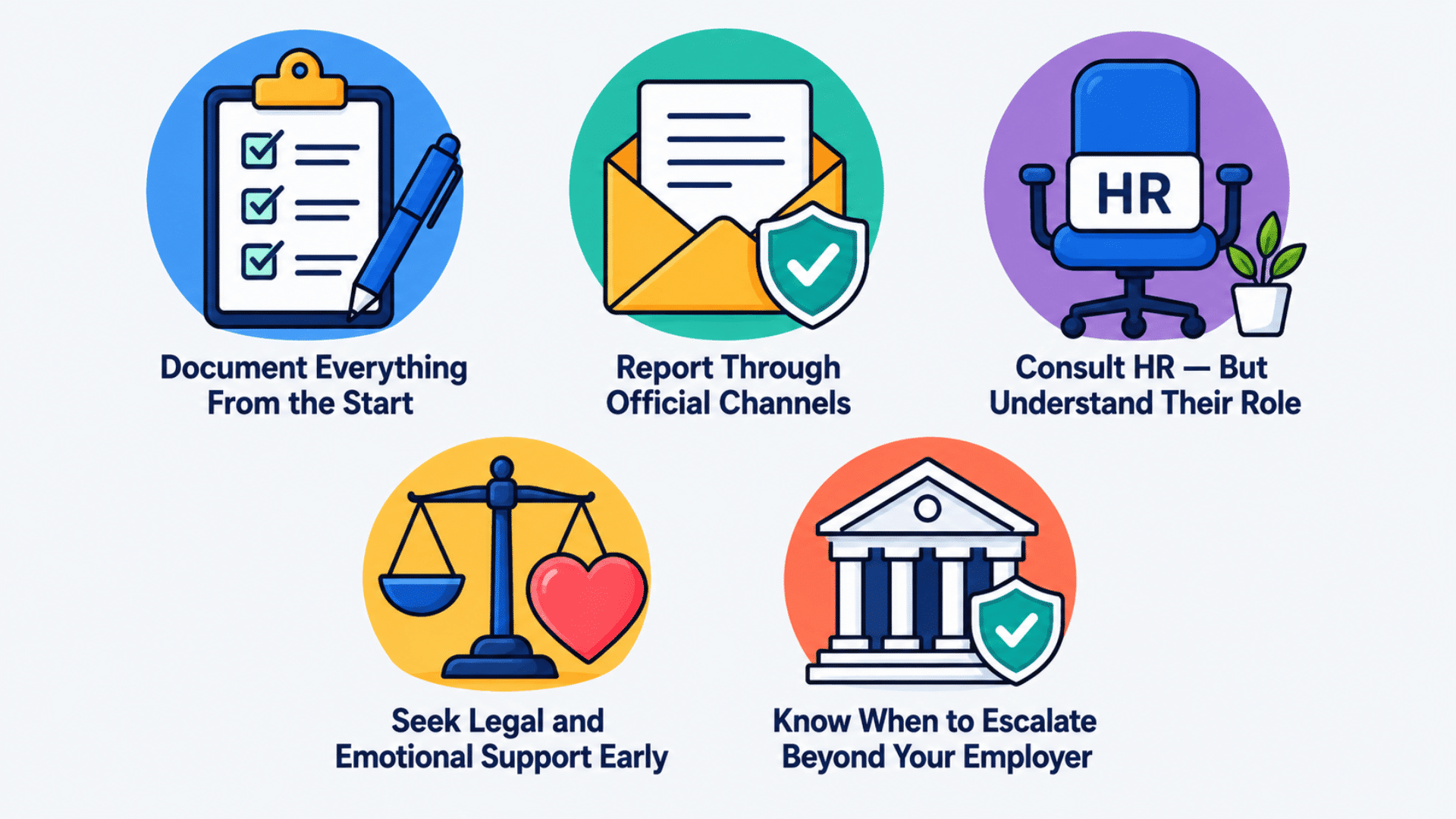
What is harassment and what is not? Now that this distinction has been made clear, the next step is to know how to respond when it occurs.
1. Document Everything From the Start
Keep a private, detailed record of every incident, including dates, times, locations, what was said or done, and who was present.
Store this outside company systems, such as in a personal email draft or a secure private document. Do not rely on memory alone; specificity is what makes documentation useful in formal proceedings.
The more consistent and detailed your records, the stronger any future complaint or legal claim becomes.
2. Report Through Official Channels
Most organizations have a formal process for raising harassment concerns, use it, and do so in writing. Written complaints create a paper trail that cannot be denied or reinterpreted later.
Follow the procedure even if you have doubts about the outcome, as this step is often a legal prerequisite before external action can be taken. Keep copies of everything you submit and any responses you receive.
3. Consult HR, But Understand Their Role
HR departments are responsible for managing organizational risk, which means their response will be shaped by legal and liability considerations.
Submit your concern formally, stick to facts, and avoid emotional language in written communications. HR’s response, or lack of one, becomes part of the record if you later escalate to the EEOC or seek legal counsel.
Do not assume that an informal conversation with HR constitutes a formal complaint.
4. Seek Legal and Emotional Support Early
Consult an employment attorney sooner rather than later, as many offer free or low-cost initial consultations and can assess whether your situation meets the legal threshold for a claim.
The EEOC accepts harassment charges directly and investigates employer conduct at no cost to the employee, while LawHelp.org connects individuals to free or low-cost legal aid by state.
The National Employment Law Project provides broader guidance on worker rights and is a reliable starting point for understanding your options.
Simultaneously, speak with a therapist, counselor, or employee assistance program to manage the psychological impact of the situation. You do not need to wait until the situation becomes severe to seek either legal or emotional support.
5. Know When to Escalate Beyond Your Employer
If internal reporting yields no results or results in retaliation, external bodies exist specifically to handle such situations.
The EEOC accepts harassment charges and investigates employer conduct. State labor agencies often provide additional avenues with different filing deadlines.
Escalating externally is not a last resort; it is a legitimate and protected step that puts formal pressure on employers who fail to act.
In Conclusion
Workplace harassment is not always loud or obvious; it can be subtle, persistent, and difficult to prove.
What remains consistent across all forms is the impact they have on the people who experience them.
Whether you are an employee navigating a difficult situation, a manager responsible for team culture, or an HR professional handling complaints, the steps outlined here provide a clear foundation.
When conduct crosses the line, knowing your rights and acting on them is the most effective response available.
Frequently Asked Questions
Is Harassment Only Illegal if It Happens Repeatedly?
Not always, a single incident of sufficient severity, such as physical assault or explicit coercion, can meet the legal threshold on its own.
Can a Person Be Harassed by Someone Outside Their Organization?
Yes, clients, vendors, or contractors can be held liable for harassment, and employers may still carry an obligation to address it.
Does Harassment Have to Be Directed at One Specific Person?
No, conduct that targets a group based on a shared characteristic, such as gender or religion, can also constitute harassment.
Can Someone Be Accused of Harassment for a Complaint They Made in Good Faith?
No, filing a harassment complaint in good faith is legally protected activity, and retaliation against a complainant is itself a separate violation under most employment laws.