

If you work for yourself, taxes can feel a bit confusing, and the self-employment tax is usually the biggest surprise.
It’s not just regular income tax. You’re also responsible for Social Security and Medicare, which employers normally help cover.
So, how much is self-employment tax, and how does it actually work? The short answer is: it depends on your income, but there’s a standard rate you should know.
In this blog, everything is broken down in simple terms, so it’s easier to understand what you owe, why you owe it, and how to plan ahead without stress.
What Is Self-Employment Tax?
Self-employment tax is a federal tax that covers Social Security and Medicare contributions. It’s based on IRS Schedule SE and applies to anyone who earns income outside traditional employment.
So if you’re bringing in money on your own terms, this tax applies to you.
You only pay the other half. But when you’re self-employed, there’s no employer to split the bill. You handle both portions yourself.
It’s the same total amount, just coming entirely out of your pocket instead of being shared.
The IRS has a pretty low threshold here. If your net earnings are $400 or more, you’re required to file and pay self-employment tax. This includes Freelancers, Independent contractors, Sole proprietors, and Gig workers.
How Much Is Self-Employment Tax?
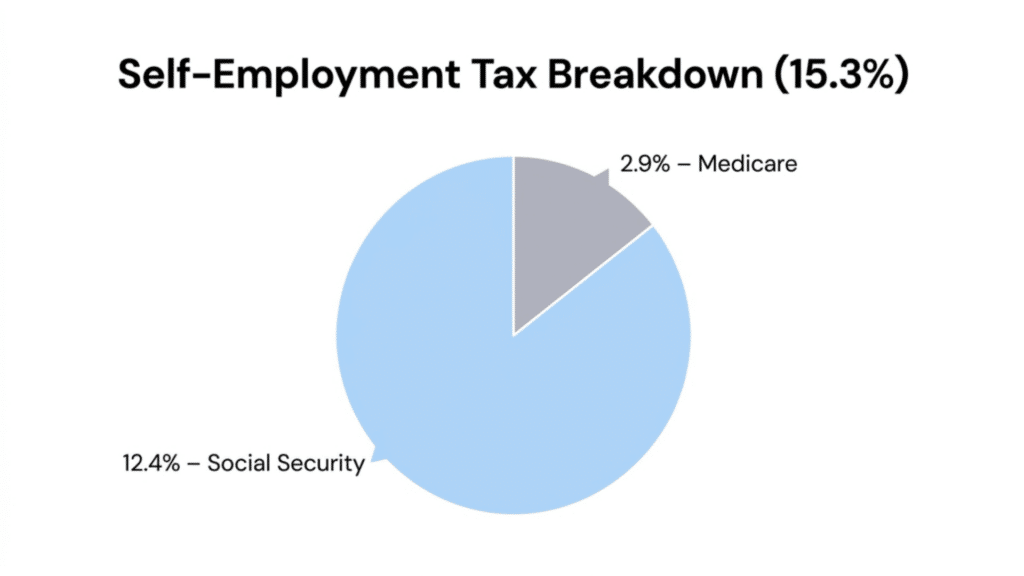
The current self-employment tax rate is 15.3%. That number is set by the IRS and breaks down into two parts. Let’s break each piece down so the full picture makes sense.
| Tax Component | Rate | Income Limit | Key Detail |
|---|---|---|---|
| Social Security Tax | 12.4% | Up to $176,100 (2026) | Applies only to earnings up to the wage base limit. No tax on income above this amount. |
| Medicare Tax | 2.9% | No cap | Applies to every dollar of net earnings |
| Additional Medicare Tax | 0.9% extra | $200,000 (single) | Kicks in once income crosses the threshold |
| Additional Medicare Tax | 0.9% extra | $250,000 (married filing jointly) | Both spouses’ combined income counts |
| Additional Medicare Tax | 0.9% extra | $125,000 (married filing separately) | Lower threshold for separate filers |
How to Calculate Self-Employment Tax
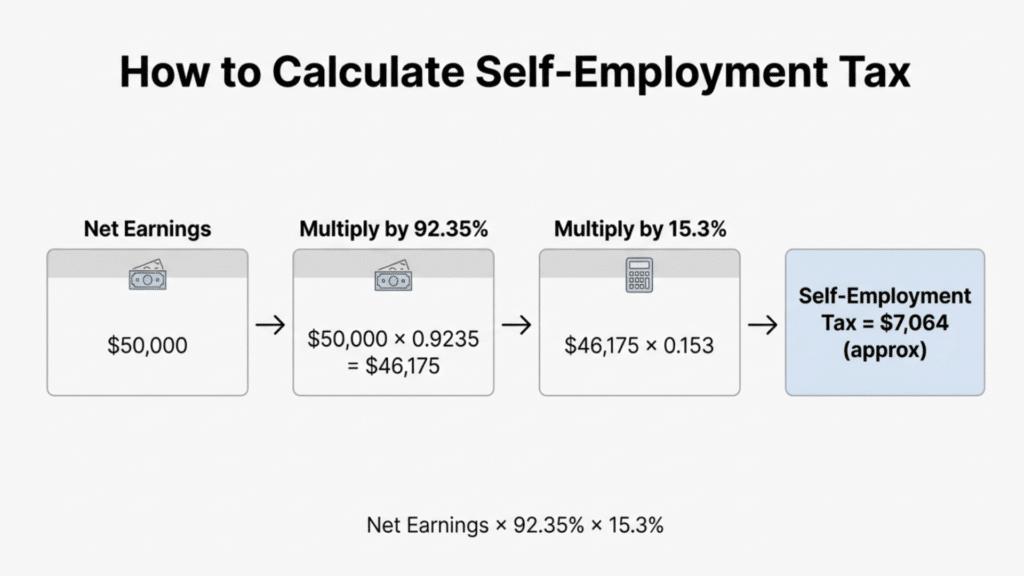
Figuring out what you owe doesn’t have to be complicated. Just follow these three steps.
Step 1: Calculate Your Net Earnings
Now, one thing that trips a lot of people up. This tax doesn’t apply to everything you make. It applies to yournet earnings, which are your income after subtracting business expenses.
So if you brought in $60,000 but spent $10,000 on business costs, you’re only being taxed on $50,000. That’s an important distinction, and it can make a real difference in what you actually owe.
Always calculate from your net, not your gross.
Step 2: Multiply by 92.35%
The IRS doesn’t tax 100% of your net earnings. You first multiply by 92.35% before applying the tax rate.
So, taking that $50,000 from our example and multiplying by 0.9235 gives you $46,175. That’s the number you carry into the next step.
Step 3: Apply the 15.3% Tax Rate
Now take that $46,175 and multiply it by 15.3%. That final number is your self-employment tax for the year, covering both Social Security and Medicare combined.
In this case, $46,175 × 0.153 lands at roughly $7,064. That’s what you’d owe on $50,000 of net earnings. If your income crosses the thresholds for the additional 0.9% Medicare tax, factor that in as well.
You can use a simple online calculator like TaxAct’s self-employment tax calculator to get a quick estimate. Just remember, these tools give rough numbers.
For accurate calculations, always refer to IRS guidelines or a tax professional.
When are Self-Employment Taxes Due?
The IRS requires quarterly estimated tax payments if you expect to owe $1,000 or more in taxes for the year. This covers both income tax and self-employment tax combined.
A good habit is setting aside a portion of every payment you receive. Depending on your income, expenses, and state taxes, that could be anywhere between 10% and 50% of your earnings.
The four payment deadlines generally fall in April, June, September, and January. If any date falls on a weekend or a federal holiday, it is shifted to the next business day.
How to Reduce Self-Employment Tax?
Good news. There are a few legal ways to bring down what you owe.
1. Deduct Half of Your Self-Employment Tax
The IRS lets you deduct 50% of your self-employment tax directly from your taxable income. It doesn’t lower the tax rate itself, but it does reduce the income subject to tax.
So if your self-employment tax comes out to $7,064, you can deduct $3,532 from your taxable income. It’s a small but meaningful adjustment that can push you into a lower tax bracket.
2. Business Expense Deductions
Any legitimate business expense reduces your net earnings, and lower net earnings mean less tax. Common deductions include:
- Home office costs
- Equipment and tools
- Internet bills
- Business-related travel
Keep your receipts and track everything throughout the year
3. Retirement Contributions
Contributing to a retirement account is another smart move. Options like a SEP-IRA or a Solo 401(k) let you set aside a portion of your income before it’s taxed.
You’re building future savings while lowering your taxable income at the same time. The contribution limits are generous for self-employed individuals, so it’s worth looking into sooner rather than later.
Self-Employment Tax Vs Income Tax
A lot of people confuse these two or assume they’re the same thing, but they’re not. Here’s a quick comparison:
| Feature | Self-Employment Tax | Income Tax |
|---|---|---|
| What It Covers | Social Security + Medicare | Federal income |
| Who Pays | Self-employed individuals | Everyone with taxable income |
| Tax Rate | 15.3% (fixed) | Varies by income bracket |
| Income Limit | Social Security capped at $176,100 | No cap |
| Calculated On | Net earnings × 92.35% | Adjusted gross income |
| IRS Form Used | Schedule SE | Form 1040 |
| Can You Deduct It | 50% is deductible from taxable income | Standard or itemized deductions apply |
| Purpose | Funds Social Security + Medicare programs | Funds general federal government operations |
How to Pay Self-Employment Tax?
To pay self-employment tax, you’ll need either a Social Security Number (SSN) or an Individual Taxpayer Identification Number (ITIN).
Most people already have an SSN; if you don’t, you can apply for one using Form SS-5 through the Social Security Administration.
Non-residents or resident aliens who aren’t eligible for an SSN can apply for an ITIN using Form W-7 through the IRS.
Once that’s sorted, paying is straightforward. You’ll calculate your tax using Schedule SE and attach it to your Form 1040. For quarterly payments, use Form 1040-ES.
The IRS offers several payment options, including IRS Direct Pay, EFTPS, debit or credit card, and check. Always save your payment confirmations for your records.
It’s a Wrap
Understanding how much the self-employment tax is doesn’t have to feel overwhelming. At 15.3%, it’s a fixed rate, and once you understand the basics, it becomes much easier to handle.
Focus on your net earnings, set aside money regularly, and stay on top of quarterly payments to avoid surprises.
Also, make sure to use deductions you’re eligible for, like business expenses or retirement contributions, to lower your overall tax burden.
Now that the basics are clear, it’s easier to plan ahead and stay in control before tax season arrives.
Frequently Asked Questions
1. What is the $600 Rule?
The $600 rule means businesses must send you a 1099-NEC form if they pay you $600 or more in a year for freelance or self-employed work.
2. What Expenses Can I Claim as Self-Employed?
Common deductions include home office costs, internet bills, travel, supplies, marketing, and a portion of utilities used for work.
3. What Can I Claim on Tax without Receipts?
You can claim some expenses, such as mileage (using standard rates) or small costs, but it’s safer to keep records or bank statements as proof.