
New software, new compliance rules, a team reshuffle. Every change means your people need new skills, and they need them fast.
At the same time, many employees are looking for opportunities to up their game and progress their careers.
Learning and Development is becoming increasingly important as organizations respond to these changes and help their people keep up with them.
This blog examines why workplace learning matters, the approaches organizations can take, and how to turn priorities into practical strategies and programs that support employee growth and career success.
What is Learning and Development?
Learning and Development (L&D) is an organized way of building up people’s knowledge, skills, and capabilities so that they can perform effectively and are in a position to take on future roles.
It includes onboarding for new joiners, role-specific training, technical and soft skills development, leadership development, and support for career progression.
Learning vs Development
Learning is focused on the present. It covers the knowledge and skills people need to do their current job well, such as product training, compliance courses, or tool tutorials.
Development is focused on the future. It builds broader capabilities, like leadership, judgment, and adaptability, that prepare people for bigger or different roles.
In short, learning closes today’s skill gaps, while development prepares people for what comes next. An effective L&D program needs both.
Why is Learning and Development Important?
Learning and Development matters because organizations are only as capable as their people.
When employees have the right skills, they work with more confidence, make fewer errors, and adapt faster as roles and tools change.
L&D also supports retention; people are more likely to stay when they see a clear path to grow.
Growing people from within also gives you a bench for senior roles, which is the heart of succession planning.
Beyond individual performance, it keeps the business aligned with changing priorities.
Types of Learning and Development
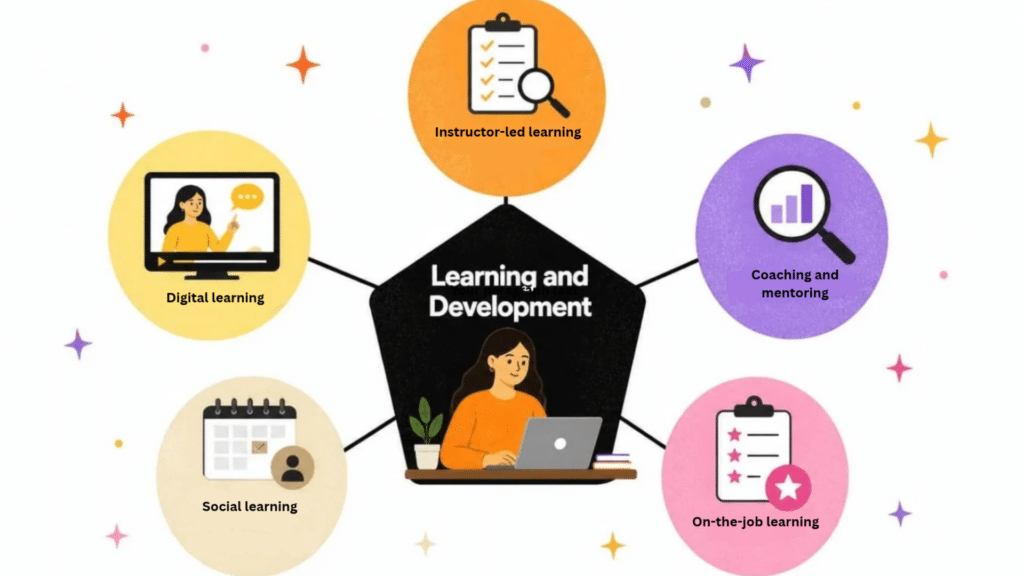
Organizations use several Learning and Development approaches to build skills and support employee growth:
-
Instructor-led learning: Workshops or classroom sessions led by an instructor, with room to discuss and ask questions.
-
Digital learning: Self-paced courses, videos, and online modules so that people can learn at their own pace and go back over the material as and when necessary.
-
On-the-job learning: Job shadowing, stretch assignments, and guided practice all help the employee to learn by applying the new skills in a real work context.
-
Coaching and mentoring: One-to-one support to help people develop specific skills, deal with issues, or plan their career.
-
Social learning: Peer discussions, knowledge-sharing sessions, and communities of practice all provide the opportunity for people to learn from each other’s experience.
Examples of L&D Programs
L&D programs vary by goal, role, and stage of the employee journey. The right mix of these programs depends on your business priorities and the skill gaps you need to close. Common examples include:
|
Type of Training |
Description |
|---|---|
|
Onboarding programs |
Help new hires understand the company, their role, and the tools they will use, so they become productive faster. |
|
Role-specific training |
Builds the technical skills a job requires, such as sales methodology, software tools, or customer support practices. |
|
Soft skills training |
Covers communication, collaboration, time management, and problem-solving. |
|
Leadership development |
Prepares high-potential employees and new managers for people-management responsibilities. |
|
Compliance training |
Keeps employees informed about regulations, safety standards, and company policies. |
|
Mentoring and coaching |
Pairs employees with experienced colleagues for personalized guidance and career support. |
|
Upskilling and reskilling |
Teaches new skills for evolving roles or helps employees move into different functions. |
How to Create an Effective Learning and Development Strategy?
An effective L&D strategy will set the priorities for building workforce capability. Review the strategy regularly as roles, technology, and organizational needs change.
-
Identify skill gaps: Compare current workforce capabilities with existing and future role requirements. Use performance data and employee feedback to identify areas that need attention.
-
Set learning goals: Define measurable goals that link workforce development to business priorities and to future roles.
-
Choose your learning method: Workshops, digital courses, coaching, or on-the-job practice. Match the method to the skill, the learner, and the work context.
-
Allocate the resources: Budget, time, tools, ownership, and leadership support prior to launch.
-
Measure the outcomes: Track levels of participation and learning, then assess the application of skills against relevant performance indicators. Use that information to inform future investment.
Learning and Development KPIs
KPIs give clear data to track progress and prove value. They help connect learning programs to real business results, so you’re not just guessing.
-
Employee Productivity Rate: Tracks how much work employees get done after training, showing whether new skills actually speed things up.
-
Revenue Growth: Measures the increase in sales after training, helping you link better skills to more money coming in.
-
Net Profit Margin: Shows how much profit remains after all costs, revealing whether training helps the business run more efficiently.
Methods to Measure ROI in L&D Programs
Training costs time and money, so it’s fair to ask if it’s actually paying off. That’s where ROI measurement comes in handy.
Kirkpatrick Model of Training Evaluation
The Kirkpatrick model is easy to follow, widely used, and looks at training through four simple levels:
-
Reaction, which asks whether people found the training engaging and relevant to their job.
-
Learning, which checks what they actually picked up.
-
Behavior, which asks if they are using those new skills on the job.
-
Results measure the bigger impact on the business, like better sales or fewer mistakes.
It works best when you plan it backward. Decide the business result you want first, then work back to the behaviors, learning, and reactions that lead there.
Phillips Model of Training Evaluation
The Phillips model builds on Kirkpatrick’s four levels and adds a fifth one: ROI.
You compare the financial benefits of a training program against what it cost to run, and the result shows up as a percentage.
The ROI Institute calculates it as ROI (%) = (net program benefits ÷ program costs) × 100, where net benefits are the money value of the results minus the full program cost.
Say a program costs $20,000 and you can tie $30,000 in value to it. That’s $10,000 in net benefits and an ROI of 50%.
It takes more effort than the other levels, but it gives leaders a number they can compare with other investments.
Learning and Development vs Training and Development
These functions can overlap, but understanding their differences helps clarify how each contributes to workplace growth and organizational success.
|
Area |
Learning and Development (L&D) |
Training and Development (T&D) |
|
Meaning |
Builds employee capabilities through ongoing learning |
Combines job training with employee development |
|
Primary focus |
Skills and continuous learning |
Job readiness, skills, and growth |
|
Typical responsibilities |
Assessing needs, designing learning, and evaluating programs |
Delivering training and supporting development |
Who is Responsible for Learning and Development?
Learning and Development is a shared responsibility, but each group plays a different role:
-
L&D and HR teams: Design the programs, assess skill needs, choose learning methods, select tools, and measure results.
-
Managers: Spot skill gaps in their teams, support day-to-day learning, give feedback, and make time for development.
-
Senior leadership: Set business priorities, approve budgets, and show that learning matters by taking part themselves.
-
Employees: Own their growth by setting goals, using the learning opportunities available, and applying new skills at work.
Jobs for Learning and Development Professionals
If you love helping people grow, a career in learning and development opens up plenty of options.
Some roles are all about creating training content, while others focus on strategy, coaching, or building skills across a whole company.
-
Instructional Designer: Builds training courses and learning materials, turning complex topics into lessons people actually understand and remember.
-
Corporate Trainer: Leads workshops and sessions that help employees sharpen skills, learn new tools, and grow in their roles.
-
L&D Manager: Plans the company’s overall training strategy, manages budgets, and makes sure programs match real business goals.
-
eLearning Developer: Creates online courses, videos, and interactive modules using authoring tools like Articulate Storyline or Adobe Captivate.
-
Talent Development Specialist: Spots skill gaps, designs career growth plans, and supports employees as they move toward leadership roles.
Final Thoughts
The value of Learning and Development lies in its ability to address genuine workforce needs and contribute to meaningful improvements in employee and organizational performance.
Organizations can make development an everyday activity by giving people time to learn, management support, and opportunities to put what they’ve learned into practice.
Ready to make learning part of your team’s everyday routine? Start small. Pick one skill gap, set a clear goal, and track the results using the KPIs above.
Frequently Asked Questions (FAQs)
How Can Managers Help Employees Apply What They Learn?
Managers can talk about how the new skills relate to the day-to-day work, give people the opportunity to try them out, and then provide feedback afterward.
Does an Organization Need a Dedicated L&D Team?
Not necessarily. Smaller organizations can start by identifying a key skill gap, tapping into the skills that they already have in-house, and then simply setting aside the time to learn.
How Can Employees Take an Active Role in Their Development?
Employees can identify the skills they’d like to develop, talk those goals over with their manager, and then look for appropriate projects, mentoring, or learning opportunities.