

If you have ever started a business, hired an employee, or opened a business bank account, chances are you have come across a nine-digit number that the IRS uses to identify your business.
It sounds technical, and the name alone is enough to make most new business owners pause. But the concept behind it is simple, and understanding what it is and why it matters can save you a lot of confusion down the road.
If you are just starting out or simply trying to understand what is a FEIN while making sense of the paperwork in front of you, this is exactly where that clarity begins.
What Is a FEIN?
A Federal Employer Identification Number (FEIN) is a unique nine-digit number issued by the Internal Revenue Service (IRS) to identify a business for federal tax purposes.
It works much like a Social Security Number (SSN), but for businesses rather than individuals. Companies use a FEIN when filing taxes, hiring employees, opening business bank accounts, and applying for licenses or loans.
Despite the name, not every business with a FEIN has employees.
Sole proprietors and other business owners may also choose to get one for tax reporting or privacy reasons. The IRS uses this number to track a business’s tax obligations and financial activities.
Who Needs a FEIN?
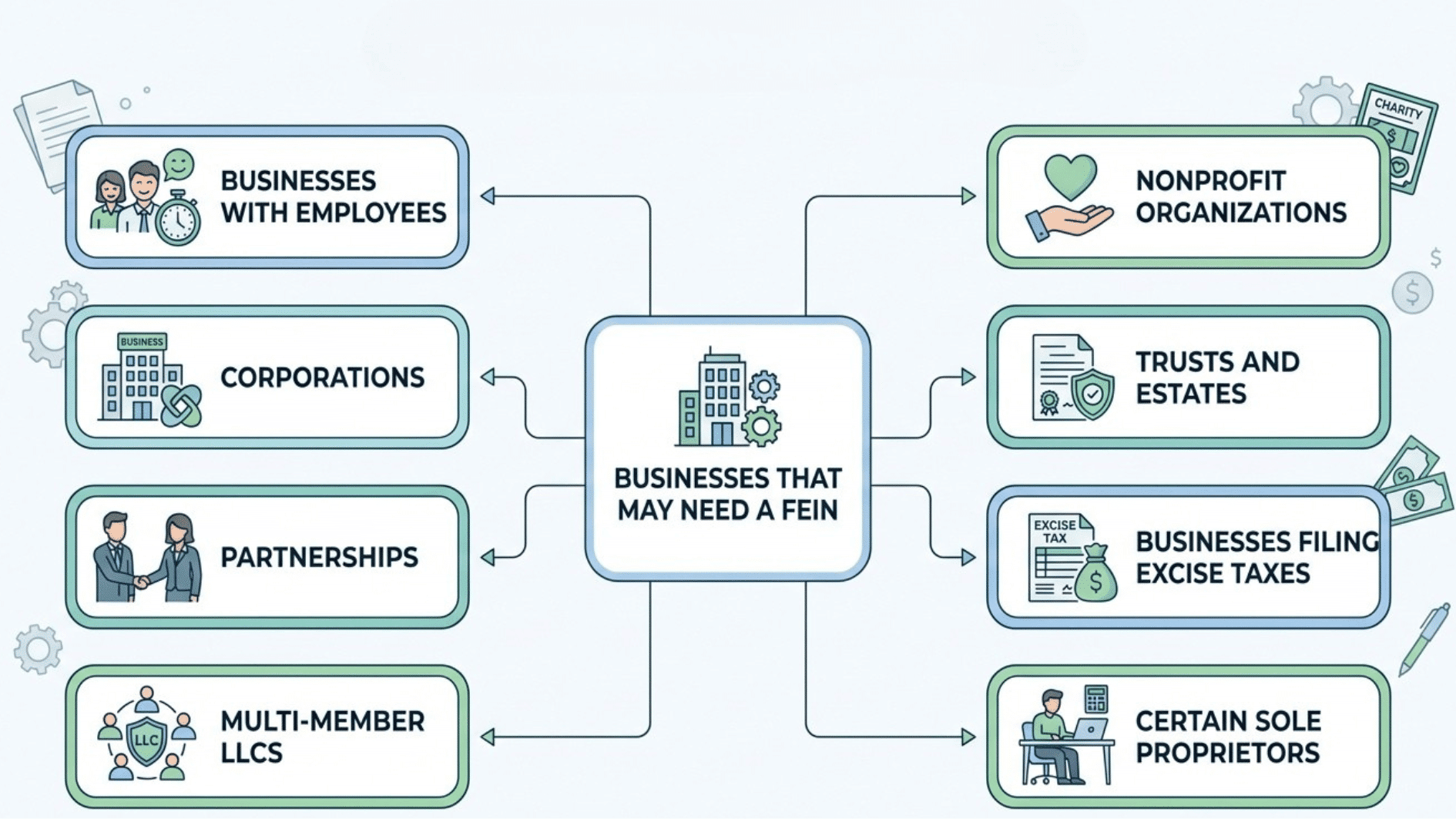
Not every business must have a FEIN, but many do. According to the IRS, businesses generally need one if they meet specific tax or organizational requirements.
- Businesses with employees: Required for reporting payroll taxes and employee wages to the IRS.
- Corporations: Needed because corporations are separate legal tax entities.
- Partnerships: Required since partnership income and tax reporting must be filed separately.
- Multi-member LLCs: Usually needed because they are taxed as partnerships by default.
- Nonprofit organizations: Required for tax filings, exemption applications, and official records.
- Trusts and estates: Needed when they have federal tax filing responsibilities.
- Businesses filing excise taxes: Required for certain industries or products subject to special federal taxes.
- Sole proprietors in certain cases: Needed if they hire employees or meet specific IRS requirements.
Is FEIN and EIN the same?
Yes, FEIN and EIN are the same. Both terms refer to the same nine-digit identification number issued by the Internal Revenue Service (IRS) to identify a business for federal tax purposes.
The only real difference is in the wording. FEIN stands for Federal Employer Identification Number, while EIN stands for Employer Identification Number.
The IRS usually uses the term EIN, but banks, lenders, payroll companies, state agencies, and business forms may use FEIN instead. This can make the terms seem different, but they are not separate numbers.
Whether someone asks for your FEIN or EIN, they are asking for the same business tax ID used to file taxes, hire employees, open business bank accounts, and handle official business records.
How to Get a FEIN?
If you’re starting a new business or need a FEIN for tax or banking purposes, choosing the right application method can help you receive your number as quickly as possible.
| Application Method | How It Works | Typical Processing Time |
|---|---|---|
| Online | Apply through the IRS online EIN application and receive your FEIN immediately if eligible. | Usually immediate |
| Fax | Complete and fax IRS Form SS-4 to the appropriate IRS fax number. | About 4 business days |
| Mail a completed Form SS-4 to the IRS processing center. | Around 4 weeks | |
| Telephone (International Applicants Only) | International applicants can apply by calling the IRS Business & Specialty Tax Line. | Issued during the call if eligibility is confirmed |
When Should a Business Apply for A FEIN?

Many businesses apply for a FEIN soon after they are formed, but the right timing depends on your business activities. Here are the most common situations when you should apply for a FEIN:
- Before hiring employees: A FEIN is generally required to report payroll taxes and employee wages.
- Before opening a business bank account: Many banks require a FEIN to open an account in your business’s name.
- Before filing business taxes: Certain business entities must use a FEIN when filing federal tax returns.
- Before applying for business licenses or permits: Government agencies may ask for a FEIN during the application process.
- Before applying for business loans or credit: Lenders often require a FEIN to verify your business and process financing applications.
- When forming a corporation, partnership, or multi-member LLC: These business structures typically need a FEIN regardless of whether they have employees.
Can a Business Have More than One FEIN?
In most cases, a business can have only one FEIN per legal entity. The FEIN stays with that business for its lifetime, even if the business changes its name or location.
However, if you create a new legal entity or make certain structural changes, such as converting a sole proprietorship into a corporation or forming a new partnership, the IRS may require you to obtain a new FEIN.
If you own multiple separate businesses that are each legally distinct entities, each one will generally need its own FEIN. Before applying for another number, it’s best to review the IRS guidelines to determine whether a new FEIN is actually required.
What Happens if You Lose or Forget Your FEIN?
If you lose or forget your FEIN, there’s no need to apply for a new one. In most cases, you can recover your existing number using your business records or by contacting the IRS after verifying your identity.
- Check your IRS confirmation letter: Your original FEIN is listed on the CP 575 notice sent by the IRS.
- Review previous tax returns: Business tax filings usually include your FEIN.
- Look at business bank records: Bank account applications and statements may contain your FEIN.
- Check payroll or accounting records: Payroll reports and bookkeeping software often store your FEIN.
- Contact the IRS: If you still can’t find it, call the IRS Business & Specialty Tax Line to retrieve your FEIN after identity verification.
- Avoid applying for a new FEIN: Losing your number doesn’t mean you need a replacement, and applying again can create unnecessary complications.
The Bottom Line
A FEIN helps give your business a clear identity for tax, banking, and official paperwork.
It may feel like a small detail at first, but it becomes important once you start hiring, filing business taxes, opening accounts, or applying for licenses.
The main thing to remember is that FEIN and EIN mean the same thing. Once you know when your business needs one and how to keep it safe, handling business records becomes much simpler.
Frequently Asked Questions
Is a FEIN Free to Get?
Yes, a FEIN is free when you apply directly through the IRS.
Can a Sole Proprietor Get a FEIN?
Yes, a sole proprietor can get a FEIN even if they are not required to have one.
Can I Use My SSN Instead of A FEIN?
Some sole proprietors can, but a FEIN is often better for privacy and business banking.
Does a FEIN Expire?
No, a FEIN does not expire once the IRS issues it.