

Employers receive accommodation requests regularly; most are manageable, but some aren’t.
When a request would genuinely blow up operations, finances, or safety, the law gives employers a way out, but it’s a narrow one. That threshold is called undue hardship.
This blog covers what that standard actually means, what clears it and what doesn’t, and how courts have applied it in practice.
Undue Hardship Definition
Under U.S. federal law, undue hardship refers to an accommodation that would impose significant difficulty or expense on the employer.
It is the legal standard that allows an employer to deny a reasonable accommodation request under the Americans with Disabilities Act (ADA) or Title VII when fulfilling it would impose a substantial burden.
In plain terms: an employer does not have to provide an accommodation if doing so would be too costly, too disruptive, or would fundamentally alter how the business runs.
The bar is deliberately high; inconvenience alone does not meet it.
Why Do Concepts Matter in Employment Law?
The undue hardship standard sits at the exact point where employer obligation ends and permissible denial begins.
That’s not an abstract legal distinction; it determines whether a denial exposes a company to litigation or holds up in court.
- Protects Employees: Employers cannot reject requests on vague grounds.
- Limits Employer Liability: Provides a legal defense when accommodation is genuinely not viable.
- Drives the Interactive Process: Both parties must engage before hardship can be claimed.
- Prevents Blanket Denials: Each request must be assessed individually.
Key Factors Used to Determine Undue Hardship

The ADA defines “significant difficulty or expense” through four specific factors. Employers must weigh all of them, not just cost, which is where most companies get it wrong.
1. Cost of the Accommodation
Absolute cost matters, but so does cost relative to the employer’s overall financial resources. A $5,000 modification may be undue for a 10-person firm, but routine for a large corporation.
Tax credits and available funding sources are also factored into the assessment.
2. Size and Resources of the Organization
Larger organizations with greater financial capacity face a higher bar for proving hardship.
Courts examine the number of employees, facilities, and the overall budget, not just the resources of the specific department affected.
3. Impact on Business Operations
The accommodation must do more than cause temporary inconvenience.
Courts look at whether it disrupts workflow, shift structures, or service delivery in a substantial and ongoing way.
Short-term adjustments during a transition period do not meet this threshold.
4. Effect on Other Employees
Permanently shifting an employee’s essential duties onto co-workers without their consent can constitute hardship.
Minor scheduling adjustments that affect other staff only in a limited way generally do not clear the legal bar.
What Counts and What Does Not Count as Undue Hardship
The EEOC’s enforcement record makes the line pretty clear. Here’s how it breaks down in practice.
| Points | Qualifies | Does Not Qualify |
|---|---|---|
| Cost | Disproportionate to budget; requires layoffs or losses | Small, one-time expense |
| Operations | Restructures a core business function | Brief workflow adjustment |
| Safety | Direct, documented, unmitigable threat | Speculative safety concerns |
| Job Functions | Eliminates an essential function entirely | Minor task modifications |
| Other Employees | Permanently shifts essential duties without consent | Minor scheduling adjustments |
| Justification | Specific, documented evidence | Assumptions or preferences |
| Process | All alternatives explored; none viable | Rejection before the interactive process |
Examples of Undue Hardship in the Workplace

Whether an accommodation qualifies as undue hardship depends entirely on the specifics of each situation.
The following examples illustrate where courts and the EEOC have drawn the line, and where employer claims have failed.
1. US Airways, Inc. v. Barnett (2002)
The Supreme Court ruled that an accommodation that conflicts with an established seniority system is ordinarily sufficient to show that it is not reasonable, absent special circumstances.
Source: Cornell
2. EEOC v. UPS (settled 2017)
The EEOC successfully challenged UPS’s rigid 12-month leave policy, which automatically terminated employees without engaging the interactive process. UPS settled for $1.7 million.
Source: HRDive
3. EEOC v. Ford Motor Co. (2015)
Ford lawfully denied a remote work request because the role required real-time, on-site attendance, confirming that telework is not always a viable accommodation.
Source: UpCounsel
4. Groff v. DeJoy (2023)
The Supreme Court raised the Title VII undue hardship bar, ruling that employers must show substantial increased costs, not merely more than minimal inconvenience, to deny religious accommodations.
Source: The Craighead Law Firm
How Do Employers Prove Undue Hardship?
Claiming undue hardship is not enough; employers must prove it. Courts require concrete evidence, not assumptions.
Employers must provide:
- Financial records showing the cost of the accommodation relative to the operating budget
- Operational analysis documenting how the accommodation would affect workflows or staffing
- Records of the interactive process, including all communications with the employee
- Evidence of alternatives considered and why each was rejected
Verbal assertions carry no legal weight; documentation must precede the denial.
Undue hardship claims fail most often not because the burden is absent, but because employers handle the process incorrectly.
| Mistake | Risk |
|---|---|
| Denying without completing the interactive process | Separate ADA violation |
| Relying on policy rather than analysis | Courts reject blanket policy defenses |
| Failing to document the assessment | A hardship claim is unenforceable without records |
| Assuming cost equals hardship automatically | Cost must be disproportionate, not merely present |
Undue Hardship and Reasonable Accommodation
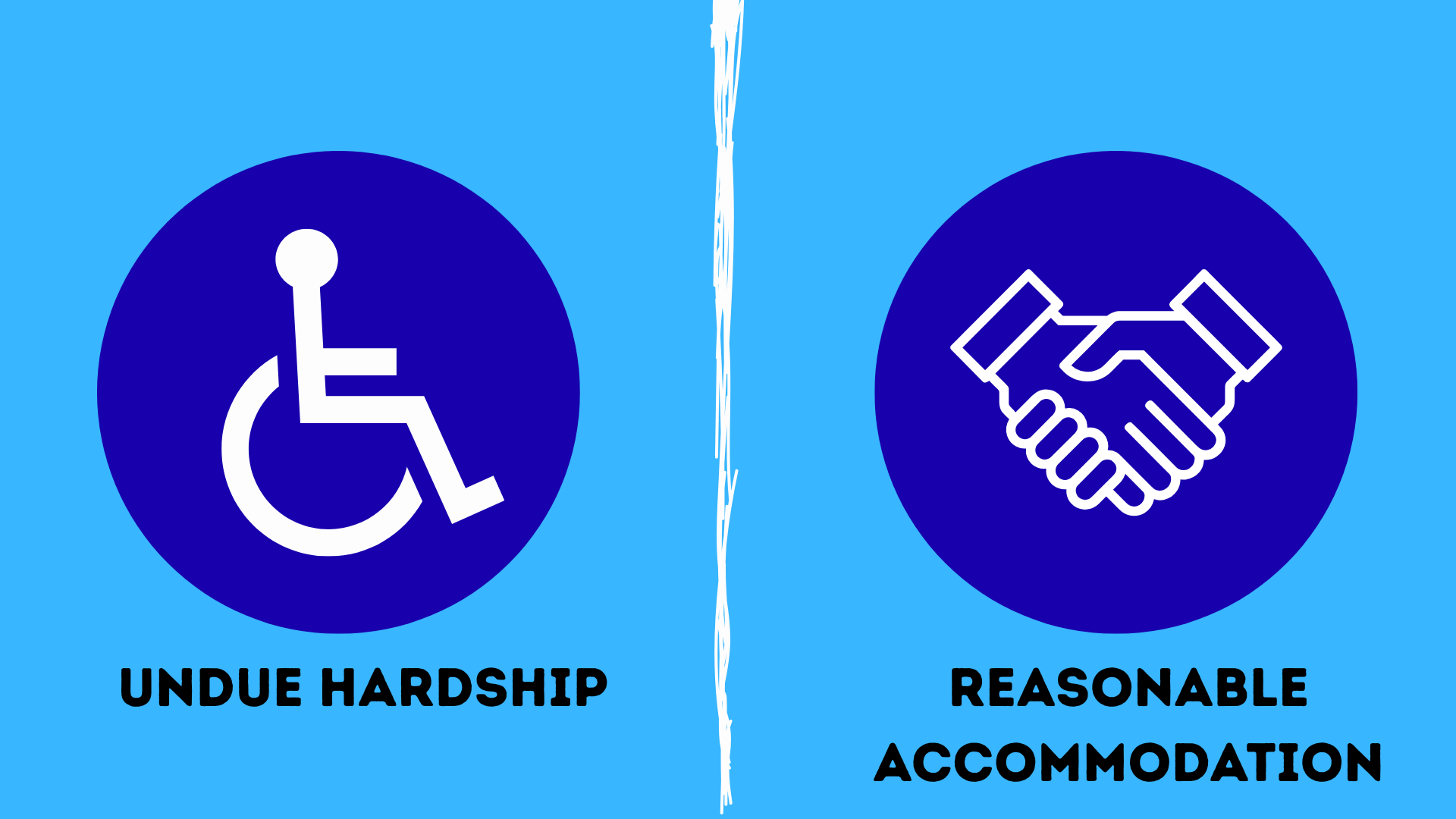
Before undue hardship becomes relevant, an employer must first determine whether a reasonable accommodation exists.
A reasonable accommodation is any modification to a job, work environment, or the way work is performed that enables a qualified individual with a disability (or sincerely held religious belief) to perform the role.
Examples include modified schedules, assistive technology, remote work, or role restructuring.
Employers must identify the limitation, consult the employee, assess all viable options, and document findings before reaching a decision.
An employer can legally deny an accommodation only under these specific, documented conditions.
| Condition | Explanation |
|---|---|
| Accommodation removes an essential function | The job would be fundamentally altered |
| Cost is genuinely disproportionate | Verified against employer size and resources |
| A direct threat exists | Specific, documented safety risk that cannot be mitigated |
| No effective accommodation exists | All options explored, and none are viable |
Conclusion
Undue hardship is a specific legal threshold, not a polite way to say no.
The bar is high, the documentation requirements are real, and the interactive process is mandatory before any denial.
Employers who treat this as paperwork to check off face real legal exposure; the EEOC’s enforcement record makes that clear.
And employees who know what the standard actually requires are in a much stronger position to push back when a denial doesn’t hold up.
Frequently Asked Questions
Can an Employer Claim Undue Hardship Before Receiving a Formal Accommodation Request?
No, hardship can only be assessed in response to a specific request, not preemptively.
Does Undue Hardship Apply to Remote Work Accommodation Requests?
Yes, though employers must show concrete operational harm rather than a general preference for in-office work.
Can a Small Business Be Held to The Same Accommodation Standards as A Large Corporation?
The obligation exists for employers with 15 or more employees, but the hardship threshold scales with the employer’s size and resources.
Is Undue Hardship a Permanent Determination, or Can It Change Over Time?
It can change if an employer’s financial position improves or technology reduces accommodation costs; a previously valid hardship claim may no longer hold.