

A write-up at work can feel small on paper but heavy in the moment. One meeting. One document. One signature. Suddenly, the tone at work changes.
For some employees, it feels unfair.
For managers, it feels necessary.
For HR, it’s usually about documentation and accountability. But what actually is a write-up?
Is it a warning? A punishment? A sign of termination coming next?
Understanding how write-ups work can make the situation feel less confusing, less personal, and far easier to handle professionally.
What Is a Write-Up at Work?
A write-up at work is a formal document employers use to address workplace issues, policy violations, or repeated concerns.
It creates an official record of what happened and outlines what needs to change moving forward.
Most write-ups include:
- A summary of the incident
- The date and time it happened
- The rule or expectation involved
- Steps expected from the employee
- Possible consequences if the issue continues
In many workplaces, a write-up becomes part of an employee’s internal record.
Some managers use write-ups as a correction tool. Others treat them as the start of a more serious disciplinary process.
Either way, the moment usually shifts the tone of the workplace relationship.
Common Reasons Employees Get Written Up
Write-ups can occur for minor recurring issues or larger workplace problems. Some are tied to performance. Others come down to behavior, communication, or policy violations.
| Workplace Issue | Example |
| Attendance problems | Repeated lateness or unapproved absences |
| Performance concerns | Missed deadlines or careless work |
| Misconduct | Disrespectful behavior or workplace arguments |
| Policy violations | Ignoring safety rules or company procedures |
| Communication issues | Inappropriate language or refusing instructions |
Different companies may use different terms for the same process.
Common names include:
- Written warning
- Disciplinary notice
- Corrective action form
- Employee warning notice
Different label. Same uncomfortable meeting.
Why Companies Use Write-Ups?

A write-up is rarely just about one late shift, one missed task, or one awkward interaction.
For companies, it’s a way to officially pause the pattern and put expectations into writing before things spiral further.
Think of it less like a dramatic courtroom moment and more like workplace receipts with signatures attached.
Most employers use write-ups to create a clear record when problems keep repeating.
They help managers document warnings, set expectations more clearly, keep disciplinary actions consistent across teams, and reduce legal risk if stronger action becomes necessary later.
Without documentation, workplace decisions can quickly turn into “who said what” arguments.
That’s why managers are often expected to record issues instead of relying on memory or casual conversations alone.
In many offices, a write-up acts like a checkpoint. It signals that the concern has officially moved beyond a quick verbal reminder.
Depending on the situation, it can come before:
- Suspension
- Shift changes
- Loss of responsibilities
- Demotion
- Termination
Still, a write-up is not always a countdown to getting fired. Many employees receive one, improve performance, and never deal with another again.
The Difference Between Verbal Warnings and Written Warnings
A verbal warning usually stays conversational. A written warning turns the issue into an official workplace record.
| Verbal Warning | Written Warning |
| Informal discussion | Official disciplinary action |
| Often undocumented | Recorded in employee file |
| Early-stage correction | More serious concern |
| Quick conversation | Formal process with paperwork |
| Easier to move past | May affect evaluations or promotions |
Many companies move from verbal warnings to written warnings before stronger disciplinary action happens.
What Happens During a Write-Up Meeting?
Most write-up meetings begin with a sentence nobody enjoys hearing: “Need a quick chat.”
The meeting is usually short, formal, and uncomfortable.
A manager or HR representative may explain the issue, show documentation, ask for the employee’s side, present the warning form, and request a signature.
Some conversations stay calm. Others feel tense enough to make the room go silent fast.
The Part Employees Often Misunderstand
Signing a write-up usually does not mean admitting fault.
In many workplaces, the signature only confirms:
|
A signature usually confirms acknowledgment, not agreement.
Many companies use signatures simply to document that the conversation happened and the employee received the notice.
Declining to sign rarely changes the outcome. In many workplaces, the write-up process continues with or without a signature.
What a Typical Employee Write-Up Includes
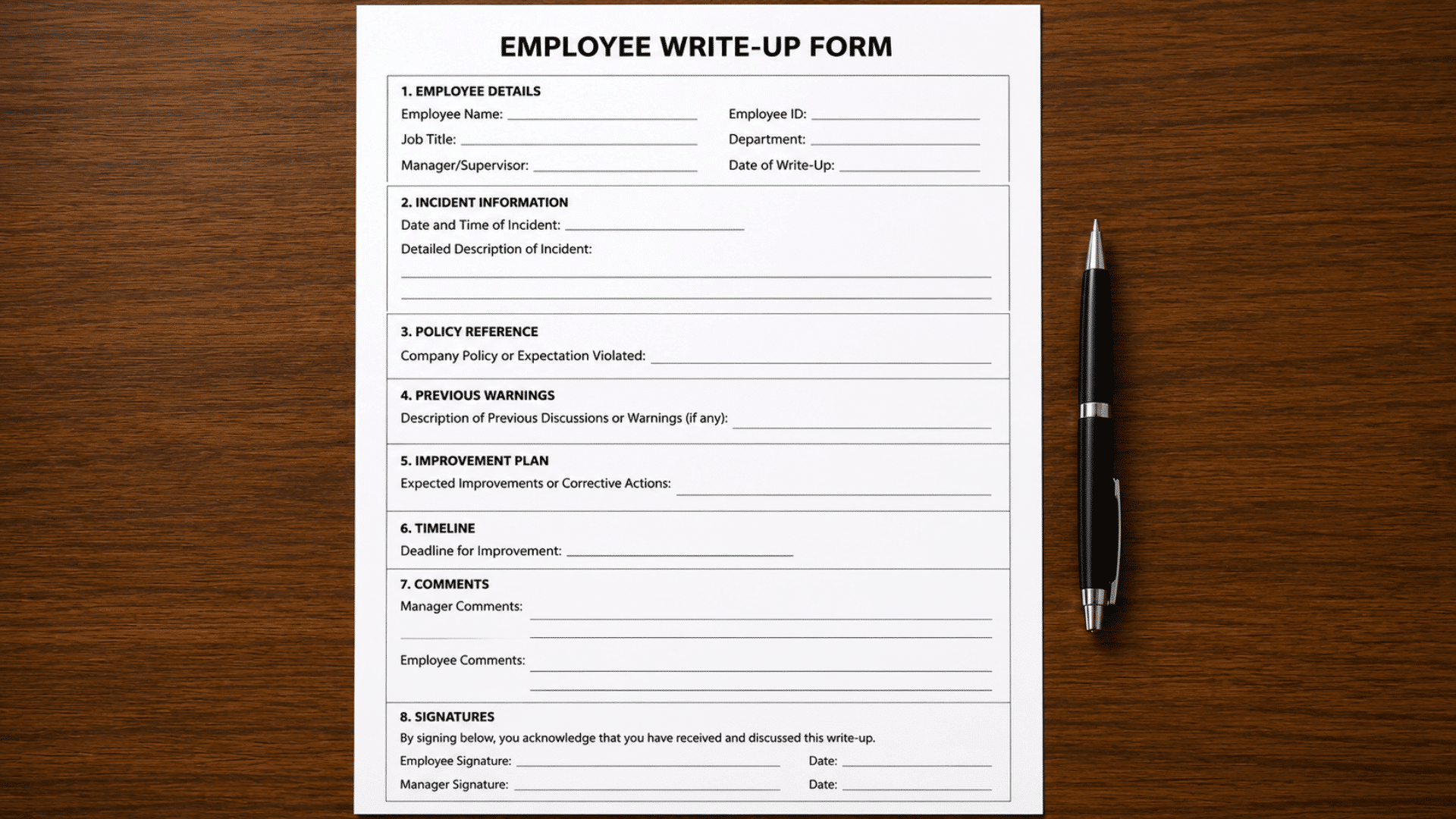
Most write-ups follow a similar format, even if the tone changes from company to company.
Some are direct and professional. Others sound unnecessarily dramatic for a missed deadline or late arrival.
Common Sections in a Write-Up
| Section | Purpose |
| Employee details | Name, role, department |
| Incident information | What happened and when |
| Policy reference | Rule or expectation involved |
| Previous warnings | Earlier discussions if applicable |
| Improvement plan | What needs to change |
| Timeline | Deadline for improvement |
| Comments section | Notes from manager and employee |
| Signature lines | Acknowledgment of the meeting |
A strong write-up focuses on facts and expectations. A weak one feels more like a threat than a correction.
Getting Written Up at Work: The Reaction and the Right Response
A write-up is rarely just paperwork. Even when the issue seems small, the emotional hit can feel much bigger than the document itself.
What Employees Usually Feel After a Write-Up
For many employees, getting written up triggers instant overthinking:
- Is this the start of termination?
- Was management already watching closely?
- Did one mistake suddenly become a permanent label?
That pressure explains why reactions often turn emotional fast.
| Emotion | What’s Happening Internally |
| Embarrassment | Feeling singled out or publicly judged |
| Anger | Believing the situation was unfair or exaggerated |
| Shock | Not expecting formal discipline at all |
| Defensiveness | Wanting to explain every detail immediately |
| Anxiety | Worrying about job security or reputation |
Online workplace discussions show a sharp divide in how people view write-ups.
Some workers see them as control tactics dressed up as “professional process.” Others believe written warnings create clarity because expectations stop being vague.
Both opinions exist because workplace culture changes everything.
The Smartest Way to Respond After Getting Written Up
The first reaction often shapes what happens next.
An emotional argument during the meeting can quickly shift attention away from the actual issue and toward behavior instead.
That’s why the strongest response is usually the calmest one.
What To Do Right Away
- Read the document fully before reacting
- Listen carefully instead of interrupting
- Ask specific questions if details seem inaccurate
- Keep emotions out of the conversation
- Request time to review the situation if needed
Not every write-up is accurate or fair. But pushing back aggressively in the moment rarely helps.
If the Write-Up Feels Unfair
Employees still have options:
- Add written clarification
- Submit screenshots, emails, or supporting context
- Use the comments section professionally
- Speak with HR if company policy allows it
A composed response often carries more credibility than frustration.
And in many workplaces, that professionalism gets remembered long after the write-up itself fades from attention.
Can a Write-Up Hurt Future Growth at Work?
A write-up can create stress beyond the actual warning. Most employees immediately think about promotions, raises, and job security.
Should a Write-Up Be Signed?
Refusing to sign usually does not stop the process.
In many workplaces, the manager simply records the refusal and moves forward.
A better move is to acknowledge receipt, add clarification if something feels inaccurate, and keep the response calm, clear, and professional.
A signature usually confirms the document was received, not that every detail is accepted.
Can It Affect Promotions or Raises?
Sometimes, yes.
A recent write-up may influence:
- Promotions
- Performance reviews
- Bonuses
- Internal transfers
- Leadership opportunities
The impact usually depends on how serious the issue was, whether similar warnings happened before, the company’s internal policy, and how the employee responds afterward. One write-up may pass quietly, while repeated problems often carry more weight.
One write-up rarely ruins long-term growth. What employers notice more is how employees respond after the warning.
How Long Do Write-Ups Stay on Record and When Do They Become Serious?
A write-up does not always disappear quickly. Some companies remove warnings after 6 to 24 months, while others keep them permanently in internal records.
How long they stay active usually depends on:
- Company HR policies
- Severity of the issue
- Industry rules
- Legal requirements
One write-up rarely ends a career on its own. The bigger concern starts when patterns build up.
Signs a Write-Up May Be Turning Serious
- Multiple write-ups in a short time
- “Final written warning” language
- Heavy HR involvement
- Increased tracking or documentation
- Being left out of meetings or projects
Still, a write-up is not always the beginning of the end. Many employees correct the issue, rebuild trust, and move forward without long-term damage.
Final Thoughts
A write-up can sting, but it does not have to define the next chapter at work.
Handled well, it becomes a signal to slow down, read the room, fix what needs fixing, and keep the record clean going forward.
The real danger is not always the document itself.
It is either ignoring the underlying pattern or reacting in a way that gives management more to document.
Have you ever been written up at work, or seen someone handle it badly? Drop your experience in the comments.
Frequently Asked Questions
Should I Quit My Job if I Get Written Up?
No, you shouldn’t quit immediately. Quitting impulsively can hurt your career momentum and disqualify you from unemployment benefits. Instead, take a step back, assess whether the write-up is a fixable misunderstanding or a sign of a toxic environment, and quietly start looking for your next job.
What Not to Disclose to HR?
The general rule is don’t bring your everyday complaints to HR. They’re not there to make your job better or easier and they might fire you simply because they don’t want to hear it. This is usually legal.
Can You Be Fired for One Write-Up?
Yes, it’s possible, but usually not automatic. Most jobs in the U.S. fall under at-will employment, which means your employer can let you go at any time for any lawful reason. But in practice, most companies follow progressive discipline rather than jumping straight to termination after one write-up.