

Drafting an employment contract is more than a formality; it’s a strategic step that defines the framework of a professional relationship.
A well-prepared contract safeguards company interests while setting clear expectations for employees, reducing the risk of misunderstandings or disputes.
From specifying roles and responsibilities to outlining compensation, leave, and legal obligations, each clause plays a crucial role in maintaining clarity and compliance.
When bringing on a new hire or formalizing an existing role, a carefully structured agreement establishes transparency and accountability from day one, creating a solid foundation for long-term collaboration.
Checklist Before Beginning an Employee Contract
Begin by collecting all essential details that will form the foundation of the employment contract. A clear understanding upfront ensures the agreement is precise and enforceable.
Key points to prepare:
- Job role and responsibilities: Define primary tasks, reporting lines, and expected deliverables.
- Compensation and benefits: Include salary, allowances, bonuses, and any perks.
- Employment type: Decide if the position is fixed-term or ongoing at-will.
- Work arrangements: Specify location, remote options, or travel requirements.
- Legal or compliance requirements: Check applicable labor laws and regulatory obligations.
Having this information ready streamlines drafting and reduces the chance of omissions or misunderstandings.
Download this ready-to-use sample employee contract to simplify your hiring process and ensure compliance. Click here.
Step-by-Step Guide: How to Write an Employee Contract

Creating a clear and comprehensive employment contract helps define expectations, protect company interests, and minimize disputes. Follow these steps to structure an effective agreement.
1. Contract Title & Parties
Start with a clear title that conveys purpose, such as Employment Agreement or [Company Name] Employment Contract. A precise title sets a formal and professional tone.
Next, identify the parties involved:
- Full legal name of the employer or company, including registered address and registration number.
- Full legal name of the employee, current residential address, and identification details.
This ensures clarity about who is legally bound by the contract.
2. Position Details
Define the employee’s role accurately. Avoid generic titles to ensure clarity in performance evaluation and reporting.
Include a comprehensive job description covering:
- Core responsibilities and daily tasks
- Expected deliverables and performance standards
- Reporting lines and supervisory responsibilities, if any
- Targets, key metrics, or project-specific obligations
Specify the primary work location and note if the role allows remote or hybrid arrangements. If transfers or relocations are possible, outline mobility requirements and notice expectations.
3. Employment Term & Start Date
Establish the effective date when obligations and benefits commence. This anchors salary, leave accrual, and other entitlements.
Include details of any probationary period:
- Duration of probation
- Evaluation criteria
- Possible outcomes (confirmation, extension, or termination)
Specify whether the contract is fixed-term or ongoing, including conditions for renewal, extension, or early termination.
4. Compensation & Benefits
Clearly define pay and benefits to prevent disputes:
Base Salary:
- Exact amount, currency, and payment frequency (monthly, bi-weekly, hourly)
- Mode of payment (direct deposit, cheque, etc.)
Variable Pay & Allowances:
- Performance bonuses, sales commissions, or profit-sharing
- Travel, meal, housing, or other work-related allowances
Benefits:
- Statutory contributions (e.g., retirement funds, social security)
- Health insurance or medical coverage
- Paid leave (annual, sick, maternity/paternity)
- Reimbursements for approved expenses
- Educational assistance, training support, or wellness programs
Clarify whether salary is Cost to Company (CTC) or take-home, and include deductions like taxes or statutory contributions.
5. Work Schedule & Leave
Outline expectations for working hours and leave:
- Schedule: Start/end times, weekly days, and remote work flexibility
- Overtime: Approval process and compensation, if applicable
- Leave entitlements: Annual/earned leave, casual leave, sick leave, maternity/paternity leave, public holidays, and special leave
- Procedures: Accrual, request process, carry-over rules, and approval workflow
Clear communication prevents misunderstandings and ensures compliance with company policy.
6. Confidentiality & Intellectual Property
Protect sensitive information and company innovations:
Confidentiality Clauses:
- Define sensitive or proprietary information
- Detail employee obligations
- State consequences of unauthorized disclosure
Intellectual Property (IP) Assignments:
- Work products, inventions, or creative output belong to the company
- Include reporting, documentation, and disclosure procedures
- Specify any retained employee rights, if applicable
- Cover work created during company hours or using company resources
7. Restrictive Covenants (Where Applicable)
Restrictive clauses safeguard business interests after employment ends:
- Non-compete: Define industries, geographic scope, and duration
- Non-solicitation: Prevent contacting clients, suppliers, or colleagues for a set period
- Ensure clauses are reasonable and enforceable in your jurisdiction
8. Termination & Notice
Clearly define how employment may end:
- Notice periods: Minimum time required by either party, with distinctions for probationary vs confirmed staff
- Termination for cause: Misconduct, breach of confidentiality, or repeated non-compliance
- Termination without cause: Voluntary or involuntary separation conditions, including severance and exit procedures
- Accrued benefits: Settlement of leave, bonuses, final salary, and return of company property
9. Dispute Resolution
Establish a structured mechanism for handling disagreements:
- Grievance procedures: Stepwise reporting and escalation channels
- Alternative dispute resolution: Mediation or arbitration before court intervention, with rules and appointing authority
- Governing law and jurisdiction: Specify applicable legal framework and location for dispute resolution
10. Legal Boilerplate & Compliance
Include standard clauses to preserve contract integrity.
The Severability clause ensures that if any part of the contract is found invalid or unenforceable, the remainder remains effective. Amendments must be made in writing and signed by both parties to be valid.
The Entire Agreement clause confirms that this document represents the full understanding between employer and employee, superseding any previous agreements.
Finally, Execution requires clearly marked signature lines with names, titles, and dates for both parties to formalize acceptance.
Sample Employee Contract Template
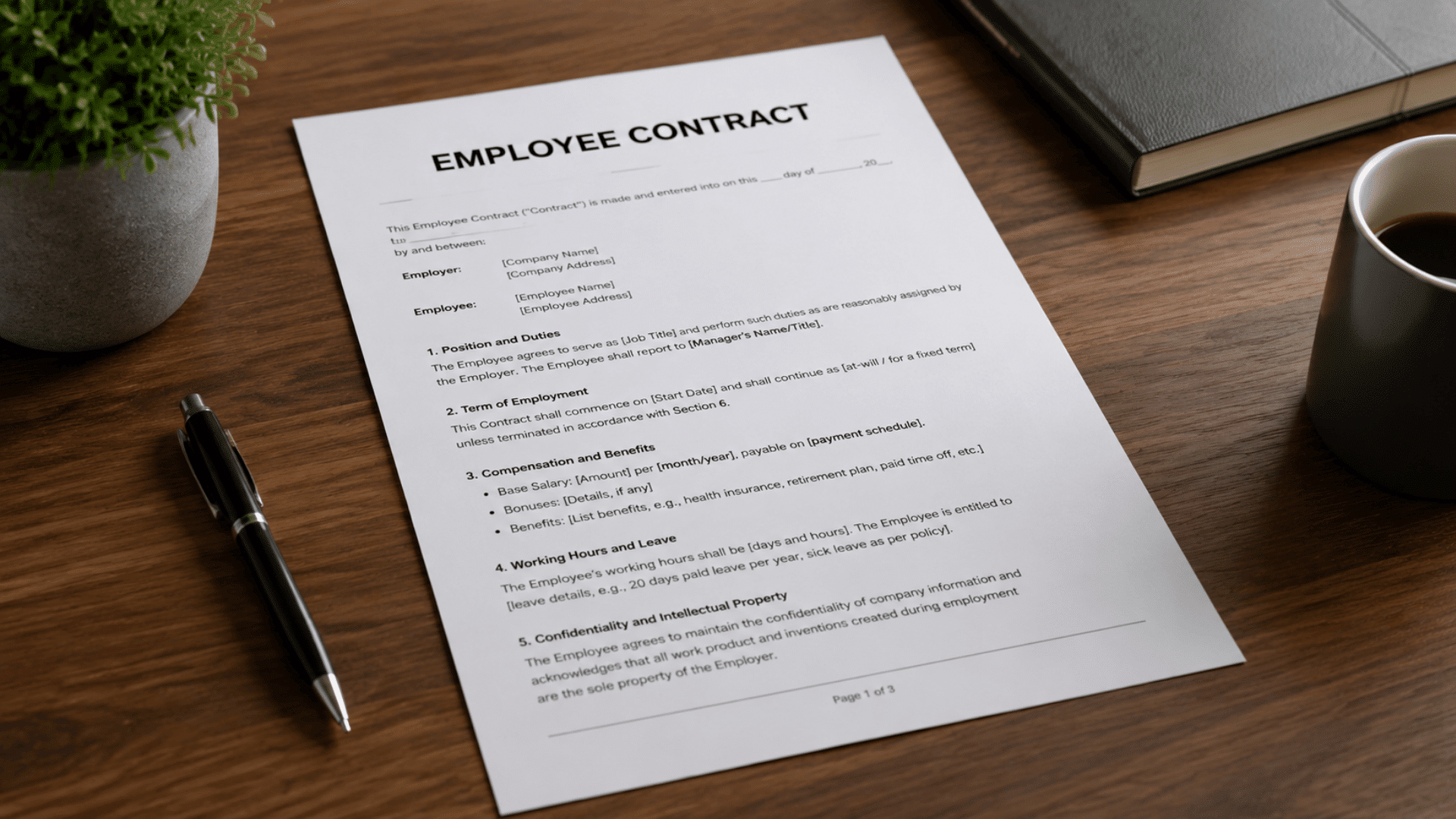
Employee Contract
Parties: This Agreement is made between [Company Name], located at [Company Address], and [Employee Name], residing at [Employee Address].
Position & Duties: Employee will serve as [Job Title], reporting to [Supervisor/Manager], performing duties including [core responsibilities] and achieving agreed targets.
Term: Employment commences on [Start Date] and continues on a permanent basis unless terminated as per contract terms.
Compensation & Benefits: Employee will receive a base salary of [Amount], payable [frequency], along with applicable bonuses, allowances, and benefits outlined in the company policy.
Work Schedule & Leave: Normal working hours are [Hours] per week, with leave entitlements as specified in the company handbook.
Confidentiality & IP: Employee agrees to maintain confidentiality and assign intellectual property rights for work produced during employment to the company.
Termination & Notice: Either party may terminate the agreement with [Notice Period], with termination for cause defined as [examples].
Governing Law & Dispute Resolution: This contract is governed by the laws of [State/Country]. Disputes will follow the internal grievance procedure and, if unresolved, arbitration or mediation.
Signatures:
For practical use, this template can be adapted to suit your company’s policies and local legal requirements.
Common Mistakes to Avoid While Writing an Employee Contract
Even small oversights in an employment contract can lead to confusion or disputes. Watch for these frequent errors:
- Vague job descriptions: Unclear responsibilities can cause misaligned expectations.
- Incomplete compensation breakdowns: Missing details on pay or benefits can create confusion.
- Missing post‑termination IP and confidentiality provisions: Lack of protection may expose sensitive information.
- Undefined probation or notice periods: Ambiguous timelines can lead to disagreements during exit or appraisal.
- Overly broad restrictive clauses: Excessive non‑compete or non‑solicitation terms may be unenforceable.
- Ignoring local labor law requirements: Non-compliance can result in legal challenges or penalties.
- Lack of dispute resolution process: Without a clear method, conflicts may escalate unnecessarily.
Wrapping Up
A well-crafted employment contract serves as a foundation for a professional and accountable workplace. It protects both the organization and its employees while providing a structured framework for roles, compensation, and obligations.
Staying precise, compliant, and up to date ensures the agreement remains effective as business and legal landscapes evolve.
What strategies do you use when creating employment contracts? Have you faced challenges in defining roles, benefits, or legal clauses?
Share your thoughts and experiences in the comments below to help others navigate the complexities of drafting clear, practical agreements.
Frequently Asked Questions
What Are the 3 C’s of A Contract?
The “3 C’s” of a contract generally refer to the fundamental principles used to evaluate whether a contract is legally valid. These three pillars are: Capacity, Consideration, and Consent.
Can I Write a Contract Myself?
Yes, you can absolutely write your own legal contract. A valid agreement doesn’t require a lawyer; it just needs to clearly outline what was agreed upon and include the essential elements of a legally binding contract.
What Is a Red Flag in A Contract?
A “red flag” in a contract is any vague, unfair, or highly one-sided clause that exposes the employer/employee to unnecessary financial or legal risk.