

Hiring the right people is hard enough. Paying them fairly and competitively is where many companies slip. That’s where compensation benchmarking comes in.
It helps you compare what you pay against the market, so you’re not guessing.
From salary benchmarking for key roles to building a clear compensation benchmarking process, the goal is simple: stay competitive without breaking your budget.
But it’s not just about numbers. It’s about fairness, retention, and making better pay decisions that actually hold up in today’s job market.
What is Compensation Benchmarking?
At its core, it is the process of comparing what your company pays employees against market standards. In simple HR terms, it helps you understand if your pay is too low, too high, or right where it should be.
Now, people often mix this up with salary benchmarking, but there’s a difference. Salary benchmarking looks only at base pay. Compensation benchmarking goes broader. It includes bonuses, benefits, and even equity.
There are also two angles to consider. Internal benchmarking checks fairness within your company, across teams, and roles.
External benchmarking compares your pay with other companies in the market, and the scope matters. It’s not just salary. It covers base pay, variable pay, perks, and long-term incentives.
The Value of Compensation Benchmarking in Modern Workplaces

Pay decisions are reviewed more closely today. A competitive market makes retention harder, and transparency laws mean employees can easily compare salaries. If pay is too low, people leave.
If it’s too high, costs rise. It helps you stay balanced while supporting fair pay and stronger DEI efforts, and it also impacts hiring speed and employer brand.
A Few Key Components are:
- Job Matching: Compare roles based on responsibilities, skills, and level, not just titles
- Market Data Sources: Use trusted salary surveys (Mercer, Radford, Willis Towers Watson) along with public data (BLS, Glassdoor, Payscale)
- Data Quality Checks: Be careful with crowdsourced data since it can be uneven or outdated
- Compensation Elements Covered: Look beyond base pay to include bonuses, benefits, perks, and equity
- Geographic Differences: Factor in the cost of labor vs. the cost of living, especially for remote roles
- Consistency in Leveling: Keep internal job levels aligned so comparisons stay accurate
Step-by-Step Compensation Benchmarking Process

A strong process brings clarity to pay decisions. Instead of reacting to market changes, you follow a structured approach that keeps hiring, retention, and fairness in check.
Step 1: Define Objectives
Before you look at any data, you need clarity on what you’re trying to solve. Without this, the entire exercise can lose direction.
- Identify if your focus is improving hiring competitiveness, reducing attrition, or meeting compliance requirements
- Align your compensation strategy with your company’s current growth stage and future plans
- Decide how aggressively you want to position your pay in the market compared to competitors
- Set clear success metrics so you can measure the impact of your decisions over time
Step 2: Identify Benchmark Roles
Trying to cover every role at once can slow down and confuse the process. A focused approach works better.
- Prioritize roles that directly impact revenue, operations, or business continuity
- Focus on positions that are hard to fill or see frequent turnover
- Include roles where employees have raised pay concerns, or inconsistencies exist
- Start with a smaller set of roles, then expand once your process is stable and repeatable
Step 3: Gather Market Data
The accuracy of your benchmarking depends heavily on the data you use. Poor data leads to poor decisions.
- Use recent and credible salary surveys and compensation databases
- Combine multiple data sources to get a more balanced and reliable view
- Ensure the data reflects your industry, company size, and geographic market
- Be cautious with crowdsourced platforms, as the data may be inconsistent or outdated
- Regularly refresh your data to keep up with market changes
Step 4: Analyze Pay Positioning
This is where raw data turns into useful insight. It helps you understand exactly where you stand.
- Compare your current salaries against market percentiles like the 25th, 50th, and 75th
- Identify which roles are below market, aligned, or above market rates
- Look for patterns across departments, job levels, or locations
- Decide your target positioning based on your hiring and retention goals
- Use these insights to guide where adjustments are needed most
Step 5: Adjust for Internal Equity
Even if you match the market, internal imbalances can still create issues. Fairness inside the company matters a lot.
- Review pay differences among employees in similar roles or levels
- Identify gaps linked to tenure, performance, or demographic factors
- Address inconsistencies that could affect morale or trust
- Ensure that any corrections are balanced and don’t create new gaps elsewhere
- Keep documentation of changes to support transparency and future reviews
Step 6: Create Compensation Bands
Once you have clarity, it’s time to build structure into your pay system. This step makes future decisions easier and more consistent.
- Define salary ranges with clear minimum, midpoint, and maximum values
- Align these ranges with both market data and your internal job structure
- Ensure bands allow flexibility for promotions, performance increases, and career progression
- Keep the structure simple enough for managers to understand and apply correctly
- Review and update bands regularly to reflect market shifts
Step 7: Implement and Communicate
Execution is where many companies struggle, so this step needs attention. Clear communication makes a big difference.
- Train managers so they understand how to use and explain the new pay structure
- Decide how transparent you want to be with employees about salary ranges and decisions
- Roll out changes in phases to avoid confusion or resistance
- Be prepared to answer employee questions and explain the reasoning behind changes
- Monitor feedback and make adjustments if needed after implementation
Compensation Benchmarking Methodologies
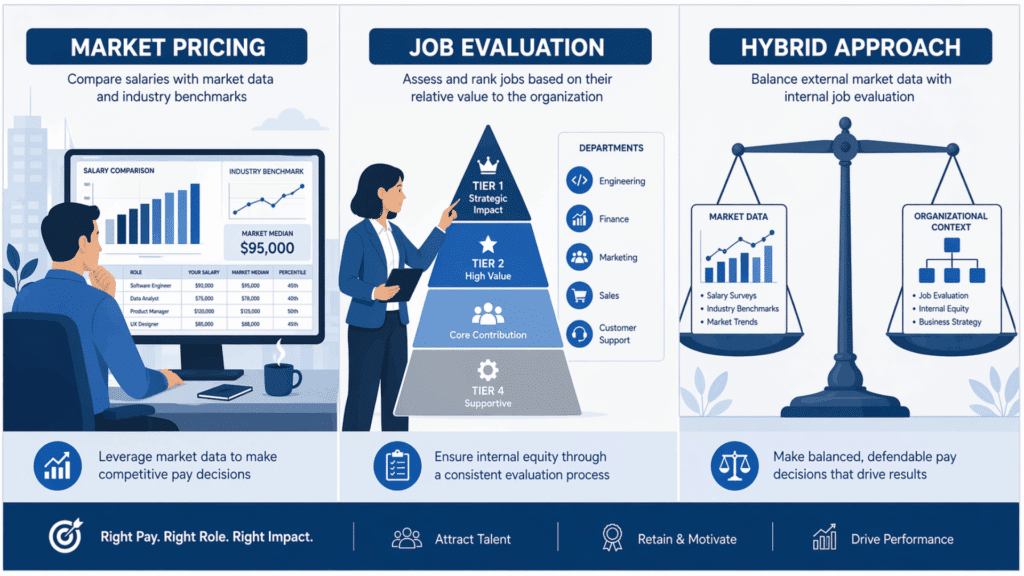
There’s no single way to approach. Companies choose methods based on their size, growth stage, and the level of structure they want in their pay decisions.
1. Market Pricing Approach
The market pricing approach compares your pay directly with external salary data. It relies on compensation surveys and industry benchmarks to understand what similar roles are being paid in other organizations.
This method is widely used because it is straightforward and fast to apply. It helps companies stay competitive in hiring by aligning pay with current market rates.
However, it may not always account for internal fairness, especially if roles within the company are not clearly defined or leveled.
2. Job Evaluation Method
The job evaluation method focuses on internal alignment. Roles are assessed and ranked based on their value to the organization, taking into account responsibilities, impact, and required skills.
This creates a structured framework in which pay is linked to role importance rather than solely to external data.
It supports fairness and consistency across teams, which can improve trust among employees.
The downside is that it takes more time and effort to set up, and it may not respond quickly to market changes.
3. Hybrid Approach
The hybrid approach combines both external and internal perspectives. It uses market data to stay competitive while also applying internal job evaluation to maintain fairness.
This balance makes it a practical choice for growing and larger organizations that need both structure and flexibility.
Over time, it helps create a more stable compensation system in which pay decisions are consistent, defensible, and aligned with both business needs and employee expectations.
Tools and Resources for Compensation Benchmarking
To run an effective process, you need the right mix of tools and data sources. Each option serves a different purpose, so knowing when to use what can save both time and effort.
| Resource Type | Examples | How It Helps |
|---|---|---|
| Salary Survey Providers | Mercer, Radford, Willis Towers Watson | Market data & industry insights |
| HR Tech Platforms | Workday, Payscale, Carta | Real-time access & easy analysis |
| Government Data | BLS Occupational Employment Statistics | Free, credible & benchmark data |
| Consultants vs In-house | External consultants or internal HR teams | Expert consultants vs in-house analysis |
Compensation Benchmarking and Pay Transparency Laws
Pay transparency is changing how companies approach compensation. Regulations now require employers to be more transparent about pay ranges, meaning guesswork is no longer an option.
Here’s how these regulations connect with your benchmarking efforts:
- Clear Pay Range Requirements: Employers are expected to include salary ranges in job postings, making it easier for candidates to compare opportunities
- Greater Visibility Into Pay Practices: Employees can now see how pay decisions are made, which increases pressure to maintain fairness and consistency
- Compliance Risks and Penalties: Failing to meet transparency requirements can lead to fines, legal issues, and damage to your employer’s reputation
- Need for Accurate Salary Benchmarking: Public pay ranges must reflect real market data, not rough estimates or outdated numbers
- Support for Fair Pay Practices: Benchmarking helps identify and correct pay gaps, supporting more equitable compensation decisions
- Stronger Documentation and Audit Readiness: A structured system creates clear records, making it easier to justify pay decisions if questioned
Government Sources for Compensation Benchmarking Data
To support accurate benchmarking, many organizations rely on government-backed datasets.
Bureau of Labor Statistics (BLS): Occupational Employment and Wage Statistics (OEWS)
Provides detailed wage data across occupations, industries, and locations. Commonly used to compare salary ranges and understand market rates.
Source:U.S Bureau of Labor Statistics
BLS: National Compensation Survey (NCS)
Covers wages, benefits, and total compensation. Helps companies benchmark beyond base salary and look at full compensation packages.
Source:U.S Bureau of Labor Statistics
BLS: Employment Cost Index (ECI)
Tracks changes in labor costs over time. Useful for adjusting compensation strategies in line with market trends.
Source: U.S Bureau of Labor Statistics
BLS: Pay and Benefits Data
Offers insights into benefits, bonuses, and employer costs, helping organizations benchmark total compensation more accurately.
Source:U.S Bureau of Labor Statistics
Challenges in Compensation Benchmarking
Getting it right is not just about data. It’s about how you use it, how often you update it, and how well you handle the common issues that come with it.
- Use Multiple Data Sources: Relying on one source can skew results, so combine surveys, public data, and internal insights
- Update Data Regularly: Refresh your data at least once a year to keep up with market shifts
- Benchmark Roles, Not Titles: Focus on responsibilities and scope, since titles can vary widely across companies
- Avoid Over-Reliance on Averages: Look at percentiles to get a clearer view of pay positioning
- Align with Business Strategy: Your pay approach should support hiring goals, growth plans, and retention needs
- Document Your Process: Keep clear records to support compliance, audits, and internal consistency
- Data Inconsistency: Different sources may show different numbers, making comparisons tricky
- Fast-Changing Markets: Roles in tech and niche areas can shift quickly, making data outdated faster
Final Verdict
Compensation benchmarking is no longer optional. It’s a core part of making fair, competitive, and consistent pay decisions.
When done right, it goes beyond simple salary benchmarking and becomes a structured system you can rely on.
By following a clear compensation benchmarking process, using the right data, and staying aware of common challenges, you set your organization up for better hiring, stronger retention, and fewer pay-related issues.
In the end, it’s not just about matching the market; it’s about building a pay strategy that actually works over time.
Frequently Asked Questions
What Does Benchmarking Mean in Compensation?
It means comparing your company’s pay with market data to determine whether it’s competitive and fair. It helps guide better salary and total compensation decisions.
What are the 25th, 50th, and 75th Percentiles in Compensation?
These show how pay compares to the market. 25th is below average, 50th is the median, and 75th is above average for a role.
What are the 4 Steps of Benchmarking?
Identify what to benchmark, collect relevant data, compare against standards, and apply insights to improve decisions.
What are the Five Types of Benchmarking?
Internal, external, competitive, functional, and strategic benchmarking. Each focuses on comparing performance or practices from different perspectives.