

Most smoothly running businesses have one thing in common: everyone knows their role.
That’s not a coincidence.
A functional organizational structure is behind that clarity in more companies than you’d think.
It groups employees by what they do best, creating focused teams, clear reporting lines, and a system that keeps operations on track.
But it’s not a perfect fit for every business.
Some swear by it. Others have walked away from it.
The reasons are more interesting than you’d expect, and once you see how it really works, you may never look at your business setup the same way again.
What Is a Functional Organizational Structure?
A functional organizational structure groups employees based on their specific skills and job functions.
Instead of mixing everyone together, each department, like marketing, finance, or human resources, operates as its own unit with a dedicated team.
Each team has a manager who oversees the work and reports to top leadership.
This setup keeps responsibilities clear, helps employees focus on what they do best, and keeps daily operations running smoothly.
In a functional structure, employee relations are typically handled by a dedicated HR department.
Clear reporting lines make it easier to address complaints, manage disputes, and maintain consistent policy enforcement.
Characteristics of Functional Organizational Structure
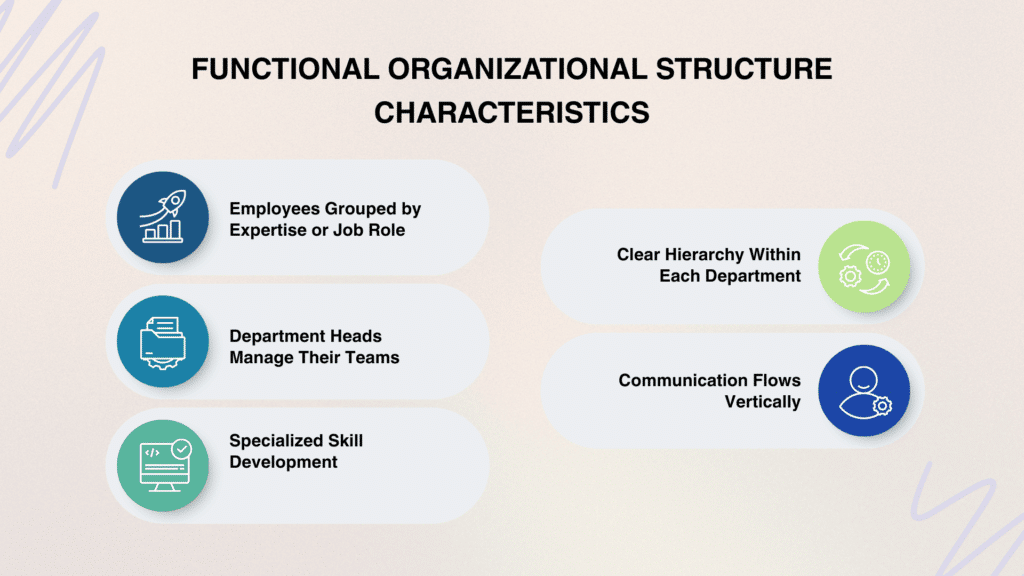
A functional organizational structure has a few defining features that set it apart from other models.
Below are the key characteristics that make this structure work:
1. Employees Grouped by Expertise or Job Role
Employees are placed in departments based on their skills and job functions.
For example, all marketing professionals work on one team, while finance professionals work on another.
This grouping ensures that people with similar knowledge work together, making it easier to manage tasks and maintain a consistent standard of work.
2. Clear Hierarchy Within Each Department
Every department has a defined chain of command. Employees know who they report to, and managers know who they oversee.
This clear structure removes confusion about roles and responsibilities, making day-to-day operations more organized and reducing the chances of tasks falling through the cracks.
3. Department Heads Manage Their Teams
Each department is led by a head or manager who is responsible for their team’s performance.
They assign tasks, monitor progress, and make decisions within their area.
This focused leadership ensures that each department stays on track and aligned with the company’s broader goals.
4. Communication Flows Vertically
In a functional organizational structure, communication moves up and down the chain of command within each department. Employees report to managers, who report to senior leadership.
Because departments operate separately, cross-team interaction can be limited. Many organizations use communication team-building activities to improve collaboration across functions.
5. Specialized Skill Development
Because employees work within focused departments, they get the chance to sharpen their expertise over time.
Regular exposure to similar tasks and projects helps team members grow into specialists in their field, which benefits both the individual and the organization in the long run.
Together, these characteristics make the functional organizational structure a reliable and well-organized model for businesses that value clarity, specialization, and efficient operations.
Advantages of a Functional Organizational Structure
A functional organizational structure brings several clear benefits to businesses.
Here are the key advantages:
- Clear Roles and Responsibilities: Employees know exactly what is expected of them and who they report to daily.
- Improved Skill Development: Working within a focused department helps employees build deep expertise over time and supports targeted corporate training programs for each function.
- Operational Efficiency: Standardized processes across departments keep workflows consistent and reduce unnecessary back-and-forth between teams.
- Easier Supervision and Control: Managers oversee employees with similar skill sets, making performance tracking and feedback more straightforward and effective.
- Cost-Effective Resource Allocation: Sharing resources within departments reduces duplication, helping the company spend smarter and operate leaner.
When used correctly, these advantages make the functional structure a strong choice for businesses that prioritize efficiency and specialized performance.
Disadvantages of a Functional Organizational Structure
While this structure has its strengths, it also has notable drawbacks. Here are the key disadvantages:
- Limited Cross-Department Communication: Teams often work in isolation, making it harder to share information and collaborate effectively.
- Slower Decision-Making: Decisions must pass through multiple management levels before getting approved, which can delay important actions.
- Reduced Flexibility: The rigid structure makes it difficult for businesses to adapt quickly when market conditions or priorities shift.
- Interdepartmental Conflicts: Departments may focus too heavily on their own goals, creating tension and misalignment with company-wide objectives.
These limitations show that while the functional structure offers order and clarity, it may not suit every business, especially those that require quick adaptation and close team collaboration.
Functional Organizational Structure Example
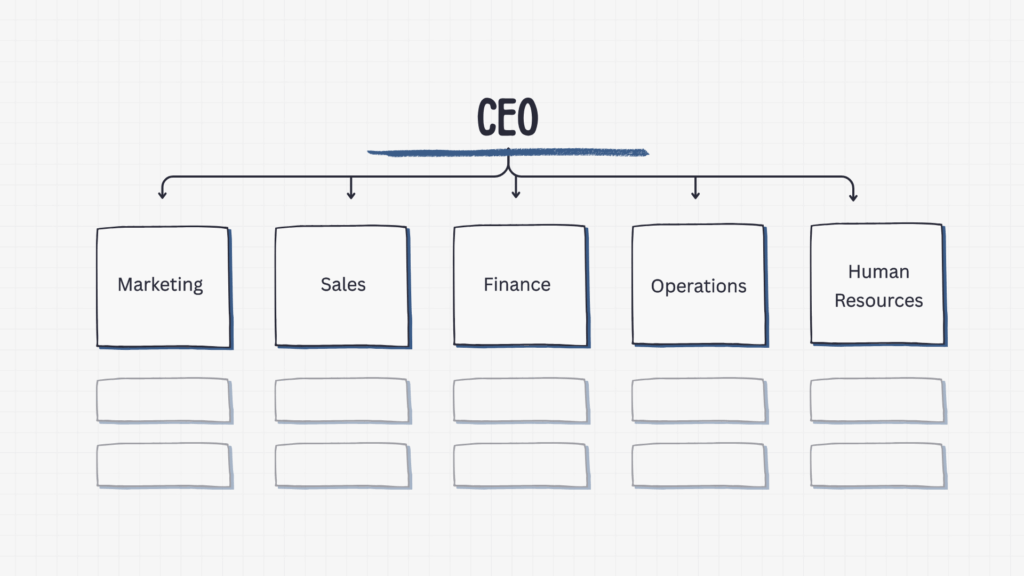
Seeing this structure in action makes it much easier to understand.
Take a company with around 200 employees. The CEO sits at the top and oversees the entire business. Reporting directly to the CEO are five department heads, each responsible for their own team:
- Marketing Department handles brand promotion, campaigns, and customer outreach
- Sales Department manages client relationships and drives revenue growth
- Finance Department oversees budgets, expenses, and financial reporting
- Human Resources Department manages hiring, employee relations, and company policies
- Operations Department ensures day-to-day business processes run without issues
Within each department, the structure looks like this:
- The department head sets goals and makes key decisions
- Supervisors or team leads manage smaller groups and assign daily tasks
- Staff members carry out the work within their specialized area
All department heads report directly to the CEO, keeping the chain of command short and clear at the top level.
This example shows how the functional structure creates a well-organized system where everyone has a defined role, a clear manager, and a focused area of work.
Functional Organizational Structure vs Other Structures
Understanding how a functional structure compares to other models helps businesses make a more informed decision.
Here is a quick side-by-side look at the key differences:
| Factor | Functional | Divisional | Matrix | Flat |
|---|---|---|---|---|
| Grouping | By job function | By product, geography, or market | By function and project | No fixed grouping |
| Reporting Lines | One manager | One manager | Two managers | Few or no managers |
| Decision-Making | Centralized | Decentralized | Shared | Fast and direct |
| Flexibility | Low | Moderate | High | High |
| Best For | Stable, specialized businesses | Large, diverse businesses | Project-based businesses | Small or startup businesses |
| Communication | Vertical | Within divisions | Both vertical and horizontal | Open and direct |
| Specialization | High | Moderate | Moderate | Low |
Each structure has its own strengths and works best in different business settings.
The functional structure stands out for businesses that value specialization and clear reporting lines, but it may not be the right fit for companies that need faster decisions or stronger cross-team collaboration.
The Bottom Line
A functional organizational structure brings order, clarity, and specialization to businesses that need it most.
It groups employees by skill, creates clear reporting lines, and helps teams focus on what they do best.
The advantages are real: better efficiency, stronger supervision, and smarter resource use.
But so are the drawbacks: slower decisions, department silos, and limited flexibility.
Compared to divisional, matrix, or flat structures, each model has its own place depending on what a business needs.
There is no one-size-fits-all answer.
The right structure depends on your goals, your team size, and how you want your business to operate day to day.
Have you worked in a functional organizational structure before? Share your experience or your favorite structure in the comments below!