


When people talk about workplace relationships, the words coworker and colleague often appear interchangeably in the same sentence.
But in professional settings, small word choices can change the tone of an email, an interview answer, an HR policy, or a workplace conversation.
This blog clearly breaks down colleague vs coworker, with examples that help you choose the right term at the right time.
| A coworker is anyone who works for the same company as you, regardless of role, while a colleague is someone in your same profession or field; for example, a payroll staffer is your coworker, but another HR professional handling hiring is your colleague. |
Why Do Workplace Terms Matter in Professional Setups?
Clear wording supports better workplace communication. The U.S. Office of Personnel Management notes that communication skills help with expectations, feedback, and performance conversations.
Workplace language is not just about grammar. It helps people understand the kind of professional relationship being discussed.
This is why the coworker vs colleague difference matters in emails, interviews, HR documents, and everyday conversations.
A company may include teammates, managers, department staff, vendors, and industry contacts. Using the right term makes the connection clearer.
Coworker vs Colleague: A Quick Difference
The difference is mostly about workplace connection and context. This comparison shows when each term fits best without overcomplicating the meaning.
| Aspect | Coworker | Colleague |
|---|---|---|
| Meaning | Someone employed by the same organization. | Someone you know through a shared profession or workplace. |
| Company | Always works for the same employer. | May work for the same or a different organization. |
| Profession | May have a completely different role or expertise. | Usually works in a similar role, team, or profession. |
| Work relationship | May have little or no direct collaboration. | More likely to work with you or share professional interests. |
| Reporting level | Can include managers, peers, and direct reports. | Often refers to peers, but modern usage can be broader. |
| Tone | Neutral and commonly used in everyday conversation. | More professional and common in formal communication. |
| Best used for | Internal conversations and general workplace references. | Emails, presentations, networking, and professional discussions. |
Colleague vs Coworker: The Term Usage in Different Work Settings
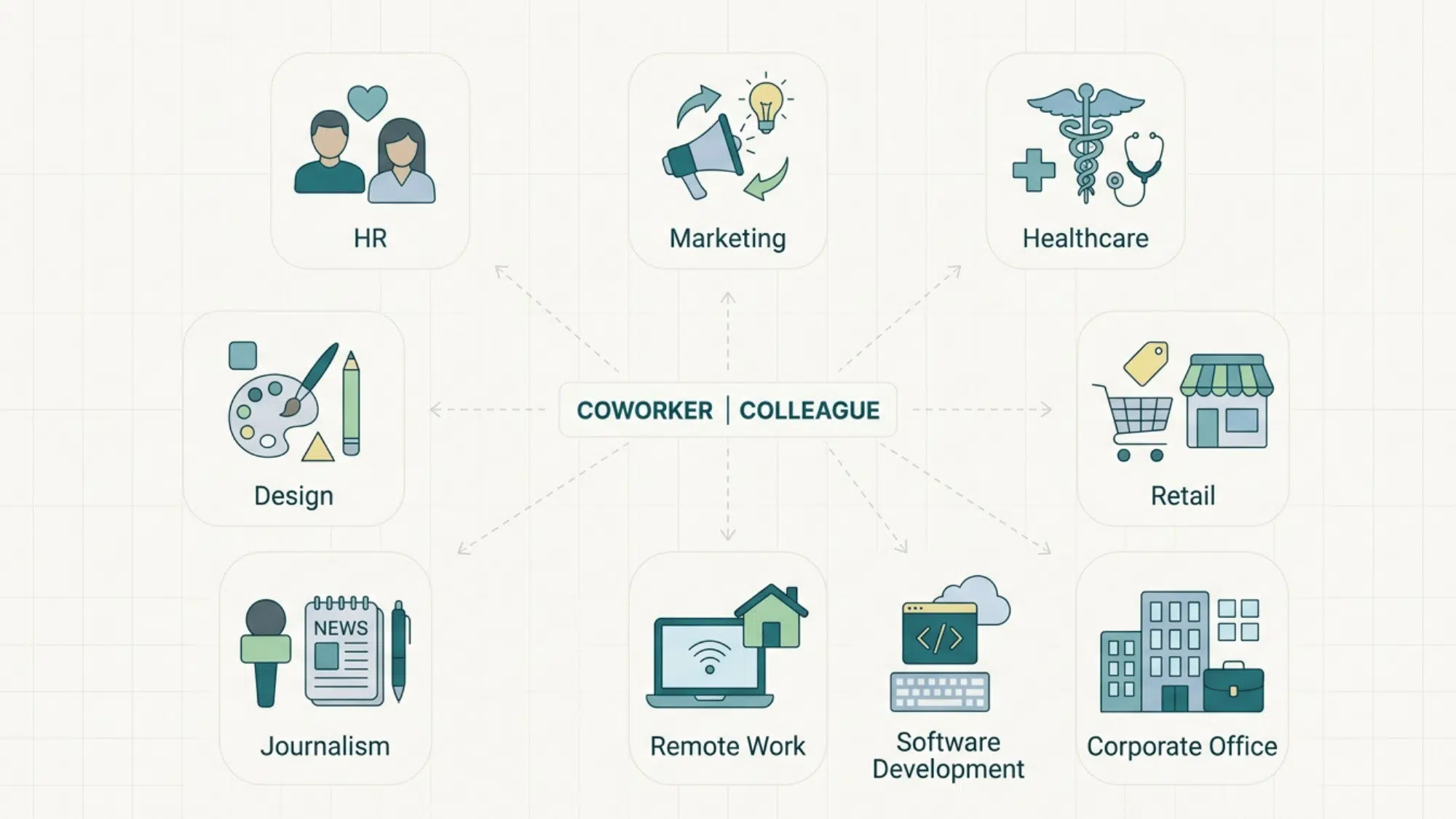
The difference becomes easier to understand when you look at real workplaces. In each setting, the right word depends on whether you mean someone in the same company or someone connected to your role.
1. HR Department
In HR, a coworker may be anyone employed by the same company, such as someone from payroll, finance, or operations.
A colleague is more likely to be another HR professional who handles hiring, employee relations, benefits, or workplace policy.
Understanding how those relationships work in practice is easier with a solid grasp of what employee relations means in the workplace and how it differs from broader HR functions.
2. Marketing Team
A coworker in marketing could include a designer, sales executive, or finance employee working in the same company.
A colleague usually refers to someone in a related marketing role, such as a content strategist, SEO specialist, or brand manager.
3. Healthcare Setting
In a hospital, a coworker may be anyone working in the same facility, including reception staff, cleaners, or administrators.
A colleague is usually another healthcare professional, such as a doctor, nurse, therapist, or specialist involved in patient care.
4. Retail Industry
In retail, a coworker can be anyone working in the same store or company, such as a cashier, stock clerk, or store manager.
A colleague often refers to someone in a similar retail role, such as another sales associate or department supervisor.
5. Corporate Office
In a corporate office, a coworker may be someone from any department under the same employer. They could be a part of various other teams.
A colleague usually refers to a professional contact you work with directly, collaborate with often, or know through your field.
6. Remote Work
In remote teams, a coworker is someone employed by the same company, even if you never meet in person or only interact through chats, calls, and shared tools.
A colleague may be someone you work with closely on projects, or someone in the same profession outside your company.
7. Design Industry
In design, a coworker may be anyone working at the same company, including developers, marketers, or project managers.
A colleague is typically another design professional, such as a graphic designer, UX designer, or art director, who shares similar creative skills, project goals, or industry knowledge.
8. Journalism
In journalism, a coworker can be anyone employed by the same media organization, including editors, photographers, or administrative staff.
A colleague is usually a journalist, reporter, or editor who works in the same field or covers similar topics.
9. Software Development
In software development, a coworker may include anyone working at the same company, such as HR staff, marketers, or support teams.
A colleague is generally another developer, engineer, or technical professional who works on similar systems, codebases, or projects.
When to Use “Coworker” or “Colleague” Professionally?
Neither word is wrong, but the setting matters. In formal communication, “colleague” often sounds more polished, while “coworker” feels clearer and more natural in everyday workplace talk.
| Situation | Use “Coworker” | Use “Colleague” |
|---|---|---|
| Same company | Anyone working in the same organization | Someone in a similar role or field |
| Different companies | Not usually used | Professionals in the same industry |
| Casual conversation | More natural and common | May sound too formal |
| Formal emails | Acceptable, but less polished | More professional and respectful |
| Networking events | Rarely used | Best for industry connections |
| LinkedIn posts | Good for teammates | Better for professional peers |
| Client conversations | Works for internal team members | Sounds more polished and formal |
Final Takeaway
The coworker vs colleague choice is not about sounding smarter. It is about matching your words to the person, setting, and relationship you are describing.
In daily office talk, coworkers keep things simple and natural. In interviews, emails, or professional introductions, colleagues often give the sentence a more polished tone.
The safest approach is to think about context first. When your wording feels clear, respectful, and easy to understand, you are using the right term.
Frequently Asked Questions
Can I Call My Senior or Manager My Coworker?
Yes. If they work for the same company, they are technically your coworker, regardless of their position.
Is Coworker Too Casual for Workplace Writing?
No. In coworker vs colleague usage, coworker works well in policies, messages, and internal updates.
Is It Rude to Say “Coworker” Instead of “Colleague”?
No. “Coworker” is not rude; it simply sounds more casual and direct.