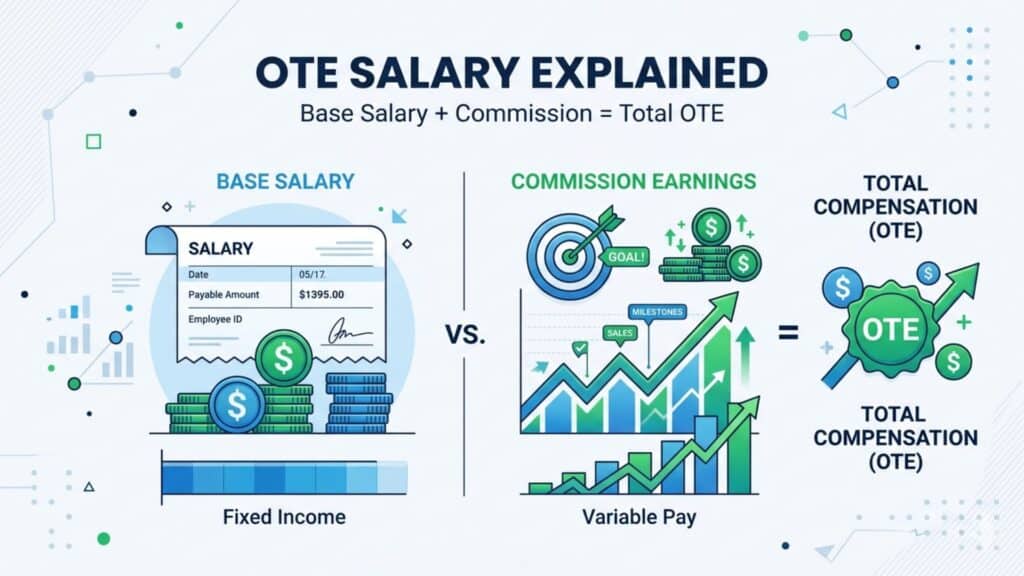

When you look at job offers, especially in sales or performance-based roles, you may often come across the term OTE salary.
But what does OTE salary actually mean, and is it guaranteed?
It can seem confusing at first because it does not always represent the exact amount you will earn each month. Understanding OTE salary meaning is critical before signing any offer with variable pay.
In this blog, you will learn what OTE means, how it is structured, and how it can impact your overall income.
What Does OTE Salary Mean?
OTE stands for On-Target Earnings. It represents the total compensation an employee is expected to earn if they meet 100% of their performance targets or quota.
OTE is not a guaranteed salary. It is a projected figure, a combination of your fixed base salary plus the variable commission or bonus you’d earn by hitting your goals.
OTE salary meaning in simple terms: OTE = Base Salary + Expected Variable Pay (commission/bonus) when targets are fully met.
It is most commonly used in:
- Sales roles (Account Executives, SDRs, BDRs).
- Business development positions.
- Recruitment jobs/staffing jobs.
- Real estate and insurance roles.
Benefits of OTE Salary
OTE structures offer genuine advantages for both employees and employers when set up fairly. Here is what makes them worth considering.
- Direct reward for performance: The stronger your results, the more you earn, unlike a flat salary, where exceptional performance goes financially unrewarded.
- Earning potential beyond a fixed salary: A well-structured OTE with uncapped commission lets high performers significantly exceed their stated target without waiting for a promotion or annual raise.
- Attracts motivated talent: OTE structures attract candidates who are confident in their abilities and motivated by results, producing stronger, more accountable teams.
- Aligns employee and company goals: Your personal financial goals naturally align with what the business needs, creating a shared purpose that flat salaries rarely generate.
The Two Core Components of OTE
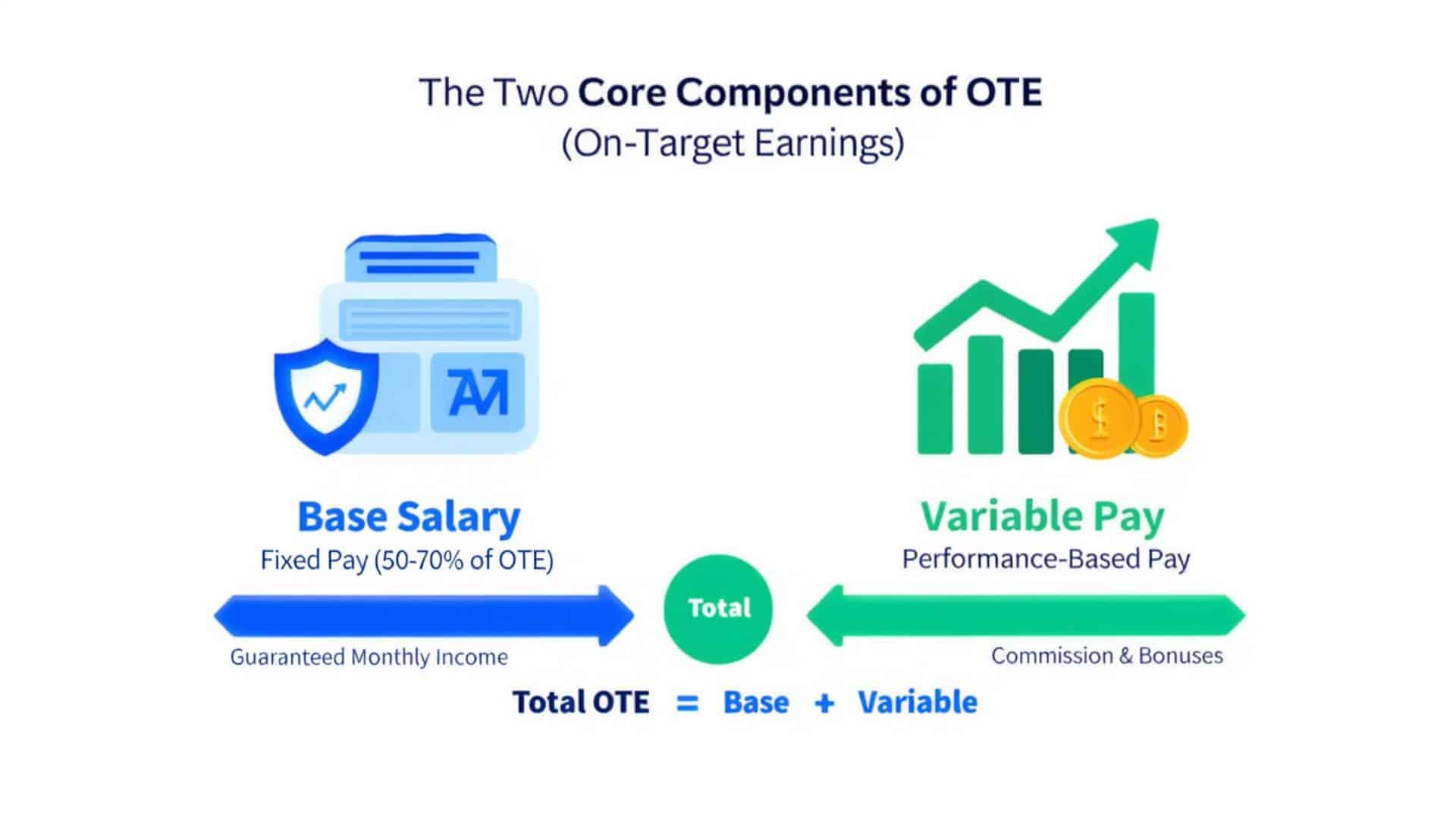
Every OTE package typically consists of two main components that together determine the total earning potential.
These parts combine fixed and performance-based pay to form the complete compensation structure, helping you better understandOTE salary meaning in practical terms.
Base Salary
This is the fixed, guaranteed portion of your pay. You receive this regardless of performance. Base salaries in OTE structures typically account for 50–70% of the total OTE, though this varies by industry and seniority.
Example: A job with a$60,000 OTE might carry a $35,000 base salary, meaning you’d need to earn the remaining $25,000 through commissions or bonuses by hitting your targets.
Variable Pay (Commission or Bonus)
This is the performance-dependent portion. It’s what you earn on top of your base when you hit your sales quota, KPIs, or other performance targets.
The split between base and variable pay is often called the pay mix, e.g., 60/40 (60% base, 40% variable). Variable pay can come in the form of:
- Commission: A percentage of deals or revenue closed
- Quarterly bonuses: Paid based on hitting specific targets
- Annual bonuses: Tied to yearly performance reviews
OTE vs Base Salary
Base salary and OTE are two key components of many compensation structures, especially in sales roles.
Understanding how they differ helps you evaluate earning potential, stability, and performance-based rewards.
| Feature | Base/Fixed Salary | OTE |
|---|---|---|
| Guaranteed? | Yes, paid every month, no matter what. | No, only earned by hitting targets |
| Performance-linked | No, fixed regardless of results. | Yes, directly tied to your performance |
| Monthly Consistency | Yes, same amount every month | No, varies based on deals and targets |
| Best for budgeting | Yes, safe and predictable. | Risky, too unpredictable to rely on fully |
| Can it increase? | Only through a raise or promotion. | Yes, exceed targets and earn above OTE |
| Risk level | Low, always guaranteed. | Higher, depending on your performance |
Base salary is your safety net, it’s the money you can always count on. OTE is your target it’s the money you work towards. Always budget around your base never around your OTE.
OTE Salary Example & How to Calculate It?
First, here’s a quick snapshot of how OTE breaks down:
- Base Salary: $40,000
- On-Target Commission: $20,000
- OTE (Total): $60,000
Now let’s walk through it step by step:
Step 1: Start with Your Base Salary.
Your base is the money you’re guaranteed every month, no matter what.
💰 In our example: $40,000 per year
Step 2: Add Your Commission.
This is the extra money you earn by hitting your sales targets.
💰 In our example: $20,000 per year
Step 3: Add Them Together.
That’s Your OTE
💰 $40,000 (base) + $20,000 (commission) = $60,000 OTE
Step 4: What if You Sell More than Expected?
If you earn more, this is called accelerated commission. Companies reward you with a higher rate for going above your target.
💰 Hit 120% of your target? You could walk away with $64,000–$68,000+
Step 5: What if You Don’t Hit Your Target?
Your paycheck shrinks. If you hit only half your quota, you earn only half the commission.
💰 Hit 50% of target? Expect around $50,000, not $60,000
Common OTE Split Structures

The OTE split refers to the ratio between your base salary and your variable pay (commission/bonus). Different roles offer different OTE splits based on how much your earnings depend on performance.
Understanding these structures helps you choose a role that fits your income needs and risk level.
1. 70/30 Split
In this structure, most of your income (70%) is fixed, while 30% depends on performance. It is typically used in entry-level or support roles where income stability is a priority.
Example: If your OTE is $50,000, you earn $35,000 as base salary and $15,000 through bonuses or commissions.
2. 60/40 Split
This means 60% of your pay is fixed and 40% is performance-based. It is widely used in mid-level roles, such as account managers and business development executives.
Example: If your OTE is $70,000, you earn $42,000 as base salary and $28,000 as variable pay.
3. 50/50 Split
This model evenly divides your earnings between fixed pay and variable incentives. It is common in core sales roles where results directly impact your income.
Example: With an $80,000 OTE, you receive $40,000 as base salary and can earn another $40,000 through commissions.
4. 40/60 Split
This means 40% of your income is fixed, and 60% depends on performance. It is typically used in senior sales or high-performance roles with aggressive targets.
Example: If your OTE is $100,000, you earn $40,000 as base salary and $60,000 through incentives.
Capped vs Uncapped OTE
This section explains how earning limits work in OTE structures. Knowing the difference helps you understand your true earning potential in a role.
What is Capped OTE?
Capped OTE means your variable earnings have a fixed limit, even if you exceed your targets.
This model is often used by companies that want to manage budgets and keep compensation predictable.
- Limits maximum incentive payout
- Reduces financial risk for employers
- May reduce motivation after reaching the cap
Example: If your OTE is $80,000, you cannot earn more than that, even with higher performance.
What is Uncapped OTE?
Uncapped OTE allows you to earn beyond your target if you exceed performance goals. It is commonly used in sales-driven roles to reward high performers.
- No upper limit on incentives
- Encourages overachievement
- Direct link between performance and earnings
Example: If your OTE is $80,000, you could earn $100,000+ by exceeding targets.
How to Evaluate Job Offers
This part helps you understand OTE salary meaning in real job offers and what you should check before accepting one.
- Check the split between base and variable pay to see how much income is fixed and how much depends on performance
- A higher base salary gives more stability, while higher variable pay increases earning potential but adds risk
- Review targets carefully to ensure they are realistic and achievable within your role
- Unclear or aggressive targets can reduce your chances of earning full OTE
- Ask how many employees actually reach their full OTE to understand real earning potential
- Look at past performance data to see if the compensation structure is fair and achievable
Conclusion
Understanding OTE salary meaning is essential before accepting any role that includes variable pay.
It is not just a number on a job offer; it is a structure that directly shapes how much you earn, how predictable your income is, and how much your results matter.
Knowing the split between your base and variable pay, whether the OTE is capped or uncapped, and whether the targets are realistically achievable gives you the information you need to evaluate an offer properly.
Always budget around your base salary, ask the right questions before signing, and treat your OTE as a goal to work toward.
The more clearly you understand, the better positioned you are to negotiate, perform, and earn what you are actually worth.
Frequently Asked Questions
What Does 120K OTE Mean?
A 120K OTE means you can earn a total of $120,000 in a year if you meet 100% of your targets. It includes a fixed base salary and variable pay, such as commissions or bonuses.
What are the Downsides of OTE?
OTE can limit earnings if there is a cap, even when you exceed targets. It may also reduce motivation for top performers and lead to job dissatisfaction.
How Does OTE Get Taxed?
The variable part of OTE, such as bonuses or commissions, is often taxed differently from base salary. It may be taxed at a higher rate since it is treated as additional income.