

Workplace investigations are a normal part of managing today’s organizations.
When concerns about conduct, safety, or policy violations arise, employers must respond in a structured and lawful way.
However, many investigations fail because the process is unclear or handled inconsistently.
Understanding how workplace investigations work helps reduce confusion and legal risk.
This article explains what workplace investigations are, when they are required, and how they should be conducted by HR.
It also outlines common examples, key steps, and documentation practices used in compliant investigations.
By the end, employers and HR professionals will have a clear view of how to manage workplace investigations fairly and in line with legal expectations.
When investigations are handled poorly, employers may face legal exposure for failing to act on reported concerns. know workplace investigation legal risks.
What are Workplace Investigations?
Workplace investigations are formal reviews started by an employer to look into a workplace issue.
They are used when there is a concern about behavior, policy violations, or possible legal problems at work.
An investigation may begin after an employee complaint, a report from a manager, or an issue found during routine checks.
The purpose of a workplace investigation is to find facts, not to punish someone automatically.
Employers use investigations to understand what happened and whether company rules or employment laws were broken.
Decisions are based on evidence, such as statements and records, rather than assumptions.
The outcome depends on what the investigation shows and how the facts apply to workplace rules and legal standards.
Workplace Investigation Examples
Workplace investigations may start for many reasons, depending on the issue reported or observed.
Each situation requires a different level of review. However, the purpose of every workplace investigation is the same: to gather facts, apply workplace rules or laws, and decide whether corrective action is needed.
- Allegations of harassment or discrimination based on protected characteristics
- Reports of retaliation after an employee raises a concern
- Safety violations that may put employees at risk
- Misuse of company property, data, or resources
- Conflicts of interest involving outside work or relationships
- Wage and hour issues, such as unpaid overtime or timekeeping concerns
- Violations of workplace conduct or ethics policies
- Anonymous reports received through ethics hotlines or reporting systems
What Happens in a Workplace Investigation?
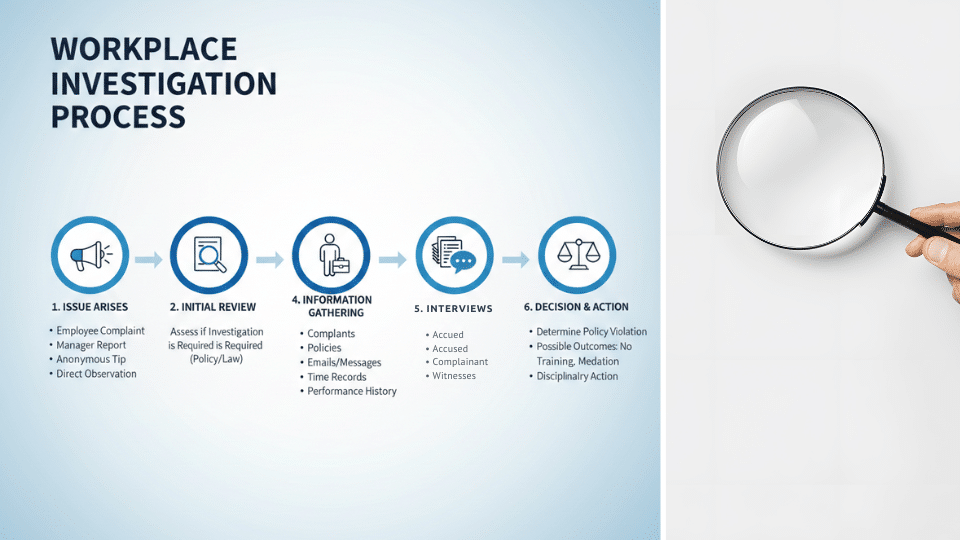
A workplace investigation begins when an employer learns about a possible problem.
This may happen through an employee complaint, a report from a manager, an anonymous tip, or something the employer notices directly.
Once the issue is known, the employer reviews it to decide whether an investigation is required under company policy or the law.
An investigator is then assigned. This is often someone from HR, but it may also be a manager or an outside professional, depending on the situation.
The investigator gathers relevant information, which usually includes written complaints, company policies, emails or messages, time records, performance history, and other records related to the issue.
The investigator also interviews the people involved and any witnesses.
After reviewing the information, the employer decides whether a policy or rule was violated and what steps, if any, should be taken.
Not every investigation leads to discipline. The purpose is to understand the facts and respond appropriately.
How an HR Should Conduct a Workplace Investigation?

A workplace investigation should follow a clear and consistent process to ensure fairness, accuracy, and legal compliance.
Step 1: Identify the Issue and decide
The process begins when an employer becomes aware of a possible problem. This may come from a complaint, a report, or an observed concern. The issue should be clearly identified before moving forward.
As a professional Hr, you should always decide whether an investigation is required
Not every concern requires a full investigation. The employer reviews the issue to determine whether company policy or the law requires formal review.
Step 2: Set the Scope and Assign an Investigator
The employer decides what needs to be reviewed and which workplace rules or laws apply. At the same time, a neutral investigator is chosen.
This person should not be involved in the issue and must remain objective throughout the process.
Step 3: Gather Information and Documents
The investigator collects all records related to the concern.
This may include written complaints, company policies, emails, messages, work schedules, time records, or past disciplinary history.
These documents help explain what happened and provide context. Gathering complete and accurate information is an important part of a fair investigation.
Read more: Types of harassment
Step 4: Interview Involved Employees
The investigator speaks with the employee who raised the concern, the employee involved, and any witnesses.
These interviews help clarify timelines, actions, and different viewpoints.
The goal is to understand the facts, not to assign blame during the interview stage. Notes are usually taken to document what is shared.
Step 5: Review Findings and Decide Next Steps
After reviewing all documents and interview notes, the employer evaluates the information as a whole.
A decision is then made about whether company policy or workplace rules were violated.
If needed, corrective steps such as training, discipline, or policy changes may follow. Some investigations close with no action when no violation is found.
Workplace Investigations and Legal Obligations
Employers are often legally required to investigate certain complaints, especially those involving harassment, discrimination, or retaliation.
Failure to investigate can expose organizations to liability, even if the original allegation is not proven.
Laws enforced by agencies such as the Equal Employment Opportunity Commission expect employers to take reasonable steps to prevent and correct unlawful conduct. Proper investigations help meet this obligation.
| Related Post: What to do if You’re Being Investigated at Work? |
Conclusion
Workplace investigations are a critical part of maintaining lawful and fair workplaces.
When handled properly, they help employers address concerns, meet legal duties, and reduce long-term risk.
A clear investigation process, supported by consistent documentation and neutral review, ensures that decisions are based on facts rather than assumptions.
Understanding how investigations work, what steps are required, and how outcomes are reached benefits both employers and employees.
It also helps prevent mistakes that can lead to disputes or legal exposure.
Strong investigation practices protect workplace integrity and support compliance with employment laws.
For organizations, reviewing investigation procedures regularly and training HR teams on proper handling remains an essential step toward consistent and defensible outcomes.