

Most workers assume a 15-minute break comes with any shift, but the rules aren’t the same everywhere.
Some states guarantee short rest breaks, while others leave the decision to employers. This can make it confusing to know what you’re actually entitled to during a 4-hour shift.
This blog explains how break rules work, why federal guidelines offer limited direction, and which states provide clear protections.
By the end, you’ll have a straightforward picture of when a 15-minute break is required and when it depends on workplace policy.
Are 15-Minute Breaks Required for a 4-Hour Shift?
Do you get a 15-minute break for working 4 hours? The answer depends on the laws in your state and the policy followed by your employer.
Short breaks, such as 10 or 15-minute rests, are treated differently from meal periods. Federal rules do not require employers to give breaks.
They only say that if an employer chooses to offer short breaks, those minutes must be paid.
Because federal rules are limited, most rights regarding breaks are established by state laws.
Some states set clear standards for short rest breaks, while others leave the decision to employers.
A 4-hour shift is often considered a short work period, so a 15-minute break for 4 hours of work is not guaranteed unless your state requires one.
Are 15-Minute Breaks Required by Law?
Break laws differ widely across the country, with each state setting its own approach to rest breaks, meal breaks, or both.
Some states give workers structured break rights, while others apply rules only to certain industries or to long shifts.
Here is a clear look at the states that have break laws in place and how those rules apply:
1. California
California mandates a paid 10-minute rest break every 4 hours.
The state also enforces a 30-minute meal break for shifts exceeding five hours, with a second break for shifts exceeding ten hours.
Employers must pay an extra hour for each missed break.
2. Colorado
Colorado requires a paid 10-minute rest break every 4 hours of work.
The state also requires a 30-minute meal break after a 5-hour shift.
Meal breaks may be unpaid if the worker is completely free from duties, but they become paid if taken on duty.
3. Kentucky
Kentucky requires employers to provide a paid 10-minute rest period for every 4 hours worked.
The state also provides a reasonable meal period, typically 30 minutes, once a shift exceeds 5 hours.
Employers are encouraged to place the break near the midpoint of the shift to maintain steady routines.
4. Minnesota
Minnesota recognizes that workers need adequate time for rest and restroom needs during each four-hour block.
The state also defines a 30-minute meal break for workers on duty for six hours or more.
Meal breaks may be unpaid when the worker is fully relieved from responsibilities.
5. Nevada
Nevada requires employers to provide a paid 10-minute rest break for every 4 hours worked, provided the shift is at least 3.5 hours.
The state also directs employers to provide a 30-minute meal break when the workday reaches eight hours.
Breaks should be placed near the midpoint of the work period whenever possible.
6. Oregon
Oregon mandates a paid 10-minute rest break for each four hours or a major fraction thereof.
The state also governs meal breaks by requiring a 30-minute break when workers reach the required shift length.
Meal breaks must be paid if the employee remains on duty.
7. Washington
In Washington, it is required that adult workers receive a paid 10-minute rest break every 4 hours on the schedule, ideally placed near the middle of the shift.
The state also requires a 30-minute meal break after a shift reaches a certain length, with paid time off if duties continue during the meal period.
8. Vermont
Vermont expects employers to offer reasonable opportunities for workers to pause for both rest and meals.
The state does not set strict minute requirements, but it makes clear that workers must be able to step away from duties at suitable times.
9. Maryland
Maryland regulates break schedules for large retail employers.
Workers in these workplaces receive a 15-minute break during shifts between four and six hours, a 30-minute break for longer shifts, and additional short breaks once the workday reaches eight hours.
These rules help support workers in high-traffic retail settings.
10. Connecticut
Connecticut has established a 30-minute meal period for employees who work at least 7.5 consecutive hours.
The break must occur after the first two hours and before the last two hours of the shift. It may be unpaid if the employee is fully relieved of duties.
11. Delaware
Delaware requires a 30-minute meal break after 7.5 consecutive hours of work.
The break must fall after the first two hours and before the final two hours. The time can be unpaid if the worker is free from responsibilities.
12. Maine
In Maine, employers are required to provide a 30-minute meal break after 6 consecutive hours of work.
If work demands prevent an uninterrupted break, the worker must be allowed to eat while continuing duties. This offers flexibility for roles with constant activity.
13. Massachusetts
Massachusetts provides a 30-minute meal break for adult employees who work more than 6 hours.
The break may be unpaid when the worker is relieved from all duties.
Short paid rest breaks are not mandated, but many employers include them through workplace policy.
14. New Hampshire
New Hampshire requires a 30-minute meal break for workers whose shift exceeds 5 consecutive hours, unless the worker can take rest periods while still performing duties.
This system offers flexibility for roles that naturally pause.
15. New York
New York applies meal break rules that depend on the length of the shift, the timing of the workday, and the type of industry.
Factory jobs, non-factory jobs, and certain shift patterns follow different schedules, creating a structured system that aligns with workplace demands.
16. North Dakota
In North Dakota, workers are to receive a 30-minute meal break when they work more than 5 hours and at least 2 employees are on duty.
The break is unpaid when the worker is fully relieved of responsibilities.
17. Rhode Island
Rhode Island requires a 30-minute meal break for shifts lasting 6 hours or more, with long shifts potentially requiring an additional break.
Meal periods are unpaid if the worker is free from duties during the time away.
18. Tennessee
In Tennessee, a 30-minute meal break is required after six consecutive hours, unless the job naturally allows for small rest periods throughout the shift.
The break can be unpaid when the worker is fully relieved from tasks.
19. West Virginia
West Virginia mandates that adult workers take a 20-minute meal break after working at least 6 consecutive hours, unless they can take small breaks throughout the shift.
This break may be unpaid when the worker is completely free from duties.
20. Illinois
Illinois requires a 20-minute meal break once an employee works 7.5 consecutive hours.
The break must be provided before the shift reaches five hours.
Additional breaks may apply in certain industries, and minors follow similar standards with closer timing rules.
21. New Jersey
New Jersey requires a 30-minute meal break for adult workers in manufacturing and related occupations after five consecutive hours.
Minors receive stronger protections tied to age and total hours worked.
Adults in other industries follow employer policy unless covered by separate rules.
State-by-State Break Law Summary
Break laws vary widely, and this quick chart shows how each state handles them.
Here’s a simple look at which states require breaks and what they offer:
| State | Rest Break Requirement | Meal Break Requirement |
|---|---|---|
| California | Paid 10-minute break every 4 hours | 30-minute meal break after 5 hours; second after 10 hours |
| Colorado | Paid 10-minute break every 4 hours | 30-minute meal break after 5 hours |
| Kentucky | Paid 10-minute break every 4 hours | Reasonable 30-minute meal break after 5 hours |
| Minnesota | Adequate time for rest/restroom each 4 hours | 30-minute meal break after 6 hours |
| Nevada | Paid 10-minute break every 4 hours (shift ≥ 3.5 hrs) | 30-minute meal break at 8 hours |
| Oregon | Paid 10-minute break every 4 hours | 30-minute meal break based on shift length |
| Washington | Paid 10-minute break every 4 hours | 30-minute meal break once shift length is met |
| Vermont | “Reasonable opportunities” for rest | “Reasonable opportunities” for meals |
| Maryland (Retail only) | 15-minute break for 4–6 hour shifts | 30-minute break for longer shifts |
| Connecticut | None required | 30-minute meal break after 7.5 hours |
| Delaware | None required | 30-minute meal break after 7.5 hours |
| Maine | None required | 30-minute meal break after 6 hours |
| Massachusetts | None required | 30-minute meal break after 6 hours |
| New Hampshire | None required | 30-minute meal break after 5 hours |
| New York | None required | Meal breaks vary by job type and shift length |
| North Dakota | None required | 30-minute meal break after 5 hours (if 2+ workers on duty) |
| Rhode Island | None required | 30-minute meal break after 6 hours |
| Tennessee | None required | 30-minute meal break after 6 hours |
| West Virginia | None required | 20-minute meal break after 6 hours |
| Illinois | None required | 20-minute meal break after 7.5 hours |
| New Jersey | Varies by occupation | 30-minute meal break after 5 hours (certain industries) |
Break Laws for Minors
Some states do not give adult workers required break rights, but do have protections laws for minors.
These rules help younger workers take regular pauses during long shifts and prevent extended periods of continuous work.
In these states, minors generally receive a meal or rest break after working a set number of consecutive hours.
The length of these breaks and the exact timing vary, but they typically fall within the four-to-six–hour range.
Employer Best Practices for Break Policy
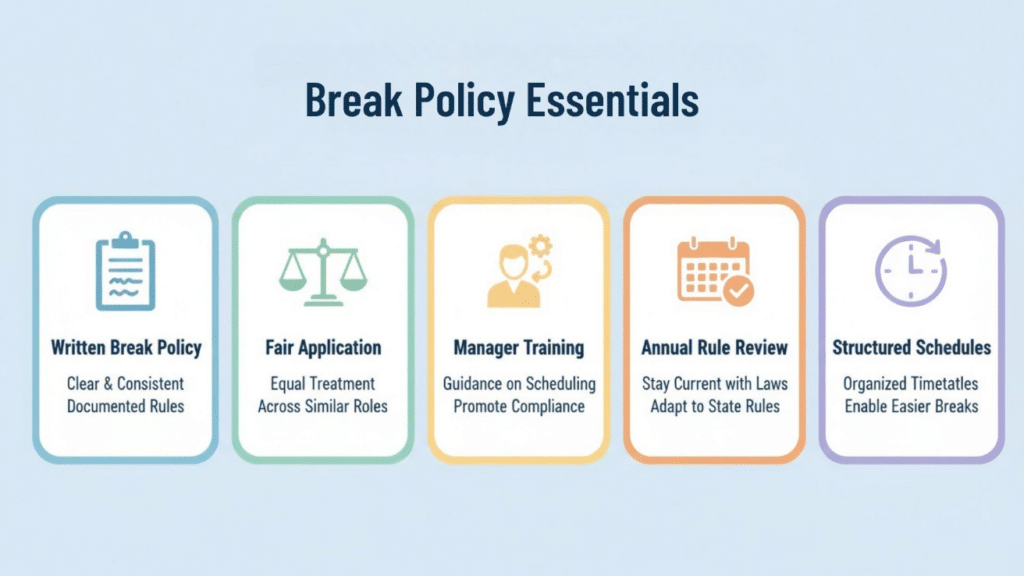
A clear break policy helps workers understand the rules for short shifts.
Employers often choose to offer short breaks because they support comfort, focus, and fairness.
1. Written break policy
A written policy gives workers clarity and prevents confusion about break timing. It also helps managers stay consistent when scheduling rest periods.
2. Fair and consistent application
The break rules should apply the same way to all workers in similar roles. This prevents misunderstandings and keeps day-to-day practice aligned with company standards.
3. Manager training
Managers should receive simple guidance on applying break rules during scheduling. This avoids mixed messages and helps teams follow the same process.
4. Annual rule review
Laws can change, so employers should check state rules each year. This helps ensure the company stays compliant without sudden policy shifts.
5. Structured schedules
Breaks are easier to take when work plans are organized and predictable. A steady schedule helps workers take short rests without disrupting operations.
Benefits of Work Breaks
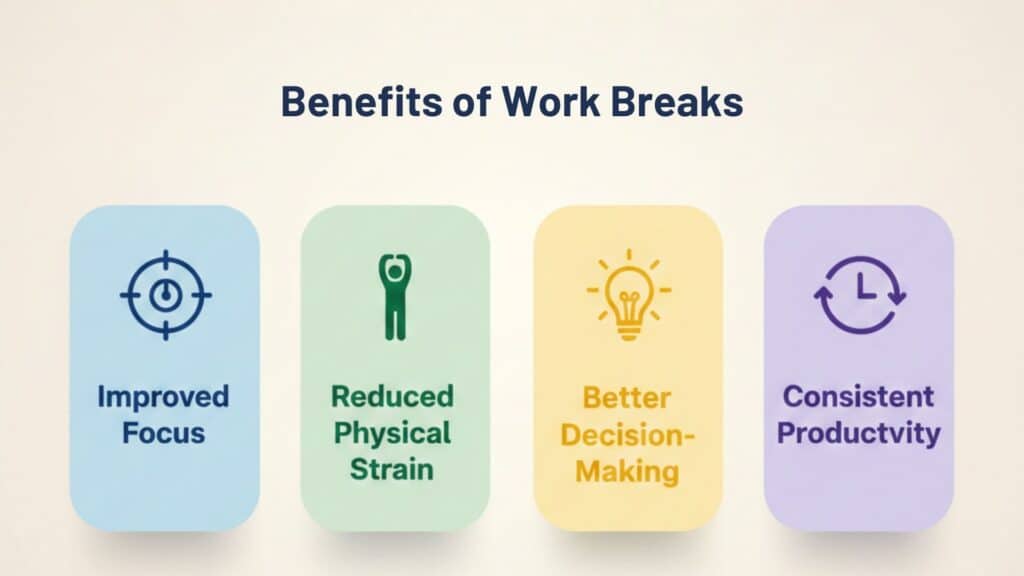
Work breaks serve an important purpose during a shift and offer practical advantages that support comfort and steady performance throughout the day.
1. Improved focus
A brief pause helps clear the mind and makes it easier to stay attentive during tasks that require steady concentration.
2. Reduced physical strain
Short rests give the body time to recover from standing, lifting, typing, or other repeated movements that can cause fatigue.
3. Better decision-making
Stepping away for a moment helps prevent rushed choices and reduces the risk of small errors building up throughout the day.
4. Consistent productivity
Regular pauses support a smoother pace of work, making it easier to stay reliable and organized throughout the entire shift.
Conclusion
A 4-hour shift may include a 15-minute break based on state rules and the policy your employer follows. Some states have clear rules that guarantee a short rest break, while many leave the choice to the workplace.
This makes it important to review your state’s rules and your company handbook to understand the exact standard that applies to your shift.
If a break was missed or the policy seems unclear, bring it up calmly with your employer or HR for clarity.
If you have faced confusion about short breaks, share your experience in the comments to help other workers.
Frequently Asked Questions
Can an Employer Combine Rest Breaks Into One Longer Break?
Some states allow combining short breaks, while others require them to be taken separately. Check your state rule or company policy for the exact approach.
Do Remote Workers Receive the Same Break Rights?
Yes. Break rules apply to remote and on-site workers in the same way. Employers must follow state laws and their own policy for all work settings.
Can a Worker Refuse a Break if They Prefer to Keep Working?
Some employers require breaks for safety or scheduling reasons. You can ask, but the final decision depends on company policy and state rules.
Do Industries Like Retail or Healthcare Follow Different Break Rules?
Some industries have separate rules based on job duties or safety needs. Check state guidelines or industry-specific rules to see if your workplace follows a different standard.