
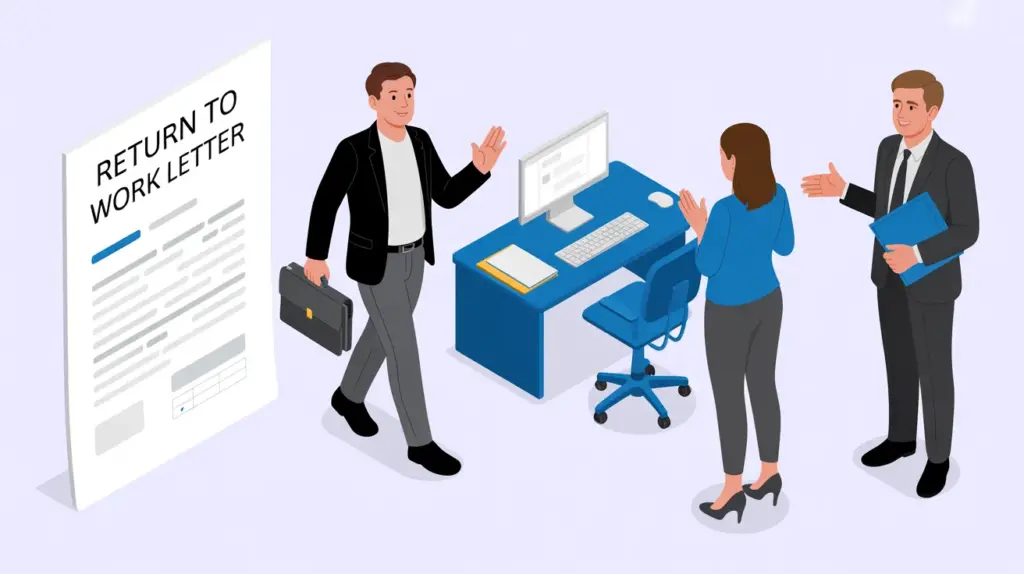

Most people spend weeks preparing to go on leave, but give little thought to what comes next, getting back to work.
Coming back isn’t just about showing up. It involves paperwork, approvals, and, in many cases, a formal return-to-work letter.
Skip it, and you risk delays, confusion, or even a disputed reinstatement.
Whether you’re an employee planning your return or an employer managing the process, this guide covers everything you need to know.
From what the letter should include to ready-to-use templates for every situation, you’ll have everything in one place.
What Is a Return to Work Letter?
A return-to-work letter is an official document that confirms an employee’s readiness to resume job duties or an employer’s authorization to do so after a leave of absence. It creates a clear, written record that protects both parties.
There are three distinct types, and it’s important not to confuse them.
Return-to-Work Letter from a Doctor: A licensed healthcare provider writes this letter to confirm the employee is physically or mentally fit to return to work. It may also outline any restrictions or accommodations needed on the job.
Return to Work Letter from Employee to Employer: Written by the employee to formally notify the employer of the intended return date, confirm readiness, and include any accommodation requests if needed.
Employer Return-to-Work Clearance Letter: Issued by the company. It confirms the employee’s reinstatement, outlines their role and pay, and notes any temporary adjustments to responsibilities or schedule.
When Is It Legally Required?
Under the Family and Medical Leave Act (FMLA), employers have the right to require a fitness-for-duty certification before allowing an employee to return from medical leave.
Many companies also have internal policies that require written clearance for all leave types. Check your employee handbook or HR department before your return date.
When Do You Need a Return to Work Letter?
Not every absence requires one, but most extended leaves do. Here are the most common situations:
- After medical leave or surgery, Employers typically need confirmation that you’re cleared to perform your job duties safely.
- After a workplace injury, Workers’ compensation cases almost always require written medical clearance before reinstatement.
- After maternity or paternity leave, A formal return letter keeps everything documented.
- After an extended sick leave, if you’ve been out for more than a few days, many companies require a doctor’s note at a minimum.
- After disability leave, A fit-for-duty letter is standard, especially if the role involves physical demands.
- Company policy requirements, Some employers require a return letter for any leave exceeding a set number of days, regardless of reason.
When in doubt, contact HR before your scheduled return date.
Types of Return to Work Letters

There isn’t a one-size-fits-all version of this letter. The type you need depends on who’s writing it and why.
Return to Work Letter from a Doctor
This letter carries the most weight from a compliance standpoint. It should come from a licensed medical provider and include:
- Medical clearance: A direct statement that the employee is fit to return to their position.
- Fit-for-duty certification: Confirmation that the employee can perform the essential functions of their role.
- Work restrictions or accommodations: Any limitations, such as reduced hours, no heavy lifting, or remote work requirements.
Employers cannot ask for a detailed diagnosis. They’re only entitled to know whether the employee can perform their job, with or without accommodations.
Return to Work Letter from Employee
This is the employee’s formal notice to their employer. It should be professional, brief, and clear. Key elements include:
- Notification of return date: State your exact start date.
- Confirmation of readiness: A brief statement that you’re prepared to resume your duties.
- Request for accommodations (if needed): If your doctor has outlined restrictions, note them here and attach the medical clearance.
Sending this letter a week or two before your return date gives HR enough time to prepare.
Employer Return to Work Letter
This letter comes from the employer and is sent to the returning employee. It should confirm:
- Reinstatement: Acknowledgment that the employee is returning to active status.
- Role, pay, and schedule: Confirmation that their position, compensation, and hours remain the same, or an explanation of any changes.
- Temporary modifications: If the employee has restrictions, outline how the company plans to accommodate them.
What to Include in a Return to Work Letter?
Every return to work letter should include:
☐ Employee’s full name
☐ Dates of leave (start and end)
☐ Intended return date
☐ A clear clearance or readiness statement
☐ Any work restrictions or accommodations, if applicable
☐ Contact information for follow-up
☐ A brief appreciation note (especially in employee letters)
☐ Specific accommodation requests with supporting documentation
☐ A reference to the HR contact managing the return process
How to Write a Return to Work Letter
Keep it structured, professional, and easy to read.
Step 1: Use a proper heading. Include your name, address, date, and the recipient’s name and title at the top.
Step 2: Write a clear subject line. Something like: Re: Return to Work, [Your Name], [Date] works well.
Step 3: Keep the tone professional. This is an official document, not a casual email.
Step 4: Get to the point quickly. State the purpose of the letter in the first sentence.
Step 5: End with a clear closing. Thank the reader, provide your contact information, and sign off with your full name.
Return to Work Letter Templates
Not sure where to start? Use these templates as a base and customize the details to fit your situation.
Simple Return to Work Letter (Employee Version)
[Your Name] [Your Address] [Date]
[Manager’s Name] [Company Name] [Company Address]
Subject: Return to Work, [Your Name], [Return Date]
Dear [Manager’s Name],
I am writing to inform you that I am prepared to return to my position as [Job Title] on [Return Date], following my leave of absence from [Start Date] to [End Date].
I have received medical clearance from my physician and am ready to resume my full duties. Please let me know if any additional documentation is required prior to my return.
Thank you for your support during my time away. I look forward to rejoining the team.
Sincerely, [Your Full Name] [Phone Number] [Email Address]
Return to Work Letter from Doctor (Medical Clearance Sample)
[Doctor’s Name], [Credentials] [Practice Name] [Address] [Date]
To Whom It May Concern,
This letter confirms that [Patient’s Full Name] is under my care and has been cleared to return to work as of [Return Date].
[Patient’s Name] is fit to perform the essential functions of their role as [Job Title]. (If restrictions apply: They are cleared to return with the following limitations: [List restrictions].)
Please feel free to contact our office with any questions.
Sincerely, [Doctor’s Name] [Contact Information] [License Number]
Return to Work Letter After Surgery
[Your Name] [Date]
Dear [Manager’s Name],
I am writing to confirm my return to [Job Title] on [Return Date] following my surgical procedure and recovery period, which began on [Start Date].
My physician has provided full medical clearance and I am prepared to return to my regular duties. I have attached the clearance documentation for your records.
Thank you for accommodating my leave. I look forward to returning to the team.
Sincerely, [Your Full Name]
Return to Work Letter After Maternity Leave
[Your Name] [Date]
Dear [Manager’s Name],
I am writing to confirm that I will be returning to my position as [Job Title] on [Return Date], following the conclusion of my maternity leave.
I am eager to return and fully committed to resuming my responsibilities. Please let me know if there is any paperwork or onboarding process I should complete beforehand.
I appreciate the support I’ve received during this time and look forward to reconnecting with the team.
Sincerely, [Your Full Name]
Return to Work Letter with Work Restrictions
[Your Name] [Date]
Dear [Manager’s Name],
I am writing to inform you of my planned return to work on [Return Date] following my leave of absence. My physician has cleared me to return with the following temporary restrictions:
- [Restriction 1, e.g., No lifting over 10 lbs]
- [Restriction 2, e.g., Limited to 6-hour shifts for the first two weeks]
I have attached my physician’s clearance letter for your records. I would appreciate the opportunity to discuss any necessary accommodations before my return date.
Thank you for your understanding.
Sincerely, [Your Full Name] [Contact Information]
Return to Work Letter for FMLA Leave
The Family and Medical Leave Act allows eligible employees up to 12 weeks of unpaid, job-protected leave per year.
When an employee returns from FMLA leave, employers may request a fitness-for-duty certification before the employee resumes work.
Employers must notify the employee of this requirement at the start of the leave, not after the fact.
The Fit-for-Duty Certification must come from the employee’s healthcare provider and confirm that the employee can perform the essential functions of their job.
Employers can only request this for the specific health condition that caused the leave.
FMLA Return to Work Letter (Employee Version)
[Your Name] [Date]
Dear [Manager’s Name / HR Department],
I am writing to confirm my return to my position as [Job Title] on [Return Date], following my FMLA leave which began on [Start Date].
Enclosed is the fitness-for-duty certification completed by my healthcare provider, as requested. I am prepared to resume my full responsibilities upon my return.
Please confirm receipt of this letter and let me know if any additional steps are required.
Sincerely, [Your Full Name] [Contact Information]
To protect their rights, workers should also be aware of common FMLA violations employees should know when dealing with workplace leave.
Common Mistakes to Avoid in a Return to Work Letter
Small errors can delay your return or create unnecessary back-and-forth with HR. Here’s what to watch out for before you hit send.
- Missing the return date: Always state the exact date you plan to return. Vague language like “soon” or “in the coming weeks” creates confusion.
- Vague medical clearance: A doctor’s note that simply says “cleared to return” without addressing job-specific functions may not satisfy FMLA or company requirements.
- Ignoring company policy: Some employers have specific forms or processes for returning employees. Always check with HR first.
- Leaving out restrictions: If your doctor has outlined limitations, include them. Omitting this can put both you and your employer in a difficult position.
A return-to-work letter is an official document. Keep it professional regardless of your relationship with your manager.
Conclusion
A return to work letter is a small step that makes a big difference.
It keeps your return official, protects your rights, and sets the right tone before you even walk back through the door.
The good news is that writing one doesn’t have to be complicated. Pick the template that fits your situation, customize the details, and run it by HR before sending.
If you found this guide helpful, share it with a colleague who might be navigating the same process.
And if you have questions about your specific situation, it’s always worth speaking with an HR professional or employment attorney.


