


Corporate buzzwords have become part of everyday workplace communication. Phrases like “circle back,” “touch base,” and “move the needle” appear in meetings, emails, and project updates across almost every industry.
Some of these terms help teams communicate faster when everyone shares the same context.
Others create confusion by sounding professional without clearly explaining what needs to happen next.
This article breaks down what corporate buzzwords mean, why people use them, which phrases frustrate employees the most, and when workplace language starts creating more confusion than clarity.
What Are Corporate Buzzwords?
Corporate buzzwords are common workplace phrases used to explain ideas, goals, or actions in a shorter way. These terms often appear in meetings, emails, and project updates to help teams communicate quickly.
A corporate buzzword becomes popular when teams repeat the same expression across daily work conversations.
Common examples include “synergy,” which refers to teamwork, “bandwidth,” which means capacity, and “pivot,” which means changing direction.
These phrases can be useful when everyone shares the same context. Problems start when vague terms replace clear communication and leave people unsure about the actual task, decision, or next step.
Why Do People Use Corporate Buzzwords?
Corporate buzzwords remain common because they help teams communicate quickly and fit into workplace culture.
- Fast Workplace Communication: Terms like “bandwidth” or “deliverables” save time during meetings and quick updates.
- Shared Workplace Language: Employees often repeat phrases used by managers and coworkers to match the company culture.
- Professional Belonging: Using common business terms can help people feel more connected within their team.
- Vague or Unclear Communication: Some buzzwords sound productive, but avoid giving clear direction or specific actions.
- Habit and Repetition: Once certain phrases become common in emails and meetings, people continue using them naturally.
Corporate words continue to spread because they combine convenience, habit, and workplace culture, even when simpler language could work better.
List of Corporate Buzzwords
Corporate buzzwords appear in almost every workplace, from meetings and emails to project discussions.
Many started with clear meanings, but repeated use turned them into common office language, even when simpler words could explain the same idea more clearly.
1. Meeting and Collaboration Buzzwords
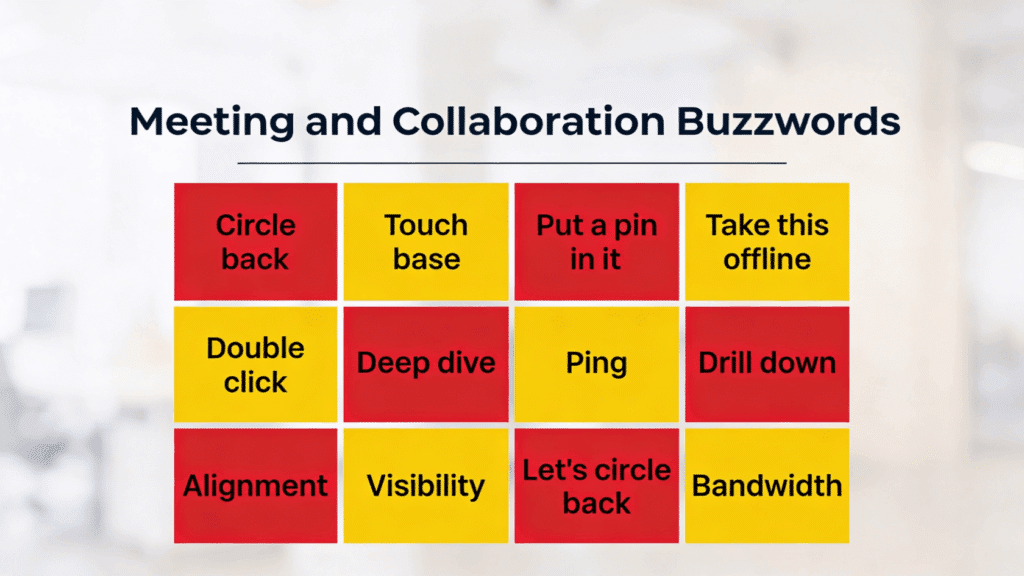
These phrases are commonly used during team discussions, video calls, and internal meetings. They usually refer to follow-ups, discussions, or group coordination.
| Phrase | Meaning |
|---|---|
| Circle back | Follow up later |
| Touch base | Have a quick check-in |
| Put a pin in it | Pause the topic for now |
| Take this offline | Discuss outside the meeting |
| Double click | Look into something more closely |
| Deep dive | Explore a topic in detail |
| Ping | Send a quick message or reminder |
| Drill down | Examine details more closely |
| Alignment | Everyone agreeing on the same plan |
| Visibility | Awareness of project progress or updates |
Saving time is the goal behind most of these phrases. Problems start when they replace direct next steps or clear decisions.
2. Growth and Performance Buzzwords
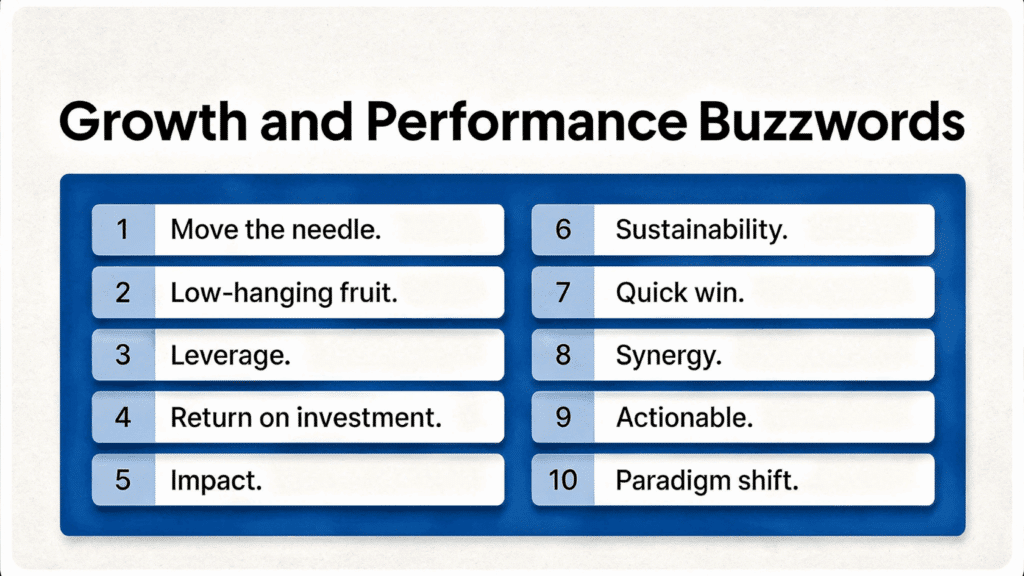
These phrases are often used in company growth discussions, performance reviews, and business planning meetings. Most of them focus on improving results, achieving targets, and measuring success.
| Phrase | Meaning |
|---|---|
| Move the needle | Make measurable progress |
| Low-hanging fruit | Easy wins to go after first |
| Leverage | Use something to get better results |
| Return on investment | Profit or value gained from spending |
| Impact | Strong effect or result |
| Sustainability | Long-term growth or stability |
| Quick win | Task that gives fast results |
Goal-setting conversations rely heavily on these terms. Clear numbers and direct plans still explain progress more effectively.
3. Leadership and Business Direction Buzzwords
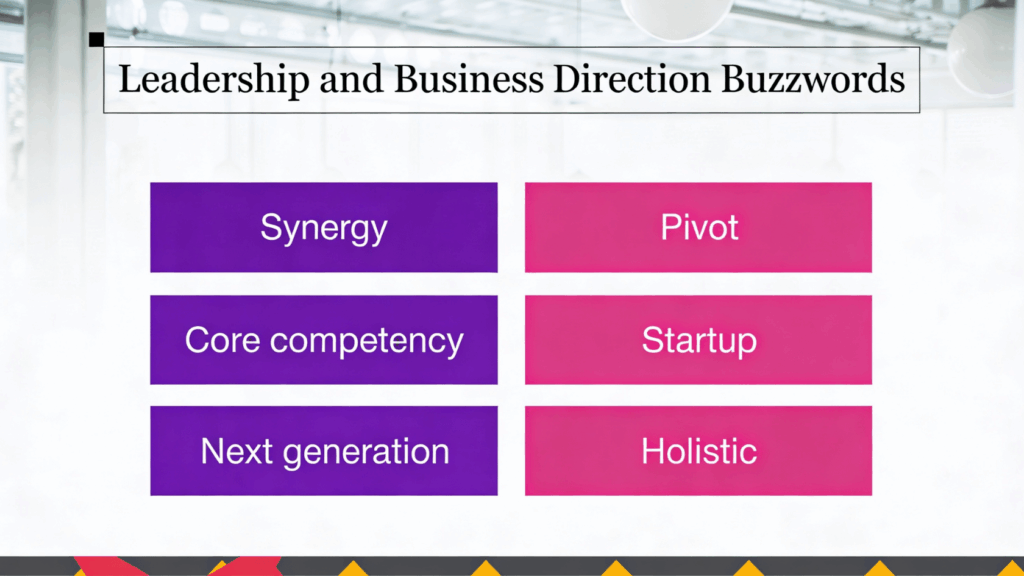
These buzzwords are commonly used in leadership discussions and company strategy conversations. They usually relate to teamwork, long-term direction, and business positioning.
| Phrase | Meaning |
|---|---|
| Synergy | Teams working better together |
| Pivot | Change direction or strategy |
| Core competency | Main strength or expertise |
| Startup | Newly formed business |
| Next generation | New and improved version of something |
| Holistic | Looking at the complete picture |
Used carefully, they can simplify big-picture discussions. Overusing them without context makes communication feel vague and hard to act on.
4. Marketing and Customer Experience Buzzwords
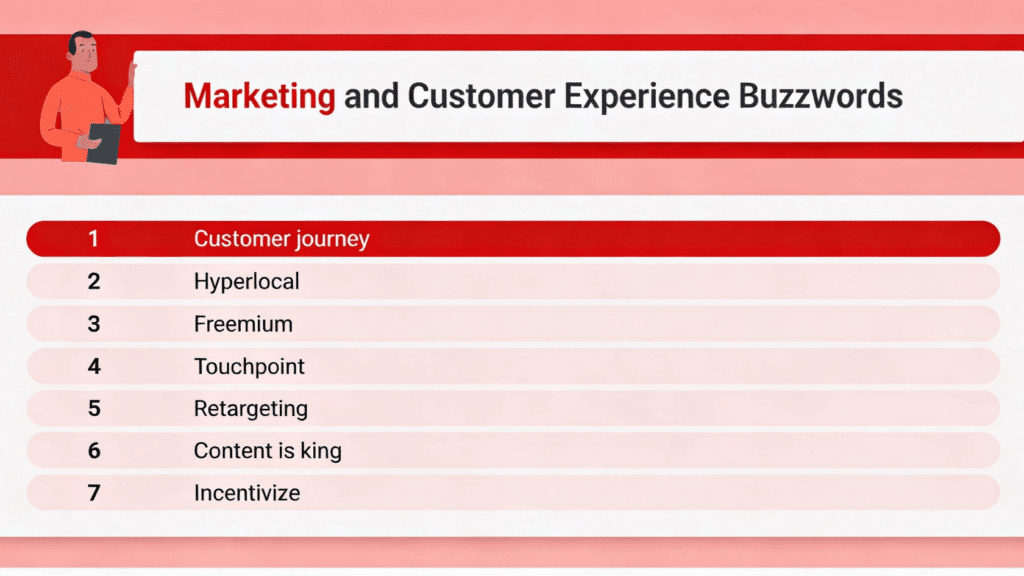
These terms are frequently used in marketing, advertising, branding, and customer engagement discussions. They usually describe customer behavior, promotion strategies, or digital campaigns.
| Phrase | Meaning |
|---|---|
| Customer journey | Customer experience from start to finish |
| Hyperlocal | Focused on a very specific area or community |
| Freemium | Free product with paid premium features |
| Touchpoint | Any interaction with a customer |
| Retargeting | Showing ads again to previous visitors |
| Content is king | Content is the main driver of engagement |
| Incentivize | Encourage action using rewards |
Shorter phrases can make complex marketing ideas easier to discuss. Without a real strategy behind them, they quickly lose meaning.
5. Technology and Digital Business Buzzwords
These buzzwords are common in technology, data, and digital business conversations. They often describe systems, platforms, or modern digital practices.
| Phrase | Meaning |
|---|---|
| Big data | Large sets of digital information |
| Ecosystem | Connected network of products or services |
| Unpack | Explain something in detail |
Fast-moving tech teams often lean on these to keep up the pace. Simple language still works better when talking across different teams or audiences.
6. Workload and Project Buzzwords
Project management and workload discussions often include phrases related to timelines, responsibilities, and team capacity.
| Phrase | Meaning |
|---|---|
| Bandwidth | Capacity or availability to take on work |
| Deliverables | Specific outputs or finished work items |
| Boil the ocean | Trying to do too much at once |
| Ballpark | Rough estimate or approximation |
| Logistics | Planning and coordination of operations |
| Quota | Fixed target or required amount |
| Pain point | Specific problem causing difficulty |
Project updates and task discussions are full of phrases like these. At the end of the day, clear deadlines and assigned ownership matter far more than workplace shorthand.
When Are Corporate Buzzwords Actually Useful?
Corporate buzzwords work best when used in the right workplace situations. They can help teams communicate faster, but they should not replace clear and direct language.
- Test workplace phrases with different teams before using them widely.
- Use common terms only when everyone understands the same meaning.
- Keep repeated process discussions short with familiar internal language.
- Use simple buzzwords during quick meetings and project updates.
- Avoid unclear phrases in client communication or cross-team discussions.
- Replace confusing jargon with direct wording whenever clarity matters.
Taking time to match language with the audience improves communication. When used carefully, corporate buzzwords can support faster and smoother teamwork.
How to Replace Corporate Buzzwords With Clearer Language?
Replacing corporate buzzwords with direct language makes communication easier to understand. Clear wording helps teams avoid confusion during meetings, emails, and project discussions.
| Situation | Corporate Buzzword | Clearer Alternative |
|---|---|---|
| Scheduling a follow-up | “Let’s circle back.” | “Let’s review this again on Friday.” |
| Giving an update | “I’ll touch base later.” | “I’ll send you an update by Thursday.” |
| Assigning responsibility | “Someone will follow up.” | “Sarah will send the final report by Monday morning.” |
| Team agreement | “We need alignment.” | “We need everyone to agree on the final plan.” |
| Discussing later | “Let’s take this offline.” | “Let’s discuss this after the meeting.” |
| Clarifying vague requests | “This needs more visibility.” | “Please share this update with the sales and marketing teams.” |
Using direct language makes workplace communication easier to follow. Short and specific sentences help people understand actions, deadlines, and responsibilities more clearly.
Corporate Buzzwords vs Business Jargon
Corporate buzzwords and business jargon are often used to mean the same thing. Both describe specialized vocabulary that recurs in professional settings.
Corporate jargon is a broader category that covers technical terms and industry-specific phrases. Buzzwords are the shorter, trendier expressions that tend to spread quickly across different teams.
Workplace slang and corporate speak are closely related terms, too. They all describe repeated professional language that can be helpful in the right context but confusing in others.
When Do Corporate Buzzwords Become a Problem?
Corporate buzzwords become a problem when they replace clear communication and leave people guessing what actually needs to happen.
- Unclear Tasks and Expectations: Phrases like “move the needle” may sound productive but often fail to clarify the actual task, timeline, or goal.
- Confusing Ownership and Responsibility: Terms like “alignment” or “synergy” can close discussions without clearly assigning the next step to anyone.
- Weak and Vague Feedback: Buzzword-heavy feedback often lacks clear guidance, making it difficult for people to improve or take action.
- Excluding People From Conversations: New employees or people outside the team may not understand certain workplace phrases, making discussions harder to follow.
- Different Interpretations Across Teams: Vague language allows people to walk away with different assumptions about the same conversation.
Corporate buzzwords start causing problems when they replace direct communication with vague language that creates confusion, delays, and unclear expectations.
Conclusion
Corporate buzzwords can help teams communicate faster, but they often create confusion when clear details are missing.
Using direct language makes meetings, feedback, and project updates easier for everyone to understand and act on.
Take a closer look at the phrases used in daily conversations at work. Small changes in wording can improve teamwork, reduce misunderstandings, and make communication more useful.
Keep reading related workplace communication topics, and drop a comment with the corporate buzzwords you hear most often at work.
Frequently Asked Questions
Are Corporate Buzzwords Different Across Industries?
Yes, Corporate buzzwords differ across industries because each field has its own work style and priorities. For example, tech uses “AI-driven,” while marketing uses “engagement” and finance uses “liquidity.”
Why do New Corporate Buzzwords Keep Appearing?
New corporate buzzwords keep appearing because businesses want to sound modern, innovative, and aligned with current trends. As industries change, new terms are created to describe new ideas, technologies, and work styles.
Do Remote Teams Use More Corporate Buzzwords?
Yes, often they do. Remote teams rely heavily on digital communication, so buzzwords are commonly used as quick shorthand in meetings, chats, and emails.