


Most workplace problems don’t start with bad intentions. They start with unclear boundaries. An employee recommends a vendor who happens to be their spouse.
A board member votes on a contract that benefits their own company.
None of these situations necessarily involves dishonesty, but all involve conflicts of interest. Without a clear policy in place, they can seriously damage your organization’s reputation, legal standing, and internal trust.
This blog covers everything you need to know: what a conflict of interest policy is, why it matters, what to include, how it differs for nonprofits, and a ready-to-use template you can adapt for your organization today.
What Counts as a Conflict of Interest?
A conflict of interest occurs when an individual’s personal interests, financial, relational, or otherwise, could influence, or appear to influence, decisions they make in their professional role.
It does not have to be an actual conflict; the appearance of a conflict is enough to require disclosure.
Common Examples Include:
- A manager hiring or promoting a personal friend or romantic partner
- An employee using company resources or confidential information for personal gain
- A staff member serving on the board of a competing or partner organization without disclosure
- A leader owning stock in a competitor
What is a Conflict of Interest Policy?
It is a formal document that defines what constitutes a conflict of interest within your organization, outlines who is covered by the policy, and establishes the process for disclosing and managing conflicts when they arise.
It is about creating transparency and a consistent process so that when conflicts do arise, and they will, your organization has a clear, fair way to handle them.
Your policy should apply to anyone with decision-making authority or access to sensitive information, such as board members, directors, managers, key employees, and other significant decision-makers.
The Need for a Conflict of Interest Policy
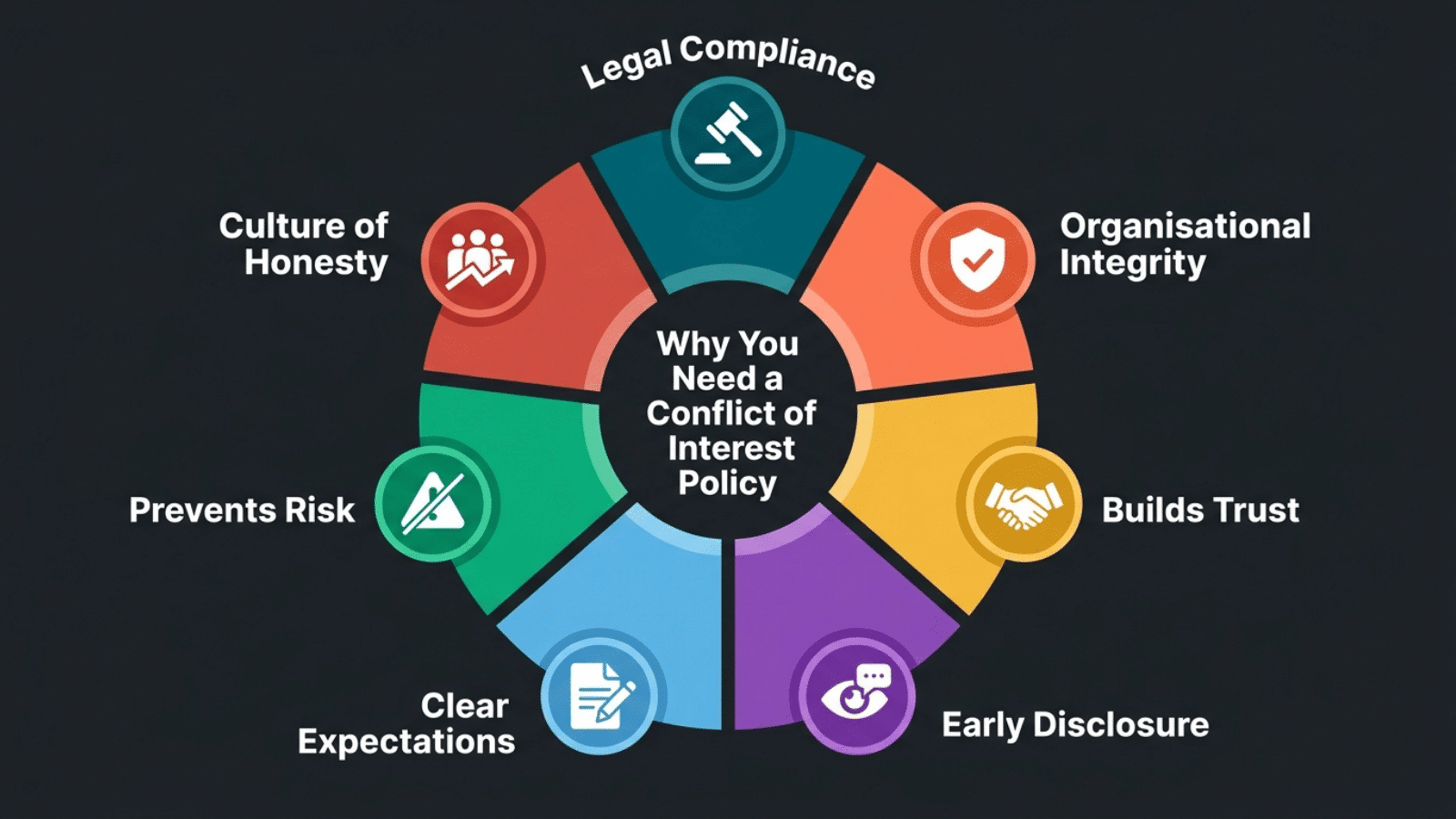
Having a written conflict-of-interest policy is not just good practice; in many cases, it is a legal requirement.
- Supports legal and regulatory compliance by helping organizations meet nonprofit and corporate governance requirements
- Protects organizational integrity by reducing the risk of biased or self-serving decisions
- Builds trust with employees, donors, clients, and partners through transparency and accountability
- Encourages early disclosure of conflicts before they become larger problems
- Creates clear expectations for employees and leadership around ethical decision-making
- Helps prevent legal, financial, and reputational risks linked to unmanaged conflicts of interest
- Promotes a culture of honesty and openness within the organization
What to Include in a Conflict of Interest Policy?
Knowing what to include in this policy can save a company a lot of trouble down the line.
1. Purpose and Scope
Start with a clear statement of why the policy exists and who it applies to.
This section should define the policy’s goals, protecting the organization’s integrity, ensuring decisions are made in the organization’s best interest, and maintaining compliance with applicable laws.
2. Definition of Conflict of Interest
Define clearly what constitutes a conflict of interest in your organization’s context.
Include both actual conflicts (where a personal interest directly affects a decision) and apparent conflicts (where a reasonable person might perceive a conflict, even if none exists).
3. Disclosure Requirements
Specify exactly what must be disclosed, when it must be disclosed, and to whom.
Best practice is to require: an annual disclosure statement signed by all covered persons, immediate disclosure within 30 days if a new conflict arises mid-year, and disclosure before any relevant decision, vote, or transaction.
4. Procedures for Managing Conflicts
Once a conflict is disclosed, the policy should explain how it will be handled.
This usually involves the individual stepping away from related discussions or decisions, a review by unbiased members or a committee, proper documentation of the situation, and a final decision on whether the action can move forward.
5. Annual Review and Compliance
While having a policy is important, it is even more critical that board members know what is included in their policy, review and sign it annually, and check to see that the policy is reflective of the organization’s needs today.
Include a provision requiring annual review of the policy itself, not just annual disclosure by covered persons.
6. Consequences for Non-Compliance
Clearly state the consequences of failing to disclose a conflict or violating the policy.
This may include disciplinary action, removal from a board or committee, or termination of employment, depending on the severity of the offense.
What Nonprofits Need to Know About Conflict of Interest Policies?
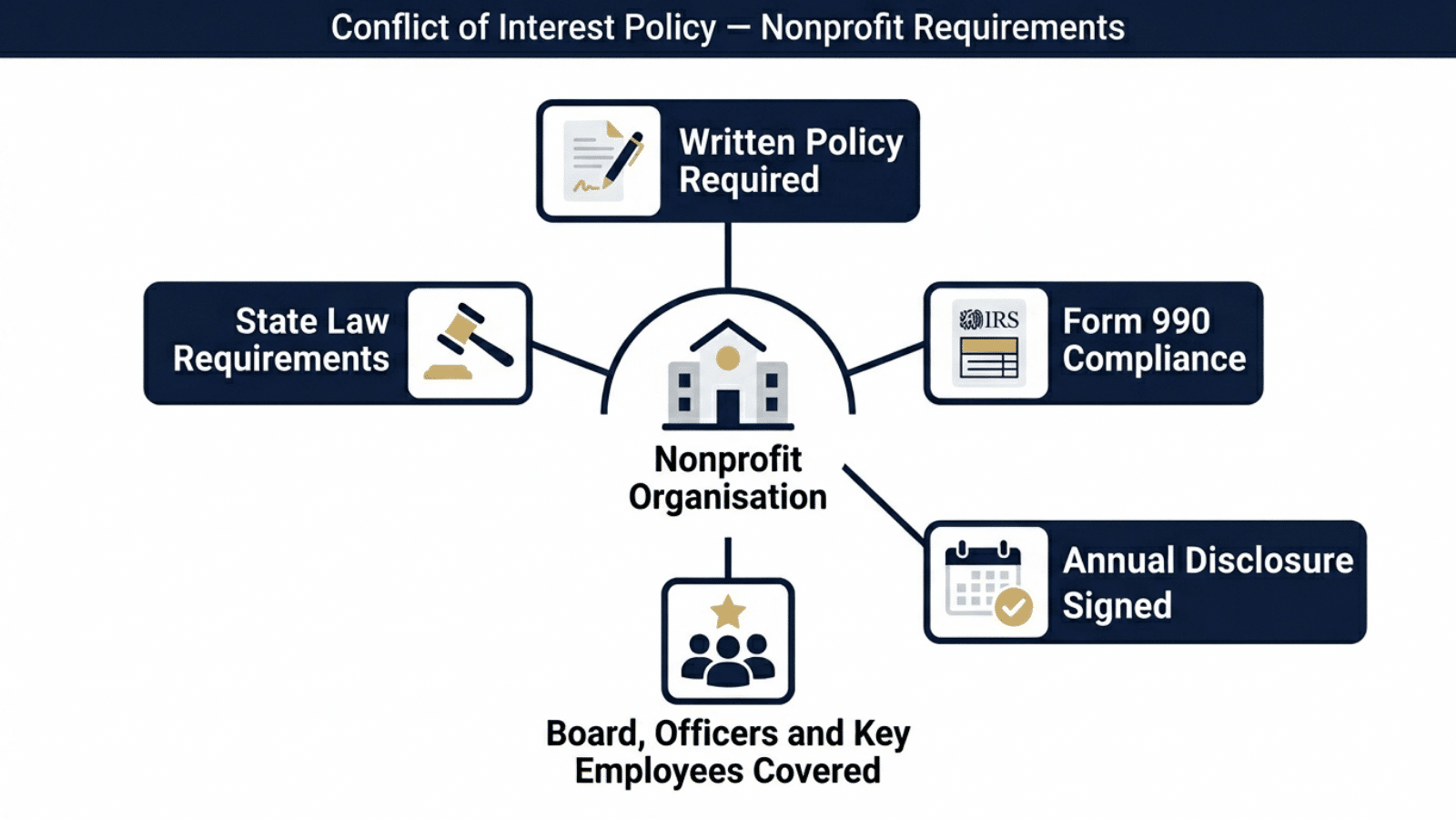
Nonprofits face greater public scrutiny than most organizations, and the legal requirements for conflict of interest policies and nonprofit compliance are more specific as a result.
IRS Requirements for Nonprofits
The IRS recommends that all nonprofits adopt a formal conflict of interest policy as part of the 501(c)(3) application process.
Part V, Section 5 of IRS Form 1023 asks questions to determine whether the organization has procedures for handling conflicts, and it recommends creating a policy if none exists.
At a minimum, your
- A definition of what constitutes a financial interest
- A process for disclosing conflicts to the board
- A recusal procedure for interested parties during votes
- A record-keeping process for all disclosed conflicts and related decisions
- Periodic reviews to ensure ongoing compliance
State-Level Requirements
Requirements vary by state. New York, for example, as part of the Nonprofit Revitalization Act of 2013, requires every nonprofit corporation to adopt a conflict of interest policy.
Check your state’s nonprofit laws carefully; some states have very specific requirements about what the policy must contain and how it must be implemented.
Covered persons in a nonprofit typically include:
- Directors, officers, and key employees
- Key employees are employees (other than officers or directors) earning more than $150,000 annually
- Key employees must also meet at least one additional criterion related to management responsibility or authority over assets, budget, or operations
- Volunteers with significant decision-making authority
Conflict of Interest Policy Template
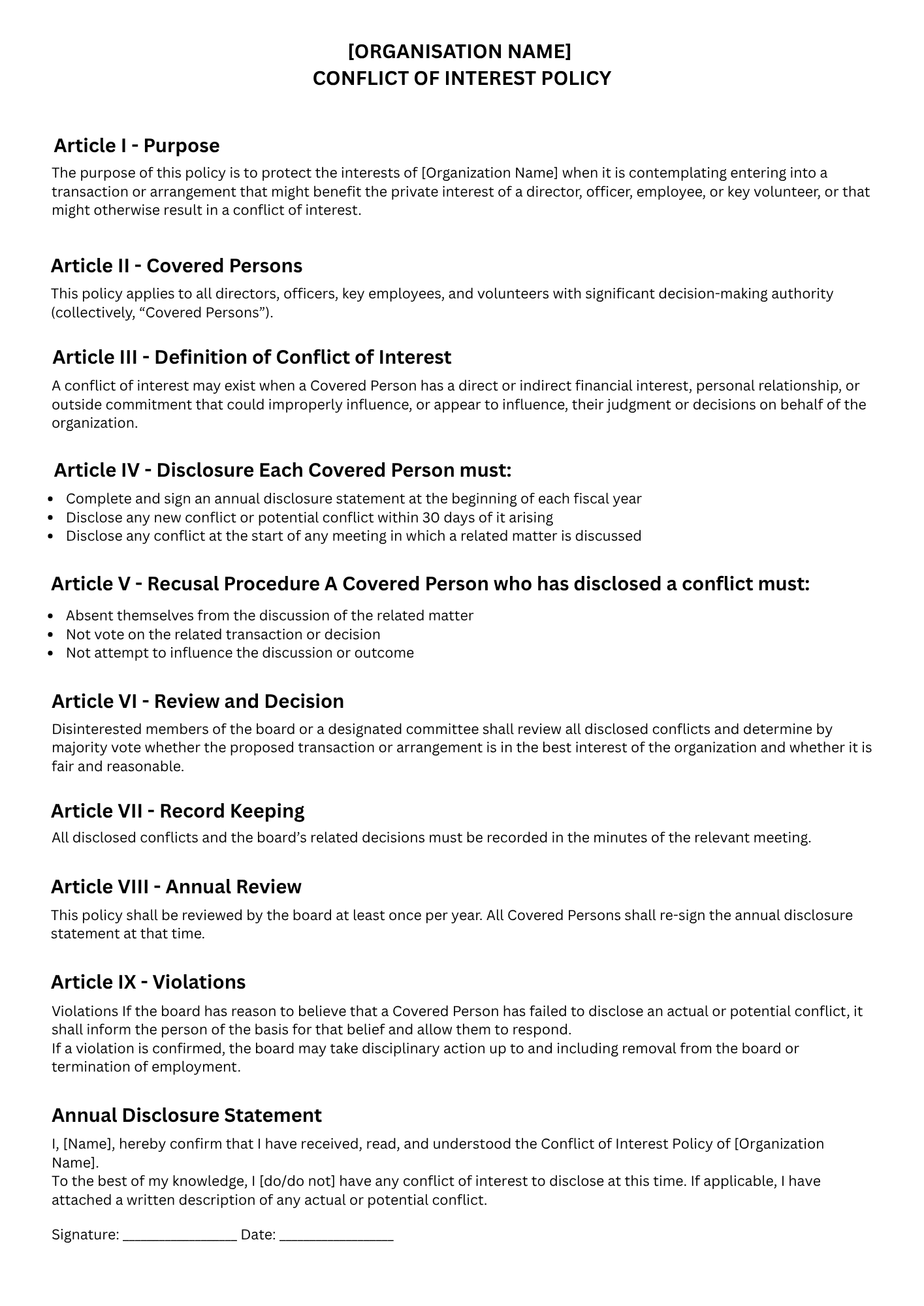
Use this template as a starting point. Customize the bracketed sections to fit your organization’s structure and applicable legal requirements.
[ORGANISATION NAME] CONFLICT OF INTEREST POLICY
Article I – Purpose The purpose of this policy is to protect the interests of [Organization Name] when it is contemplating entering into a transaction or arrangement that might benefit the private interest of a director, officer, employee, or key volunteer, or that might otherwise result in a conflict of interest.
Article II – Covered Persons This policy applies to all directors, officers, key employees, and volunteers with significant decision-making authority (collectively, “Covered Persons”).
Article III – Definition of Conflict of Interest A conflict of interest may exist when a Covered Person has a direct or indirect financial interest, personal relationship, or outside commitment that could improperly influence, or appear to influence, their judgment or decisions on behalf of the organization.
Article IV – Disclosure Each Covered Person must:
- Complete and sign an annual disclosure statement at the beginning of each fiscal year
- Disclose any new conflict or potential conflict within 30 days of it arising
- Disclose any conflict at the start of any meeting in which a related matter is discussed
Article V – Recusal Procedure A Covered Person who has disclosed a conflict must:
- Absence from the discussion of the related matter
- Do not vote on the related transaction or decision
- Do not attempt to influence the discussion or outcome
Article VI – Review and Decision Disinterested members of the board or a designated committee shall review all disclosed conflicts and determine by majority vote whether the proposed transaction or arrangement is in the best interest of the organization and whether it is fair and reasonable.
Article VII – Record Keeping All disclosed conflicts and the board’s related decisions must be recorded in the minutes of the relevant meeting.
Article VIII – Annual Review This policy shall be reviewed by the board at least once per year. All Covered Persons shall re-sign the annual disclosure statement at that time.
Article IX – Violations If the board has reason to believe that a Covered Person has failed to disclose an actual or potential conflict, it shall inform the person of the basis for that belief and allow them to respond.
If a violation is confirmed, the board may take disciplinary action up to and including removal from the board or termination of employment.
Annual Disclosure Statement
I, [Name], hereby confirm that I have received, read, and understood the Conflict of Interest Policy of [Organization Name].
To the best of my knowledge, I [do/do not] have any conflict of interest to disclose at this time. If applicable, I have attached a written description of any actual or potential conflict.
Signature: ___________________ Date: ___________________
You can view and download the complete PDF here.
Ways to Implement and Enforce Your Conflict of Interest Policy
Having a policy in place is only effective if it is consistently implemented, reviewed, and documented across the organization.
- Introduce the policy during onboarding and collect signed disclosure statements
- Keep the policy easily accessible through a shared platform or portal
- Review and re-sign the policy annually with regular compliance discussions
- Record all disclosed conflicts, recusals, and related decisions in meeting minutes
- Review and update the policy at least once a year to ensure continued effectiveness
The Bottom Line
A well-written conflict of interest policy is one of the most important governance documents your organization can have.
It protects your employees, your leadership, your reputation, and, particularly for nonprofits, your legal and tax-exempt standing.
Use the template in this guide as your starting point, customize it to fit your organization’s structure and applicable state laws, and ensure it is reviewed, signed, and accessible every year.
If you are a nonprofit, check your state’s specific requirements in addition to the IRS guidance, and when in doubt, consult a nonprofit attorney before finalizing your policy.
Frequently Asked Questions
What are the Four Types of Conflicts of Interest?
The four main types of conflicts of interest are financial, relational, competitive, and confidential conflicts. These arise when personal interests or misuse of confidential information interfere with professional responsibilities.
What are the 4 D’s of Conflict of Interest?
The 4 D’s of conflict of interest are disclose, distance, delegate, and disassociate. These measures help organizations identify, manage, and reduce the risk of biased decision-making.
What is the Most Common Form of Conflict of Interest?
One of the most common forms of conflict of interest is self-dealing. This happens when a person in authority uses their position to benefit themselves or an organization to which they are connected.